
White hat link building is the practice of earning or placing relevant backlinks through content, relationships, editorial judgment and genuine usefulness rather than manipulating search rankings. For a SaaS company, that might mean publishing original research that industry writers cite. For an e-commerce brand, it could mean contributing expert commentary to a specialist publication. For an SEO agency, it may involve carefully vetted guest posts and niche edits delivered under a transparent white-label process.
The distinction is not whether a link was obtained through outreach. Outreach can support legitimate promotion. The distinction is why the link exists, where it appears and whether the surrounding page helps its audience. Google’s Search Essentials describe link spam as practices intended to manipulate rankings through links, including excessive link exchanges, automated link creation and advertorial links that pass ranking credit without appropriate qualification; the current guidance is available in Google’s 2026 spam policies.
What White Hat Link Building actually means
A backlink is not automatically valuable because it comes from a site with a high authority metric. A useful link connects a relevant audience with a credible next step. White hat work therefore evaluates the whole placement: the publisher, page topic, reader intent, editorial context, destination page and disclosure requirements.
Relevance comes before raw authority. A link from a respected cybersecurity publication may be highly useful for a security SaaS product, but only if the linked page answers a cybersecurity question raised by the article. The same domain may be a poor fit for a local fashion retailer. Conversely, a specialist publisher with modest third-party metrics may be an excellent commercial fit if it has real readers, coherent coverage and a history of publishing in the niche.
White hat does not mean that every link must be unsolicited. It means the acquisition method should withstand a reasonable editorial and user-experience test. Ask:
- Would the article still be useful if search engines ignored the backlink?
- Does the publisher serve a recognisable audience rather than a collection of unrelated keywords?
- Is the destination genuinely relevant to the sentence and the reader’s next question?
- Would the brand be comfortable showing the placement to a customer, partner or regulator?
- Can the link be disclosed or qualified without undermining the commercial arrangement?
Editorial links, contributed content and paid placements
There are several legitimate routes to a backlink, but they carry different controls. Editorial coverage is selected by a publisher because the story, data or expert is worth covering. A contributed article is created with a publication’s editorial agreement. A niche edit adds a relevant reference to an existing page. A sponsored placement involves compensation and may need a clear disclosure and a qualified link.
Payment changes the compliance question. Google’s guidance recommends qualifying links that are advertisements or paid placements, using attributes such as rel="sponsored", and recommends rel="ugc" for user-generated content; see the official 2026 documentation on qualifying outbound links. The practical lesson is not to disguise a commercial relationship as independent editorial endorsement.
For agencies and brands, a white hat brief should record the intended link type, the publisher’s editorial conditions and the required qualification. That prevents a sales promise such as “dofollow authority link” from overriding a publisher’s standards or a search engine’s guidance.
Why it matters for organic growth and brand risk
Links can help discovery, referral traffic, reputation and the distribution of useful content. They can also expose a business to avoidable risk when acquisition is treated as a volume exercise. The objective is not to collect the largest possible backlink count. It is to build a defensible set of references that supports pages with a clear business purpose.
Start with the page that deserves a link. A product page may convert well but offer little reason for a journalist to cite it. A research report, calculator, benchmark, glossary, data set or original guide may be more linkable. The commercial page can then receive qualified internal links from that asset, while external links point to the most natural destination.
For example, a B2B software company selling procurement software could create a supplier-risk checklist based on public data and expert interviews. Outreach can then offer the checklist to procurement publications. The campaign is stronger than asking editors to insert a naked product link into an unrelated article because the asset gives the publication a useful reference.
Different audiences need different linkable assets
- SaaS: integration guides, benchmark reports, templates, calculators and technical explainers.
- E-commerce: buying research, original product testing, seasonal data, visual guides and expert commentary.
- B2B: surveys, operational checklists, regulatory explainers and decision frameworks.
- Casino and iGaming: responsible-gambling resources, market analysis, game explainers and jurisdiction-specific educational content, subject to applicable law and publisher policy.
- SEO agencies: documented processes, anonymised methodology, client-safe research and useful white-label reporting assets.
Traffic quality is a decision signal, not a trophy metric. Third-party authority scores can help with triage, but they do not prove readership, editorial quality or suitability. A publisher review should look for organic visibility, topical consistency, recent publishing activity, outbound-link patterns, author credibility and obvious signs of scaled content.
Google’s Search Console documentation explains that its Links report shows examples of links to a site and the pages receiving internal links, while also noting that the report is not a complete list of every link; consult the official 2026 Search Console Links report guidance. Use that report for directional monitoring, not as a universal ledger of link value.
For a company that wants support without manipulative schemes, SEO services helps identify SEO support for improving a website’s search visibility while keeping the acquisition process aligned with broader digital marketing strategy.
How a white hat campaign works in practice
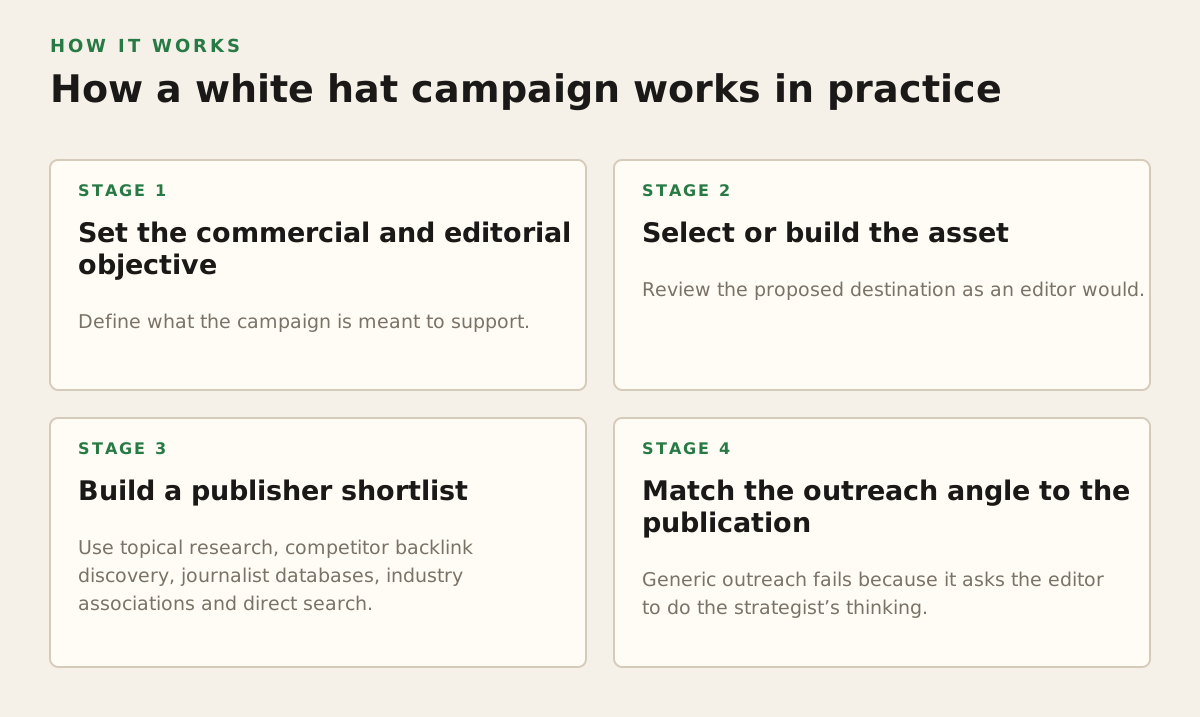
A reliable campaign is a sequence of decisions, not a spreadsheet of domains. The workflow below works for an in-house marketing manager, a specialist agency or a white-label fulfilment partner. The exact channel mix should follow the asset, market and risk tolerance.
1. Set the commercial and editorial objective
Define what the campaign is meant to support. “More links” is not a usable objective. A better brief might be: improve discovery of a technical guide in the German-speaking market; earn citations for an original e-commerce study; or increase relevant referral visits to a casino compliance resource.
Record the target market, language, page type, acceptable topics, prohibited claims, anchor-text preferences and approval owner. If several countries are involved, separate them rather than treating one English-language campaign as a substitute for local relevance.
2. Select or build the asset
Review the proposed destination as an editor would. It should contain a clear claim, answer, tool or evidence that another publisher can reference. Improve weak assets before outreach. Common fixes include adding methodology, naming sources, showing update dates, clarifying definitions and making the page easier to scan.
Anchor text should describe the destination naturally. Branded anchors, plain URLs and descriptive phrases usually give an editor more flexibility than forcing an exact commercial keyword into every article. A link to a page about supplier onboarding should not be labelled with an unrelated phrase merely because that phrase has search demand.
3. Build a publisher shortlist
Use topical research, competitor backlink discovery, journalist databases, industry associations and direct search. Then manually inspect each prospect. A domain score can be one filter, but it should not be the acceptance rule.
- Check whether the site has a coherent subject area and identifiable editorial ownership.
- Review several recent articles, not just the proposed page.
- Inspect whether articles contain useful citations or merely interchangeable outbound links.
- Check search visibility and traffic patterns with your chosen tools, treating estimates as estimates.
- Confirm language, geography, audience, commercial restrictions and gambling or financial-content policies.
- Reject obvious link farms, PBN footprints, spun content and pages created mainly to sell links.
For a starting policy, an agency might require a publisher to meet a minimum third-party authority score, demonstrate relevant organic traffic and pass a manual editorial review. Those are illustrative internal controls, not universal benchmarks. The right thresholds depend on the sector, geography, budget and consequences of a poor placement.
4. Match the outreach angle to the publication
Generic outreach fails because it asks the editor to do the strategist’s thinking. A credible pitch identifies the audience, explains the useful contribution and proposes a specific fit. A data-led story may suit a business publication; a practical checklist may suit a trade journal; an expert quote may suit a journalist working to a deadline.
For guest posts, prepare an outline that respects the publication’s existing style. For niche edits, propose a precise contextual addition and accept that the editor may decline. For digital PR, lead with the evidence or expert rather than the desired anchor text.
5. Review the draft and placement
Before publication, check factual accuracy, brand claims, links, headings, author information, disclosures and destination relevance. After publication, confirm that the article is live at the agreed URL and that the link appears in the intended context. Keep the record of the publisher, URL, date, target page, anchor, link attributes and approval notes.
authority link building is a useful route when the campaign requires a more deliberate selection of relevant publications and pages rather than a bulk list of domains.
Worked example with illustrative numbers
Consider a fictional B2B software campaign. The marketing manager has one original report, two supporting guides and a six-week outreach window. The following is an illustrative planning model, not a promised result:
- Review 40 potential publishers and retain 16 after topical, traffic and editorial checks.
- Prepare 3 story angles: a data finding, an expert commentary angle and a practical checklist.
- Send 16 tailored pitches, with no more than 1–2 follow-ups per contact.
- Approve up to 6 placements if each has a relevant audience and a natural destination.
- Measure referral visits, assisted conversions, indexing, brand mentions and placement quality—not only links secured.
The model deliberately includes rejection. A campaign that approves every opportunity can look productive in a report while weakening the site’s overall link profile and brand credibility.
Where White Hat Link Building breaks down
Most failures are process failures rather than failures of imagination. The team may have a good asset but poor prospecting, a strong publisher but an unsuitable page, or a compliant method undermined by aggressive anchor requirements.
Link metrics replace editorial judgment
Domain Rating, Domain Authority and similar scores are proprietary estimates. They can help prioritise manual checks but do not establish that a page has real readers or that a link will help a particular URL. Scores can also be distorted by historical links, unrelated topical coverage or a domain that has recently changed hands.
Reject the metric when the context is wrong. A high-scoring general site with dozens of unrelated commercial articles may be a weaker prospect than a smaller, specialist publication with clear readership and strong topical alignment.
Scale creates unnatural patterns
Large campaigns can produce repeated article structures, identical author bios, commercial anchor distributions and clusters of publishers with similar templates. Even when each individual article appears readable, the pattern can reveal that the primary purpose is link placement.
Google’s guidance specifically warns against links created primarily to manipulate rankings and against large-scale article campaigns where the main intent is building links; the relevant policy is in the 2026 Google link-spam documentation. A practical response is to vary the editorial format because the story requires it—not to manufacture randomness—and to decline placements that cannot stand on their own.
Commercial anchors overpower natural language
A client may request an exact-match anchor for every placement because it appears aligned with a target keyword. That can make copy awkward and constrain publishers. It also encourages the team to value the anchor over the reader’s needs.
A safer approval rule is to prioritise meaning and usability. Let the editor choose between a brand name, product name, descriptive phrase or naked URL when those options better fit the sentence. The destination page should do the ranking work through its content, internal linking and overall relevance rather than relying on repetitive external wording.
Regulated verticals add another layer
Casino, betting, finance, health and other regulated sectors need more than a backlink checklist. A placement can be thematically relevant yet still create problems if it makes an unsupported promise, targets a restricted jurisdiction, omits a required disclosure or conflicts with the publisher’s advertising policy.
For iGaming campaigns, maintain a market-by-market approval sheet covering permitted language, responsible-gambling references, age restrictions, licensing claims and prohibited destinations. Do not assume that a “gambling-friendly” publisher permits every operator, offer or jurisdiction. Editorial fit and legal review remain separate decisions.
Paid endorsements also require care. The U.S. Federal Trade Commission’s 2026 Endorsement Guides resource explains that endorsements and material connections can trigger disclosure obligations. Applicability depends on the facts and jurisdiction, so use legal counsel for campaign-specific advice rather than treating a link attribute as a complete compliance solution.
White-label delivery hides important context
An agency outsourcing fulfilment may receive a polished monthly report without seeing the original outreach, publisher checks or editorial conditions. That makes quality difficult to audit and can transfer avoidable risk to the agency’s client relationship.
- Require the fulfilment partner to disclose the live URL, target page, anchor and placement date.
- Ask for the reason the publisher was accepted, not just its metric score.
- Set explicit rejection rules for PBNs, link farms, spun articles and irrelevant sites.
- Define how paid, sponsored or user-generated links will be qualified.
- Reserve the right to reject a placement that fails a final manual review.
How practitioners apply it across business models
The same principles produce different campaigns depending on the buyer’s job. An agency needs repeatability and client-safe reporting. A SaaS company needs links to assets that explain a complex product. An e-commerce team needs seasonal relevance and commercial restraint. A casino brand needs jurisdictional and publisher-policy control.
For SEO agencies and white-label teams
Turn the client brief into an acceptance matrix before prospecting. Include industries, countries, languages, prohibited topics, minimum quality controls, target pages, anchor preferences and escalation contacts. This lets a fulfilment partner work independently without making silent assumptions.
Report decisions, not just deliverables. A useful report can show accepted placements, rejected opportunities, reasons for rejection, live URLs, link attributes, topical fit and any publisher changes. link building services can support agencies that need a structured external workflow while retaining approval over the final links.
For SaaS and B2B brands
Prioritise assets that reduce uncertainty for the audience. Technical comparisons, implementation checklists, original research and calculators are often easier to reference than a product overview. Pitch subject-matter experts for commentary, but do not turn every response into a sales paragraph.
Map each external placement to a measurable business role. A trade publication may support qualified referral traffic and credibility. A research citation may strengthen the distribution of an asset. A niche edit may help a reader find a deeper explanation. Not every link needs to point to a money page.
For e-commerce companies
Use product expertise without manufacturing editorial recommendations. Gift guides, testing methodology, sizing research, maintenance advice and original category data can create genuine reasons for coverage. Keep commercial claims substantiated and make sure the linked page matches the promise made in the article.
For casino, betting and iGaming brands
Build a restricted publisher list rather than treating every entertainment or sports site as suitable. Review audience location, licensing language, responsible-gambling requirements, offer terms and whether the site permits operator links. Separate educational content from acquisition pages when that improves editorial credibility.
For an international campaign, a sensible starting policy is to maintain separate approval queues for each target jurisdiction and language. This is an illustrative governance recommendation, not a legal threshold. Local counsel or compliance specialists should confirm the rules that apply to the operator and campaign.
For measurement and maintenance
Measure the campaign at three levels:
- Placement quality: relevance, publisher integrity, page context, link attribute and permanence.
- Search contribution: indexing, referring-page visibility, internal-link support and changes to the target page’s organic performance.
- Business contribution: referral sessions, assisted conversions, qualified leads, branded searches and useful relationships created.
Do not promise a ranking lift from a specific placement. Rankings depend on many signals, competition, content quality, technical accessibility, search intent and changes in search systems. A defensible report distinguishes what the campaign delivered from what the wider SEO programme may influence.
Use a quarterly link audit as a maintenance control. Recheck important placements for page removal, redirects, changed content, altered link attributes and publisher-wide quality deterioration. If a site becomes irrelevant or starts publishing obvious link inventory, flag it for review instead of assuming its previous acceptance remains valid.
The clearest recommendation for 2026 is to run white hat link building as an editorial quality programme: create assets worth citing, shortlist publishers manually, accept natural link context, document commercial relationships and measure business relevance alongside authority metrics. Web Push offers hand-vetted guest posts, niche edits, authority links, digital PR and linkable assets for SaaS, e-commerce, B2B and gambling-friendly campaigns; Web Push if you need a senior-led partner or white-label fulfilment process.
Authored with NotFair SEO