
Choosing link building services is not simply a matter of buying more backlinks. An SEO agency needs dependable fulfillment without exposing its client accounts; a SaaS or B2B team needs relevant pages that support commercial topics; an e-commerce brand may need digital PR and product-led assets; and a casino or betting operator needs publishers that accept gambling-related content. This guide helps you decide which service category fits the job, how much internal work it creates, what to measure, and which questions expose weak suppliers before a contract is signed.
The central decision is whether you need controlled placements, editorial attention, or a repeatable production partner. Those are different jobs. A guest post can offer predictable topical placement, while digital PR has greater creative and approval uncertainty. A niche edit may be efficient when a relevant page already exists, but it is unsuitable when the page is poorly maintained or the surrounding content is unrelated. Treat the service as an operating process—not a list of domain metrics.
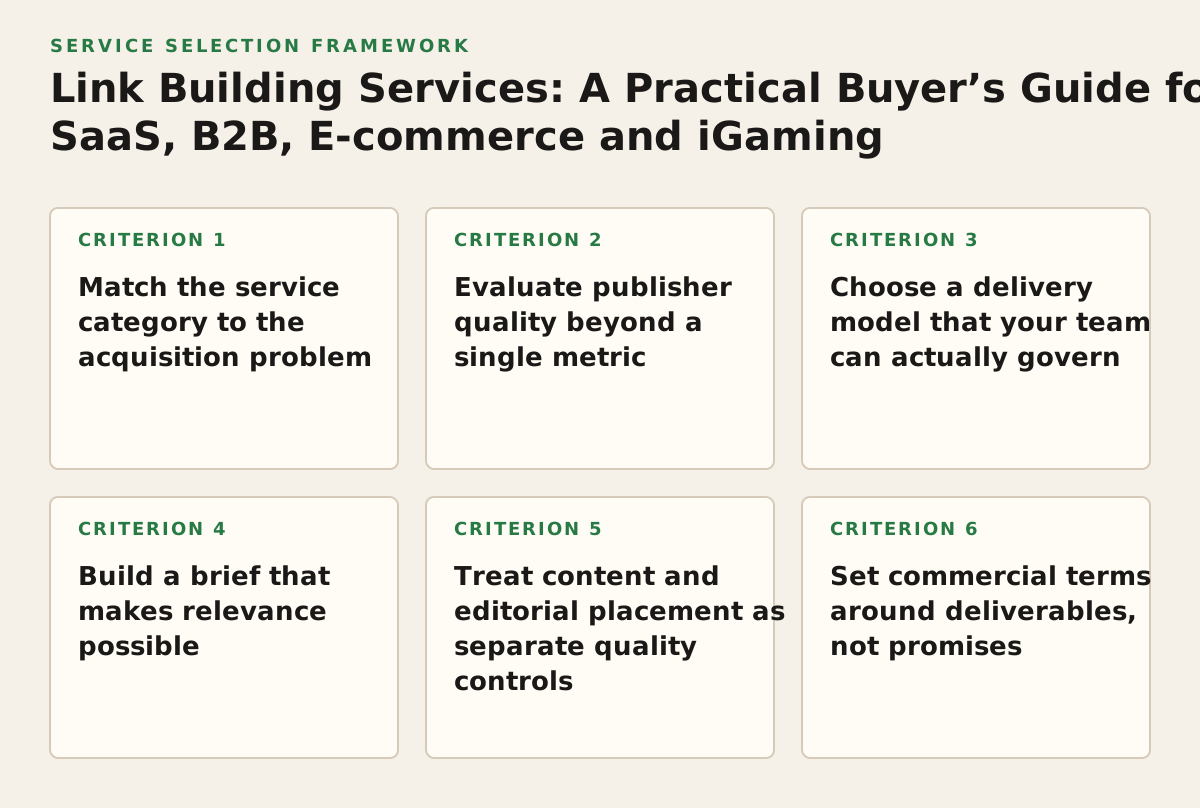
1. Match the service category to the acquisition problem
Start with the asset, audience, and type of authority you are trying to earn. The same buyer may use several categories, but each solves a different bottleneck.
| Buyer need | Best-fit service | Why it fits | Main trade-off | Useful success measure |
|---|---|---|---|---|
| Agency needs recurring fulfillment under its own brand | White-label link building | Outsourced prospecting, outreach, placement coordination, and reporting | Less direct control over every conversation and publisher relationship | Brief-to-placement accuracy, approval rate, delivery reliability, and client retention |
| SaaS or B2B brand needs contextual links to guides, comparison pages, or research | Guest posts and authority links | Allows a planned topic, destination URL, and relevant editorial context | Requires strong content review and careful anchor selection | Relevant referring domains, indexed placements, qualified referral visits, and assisted conversions |
| Existing article is strong but lacks a useful reference | Niche edits | Uses an already-published page whose context may match the target resource | Page history, link neighborhood, and edit quality can be difficult to control | Contextual relevance, page stability, indexing, and referral engagement |
| E-commerce or B2B brand has a newsworthy asset | Digital PR and linkable assets | Creates a reason for journalists, publishers, or communities to cite the brand | Higher creative, approval, and media-response uncertainty | Quality coverage, referring domains, brand mentions, and assisted organic demand |
| Casino, betting, or iGaming brand needs suitable publishing environments | Gambling-friendly guest posts, niche edits, or digital PR | Filters prospects for commercial, legal, and editorial acceptance before outreach | Smaller eligible inventory and stricter content or market restrictions | Approved-market relevance, live placement quality, compliance review, and referral value |
| Brand wants authority around a difficult commercial topic | authority link building | Prioritizes stronger, more relevant publishers and destination assets | Often needs better assets, more approvals, and a longer planning cycle | Relevant authority of linking sites, target-page visibility, and qualified organic outcomes |
Use guest posts for control when you can supply a defensible topic and want the destination URL, angle, and anchor discussed in advance. Use niche edits when a page already earns attention and the proposed reference genuinely improves it. Use digital PR when the story itself is the link magnet; do not use it as a disguised request for an exact-match commercial link.
Implementation example
Suppose a B2B software company has a research report on procurement delays. A guest-post campaign could propose practical articles on supplier risk, contract workflows, and purchasing operations, each pointing to the report where it adds evidence. A digital PR campaign could package the report into a pressable finding. A niche edit would only make sense if an existing, maintained article already discusses procurement delays and lacks a source for the relevant claim.
Failure mode: buying the category with the highest apparent authority rather than the one that matches the asset. The result is often a link that is technically live but editorially strained, hard to approve, or useless to the intended audience.
2. Evaluate publisher quality beyond a single metric
Domain Rating, Domain Authority, organic traffic estimates, and similar scores can help sort a prospect list, but none proves that a placement is worthwhile. A buyer should inspect the actual linking page, the publisher’s topical fit, and whether the site appears to serve a real audience.
Google’s documentation distinguishes natural, paid, and user-generated links and recommends qualifying paid links with appropriate attributes such as rel="sponsored" or rel="nofollow"; its guidance is available in the official qualifying outbound links documentation. This matters when a supplier describes every paid placement as “editorial” without explaining how the publisher labels or qualifies it.
Request evidence in the vendor review
- The proposed domain and exact page type, not only a spreadsheet of domain scores.
- Recent examples showing topic, placement position, destination URL, and anchor treatment.
- Evidence that the site has a coherent editorial history rather than a large collection of unrelated sponsored pages.
- The publisher’s policy for gambling, finance, health, supplements, regulated products, and other restricted subjects.
- Whether links are permanent, subject to removal, or dependent on a recurring publishing arrangement.
- How the supplier checks indexability, redirects, canonicalization, and accidental noindex instructions.
Traffic quality beats vanity scale when the buyer cares about referral visits, brand exposure, or a defensible editorial profile. A smaller industry publication with an engaged audience can be more useful than a high-metric site whose content is unrelated to the buyer’s market.
Implementation example
For a German e-commerce brand, create a prospect scorecard with separate fields for German-language relevance, audience geography, category alignment, page quality, estimated organic visibility, outbound-link patterns, and commercial restrictions. A site passes only if it meets the minimum requirements for relevance and editorial quality; a high authority score cannot compensate for a poor topical match.
Failure mode: accepting screenshots or historic examples as proof of current quality. Domains change hands, traffic falls, pages are deleted, and publishers alter outbound-link policies. Require checks close to approval and record the date of each review.
3. Choose a delivery model that your team can actually govern
The delivery model determines how much work remains with the buyer. A direct campaign may give a brand closer control over strategy and publisher communication, while an agency-led service can absorb prospecting, negotiation, writing, and reporting. White-label fulfillment adds another requirement: the provider must make its process usable inside someone else’s client relationship.
Compare the operating burden
- Direct outreach: the buyer owns research, contact discovery, negotiation, briefs, writing, follow-up, and publisher maintenance.
- Managed placements: the supplier handles prospecting and outreach, while the buyer usually approves sites, topics, and content.
- White-label fulfillment: the supplier delivers behind the agency’s brand, requiring agreed templates, response times, escalation rules, and client-safe reporting.
- Digital PR: the buyer must often provide data, experts, creative approvals, legal review, and rapid responses to media questions.
Ask where the handoffs occur. A service can look fully managed until the buyer discovers that it must rewrite every article, validate every domain, chase missing URLs, and explain unexplained substitutions to its client. Define approval gates before work begins: prospect approval, angle approval, draft approval, live-link verification, and replacement policy.
For white-label work, clarify whether the supplier communicates directly with the end client, uses the agency’s email identity, or remains invisible. Also define who owns the strategy, who handles complaints from publishers, and who explains a delayed or rejected placement.
Implementation example
An SEO agency serving five SaaS clients might create one shared intake form with client-specific exclusions, target pages, preferred markets, prohibited anchors, and approval contacts. The fulfillment partner then returns prospects in batches, waits for approval, produces content, and reports live URLs using the agency’s format. A rejected publisher is logged with a reason rather than silently replaced with a weaker domain.
Failure mode: outsourcing execution without outsourcing decisions. If the supplier receives only “get links to this homepage,” it will have to guess the audience, page purpose, risk tolerance, and acceptable anchor profile. That ambiguity creates avoidable revisions and inconsistent placements.
4. Build a brief that makes relevance possible
Good outreach cannot rescue an unsuitable destination page. Before selecting a service, map the target URL to a genuine information need. Commercial pages can earn links, but they often need supporting assets—research, calculators, original data, detailed guides, templates, or expert commentary—that publishers can reference naturally.
Use a page-first campaign brief containing:
- Business objective and intended audience.
- Target URL, page type, primary topic, and acceptable supporting URLs.
- Countries, languages, and industries that matter.
- Topics to pursue and topics to exclude.
- Anchor preferences stated as guidance, not a demand for repeated exact-match text.
- Publisher requirements, including minimum relevance, traffic checks, and gambling or regulated-sector rules.
- Claims that require evidence, legal review, medical review, or compliance approval.
- Definition of a live placement and the process for correcting or replacing one.
Google’s official spam policies identify link spam and manipulative practices as a search-quality concern. The practical implication is not “never obtain a link”; it is to avoid campaigns built around manufactured patterns, irrelevant placements, or content created primarily to pass ranking credit.
Implementation example
For a casino operator entering a regulated European market, the brief should identify the approved country, permitted terminology, responsible-gambling language, landing-page restrictions, and whether the publisher can link to a brand page or only an informational resource. A gambling-friendly publisher is not automatically suitable: audience geography and compliance review still matter.
Failure mode: forcing every placement to use a commercial landing page and exact anchor. This narrows publisher fit, makes articles less useful, and can produce an unnatural campaign pattern. Let the editorial context determine whether a brand mention, URL, partial phrase, or descriptive anchor is appropriate.
5. Treat content and editorial placement as separate quality controls
A placement has two components: the publisher’s context and the content that earns inclusion. A well-written article on the wrong site remains a poor fit; a relevant site can still reject thin, promotional, or unsupported copy. Separate the checks so one strength does not hide the other.
Review the publisher context
- Does the article’s subject belong on the site without an awkward commercial jump?
- Are neighboring articles useful, current, and written for a recognizable audience?
- Does the proposed link support a claim, definition, source, or next step?
- Are sponsored, commercial, or contributor pages clearly distinguished?
- Would a reader plausibly click the link without being instructed to do so?
Review the content itself
- Does it contain a specific point of view, process, example, or evidence?
- Are claims supported or carefully qualified?
- Does the introduction earn the reader’s attention without padding?
- Are the links limited to destinations that genuinely help the reader?
- Has the content been checked for copied passages, inaccurate claims, and brand-inappropriate language?
The U.S. Federal Trade Commission’s Native Advertising: A Guide for Businesses explains that advertising should not mislead consumers about its commercial nature. Requirements differ by jurisdiction and publisher, but the operational lesson is clear: ask how sponsored or contributor content is identified, and do not conceal material commercial relationships behind editorial language.
Implementation example
An e-commerce brand selling ergonomic office equipment could commission a guest article about evaluating workstation comfort. The article may cite the brand’s sizing guide if that guide answers a specific question, but it should not become a product catalogue. A separate product page can be supported through digital PR, expert commentary, or a useful comparison asset.
Failure mode: letting a supplier auto-generate interchangeable articles at scale. Even when grammar is acceptable, generic copy gives editors little reason to publish it and gives readers little reason to trust the linked brand.
6. Set commercial terms around deliverables, not promises
There is no universally correct pricing model for link acquisition. Suppliers may charge per placement, per campaign, through a monthly retainer, by content and outreach components, or through a custom digital PR project. The buyer’s task is to understand what is included and which activities remain billable.
Questions to ask about budget and pricing
- Is the fee tied to a live, approved placement, or to outreach activity regardless of outcome?
- Does the fee include research, writing, editing, publisher negotiation, revisions, and reporting?
- Are premium publishers, specialist writers, translations, or data assets handled separately?
- What happens when a prospect rejects the content or removes a link?
- Are there minimum commitments, setup fees, renewal terms, or notice periods?
- Can the buyer pause work when a client’s priorities or compliance position changes?
- Who pays for replacement content when a publisher requests substantial revisions?
Use an illustrative starting policy, not a universal benchmark: approve a small pilot with a defined number of target pages, a documented quality floor, and a review after the first reporting cycle. The point is to test process fit and approval friction before committing to a larger recurring program—not to assume that an early sample predicts every future result.
Success should be measured at several levels. Delivery metrics show whether the supplier did the work. Quality metrics show whether the links are worth retaining. Business metrics show whether the campaign supports the broader organic program.
- Delivery: approved prospects, published placements, completion rate, turnaround time, and replacement handling.
- Quality: topical relevance, target-page fit, indexability, link attributes, publisher stability, and referral engagement.
- Search: impressions, clicks, rankings for relevant queries, and visibility of the supported page.
- Business: qualified referral sessions, assisted conversions, branded demand, and revenue where reliable attribution exists.
Google Search Console’s official Links report documentation explains what the report shows and what it does not show. Use it as one directional input, not as a complete inventory or a direct proof that a specific placement caused a ranking change.
Failure mode: paying for a domain score or a promised ranking position. A provider cannot honestly guarantee that one link will produce a particular ranking or revenue outcome because competition, content quality, crawling, search intent, and technical issues also affect performance.
7. Make reporting auditable and expectations falsifiable
A useful report lets an account manager answer, “What was acquired, why was it selected, and what should happen next?” It should not be a monthly export of URLs with no context.
Require a placement record
- Publisher domain, page title, live URL, publication date, and target URL.
- Topic and reason the placement is relevant to the audience.
- Anchor or linked brand mention and link attribute, where visible.
- Country and language, especially for regional or regulated campaigns.
- Approval status, content owner, and any disclosure or sponsorship label.
- Indexability and redirect checks performed after publication.
- Follow-up date for link stability and the remedy if the link disappears.
For referral measurement, keep campaign naming consistent and use tagged links where appropriate. Google Analytics’ official campaign URL guidance describes how UTM parameters identify campaign traffic. Tagging does not prove SEO causality, but it can make referral activity easier to separate from other acquisition sources.
Search visibility should be assessed against a pre-campaign baseline and a defined observation window. Do not attribute a movement to link building if the page was also rewritten, internally linked, redirected, expanded, or affected by a broad search-system change during the same period.
Demand transparent uncertainty in the report. “Published but not indexed at the check date” is more useful than silently presenting it as complete. Likewise, “referral clicks recorded, no assisted conversion yet” is a valid result, not evidence that the placement should be hidden.
Failure mode: reporting only the number of links delivered. Volume can rise while relevance, page quality, and business usefulness decline. Require the supplier to explain rejected prospects, substitutions, removals, and deviations from the brief.
Vendor interview checklist: questions that reveal the process
Use the following checklist in a discovery call or written evaluation. Ask for examples, not assurances.
- How do you define a qualified publisher for this industry, country, and language?
- Can we approve domains and topics before content is written?
- How do you identify sites with real editorial activity rather than recycled placement inventory?
- What checks do you perform on traffic, topical relevance, indexability, outbound-link patterns, and ownership?
- How do you handle sponsored, paid, affiliate, and contributor disclosures?
- What is your policy for link attributes such as sponsored or nofollow?
- Can you support restricted verticals such as gambling, betting, finance, or health, and what review is required?
- Who writes the content, how many revision rounds are included, and who owns final approval?
- What happens if a publisher rejects the article, changes the page, removes the link, or adds an unsuitable neighboring link?
- What exactly appears in the monthly report, and when are live URLs verified?
- How are client confidentiality and white-label communication handled?
- Which parts of the work are fixed, variable, recurring, or charged separately?
- What would make you reject a proposed target page or campaign?
Watch the answers for specific operational boundaries. “We use high-quality sites” is not a method. A credible answer explains screening, approvals, attributes, replacement terms, content ownership, and reporting. Also ask the supplier to describe a campaign they would decline; refusal criteria often reveal more than a list of strengths.
Red flags that should stop or reshape the engagement
Some risks can be managed through tighter approvals. Others indicate that the supplier’s incentives are incompatible with a defensible campaign.
- Guaranteed rankings, guaranteed traffic, or guaranteed algorithmic outcomes.
- Large volume promises without a clear relevance and publisher-quality definition.
- Refusal to disclose live URLs after publication.
- Domains selected only by a score, with no page-level or audience review.
- Exact-match anchor requirements applied across unrelated editorial contexts.
- Content that exists only to place a link and contains no useful information.
- Unclear ownership of accounts, content, relationships, or reporting data.
- No replacement policy for deleted, redirected, or materially changed placements.
- Pressure to skip legal, brand, market, or responsible-gambling review.
- Claims that paid placements are always “natural” and never require disclosure or qualification.
Bing’s official Webmaster Guidelines also emphasize quality, relevance, and avoiding manipulative practices. Search engines differ in documentation and systems, but a conservative standard is sensible: acquire references that make sense to users even if no ranking benefit arrives.
Do not confuse secrecy with quality. A supplier may reasonably protect publisher contact details before approval, but it should still explain its selection method and provide enough evidence for the buyer to judge each delivered placement. If the buyer cannot inspect the work, the buyer cannot govern the risk.
A sequenced implementation plan for selecting and managing the service
- Define the business job. Decide whether the priority is qualified referral exposure, support for a specific organic page, regional visibility, white-label capacity, or a newsworthy campaign. Record what success would look like without promising a ranking result.
- Audit the destination assets. List pages that can genuinely help a reader. Improve weak pages before outreach, and create a research report, tool, guide, comparison, or expert resource when commercial pages offer no natural citation point.
- Set campaign boundaries. Document markets, languages, vertical restrictions, acceptable publishers, prohibited topics, brand claims, anchor guidance, and compliance approvals. For casino and betting campaigns, specify approved jurisdictions and responsible-gambling requirements.
- Select the service category. Choose guest posts for planned contextual coverage, niche edits for genuinely suitable existing pages, authority links for higher-value topical targets, digital PR for assets with a real story, and white-label fulfillment when the bottleneck is agency capacity.
- Run vendor interviews. Use the checklist above and request a sample workflow: prospect review, brief, draft approval, publication, verification, and replacement. Reject answers that rely on guarantees or unexplained metrics.
- Agree the commercial model. Define what counts as delivery, which tasks are included, how substitutions work, whether placements are recurring or one-time, and what happens when a link is removed. Treat any budget or volume as an illustrative starting policy tied to capacity and quality controls.
- Launch a controlled pilot. Use a limited set of pages and publishers with explicit approval gates. Track delivery, relevance, editorial quality, indexability, referral activity, and internal revision time.
- Review before scaling. Compare the pilot with the agreed quality floor. Expand only when the supplier meets the brief without creating excessive client-management work. Pause when publisher quality, transparency, or compliance falls below the agreed standard.
- Maintain the asset and link portfolio. Recheck important placements, update destination content, monitor referral traffic, and retire campaigns whose pages or audiences no longer fit. A live link is not permanently valuable if its context has deteriorated.
This process gives an agency, SaaS team, e-commerce manager, B2B marketer, or iGaming operator a defensible way to buy and evaluate link building services without reducing the decision to domain scores or monthly link counts. Web Push offers hand-vetted guest posts, niche edits, authority links, digital PR, linkable assets, and white-label fulfillment for relevant editorial and gambling-friendly publishing requirements; explore Web Push when you need a senior-led partner to work within these controls.
Authored with NotFair SEO