
White label SEO is the delivery of search optimization work by one provider under another agency’s brand. In link building, that usually means a specialist researches prospects, creates or adapts content, conducts outreach, secures placements, and supplies evidence while the client-facing agency owns the strategy, relationship, and reporting. The arrangement is not simply “buying links cheaply and adding a logo”; it is a managed production system with standards, approvals, quality controls, and clear responsibility for risk.
That distinction matters to agencies selling organic growth, SaaS brands buying authority links, e-commerce teams planning digital PR, and casino or iGaming marketers that need publishers willing to cover regulated topics. A white-label partner can expand delivery capacity, but only if the agency can explain what is being delivered, verify it independently, and reject work that does not fit the client’s commercial or editorial requirements.
What White Label SEO includes—and what it does not
A useful definition starts with the boundary between outsourced fulfillment and outsourced strategy. A partner may execute a brief without deciding which pages deserve links, which markets matter, or how the work fits the client’s wider search plan. Those decisions normally remain with the agency or brand that owns the account.
The production layer
For a link-building campaign, the production layer can include:
- Turning target URLs, anchor preferences, industries, and exclusions into a prospecting brief.
- Finding relevant publishers and checking topical fit, visible editorial standards, organic traffic signals, and outbound-link patterns.
- Pitching guest contributions, negotiating publication details, or locating suitable existing pages for niche edits.
- Writing a new article, briefing a writer, editing supplied material, or creating a linkable asset such as a data-led guide.
- Recording the live URL, target page, anchor text, publication date, surrounding context, and any agreed replacement or correction policy.
The agency then packages that work as part of its own client-facing service. It might sell technical SEO, content marketing, digital PR, or a broader link building services, with link acquisition supplied behind the scenes. In a good arrangement, the client receives a coherent report rather than a confusing hand-off between several vendors.
Three models that are often confused
White-label fulfillment means the provider is intentionally invisible to the end client, subject to the commercial agreement. The agency controls communication and presentation. A referral model is different: the specialist may speak directly to the client and retain visible ownership of delivery. A marketplace model is different again: the buyer selects individual placements from a catalog, often with less strategic coordination.
None of these models is automatically good or bad. The important questions are who approves targets, who owns publisher relationships, who checks the live placement, and who handles a problem after publication.
White label SEO also does not mean hiding a manipulative scheme. Google’s guidance identifies buying or selling links that pass ranking credit, excessive link exchanges, and automated link creation as examples of link spam; the current policy is documented in its Search Essentials spam policies. A discreet supplier still has to operate within the same search and advertising constraints as a visible one.
Why agencies use white-label delivery
The commercial case is usually about capacity without permanent headcount. An agency may understand organic strategy and account management but lack enough researchers, writers, editors, and outreach operators to fulfill every campaign consistently. Hiring for occasional demand can create idle capacity; doing everything internally can make delivery slow or force senior strategists into repetitive production.
There is also a specialization problem. A B2B SaaS campaign may need technically accurate articles on APIs, data governance, or workflow software. A betting brand may need gambling-friendly publishers, careful language, and market-specific review. An e-commerce business may need product-category relevance rather than generic marketing placements. Each requires different prospecting and editorial judgment.
Where the value appears
- Faster campaign activation: a documented fulfillment team can begin prospecting while the account lead finalizes broader content and technical priorities.
- More predictable workflow: standard briefs and review stages reduce the number of decisions repeated for every client.
- Access to specialist relationships: a provider may already know which publishers accept technical, commercial, regional, or gambling-related subjects.
- Better use of senior time: strategists can focus on page selection, positioning, internal linking, and client communication instead of chasing every placement.
- Scalable white-label reporting: live URLs and placement evidence can be formatted under the agency’s reporting structure.
These benefits only exist when quality is operationally defined. “High authority” is not enough. A publisher that has a strong third-party metric but no relevant audience, weak editorial controls, or an unnatural concentration of commercial outbound links may be a poor fit.
Illustrative capacity planning
The following is an illustrative starting policy, not a universal benchmark. Suppose an agency has six active campaigns and wants four approved placements per campaign in a monthly sprint. That creates a target of 24 live placements. If the agency estimates that only half of approved prospects will publish, it needs about 48 accepted opportunities in the pipeline. If it expects one in three initial prospects to pass review, prospecting must begin with roughly 144 candidates.
- 6 campaigns × 4 placements = 24 target publications.
- 24 publications ÷ 50% assumed success rate = 48 approved opportunities.
- 48 opportunities ÷ 33% assumed acceptance rate = about 144 prospects.
The arithmetic is less important than the discipline. An agency should model its own acceptance, revision, rejection, and replacement rates instead of promising a number of links based only on a supplier’s inventory.
How a white-label link campaign works
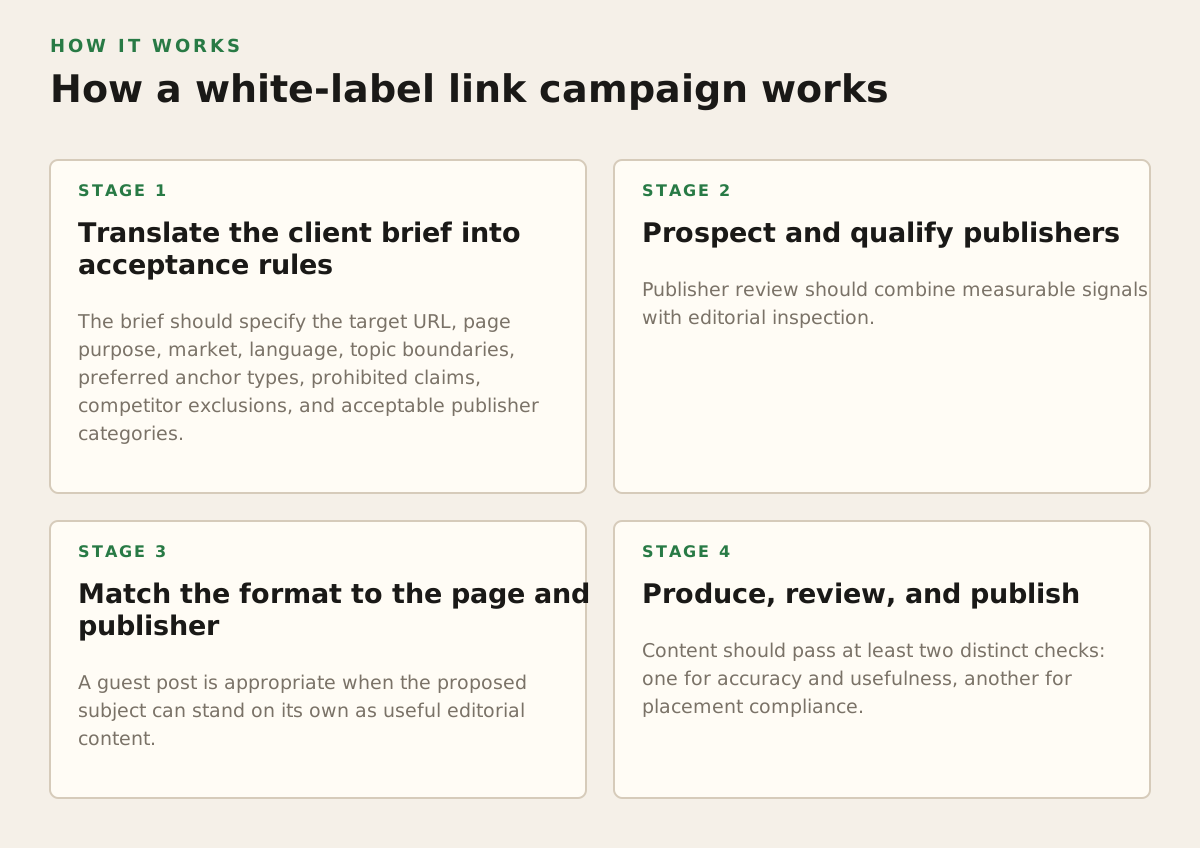
A reliable campaign is a sequence of gates, not a single order form. The first gate is strategic: choose pages before choosing publishers. A link to a weak, irrelevant, or commercially premature page may produce a deliverable without improving the client’s business objective.
1. Translate the client brief into acceptance rules
The brief should specify the target URL, page purpose, market, language, topic boundaries, preferred anchor types, prohibited claims, competitor exclusions, and acceptable publisher categories. It should also distinguish between a primary page and fallback pages. A SaaS homepage, for example, may be less suitable for every placement than a detailed integration guide or research report.
Anchor text needs restraint. Branded anchors, naked URLs, and descriptive phrases are often easier to place naturally than an exact commercial phrase. The agency should approve the final anchor in context, not treat the anchor field as an instruction to force wording into an article.
2. Prospect and qualify publishers
Publisher review should combine measurable signals with editorial inspection. Domain Rating or another third-party authority metric can help sort a large list, but it is not proof of quality or of a ranking outcome. Reviewers should inspect:
- Whether recent articles are genuinely related to the client’s market or audience.
- Whether the site has signs of real organic visibility, such as indexed topical coverage and consistent publishing history.
- Whether authorship, contact information, corrections, and commercial disclosures are handled credibly.
- Whether outbound links appear editorially placed or are concentrated in thin sponsored pages.
- Whether the site publishes obvious link-farm content, spun articles, hacked pages, or a large volume of unrelated niches.
- Whether the market, language, and legal sensitivity suit the campaign.
For clients that need a starting filter, Web Push describes its own inventory as hand-vetted DR 30+ publishers with real organic traffic, excluding link farms and PBNs. That is a supplier policy, not a guarantee that every placement will be valuable or that a metric threshold substitutes for human review.
3. Match the format to the page and publisher
A guest post is appropriate when the proposed subject can stand on its own as useful editorial content. A niche edit may be appropriate when an existing article has a genuine contextual gap and the target page improves the explanation. A digital PR placement usually begins with a story, dataset, expert commentary, or asset that a publisher would have a reason to cite.
Context must justify the link. Google’s guidance on crawlable links explains how links should be implemented so search systems can understand them, while its outbound-link qualification guidance distinguishes ordinary editorial links from paid or user-generated links. Technical correctness does not make an irrelevant link editorially appropriate.
4. Produce, review, and publish
Content should pass at least two distinct checks: one for accuracy and usefulness, another for placement compliance. The first asks whether the article deserves to exist. The second asks whether the publisher, URL, link attribute, anchor, disclosure, and surrounding text match the brief.
Paid or sponsored arrangements require particular care. Google recommends qualifying paid links with rel="sponsored" and describes nofollow as another way to indicate that a link should not pass ranking credit in its official link qualification documentation. Separately, the U.S. Federal Trade Commission explains that advertising disclosures should be clear and conspicuous in its Disclosures 101 guidance. The applicable law depends on the markets and parties involved, so an agency should not treat a search guideline as legal advice.
5. Verify the live asset and report it
Verification is a separate operation, not an assumption that publication means completion. A useful record includes:
- Live URL and date checked.
- Target URL and final anchor text.
- Link location and whether it is indexable in the rendered page.
- Publisher topic, country, language, and relevant quality notes.
- Article title, author or commercial label, and any required disclosure.
- Screenshot or archived evidence where contractually appropriate.
- Replacement terms if the page is removed or substantially changed.
Do not promise indexing or ranking movement merely because a page is live. Google Search Console’s documentation says the Links report is a sample of links known to Google rather than a complete list, as described in its official Search Console links report documentation. That makes it useful for investigation, but unsuitable as a short-term delivery counter.
Where white-label SEO breaks
Most failures happen at the interfaces between strategy, fulfillment, and reporting. Low transparency creates operational risk even when the final links look acceptable. If an agency cannot see how a prospect was qualified or why an anchor was chosen, it cannot defend the work to a demanding client.
Vague quality language
Terms such as “premium,” “authority,” and “real traffic” need definitions. Ask what is checked, when it is checked, and what causes rejection. A sensible policy might reject a site with irrelevant recent content, a suspicious outbound-link profile, or no clear audience even when its third-party metric exceeds the minimum.
For example, an illustrative review rule could require a DR 30+ domain, topical relevance, evidence of organic traffic, and a manual content check, with any one of those being insufficient on its own. This is a starting policy for discussion, not a Google threshold and not a prediction of results.
Volume incentives distort judgment
A supplier paid or evaluated mainly on the number of live links has an incentive to accept marginal publishers, reuse thin topics, and force anchors. The agency should track rejection reasons, not only completed placements. A high rejection rate may mean the brief is too narrow, prospecting is weak, or the partner is sending inventory that should have been filtered internally.
Industry and compliance mismatch
Casino, betting, and iGaming campaigns illustrate the problem. A publisher may accept a general business article but reject gambling content, affiliate language, responsible-gaming references, or a target market. An apparently relevant finance site may also have restrictions on regulated advertisers. The brief should identify permitted verticals, markets, claims, and landing-page types before outreach begins.
Other sensitive areas create similar constraints:
- Health content may require qualified review and careful evidence handling.
- Financial content may need local regulatory and disclosure review.
- Children’s products and data-related subjects require extra caution around claims and audience.
- Technical B2B content can fail when writers simplify the product inaccurately.
- Multilingual campaigns can lose meaning when anchors or product terminology are translated literally.
Client expectation drift
Some clients hear “authority links” and infer guaranteed rankings. That is a sales and reporting problem, not a fulfillment problem alone. Search performance depends on the target page, competing results, technical accessibility, content quality, internal links, market, and time. A responsible proposal describes the work and decision criteria rather than promising a fixed position.
Another failure is reporting every placement as equivalent. A relevant editorial mention on a page that attracts the client’s audience is not the same commercial asset as a barely related page with a stronger metric. Reporting should preserve those distinctions.
How practitioners apply it by client type
The same white-label process should produce different decisions for different businesses. Relevance is a commercial variable, not merely a topical label. The best target is often the page and publisher combination that supports a specific customer journey.
SaaS and B2B
Start with assets that explain a problem: integration documentation, original research, templates, comparison frameworks, or operational guides. A guest article can introduce the problem and link to a deeper resource; a niche edit may strengthen an existing explanation of a workflow. Avoid vague thought leadership that mentions the software without teaching the reader anything.
An illustrative SaaS brief might prioritize:
- One integration guide as the primary target.
- Two adjacent topics, such as implementation and process design.
- Branded or descriptive anchors rather than repeated exact-match commercial wording.
- Publishers read by practitioners, not only sites that list software tools.
The account lead should then connect placements to internal linking and content updates. A backlink to an unlinked orphan page, or to a page that does not answer the article’s promise, wastes part of the opportunity.
E-commerce
E-commerce campaigns need more than links to product pages. Useful destinations may include buying guides, original product research, size or compatibility resources, and category explainers. Publishers should be screened for audience overlap and editorial tolerance for commercial references.
A linkable asset can earn attention without asking every article to promote a product. For example, a retailer selling outdoor equipment might create a seasonal maintenance guide or a comparison dataset, then use outreach to place expert commentary around the underlying topic. The link can point to the resource while the site’s internal navigation connects readers to relevant categories.
Casino, betting, and iGaming
These campaigns require a publisher list built around gambling-friendly inventory, not a general list with gambling added at the end. Confirm whether the site accepts the relevant jurisdiction, terminology, affiliate relationships, and landing-page type. A placement that is live but violates the client’s market restrictions is not a successful delivery.
Content quality matters especially here because generic casino copy is easy to recognize and difficult to justify editorially. Stronger angles might involve sports data, probability education, responsible gambling, technology, payments, or industry analysis—provided the claims are accurate and the destination is appropriate.
Agencies buying fulfillment
An agency should decide what remains proprietary. It may keep its strategic framework, client communication, and account-level reporting while sharing only the information necessary for production. That is compatible with white-label work, but secrecy should not prevent internal auditing.
Before appointing a partner, ask for answers to these operational questions:
- Who makes the final publisher acceptance decision?
- Can the agency reject a placement without losing the campaign’s commercial logic?
- How are links checked after publication?
- What happens when an article is edited, redirected, deleted, or deindexed?
- Which content is written from scratch, and which is supplied or adapted?
- How are regulated verticals, local languages, and prohibited claims handled?
- What evidence accompanies each delivered placement?
These questions expose whether a provider is offering a controlled service or merely reselling access to a list of sites. The former can become part of an agency’s process; the latter can create support work that exceeds the time saved.
A practical operating policy for 2026
For 2026 campaigns, use white-label SEO as a quality-controlled extension of strategy, not as a substitute for it. The client-facing agency should own the objective, target-page selection, risk tolerance, and interpretation of results. The fulfillment partner should own the agreed production tasks and supply enough evidence for the agency to audit them.
Set the minimum viable brief
Every campaign brief should contain:
- Business goal and target market.
- Approved and excluded URLs.
- Topic boundaries and subject-matter requirements.
- Anchor preferences with examples of natural alternatives.
- Publisher requirements, including language, country, vertical, and minimum quality signals.
- Disclosure, link-attribute, and compliance instructions.
- Review deadlines and replacement expectations.
If the client cannot explain why a target page matters, pause prospecting and fix the strategy. More outreach will not solve a destination problem.
Use a staged approval system
A practical workflow can have four statuses: prospect, approved, drafted, and live. The agency approves prospects before content is commissioned, reviews drafts before publication where the agreement allows it, and verifies every live URL afterward. This prevents a supplier from spending effort on a publisher that later fails a client’s restrictions.
Maintain a rejection log with categories such as irrelevant audience, suspicious site pattern, unacceptable market, weak article fit, forced anchor, or compliance concern. Over time, the log improves the brief and shows whether the partner is learning from feedback.
Measure delivery quality, not vanity volume
Use a small dashboard that separates activity from outcome:
| Area | Useful question | Decision it supports |
|---|---|---|
| Relevance | Does the publisher reach the intended audience? | Keep, reject, or change prospecting criteria |
| Editorial fit | Does the article earn its place without forced wording? | Revise, redirect, or cancel before publication |
| Technical delivery | Is the final URL, anchor, and link attribute correct? | Request correction or record completion |
| Durability | Does the page remain live and materially unchanged? | Trigger replacement or investigate publisher quality |
| Business alignment | Does the link support a useful page and customer journey? | Adjust targets and content priorities |
Do not use a third-party authority score as the sole success metric. It can be one screening input, while relevance, editorial integrity, destination quality, and durability determine whether the placement belongs in the client report.
Make the recommendation explicit
For an agency with a clear strategy but limited outreach or editorial capacity, white-label fulfillment is a sensible way to extend delivery—provided the agency retains approval rights and audits live work. For a brand without a defined content and internal-linking plan, buying placements first is premature; fix the asset and page strategy before scaling outreach.
Web Push supports agencies and brands with hand-vetted guest posts, niche edits, authority link building, digital PR, linkable assets, and white-label fulfillment, including gambling-friendly publishers for casino, betting, and iGaming campaigns. If you need a partner that can work from your standards rather than replace them, Web Push is the appropriate next step.
Authored with NotFair SEO