
Guest posting sites are useful only when they help you earn a relevant, editorially controlled mention on a real publication. For an SEO agency outsourcing fulfillment, a SaaS team building category authority, an e-commerce brand pursuing referral traffic, or an iGaming marketer needing gambling-friendly inventory, the practical buying job is the same: acquire credible guest-post placements without spending weeks prospecting, negotiating and checking every domain.
This is a comparison of managed guest-post and link-building services, not a list of random blogs where anyone can upload an article. The companies below source or sell editorial placements, but they differ in how much of the work they perform, how transparent their inventory is and how suitable they are for regulated or competitive niches. A service may call its inventory “guest posting sites,” “publisher placements” or “authority links”; the underlying question is whether the proposed page is relevant, indexed and worth associating with your brand.
I evaluated each option against four practical criteria:
- Placement quality: the relevance, editorial context, organic visibility and spam controls a buyer can reasonably verify.
- Workflow burden: whether the buyer supplies targets and content or receives prospecting, writing, outreach and reporting.
- Commercial fit: how clearly the service communicates pricing, minimums, packages, custom campaigns and white-label potential.
- Risk and suitability: whether the model works for strict brand guidelines, difficult niches, international campaigns and long-term authority building.
There is also an important category distinction. Managed outreach agencies handle prospecting and publisher relationships. Placement marketplaces may offer a catalogue from which you select sites. Digital PR-led providers pursue editorial coverage through campaigns rather than selling a fixed list of guest-post opportunities. None is automatically superior: a local SaaS launch may need relevance and speed, while a casino operator may need a supplier that confirms gambling-friendly inventory before any content is commissioned.
Google’s guidance is a useful boundary for every option in this list. Its link-spam documentation identifies manipulative links created primarily to influence rankings as a problem, while paid or sponsored links should be appropriately qualified; see the official Google Search spam policies. Treat a placement as a marketing asset first and a ranking signal second. Do not buy a link merely because a spreadsheet shows a high third-party metric.
1. FATJOE
What it does well
FATJOE is an established, productised SEO fulfillment provider covering link building and content services. Its appeal is operational simplicity: agencies and in-house marketers can order defined services rather than beginning with a blank campaign brief. That makes it a plausible fit when the buyer needs repeatable fulfilment across several clients or pages.
The commercial model is service-based rather than a self-serve directory of publisher contacts. The official FATJOE pricing page is the appropriate place to verify current packages, order sizes and available services in 2026; do not rely on an old agency spreadsheet. Productised ordering reduces procurement friction, but it can also make an unusual campaign harder to scope if you need a narrow country, language, vertical or publisher profile.
Operational trade-offs
- Best for: agencies that want a familiar fulfilment workflow and repeatable link-building orders.
- Does not suit: buyers who require every target publication to be approved before outreach or who want a bespoke digital PR narrative.
- Implementation burden: low to moderate; expect to provide URLs, anchor guidance, audience context and exclusions, then review delivery.
- Commercial model: package or order-based; verify current minimums, turnaround and revision terms directly.
- Standout: a straightforward route for turning an ongoing link requirement into an outsourced production process.
For a B2B software client, FATJOE may be efficient when the brief is “earn relevant editorial links to three product-led guides each month.” It is less obviously suited to a campaign where the publisher list itself is the strategic deliverable. Ask how domains are selected, how often a site can be reused, what happens when a placement is rejected and whether the reporting includes the live URL, target page, anchor, publication date and any link attributes.
2. Stellar SEO
Where it fits
Stellar SEO positions itself around managed link building and outreach rather than simply selling access to a static list. That distinction matters for brands that want a campaign built around topical relevance: a cybersecurity company should not accept a general business article merely because the host has a strong domain score.
The official link-building service page should be checked for the current scope, process and deliverables. A managed model normally creates more briefing work at the start, but it can produce a better decision trail: which sites were considered, why a topic was proposed and whether the link belongs naturally in the article. Confirm those details before signing, because “outreach” can mean anything from genuine relationship-led pitching to sending a prewritten article to a supplied list.
Decision notes
- Best for: SaaS and B2B teams that value a campaign process over choosing from a large catalogue.
- Does not suit: a buyer whose only requirement is the cheapest available placement at a stated domain-rating threshold.
- Implementation burden: moderate; stronger results depend on clear topical clusters, useful assets and fast approval of proposed angles.
- Commercial model: managed-service campaign pricing; verify whether writing, prospecting, replacements and reporting are included.
- Standout: a more consultative option when relevance and outreach strategy matter as much as the final URL.
A practical test is to request a sample campaign plan without asking for a guaranteed ranking result. The plan should explain the audience, proposed content angle, target page and reason the publication would accept the contribution. If the response contains only metrics and no editorial rationale, the service is behaving more like inventory brokerage than outreach.
3. LinkBuilder.com
Service model
LinkBuilder.com is aimed at companies seeking outsourced link acquisition, with a workflow that can cover strategy, prospecting, outreach and placement delivery. It is relevant to marketing managers who know which commercial pages need authority but do not have an internal outreach specialist to build publisher relationships.
Its official pricing page is the right reference for current packages and scope. Pricing pages are useful, but they do not answer the quality questions that determine campaign value. Before ordering, ask for the definition of an acceptable site, the treatment of sponsored or nofollow links, the replacement policy and whether the service will reject a domain with obvious paid-post footprints.
Strengths and limitations
- Best for: growth teams that want an end-to-end link acquisition partner rather than a list of sites to contact themselves.
- Does not suit: brands with no capacity to review content or approve domains, unless the engagement explicitly includes those controls.
- Implementation burden: moderate; the provider can handle much of the workflow, but strategic input and approvals still affect quality.
- Commercial model: package or campaign-based; confirm what is fixed, what is bespoke and what incurs an additional fee.
- Standout: a logical shortlist candidate when the buyer wants link acquisition treated as a managed marketing channel.
For e-commerce, the important question is not simply whether a blog accepts product-related contributions. Examine the proposed article’s likely reader and outbound-link pattern. A guide about choosing commercial kitchen equipment on a hospitality publication may support a B2B supplier; a thin “best products” page surrounded by unrelated affiliate links may create little brand value even if the URL is technically live.
4. Authority Builders

Publisher-led buying
Authority Builders is a recognised placement-focused option for buyers who want access to publisher opportunities and links selected around authority criteria. It is particularly relevant when the marketing team has a target page and content capability but wants help obtaining a placement without owning the entire outreach operation.
Review the current Authority Builders pricing page before comparing quoted costs with agencies. A catalogue or placement-led model can make selection more visible, but visibility is not the same as editorial quality. Check traffic by country, topical fit, recent publishing activity, outbound-link patterns and whether the offered page has an audience that could plausibly care about your subject.
Buyer profile
- Best for: experienced SEO teams that can assess domains and provide or approve content quickly.
- Does not suit: companies expecting a fully managed brand campaign, extensive messaging strategy or guaranteed referral traffic.
- Implementation burden: moderate; selection and quality control remain important even when placement sourcing is simplified.
- Commercial model: placement or package pricing; verify inventory availability, link attributes, content rules and replacement terms.
- Standout: useful when the buyer wants a more direct relationship with the placement-selection stage.
A sensible approval sheet should contain more than domain rating. Include the page’s estimated organic traffic trend, principal countries, topical category, publication frequency, visible sponsored-post labels, typical article depth and the number of links pointing to unrelated commercial sites. Third-party metrics can help prioritize review, but they cannot prove that a publisher is valuable to your audience.
5. uSERP
Managed authority campaigns
uSERP is a managed SEO and digital PR provider that suits organizations pursuing authority through content-led outreach and earned media-style campaigns. It is a stronger conceptual fit for a funded SaaS or B2B brand with a research angle, original data or a genuinely useful asset than for a buyer looking for a single low-cost guest article.
The provider’s official pricing page should be consulted for current engagement formats and qualification requirements. A managed campaign may involve more strategic discovery than a placement marketplace, which raises the initial implementation burden. The trade-off is that a useful asset or strong point of view gives outreach a reason to exist beyond “please add my link.”
Fit check
- Best for: SaaS, B2B and e-commerce brands able to invest in original research, expert commentary or linkable assets.
- Does not suit: a campaign whose brief is limited to exact-match anchors and a fixed number of guaranteed guest posts.
- Implementation burden: moderate to high; approvals, subject-matter expertise and asset production can be central to the campaign.
- Commercial model: managed campaign or retainer-style engagement; verify deliverables and qualification on the current site.
- Standout: the digital PR orientation, which can make coverage more defensible than a generic contributed article.
Use a provider in this category when the commercial page is not the only target. For example, an accounting SaaS company could publish a survey of invoice-payment delays, then pitch the findings to finance and small-business publications. The link is a by-product of a story journalists or editors can use. If the brand has no asset, data or expert access, the campaign may become ordinary outreach with a higher strategic fee.
6. Outreach Monks

Scale and niche coverage
Outreach Monks offers managed outreach and link-building services for businesses and agencies. Its potential value is operational scale: a buyer can outsource prospecting, content coordination and placement management instead of building a team for each campaign. This is relevant to white-label agencies that need a fulfilment partner while retaining the client relationship.
Check the current Outreach Monks pricing information for package boundaries and service inclusions. Do not assume that a provider’s ability to cover many niches means it is automatically appropriate for regulated verticals. Casino, betting and iGaming campaigns should confirm acceptable countries, language, anchor policies, responsible-gambling context and whether the proposed hosts have genuine topical adjacency.
Operational verdict
- Best for: agencies and marketing teams needing outsourced outreach at a repeatable production cadence.
- Does not suit: highly regulated brands that will not approve placements without manual publisher and compliance review.
- Implementation burden: moderate; outsourcing reduces prospecting work but does not remove briefing, approvals or compliance checks.
- Commercial model: package or custom campaign pricing; verify white-label reporting, content ownership and replacement rules.
- Standout: a practical contender for agencies comparing fulfillment capacity rather than buying one-off editorial advice.
For a white-label arrangement, request a sample client-facing report before agreeing to volume. It should show the live URL, target URL, anchor text, publication date and relevant quality evidence without exposing the supplier’s internal process. Also clarify who handles publisher communication when a client rejects a draft. A low unit cost is not useful if your account manager spends an hour repairing unclear delivery records.
7. Web Push
Senior-led, vetted placements
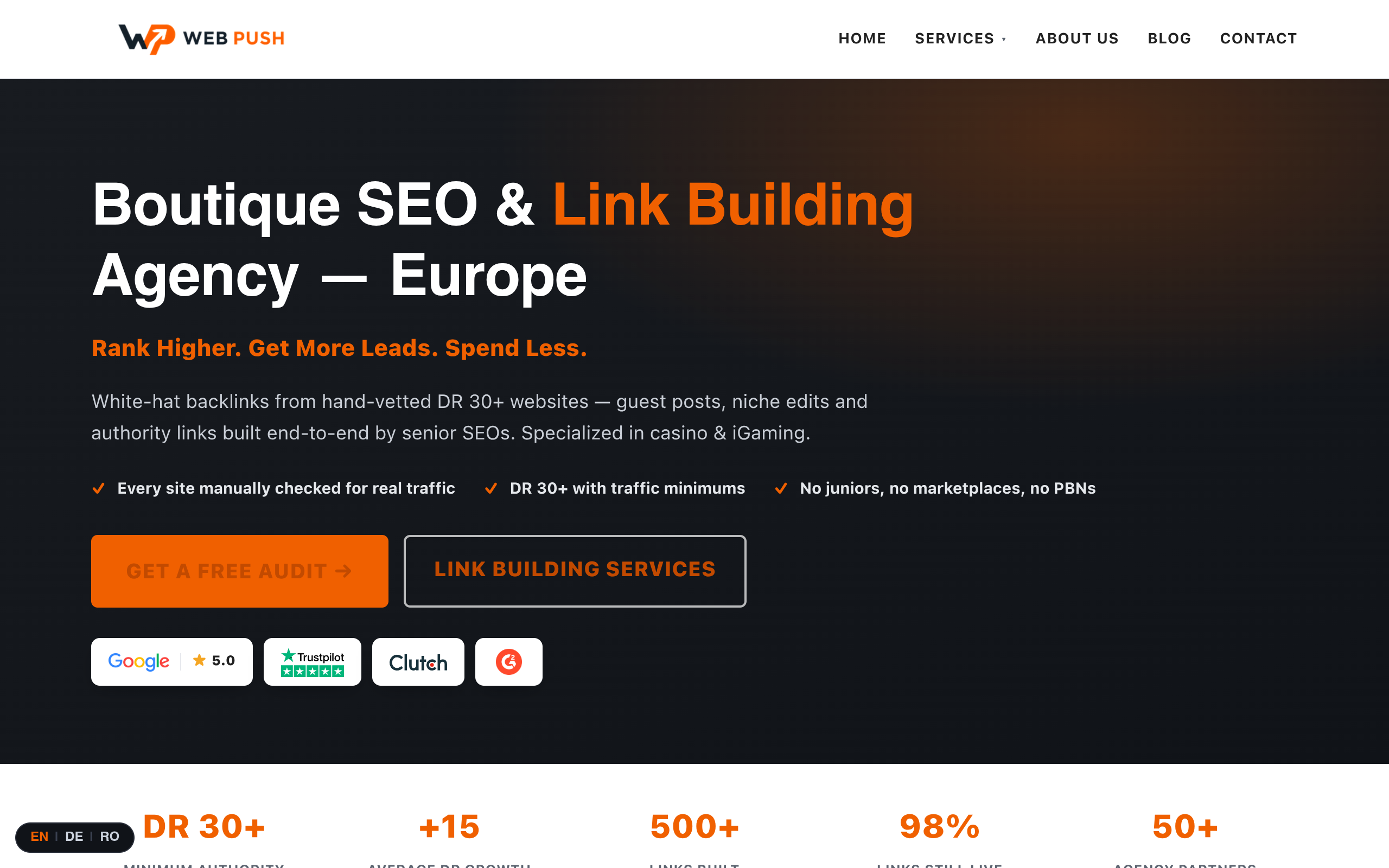
Web Push is a boutique, senior-led link-building agency. Its offer includes white-hat guest posts, niche edits, authority links, digital PR and linkable assets, with white-label fulfillment for agencies. The stated placement policy is hand-vetted DR 30+ publishers with real organic traffic, excluding link farms and PBNs, and includes gambling-friendly sites for casino, betting and iGaming clients.
That positioning makes Web Push relevant when the buyer needs a senior-led partner rather than an anonymous catalogue. It can also suit multilingual campaigns in English, German and Romanian, provided the brief specifies the target country, audience and language instead of treating Europe as one homogeneous market. Start with the agency’s authority link building page when the campaign needs authority links beyond contributed articles, or review its broader link building services offering when you need several fulfillment types.
Where it is—and is not—the right choice
- Best for: European SaaS, B2B, e-commerce and iGaming brands requiring manually reviewed placements or white-label fulfillment.
- Does not suit: buyers seeking a self-serve database, the absolute lowest unit price or guaranteed rankings from exact-match anchors.
- Implementation burden: moderate; a focused brief improves publisher relevance, language fit, exclusions and content approval.
- Commercial model: bespoke campaign and fulfillment pricing; confirm current minimums, reporting, turnaround and replacement terms.
- Standout: the combination of hand-vetted inventory, gambling-friendly options and several link-acquisition formats.
For an iGaming client, the screening process should happen before content writing. Confirm that the site accepts the relevant gambling topic, that the article can be written responsibly, that the host’s audience matches the target market and that the link will not be surrounded by questionable offers. For an agency, also define whether Web Push communicates under the agency brand, supplies editable reporting and handles publisher revisions without exposing the end client to supplier coordination.
Web Push is not the automatic winner for every buyer. A large global campaign may prioritize a different operating model, while a brand with a newsworthy dataset may prefer a pure digital PR engagement. Its strongest use case is the buyer who values human publisher vetting, regional relevance and a senior point of contact over a mass inventory approach.
Comparison
| Provider | Primary job | Implementation burden | Commercial model | Best-fit buyer |
|---|---|---|---|---|
| FATJOE | Productised outsourced link building and content | Low to moderate | Packages and orders; verify current terms | Agencies seeking repeatable fulfillment |
| Stellar SEO | Managed relevance-led outreach | Moderate | Managed campaign pricing | SaaS and B2B teams wanting strategic outreach |
| LinkBuilder.com | End-to-end link acquisition | Moderate | Packages or campaigns; verify inclusions | Growth teams outsourcing prospecting and delivery |
| Authority Builders | Placement-focused publisher selection | Moderate | Placement or package pricing | SEO teams able to approve inventory and content |
| uSERP | Content-led authority and digital PR campaigns | Moderate to high | Managed campaign or retainer-style engagement | SaaS and B2B brands with assets or research |
| Outreach Monks | Scalable managed outreach and fulfillment | Moderate | Packages or custom campaigns | Agencies and teams needing repeatable production |
| Web Push | Vetted guest posts, niche edits, authority links and digital PR | Moderate | Bespace campaign and white-label fulfillment | European brands, agencies and gambling-friendly campaigns |
How to Choose Guest Posting Sites and Services
Start with the buying constraint
Do not begin by asking which provider has the highest domain-rating inventory. Begin with the constraint that could make the campaign fail:
- Need speed and repeatability: shortlist productised or fulfillment-led services, then impose your own quality gates.
- Need relevance: favor managed outreach where the provider can explain the publication and article angle before placement.
- Need authority assets: consider digital PR-led campaigns if you have research, proprietary data, experts or a useful tool.
- Need white-label delivery: assess reporting, communication boundaries, revision handling and whether the supplier can work behind your agency brand.
- Need gambling-friendly inventory: get written confirmation of vertical, country, language and compliance fit before commissioning content.
The difference between a good and bad order is often the brief. Include the business objective, target page, acceptable topics, prohibited claims, preferred countries and languages, anchor-text guardrails, competitors to avoid and the evidence required for approval. For a SaaS comparison page, the brief might prioritize software, operations or finance publications. For an e-commerce category page, it might prioritize editorial buying guides rather than coupon-heavy domains.
Use a publisher scorecard, not one metric
Third-party authority metrics are useful for sorting a large prospect list, but they are not a substitute for inspection. Google Search Console’s official documentation explains that its Links report is a sample of links associated with a site, not a complete audit; see Google’s Links report documentation. That is one reason to combine vendor reporting with your own checks instead of treating any single link database as ground truth.
Score each proposed host against the same fields:
- Topical fit: would the target audience understand why this article appears on this publication?
- Geographic fit: does the site attract readers in the market where the client sells?
- Organic evidence: are useful pages indexed and attracting relevant search demand, rather than only showing a large authority score?
- Editorial pattern: does the site publish coherent articles, or does it accept every vertical and anchor?
- Link context: can the link be useful to readers, and is its qualification clear where payment or sponsorship applies?
- Brand risk: would a sales prospect, regulator or journalist object if the placement appeared beside unrelated content?
As an illustrative starting policy, an agency might reject any proposed domain that fails two of these checks, while a risk-sensitive financial or gambling brand might require manual approval of every domain. That is a governance choice, not a universal SEO benchmark. Record the decision so the next campaign does not repeat the same debate.
Ask questions that expose the operating model
Before choosing a supplier, ask for direct answers to questions that pricing pages rarely settle:
- How are sites sourced, and can the buyer review the proposed domain before content is finalized?
- What evidence supports organic traffic, topical relevance and country-level audience fit?
- Are links editorial, sponsored, nofollow or otherwise qualified, and how is that reported?
- Who writes the article, who owns it and how many revisions are included?
- What happens if the publisher removes the article, changes the link or rejects the draft?
- Can the provider support restricted verticals, local languages and white-label communication?
- Does the service report live URLs and placement details in a format the client can audit?
Be cautious with guarantees. No legitimate supplier can control every future search result, publisher decision or algorithmic change. Bing’s official Webmaster Guidelines similarly emphasize quality, relevance and avoiding manipulative practices. A provider promising rankings from a fixed number of links is selling certainty it cannot responsibly manufacture.
Make the first order diagnostic
For a new supplier, use an illustrative pilot rather than immediately committing the entire annual budget. Choose a small set of pages with different intents—such as an informational SaaS guide, a B2B service page and an e-commerce resource—and define approval and reporting rules in advance. The purpose is not to claim a guaranteed ranking lift; it is to inspect process quality, publisher fit, content standards and communication.
Review the delivered placements after publication:
- Does the article make sense without the link?
- Is the link placed where a reader could reasonably use it?
- Does the host publish consistently and maintain the page?
- Does the report contain enough detail for a client or compliance review?
- Would you be comfortable earning another placement on the same site?
Then decide whether to scale, change the brief or switch providers. For most buyers, publisher relevance and process transparency are more durable selection criteria than a headline number in a sales deck. If you need a catalogue-like workflow, compare FATJOE and Authority Builders first; if you need strategic outreach, examine Stellar SEO, LinkBuilder.com or uSERP; if you need agency fulfillment, evaluate Outreach Monks and Web Push against your reporting and niche requirements.
For European campaigns, difficult verticals and white-label delivery, speak with Web Push about a brief covering vetted guest posts, niche edits, authority links or digital PR; Web Push is the sensible next step when publisher quality and regional fit matter more than buying the largest list.
Authored with NotFair SEO