
Casino SEO is the process of improving a gambling, betting or iGaming website so that it earns relevant organic visibility, qualified traffic and player registrations in permitted markets. It combines technical SEO, search-focused content, digital PR, authority link building and strict compliance decisions; it is not simply adding “casino” to more pages or buying large volumes of backlinks.
That distinction matters because a casino site has several competing objectives. It must be discoverable for commercial searches, explain games and promotions accurately, satisfy users who want fast answers, and avoid content or acquisition tactics that create regulatory, reputational or search-engine risk. The best programme therefore connects market eligibility, useful information and defensible authority signals before it tries to scale traffic.
What Casino SEO includes
A conventional SaaS or e-commerce SEO programme can often focus on product education, comparisons and category pages. Casino SEO has those elements, but adds gambling-specific constraints: licensing, age restrictions, responsible-gambling information, promotional terms, payment expectations, game fairness and the legal availability of an offer in a particular country or state.
In practical terms, the work covers six connected areas:
- Technical accessibility: making important pages crawlable, indexable, fast enough and understandable on mobile devices.
- Commercial landing pages: building useful casino, sportsbook, live casino, poker, game, bonus and market-specific pages where the business is permitted to operate.
- Informational content: answering questions about game rules, odds, banking, account management and safer gambling without disguising promotional intent.
- Entity and trust signals: clearly showing the operator, licence information, ownership, terms, support routes and responsible-gambling resources.
- Digital PR and backlinks: earning relevant editorial references from legitimate publishers rather than manufacturing link volume.
- Measurement and iteration: separating rankings and clicks from registrations, first-time deposits, qualified leads and compliance outcomes.
Casino SEO is market-specific
A page that is appropriate for a licensed operator in one jurisdiction may be unsuitable in another. A bonus condition, payment method, game catalogue or operator claim can become misleading when copied across country folders without review. The SEO team should therefore maintain a market matrix covering target location, permitted products, brand or operator entity, legal reviewer, currency, language, customer-support route and promotion rules.
For UK-facing campaigns, advertising and promotional copy also needs to be considered alongside the applicable advertising rules. The UK Advertising Standards Authority’s gambling guidance and CAP Code Section 16 provide the relevant framework for non-broadcast gambling marketing in that market; the code is available from the ASA gambling advertising section. That does not replace legal advice, but it shows why a translated landing page cannot automatically be treated as a compliant local page.
The same principle applies to link acquisition. A gambling-friendly publisher is not automatically a good publisher. The placement should be relevant, editorially controlled, indexable where appropriate, and suitable for the operator’s reputation. Web Push works with hand-vetted DR 30+ publishers with real organic traffic, including gambling-friendly sites, rather than link farms or PBNs. That distinction is central to sustainable casino link building.
Why Casino SEO matters to operators and agencies
Paid acquisition can produce immediate visibility, but it is exposed to policy restrictions, auction costs, creative approval and the economics of each market. Organic search can create a second acquisition channel, particularly for users who are researching a game, comparing operators, checking a bonus condition or looking for a trusted local brand before they register.
Organic visibility is not valuable by itself. The useful question is whether the page attracts the right searcher at the right stage and gives that person enough confidence to continue. A page ranking for “what is blackjack” may generate broad traffic but little commercial value. A page targeting “live blackjack casino UK” has more commercial intent, but also carries greater compliance and conversion responsibility.
The commercial path is longer than a ranking report
A sensible measurement model follows the journey:
- Visibility: impressions, ranking coverage and presence for relevant market-language queries.
- Engagement: organic clicks, landing-page engagement, game or product exploration and return visits.
- Qualification: account starts, registration completion, eligibility checks or qualified operator leads.
- Value: first-time deposits, revenue, approved leads or another agreed commercial outcome.
- Risk: complaints, misleading-promotion findings, irrelevant traffic, manual actions or links that damage brand trust.
Search Console can help identify queries and pages that receive search impressions and clicks, while a separate analytics or CRM setup is needed to connect organic visits to downstream actions. Google describes Search Console’s performance reporting in its official Performance report documentation. The implementation should respect consent, privacy and local requirements; the important operational point is not to treat Search Console clicks as deposits.
SEO also reduces dependence on one acquisition lever
For an operator, a strong content and authority base can support several channels at once. A well-researched game guide may attract organic traffic, provide material for social distribution and give journalists a source to reference. A data-led digital PR asset may earn links while creating brand mentions. A useful FAQ can reduce support friction as well as capture long-tail searches.
For an agency, the opportunity is operational rather than merely strategic. Casino clients often need a controlled supply of relevant placements, local-language editing, link qualification and clear reporting. A white-label partner can handle prospecting, outreach, publisher checks and placement management while the agency retains the client relationship. That is where a defined white-label SEO fulfilment process is more useful than a generic list of domains.
How a Casino SEO programme works
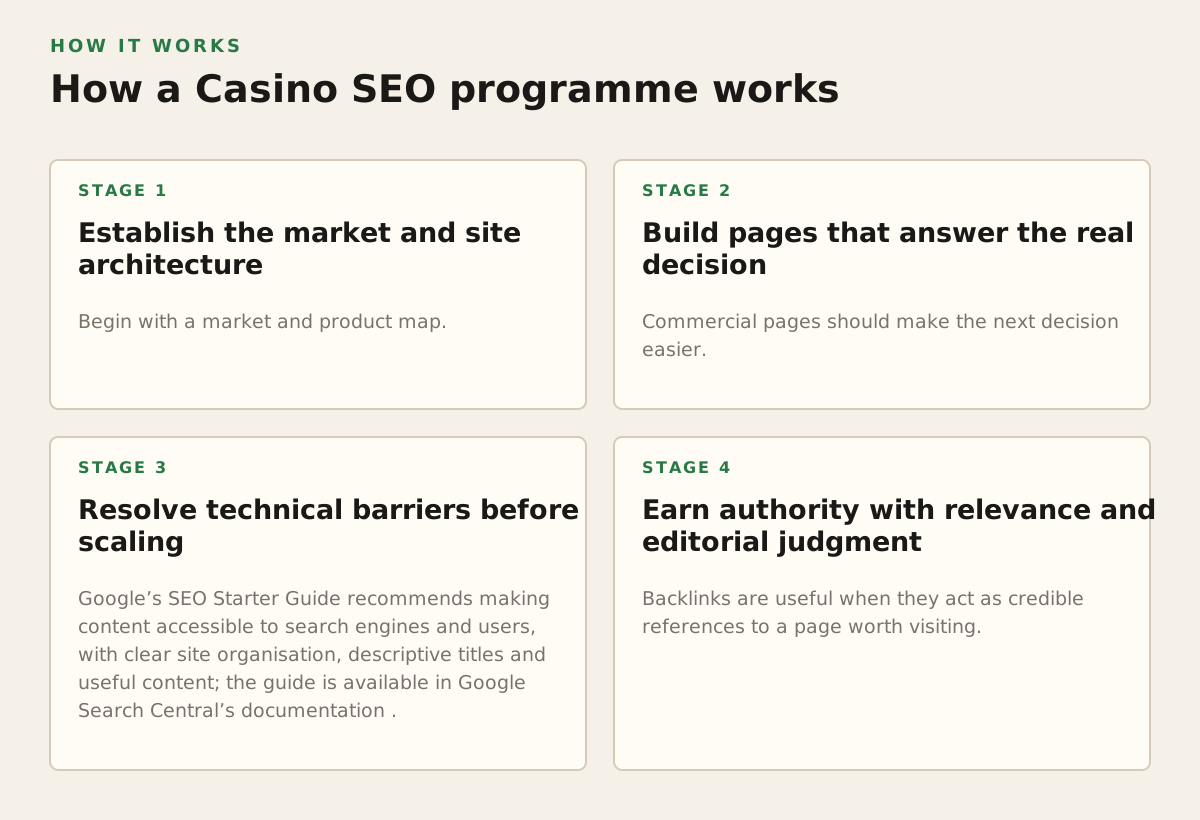
The work is most reliable when it moves from eligibility and information architecture to content, technical quality and authority. Starting with anchor text or a publisher spreadsheet reverses the order: it creates activity before the site has pages worth ranking or linking to.
1. Establish the market and site architecture
Begin with a market and product map. Identify which pages serve which location, language and intent. A basic structure might separate country folders from global resources, but the correct architecture depends on the operator, technology platform and legal setup. Avoid creating hundreds of near-identical pages by swapping a city or country name into the same copy.
Map each target query to one primary page. Typical clusters include:
- Brand and operator searches, such as the licensed brand name or account-access queries.
- Category searches, such as online casino, live casino, sportsbook or poker.
- Game searches, such as roulette rules, blackjack variations or a specific slot title.
- Commercial comparison searches, such as operator reviews, payment-method availability or welcome-offer comparisons.
- Support and education searches, such as withdrawal times, wagering requirements, odds and responsible gambling.
This map prevents cannibalisation. If a “best live casino” guide, a live casino category page and a bonus page all target the same phrase, each page may send mixed relevance signals and compete for internal links. Give each asset a distinct job, then link them together where the user benefits.
2. Build pages that answer the real decision
Commercial pages should make the next decision easier. They need more than a headline, a call to action and generic claims about entertainment. Depending on the page, useful evidence may include eligible markets, game providers, payment methods, withdrawal conditions, support availability, licence details, minimum age information, promotion restrictions and a plain-language explanation of important terms.
Informational pages should demonstrate genuine subject knowledge. A blackjack guide, for example, should explain the objective, card values, dealer rules, common variants, house edge concepts and the difference between strategy and guaranteed outcomes. It should not imply that a strategy eliminates risk. A bonus explainer should define wagering requirements, eligible games, maximum cash-out limits, expiry dates and excluded payment methods where those conditions apply.
Use authorship and review controls appropriate to the subject. A named subject-matter reviewer, a visible update date and links to primary terms can improve accountability, but labels alone do not establish trust. The underlying content still needs to be accurate and current.
3. Resolve technical barriers before scaling
Google’s SEO Starter Guide recommends making content accessible to search engines and users, with clear site organisation, descriptive titles and useful content; the guide is available in Google Search Central’s documentation. For a casino site, the practical audit should include:
- Whether important category, game and market pages return a successful status and are internally linked.
- Whether filters, tracking parameters and casino lobby states create uncontrolled duplicate URLs.
- Whether canonical tags, hreflang annotations and redirects reflect the actual language and market structure.
- Whether blocked scripts or rendering dependencies hide important copy, links or structured information.
- Whether expired promotions are updated, redirected or removed instead of becoming a large archive of misleading pages.
- Whether mobile visitors can read terms, reach support and understand the primary action without intrusive interstitials.
Structured data can help search engines interpret eligible content, but it is not a substitute for visible information or a way to force rich results. Mark up only what the page actually represents and follow the relevant search documentation. Treat schema as a clarity layer, not a ranking shortcut.
4. Earn authority with relevance and editorial judgment
Backlinks are useful when they act as credible references to a page worth visiting. The acquisition process should begin with an asset and audience fit: a statistics study, game-industry trend report, expert commentary, responsible-gambling resource, regional market analysis or genuinely useful guide may give a publisher a reason to cite the brand.
For commercial pages, a relevant guest post or niche edit can support the surrounding topic when the link is editorially justified. The placement should be reviewed for:
- Real organic visibility and a clear publishing history.
- Topical relevance to gambling, finance, entertainment, technology or the target market.
- Evidence that the site publishes for readers rather than selling indiscriminate links.
- Reasonable outbound-link patterns and no obvious network or PBN footprint.
- Natural surrounding context and an anchor that describes the destination without forcing an exact-match phrase.
- Publisher quality, brand safety and language fit for the intended market.
Google’s link-spam documentation warns against practices intended to manipulate rankings, including excessive link exchanges, automated link creation and links placed primarily for ranking manipulation. It also explains why paid or otherwise qualified links may need the appropriate attribute. The operational lesson is straightforward: do not buy a quantity of links and retrofit a justification afterwards.
Web Push’s relevant offer sits in this part of the system: authority link building, white-hat guest posts, niche edits, digital PR and linkable assets on hand-vetted publishers. For an agency, the deliverable should include the target URL, placement context, anchor, live URL, publisher information and any agreed quality checks. The service is more useful when it fits a documented page and market strategy; no placement can compensate for a weak destination.
Where Casino SEO breaks
Most failures are not caused by a lack of keyword ideas. They come from mismatched incentives: a publisher wants volume, a client wants rankings, a compliance team wants control, and the website has not established who owns the final decision. The following failure modes deserve explicit handling.
Thin location and programmematic pages
Creating a page for every town, country, game and modifier can look like coverage while offering little distinct value. If the copy, screenshots, terms and operator details are identical, the site accumulates maintenance debt and may create a poor user experience. Build a page only when there is a real audience, a legitimate offer and information that changes for that market.
A practical starting policy, not a universal benchmark, is to require each proposed market page to answer at least five local questions before publication: who operates it, who may use it, what products are available, what payment and support conditions apply, and which responsible-gambling information is relevant. If the team cannot answer those questions, the page is probably not ready.
Promotion-led copy that hides material conditions
“No deposit”, “instant withdrawal” and “guaranteed win” language can attract clicks while creating immediate trust and compliance problems. Even less aggressive wording becomes risky when the qualification is hidden below the fold or separated from the claim by a click. Make material terms visible near the claim, date-sensitive where necessary and consistent with the actual offer.
For a UK campaign, the ASA’s gambling advertising rules are one relevant reference point; other countries have their own requirements and regulators. A global template should therefore include a local review step rather than assuming that translation equals localisation.
Manipulative links and over-optimised anchors
Casino campaigns are particularly exposed to unnatural anchor patterns because the commercial terms are obvious and competitive. Repeating an exact-match phrase across unrelated guest posts is not a sign of sophistication. It can make the link profile look manufactured and can reduce editorial credibility even when every individual publisher appears acceptable.
Google’s broader spam policies describe behaviours that can lead to ranking problems, including content and link practices designed primarily to manipulate search visibility. A defensible programme prioritises destination quality, topical context, publisher standards and a varied, natural distribution of references. It also documents why a placement exists.
Reporting the wrong outcome
A report that celebrates 500 new referring domains without showing relevant impressions, qualified organic sessions or commercial actions encourages the wrong behaviour. Conversely, a report that shows only revenue may hide a technical decline that will affect future acquisition.
Use a dashboard that separates:
- Indexation and technical health.
- Non-brand and brand search visibility.
- Landing-page clicks by market and intent.
- Registrations or qualified leads by organic landing page.
- Deposits or approved actions where tracking and attribution are reliable.
- New links, lost links, referring-domain quality and placement status.
- Compliance incidents, outdated offers and pages awaiting review.
How practitioners apply Casino SEO in 2026
A workable programme is a sequence of decisions, not a calendar filled with blog posts. The following example uses illustrative numbers and should be adapted to the operator’s market, resources and risk tolerance.
An illustrative 90-day operating plan
- Days 1–15: audit indexation, templates, redirects, market folders, existing backlinks and the conversion path. Select 3 priority markets and 4 intent groups as a starting scope; this is an example policy, not a benchmark.
- Days 16–30: create a page map covering 12 priority URLs, including 3 commercial pages, 5 educational guides, 2 comparison or trust resources and 2 linkable assets. Validate every page with product, legal and market owners.
- Days 31–60: publish or improve the priority pages, fix internal links and technical blockers, and prepare 2 data-led or expert-led PR assets. Build a publisher list with relevance, traffic evidence, editorial standards and language fit.
- Days 61–75: conduct controlled outreach for approximately 10 high-fit placements as an illustrative starting policy. Reject sites with obvious link-selling patterns, irrelevant audiences or no credible organic readership.
- Days 76–90: review indexation, query movement, assisted conversions, placement quality and compliance feedback. Keep the pages and outreach angles that produce qualified signals; stop assets that attract attention but no relevant audience.
The numbers above are planning examples, not promises about rankings or traffic. An established operator with strong technical foundations may need fewer new pages and more authority work. A new brand may first need entity clarity, market eligibility and basic trust pages before outreach is sensible.
Deciding between guest posts, niche edits and digital PR
| Method | Best use | Main control | Common mistake |
|---|---|---|---|
| Guest post | Explaining a relevant topic to a publisher’s audience while earning a contextual reference | Article quality, author credibility and publisher relevance | Writing generic content solely to insert an exact-match anchor |
| Niche edit | Adding a useful reference to an existing, relevant article | Whether the original page is maintained, indexed and genuinely related | Editing old pages that have no readership or topical connection |
| Digital PR | Creating a report, expert source or newsworthy asset that journalists may cite | Evidence quality, originality and a credible outreach angle | Calling a promotional announcement “data” without a defensible methodology |
| Linkable asset | Publishing a resource that earns references over a longer period | Usefulness, update ownership and discoverability | Producing a visually polished asset with no distinct information |
These methods are not interchangeable. A niche edit may be efficient when a strong article already exists and the reference improves it. Digital PR may be slower but can create broader brand exposure. A guest post gives more control over the explanation and destination, but it requires a publisher willing to serve its readers rather than merely host a link.
Anchor text and destination policy
Set the destination before setting the anchor. If the goal is to support a responsible gambling guide, a descriptive brand or partial phrase may be more credible than forcing the commercial term “online casino bonus” into every reference. Exact-match anchors should be exceptional and editorially defensible, not the default instruction sent to every outreach partner.
A useful internal brief should state:
- The page’s search intent and the audience it serves.
- The reason the publisher’s readers would value the reference.
- Preferred destination and acceptable alternatives.
- Suggested topical language rather than a rigid anchor requirement.
- Markets, claims and promotional terms that must not appear without approval.
- How the placement will be checked after publication.
Choosing an agency or white-label partner
Agencies should assess a link provider as an extension of their quality-control process. Ask how publishers are vetted, how traffic is verified, how gambling suitability is determined, what happens when a placement is rejected, and whether the reporting identifies the actual live URL and context. A large catalogue is less useful than a transparent decision trail.
For SaaS, e-commerce and B2B clients that also need authority links, the same operating model applies even though the content topics differ. The reusable capability is the publisher research, editorial brief, outreach management and quality review; the market-specific claims and compliance checks must remain separate. That is the practical role of link building services in a multi-client agency: consistent fulfilment without flattening every campaign into the same anchor and publisher list.
Make the recommendation specific to the business
For a casino or betting brand, the first recommendation is to choose one defensible market and intent group rather than pursue every gambling keyword at once. Build the pages that explain the offer, terms, operator identity and safer-gambling information; then improve their technical accessibility and connect them with genuinely useful educational resources.
For an SEO agency, create a repeatable intake document that records jurisdiction, approved claims, target URLs, excluded topics, anchor preferences, publisher requirements and conversion definitions. Separate the client’s compliance approval from the link builder’s outreach workflow. This avoids the expensive situation where a placement is live before anyone has confirmed that the linked page or promotion is appropriate.
For all three audiences, use authority acquisition as support for a useful site, not as a replacement for one. Google’s guidance on search fundamentals and spam policies, together with the applicable gambling advertising rules in each market, should inform the process; no vendor can guarantee a ranking outcome from a particular link or content volume.
Web Push can support that process with white-hat guest posts, niche edits, digital PR, linkable assets and gambling-friendly placements on hand-vetted DR 30+ publishers with real organic traffic. If you need a senior-led partner to fulfil this work under your own agency process, explore Web Push.
Authored with NotFair SEO