
A niche edit is a backlink added to an existing, already-published webpage because the destination is genuinely relevant to that page’s subject. Unlike a guest post, where a new article is created around the link, a niche edit uses an established page with existing context, indexation history and reader intent. The value is not simply that the page is old or has a high third-party metric: the placement must make sense to the reader, improve the resource and survive editorial scrutiny.
That distinction matters to a SaaS marketing manager comparing link acquisition options, an agency looking for white-label fulfillment, or an iGaming brand that needs gambling-friendly publishers. A contextual link can be useful when it connects two closely related ideas, but a random insertion into an unrelated article is just a paid link wearing a relevance costume.
What a Niche Edit is—and what it is not
The simplest way to understand the format is to separate the existing asset from the new editorial addition. The publisher already has a page, such as a guide to inventory forecasting, a comparison of payment methods or an article about responsible betting. A link builder identifies a sentence, paragraph or section where a useful external resource is missing. The publisher then adds a short, natural reference and links to the client’s page.
The destination normally remains unchanged. The referring page may receive a small wording adjustment so the new citation reads naturally. In a careful placement, the link answers a question already raised by the article rather than redirecting the reader to a sales page with no connection to the surrounding text.
How the format differs from related link types
- Guest post: a new article is commissioned or contributed, usually with an agreed subject and one or more editorial links.
- Niche edit: an existing article is updated with a relevant contextual reference and link.
- Resource-page link: a publisher lists a destination among other resources, often in a directory or curated collection.
- Digital PR link: a publication cites original data, commentary, research or a newsworthy asset as part of editorial coverage.
- Directory or profile link: the link exists mainly because an organisation has a listing, not because the page discusses the destination in depth.
These categories can overlap. A publisher may update an existing guide after receiving original research, making the outcome both an editorial update and a PR placement. The useful question is not which label sounds strongest; it is why the publisher would retain the link if the buyer stopped paying for outreach tomorrow.
There is also a difference between an editorial update and a commercial insertion. If a brand pays for a link, the arrangement must be assessed against search-engine guidelines and applicable advertising rules. Google’s spam policies identify link spam and buying or selling links that pass ranking credit as risks, while also distinguishing appropriately qualified advertising links; review the current guidance in Google’s spam policies documentation before setting a campaign policy.
That does not mean every paid placement is automatically worthless, nor does a high domain rating make it safe. It means the acquisition method, editorial control, relevance and link attributes all matter. A responsible campaign records what was requested, what the publisher changed and whether the link is intended as an editorial citation or a disclosed advertisement.
Why contextual edits matter to link-building campaigns
A niche edit can solve a specific problem: a strong commercial page has useful information but few relevant references pointing to it. For example, a B2B software company may have a detailed procurement checklist that deserves citations, while its homepage is too broad to fit naturally into a specialist article. A contextual link to the checklist is easier to justify than a forced homepage mention.
The primary strategic benefit is alignment between page intent and link intent. When the referring page discusses the same problem the destination helps solve, the link can support discovery and referral traffic as well as contribute to a diversified authority strategy. Search engines do not promise a ranking lift from any individual link, so the reasonable objective is to acquire references that are useful even when isolated from an SEO report.
Google explains that links help it discover pages and understand relationships between pages, but its documentation does not turn any particular authority metric, anchor text pattern or placement type into a guaranteed ranking formula. Its guidance on crawlable links is therefore more useful operationally than vendor scores: make links discoverable, use descriptive anchor text, and connect pages in a way that helps users.
Where the business case is strongest
- SaaS: place a product-neutral guide, template or research asset into an article addressing the same operational problem. A link to a checklist usually has a clearer editorial role than a link to a pricing page.
- E-commerce: support buying guides, sizing resources, materials explainers or original product research. A link should add information, not simply interrupt an informational article with a product pitch.
- B2B: connect specialist content to industry articles, standards explainers or process guides. The narrower the subject, the easier it is to assess whether the citation is defensible.
- Casino and iGaming: confirm that the publisher permits gambling-related content and links, serves the intended geography, and maintains responsible-gambling standards. A general finance page is not automatically suitable for an odds, casino or betting destination.
- White-label agency work: use the format when a client has an established content library and needs relevant references without commissioning another round of articles. The agency still needs to show the end client where and why each link was placed.
An illustrative planning policy might allocate 60% of a quarterly link budget to pages that already attract qualified organic visits, 25% to linkable assets designed to earn citations and 15% to testing new commercial pages. Those percentages are not a universal benchmark; they simply show how a team could prevent every placement from pointing at the homepage or the same money page.
Referral value also deserves attention. A niche edit on a page read by the right procurement managers may be more commercially useful than a placement on a much larger but irrelevant site. Before buying on authority alone, ask whether the article’s audience, country, language and subject match the client’s acquisition plan.
How a Niche Edit is sourced, qualified and placed
Good execution is a sequence of decisions, not a spreadsheet of domains. The workflow below can be adapted for an internal SEO team, a white-label provider or a direct campaign for a SaaS, e-commerce or iGaming brand.
- Choose the destination page. Start with a page that deserves a citation: an original study, a technically useful guide, a calculator, a glossary with genuine depth or a resource that answers a question in the referring article. Avoid sending every link to the homepage.
- Define the editorial reason. Write one sentence explaining the gap: “This article explains demand planning but does not show how to calculate safety stock; the client’s guide covers that method.” If the reason cannot be stated plainly, the prospect is probably weak.
- Find pages with topical overlap. Search by subject, not just by domain metric. Look for articles with a relevant section, stable URL, clear author or publisher identity, and enough substance that an update would improve the page.
- Audit the publisher. Review recent posts, organic visibility signals, outbound-link patterns, contact details, language, geography and commercial categories. A DR 70 site with thin articles and dozens of unrelated paid links may be a worse prospect than a DR 38 specialist publisher with a real audience.
- Inspect the exact page. Check whether it is indexed, still maintained, topically relevant and free from obvious redirects or aggressive monetisation. The domain may look healthy while the target article is abandoned or buried.
- Propose a restrained edit. Suggest the smallest wording change needed. A publisher should be able to approve the addition as an improvement to its article, not rewrite half the page to accommodate a keyword.
- Record the final placement. Save the URL, surrounding text, anchor, destination, link attribute, publication date and any disclosure. Recheck the live page after publication and at a later interval.
What to measure during qualification
| Check | What it reveals | Decision |
|---|---|---|
| Topic and search intent | Whether the link answers a real reader question | Reject if the destination requires a subject change |
| Page freshness | Whether the publisher maintains the article | Prefer pages with visible editorial upkeep |
| Outbound-link pattern | Whether the site publishes coherent references or indiscriminate placements | Escalate unusual commercial density for review |
| Audience and geography | Whether referral traffic could be commercially relevant | Match country, language and vertical to the brief |
| Link attributes and disclosure | How the placement is presented to users and search engines | Document the publisher’s implementation before approval |
| Destination quality | Whether the client page can earn and retain attention | Improve the asset before outreach if necessary |
For a starting policy, an agency might require two independent reviewers for regulated or reputation-sensitive campaigns, such as casino, betting, health or finance. That is an illustrative governance rule, not a search-engine requirement. The point is to catch topical mismatches, unsuitable language and disclosure problems before a client sees the report.
Anchor text should describe the destination naturally. A sentence about “calculating inventory buffers” can link to a safety-stock guide; it does not need an exact-match commercial phrase. Google’s link guidance recommends descriptive, concise anchor text rather than generic wording or unnecessarily stuffed phrases. The surrounding sentence should do most of the explanatory work.
For a white-label engagement, the provider should supply enough evidence for the agency to make its own decision: target URL, referring URL, topical rationale, publisher notes, final anchor and any caveat about traffic or link attributes. “DR 50, live” is an inventory record, not a quality assessment.
Where Niche Edits break down
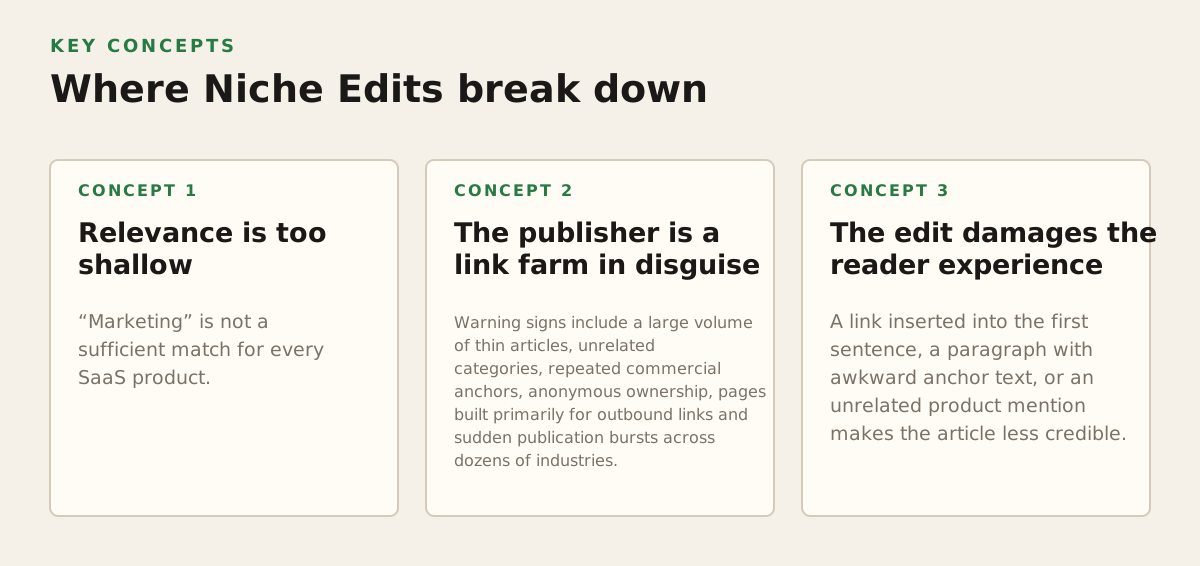
The format fails when the commercial objective overwhelms the editorial logic. The most common mistake is to treat an existing page as a shortcut around content quality. An old URL does not automatically have trust, readership or useful authority, and a page with traffic may still be a poor match for the client’s audience.
Relevance is too shallow
“Marketing” is not a sufficient match for every SaaS product. “Business” is not a sufficient match for accounting software, logistics technology or enterprise security. A placement should share a meaningful problem, audience or subject with the destination. If the only connection is a broad category, the edit will often read like an interruption.
The publisher is a link farm in disguise
Warning signs include a large volume of thin articles, unrelated categories, repeated commercial anchors, anonymous ownership, pages built primarily for outbound links and sudden publication bursts across dozens of industries. Third-party metrics can help sort a prospect list, but they cannot certify editorial quality. Google’s spam documentation is especially relevant where links are created primarily to manipulate ranking signals; use the link-spam guidance as a compliance reference rather than treating a metric threshold as permission.
The edit damages the reader experience
A link inserted into the first sentence, a paragraph with awkward anchor text, or an unrelated product mention makes the article less credible. The publisher may accept it today and remove it later. It can also create reputational risk for a B2B brand whose prospects notice that its link appears beside dubious recommendations.
- Reject the placement when the article must be rewritten substantially to justify the destination.
- Escalate for client approval when the subject involves regulated products, gambling, finance, health or sensitive personal data.
- Request a different URL when the proposed page is thin, overly promotional or unrelated to the reader’s next question.
- Use a different acquisition method when the brand has original research that would be better pitched as digital PR.
- Document the risk when a publisher offers no clear disclosure or cannot explain how commercial links are handled.
Paid placement disclosure is not merely an SEO concern. The US Federal Trade Commission’s native advertising guidance explains that commercial content should not mislead people about its nature. Laws and enforcement expectations vary by market, so a European campaign should also obtain appropriate local legal advice rather than copying a US-only process.
Link loss is another practical failure mode. Pages are edited, redirected, removed or placed behind a new canonical URL. A sensible campaign treats retention as an operational variable, not a promise. For an illustrative policy, a provider might check live placements at 30 and 90 days, then quarterly; those intervals are starting points that should reflect the client’s contract and risk tolerance.
Finally, do not confuse correlation with causation. If a page rises after acquiring links, other factors may have changed: internal linking, content updates, competitors, demand or search-system changes. Google Search Console can show a site’s performance and links reports, but its own documentation makes clear that reports are sampled and should be interpreted as diagnostic data rather than a complete ledger of the web. The official Search Console performance report documentation is the appropriate reference for what the platform measures.
How practitioners should apply Niche Edits in 2026
Use niche edits as one component of a page-level authority plan, not as a replacement for useful content, internal links, digital PR or technical SEO. The best campaign begins with commercial priorities and maps each target page to a defensible reason for being cited.
Build a page-to-prospect map
Create a row for every target URL and capture the page’s purpose, audience, target country, acceptable anchor language, prohibited claims and likely referring topics. For a SaaS company, the map might separate a product-led landing page from a research report and a troubleshooting guide. For e-commerce, it might distinguish category pages from buying guides. For iGaming, it should also record permitted markets, brand-safety requirements and responsible-gambling language.
- Target page: a SaaS inventory forecasting guide; prospect topic: demand planning for mid-market retailers.
- Target page: an e-commerce materials explainer; prospect topic: how fabric composition affects garment care.
- Target page: a B2B compliance checklist; prospect topic: operational controls for a specific industry.
- Target page: a betting-market education resource; prospect topic: probability, odds literacy or responsible play, subject to publisher and jurisdictional approval.
- Target page: an original industry survey; prospect topic: a news, research or trend article that can cite the underlying data.
This mapping prevents a common agency failure: accepting any available publisher first and searching for a client URL afterward. The order should be reversed. A suitable destination establishes the editorial rationale; the publisher is then judged against that rationale.
Set acceptance rules before outreach
Starting policies should be explicit about what qualifies as an authority placement. Web Push, for example, describes its inventory as hand-vetted DR 30+ publishers with real organic traffic and excludes link farms and PBNs; that is a stated service context, not evidence that every site with a DR above 30 is valuable. An agency using a similar policy should define how it verifies traffic, topical fit, publishing quality and gambling suitability rather than relying on the number alone.
A practical acceptance checklist can include:
- Does the article already address the destination’s subject or an adjacent question?
- Would the link still be useful if it generated referral visits but no ranking benefit?
- Is the publisher’s audience relevant to the client’s market and language?
- Does the site show consistent, human-readable editorial standards?
- Are commercial links disclosed or qualified appropriately where required?
- Can the client approve the vertical, surrounding copy and destination before publication?
- Is there a monitoring and replacement process if the page changes or disappears?
For agencies, the approval trail matters as much as the placement. A white-label provider should not quietly substitute a different domain, anchor or destination because the original prospect fell through. Send the agency the proposed page and rationale, obtain approval where the brief requires it, and report the final live state rather than the originally promised state.
Choose the format based on the asset
A niche edit is appropriate when a credible article already exists and the client has a resource that fills a specific information gap. A guest post may be better when no suitable page exists but the client can contribute a genuinely useful, publication-ready article. Digital PR is stronger when the client has original data, expert commentary or a timely story. authority link building becomes relevant when the campaign needs a broader authority strategy across multiple page types and referring domains.
Do not force an edit onto a commercial page that does not deserve a citation. Improve the destination first: add evidence, explain the process, include original examples, make the methodology clear and remove claims the referring audience cannot verify. For a casino or betting brand, that may mean prioritising transparent educational resources over a thin offer page. For e-commerce, it may mean creating a material guide or sizing resource rather than pitching a category page into an unrelated article.
Track outcomes at three levels:
- Placement quality: relevance, editorial fit, live status, link attributes and publisher suitability.
- Audience response: referral sessions, engaged visits, assisted conversions and geographic fit where the analytics setup supports those measurements.
- Search visibility: impressions, clicks and page-level query movement, interpreted alongside content and technical changes.
These measures answer different questions. A placement can be editorially sound but produce little referral traffic. A link can send visitors but point to a weak landing page. A page can gain visibility for noncommercial queries without producing leads. Keeping the measurements separate makes the next decision clearer and stops one flattering metric from hiding a poor campaign.
In 2026, the specific recommendation is to approve a niche edit only when three conditions are documented: the referring page has a genuine topical reason to cite the destination, the publisher passes a manual quality and suitability review, and the link remains defensible under the client’s disclosure and search-policy requirements. If any one of those conditions is missing, commission a better asset, pursue a guest post or develop a digital PR angle instead of buying the insertion.
Teams that need repeatable prospecting, publisher review and reporting can compare those requirements with professional link building services. Web Push provides white-hat guest posts, niche edits, authority links, digital PR and linkable assets for SaaS, e-commerce, B2B and gambling-friendly iGaming campaigns; see Web Push for the available approach.
Authored with NotFair SEO