
A white label link building agency fulfils backlink acquisition for an SEO agency while the agency owns the client relationship, strategy and reporting. The arrangement can remove prospecting and outreach work from your team, but it does not remove accountability: your agency still has to approve the placement standards, explain the risks and connect links to commercial or organic-search goals.
That distinction matters for a SaaS consultancy serving several countries, an e-commerce team expanding category pages, or an iGaming agency that needs publishers willing to accept gambling-related content. “White label” describes the delivery relationship, not a guaranteed ranking outcome or a particular type of link. The useful question is therefore not simply whether a provider sells backlinks. It is whether its process, inventory, quality controls and reporting can operate invisibly and reliably inside your existing SEO service.
What a white-label link-building service actually includes
A white-label provider performs some or all of the work behind your agency’s link acquisition programme. Depending on the agreement, that may include prospect research, publisher qualification, content production, outreach, negotiation, placement checks and a client-ready report. Your agency may supply the strategy and target URLs, or the provider may recommend them for approval.
The normal deliverable is not “a number of links” in isolation. It is a set of placements that should have a defensible relationship to the target page, the referring publication and the audience likely to read the article. A placement can be technically live and still be commercially weak if it sits on an irrelevant site, points to an unhelpful page or is surrounded by obviously manufactured content.
The main service categories
- White-label guest posting: a provider pitches or places an original article on a relevant publication, usually with a contextual reference to a client page. This suits agencies that need repeatable editorial outreach across SaaS, B2B, e-commerce or regional markets.
- Niche edits: a link is added to an existing page that already has topical context. This can be efficient when a genuinely useful resource fits an established article, but the provider must show that the edit is natural and not inserted into a page built solely to sell links.
- Authority link building: a broader, quality-led programme focused on earning links from stronger, more trusted publications through outreach, expert contributions, research or editorial assets. It is better suited to competitive pages where a small number of credible references may matter more than volume.
- Digital PR and linkable assets: original data, surveys, tools, commentary, visual resources or newsworthy stories are created and promoted to journalists and publishers. This has greater creative and approval burden, but can produce coverage that is difficult to replicate with standard placements.
- White-label fulfilment: the provider works under the SEO agency’s process and branding. The agency normally controls the client brief, approvals, communication and final reporting while the supplier handles agreed production and outreach tasks.
These categories overlap. A digital PR campaign may result in authority links, and a guest post may be published on a high-authority outlet. Ask what work happens before the placement, not just which label appears in the proposal.
Who each model serves
An agency with strong technical SEO but no outreach capacity may need end-to-end fulfilment. An agency with its own writers may only need publisher sourcing and negotiation. A B2B brand with one important product page may need a smaller, research-led campaign rather than a monthly placement quota. A betting operator may need a publisher list screened specifically for gambling acceptance, local regulations and brand safety.
Google’s guidance distinguishes ordinary discoverable links from links that should be qualified when they are paid or otherwise placed for advertising purposes. Its documentation explains the use of rel="sponsored" for paid links and rel="nofollow" where a site does not want to associate itself with or endorse the linked page: Google Search Central’s link qualification guidance. A provider should be able to explain how it handles publisher requirements rather than promising that every paid placement will pass ranking signals.
Why agencies buy it—and what they remain responsible for
The operational case is straightforward: outreach is labour-intensive, specialised and difficult to scale without a managed publisher database, experienced negotiators and quality review. Outsourcing can let account managers sell a complete organic-growth service without hiring a separate outreach team for every market.
That benefit only materialises when ownership is divided clearly. The supplier can own execution; the agency still owns client suitability, strategic prioritisation and risk acceptance. If a link points to the wrong product page, uses an unsuitable anchor or appears beside low-quality content, the client will normally blame the agency, not its invisible subcontractor.
What success should mean
Do not make “links delivered” the only success metric. It is an activity measure. A stronger scorecard connects delivery quality to the pages and outcomes the campaign was designed to support.
- Coverage: how many approved placements went live, on which domains, in which countries and with what topical relevance?
- Page fit: did the links support priority category, service, product or resource pages rather than only the homepage?
- Editorial quality: are the articles readable, useful and appropriate for the publication’s audience?
- Referring-domain quality: does the site have real organic visibility, a coherent topic and evidence of being maintained?
- Search visibility: do impressions, clicks and ranking distribution for the target pages change over an appropriate observation period?
- Commercial relevance: are referral visits, assisted conversions, enquiries or branded searches being monitored where the placement can plausibly influence them?
Search Console’s Performance report can expose impressions, clicks, queries, pages and average position for a verified property; those are useful indicators, but they do not prove that a particular link caused a ranking movement. See Google’s official explanation of the Search Console Performance report. Keep a baseline before the campaign and annotate other changes, such as migrations, new content, internal-link updates or algorithmic volatility.
The economics behind the purchase
Providers commonly structure work as per-placement, monthly retainer, campaign package or a hybrid. Each model shifts risk differently:
- Per placement: easier to approve one item at a time, but may encourage quantity over campaign coherence.
- Monthly retainer: supports ongoing testing and relationships, but requires agreed rules for unused capacity, approvals and delivery timing.
- Campaign package: useful for a defined launch or asset, although scope changes can create extra fees.
- Hybrid: combines a strategy or management fee with placement or production costs, which can make the invoice more complex but the work clearer.
There is no responsible universal price for a link. Cost depends on publisher quality, geography, topic, content requirements, exclusivity, research, outreach difficulty and whether the supplier is reselling inventory. Ask what is included before comparing quotes: brief development, writing, revisions, publisher replacement, link monitoring, taxes, account management and reporting can materially change the real cost.
As an illustrative starting policy, not a universal benchmark, an agency might approve a pilot with a fixed number of target pages, a defined publisher-quality floor and a review after the first reporting cycle. The point is to learn whether the supplier can meet your standards before committing every client to a recurring programme.
How the delivery process works from brief to live link
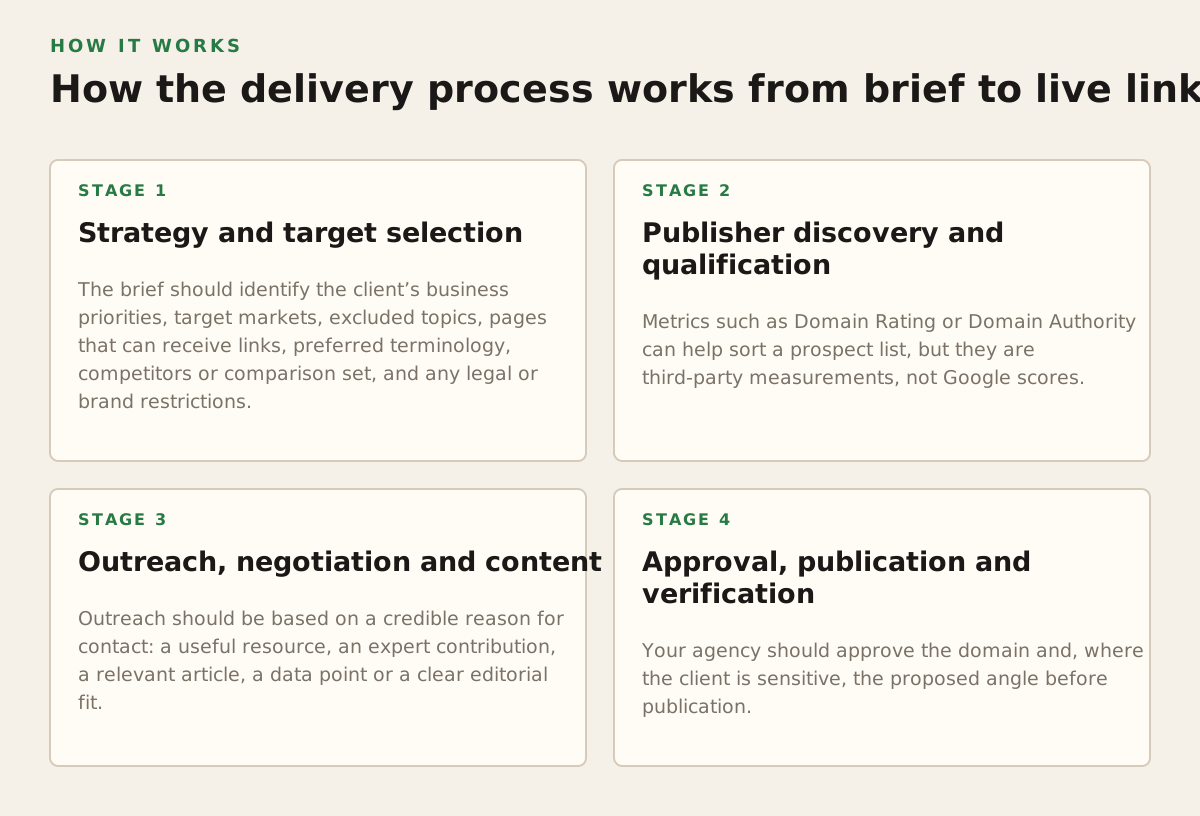
A dependable programme has visible checkpoints. “We have a network” is not a process. Your team should know how a target is selected, how a site is screened, who approves the content and what happens if a placement disappears.
1. Strategy and target selection
The brief should identify the client’s business priorities, target markets, excluded topics, pages that can receive links, preferred terminology, competitors or comparison set, and any legal or brand restrictions. It should also distinguish pages that need authority from pages that need traffic, referral exposure or supporting internal links.
Anchor text deserves special care. A natural campaign normally uses a mix of brand, URL, descriptive and partial-match references determined by the wording that makes sense in the article. A supplier that promises a precise commercial keyword in every placement is treating the link as a mechanical ranking input rather than an editorial reference.
2. Publisher discovery and qualification
Metrics such as Domain Rating or Domain Authority can help sort a prospect list, but they are third-party measurements, not Google scores. A site with a high metric can still have irrelevant content, suspicious outbound-link patterns or no meaningful readership. A site with a lower score may be highly relevant in a specialist market and valuable for referral exposure.
A practical review should examine:
- topical and geographic relevance to the client;
- recent publishing activity and editorial consistency;
- organic traffic trends and visible search presence;
- the proportion and context of commercial outbound links;
- author pages, contact details and signs of genuine editorial ownership;
- placement location, permanence expectations and any disclosure requirements;
- acceptance rules for regulated subjects such as gambling, finance, health or supplements.
Google’s Search Essentials identify spam policies and warn against practices intended to manipulate ranking systems, including link spam. Review the official Google Search spam policies when writing your internal supplier standards. The practical implication is not that every outreach link is automatically invalid; it is that a programme built around manipulative patterns can create avoidable risk.
3. Outreach, negotiation and content
Outreach should be based on a credible reason for contact: a useful resource, an expert contribution, a relevant article, a data point or a clear editorial fit. If the entire pitch is “we will pay for a link,” the supplier should disclose how the publisher labels that relationship and whether the resulting link is intended as advertising or editorial endorsement.
For guest posts, the content brief needs more than a keyword. It should specify reader, search intent, angle, evidence, examples, claims that require verification, internal links and the role of the client reference. An article about payment infrastructure for a SaaS audience requires different expertise from one about responsible gambling or sportsbook technology. Generic writing increases the chance of rejection and weakens the value of a live placement.
4. Approval, publication and verification
Your agency should approve the domain and, where the client is sensitive, the proposed angle before publication. After the link goes live, verify the exact URL, anchor, surrounding copy, indexability, canonical situation, publication date and whether the page is accessible without a login or interstitial that prevents ordinary users from reaching it.
Do not assume “permanent” means guaranteed forever. Publishers close, redesign, merge or remove pages. The contract should state the monitoring period, replacement policy and what counts as a valid replacement. A provider that will not document these conditions leaves your agency unable to explain attrition to a client.
5. Reporting and learning
A useful white-label report lets an agency understand and defend the work without exposing the subcontractor relationship. At minimum, record the live URL, target URL, anchor text, domain, topical category, country, publication date, status and any agreed quality indicators. Add a short explanation of the placement’s intended role.
Reporting should also support decisions. If relevant referral traffic is absent, perhaps the publication’s audience is wrong. If target-page impressions are unchanged, the page may need better content or internal links rather than more placements. If publishers repeatedly reject a topic, the campaign angle or regulatory review may be the constraint.
Where outsourced link building breaks down
The most expensive failures are usually predictable. They start when a buyer purchases a vague quantity, accepts opaque domains or treats authority metrics as a substitute for inspection.
Red flags in a proposal
- Guaranteed rankings or guaranteed traffic: no supplier controls Google’s systems, competitors, seasonality or the client’s entire search environment.
- Unverifiable inventory: the provider will not show sample domains, anonymised examples or a qualification method before payment.
- Fixed keyword-heavy anchors: this suggests the campaign is optimised for an artificial pattern.
- Very broad topical claims: a provider accepting every niche, language and regulated industry without explaining editorial constraints may be relying on low-control inventory.
- Metrics without context: a DR or DA number does not reveal relevance, traffic quality, outbound-link behaviour or editorial standards.
- Content written after placement approval: this can produce awkward articles that exist only to host the link.
- No replacement or monitoring policy: the buyer carries all risk when a page is deleted, redirected or materially changed.
- Unclear disclosure practice: paid or sponsored relationships should be handled according to publisher policy and applicable advertising rules.
A second failure is strategic overproduction. More referring domains are not automatically better if they all target the same page, use similar anchors and come from the same type of publication. Diversify by topic, geography, page type and purpose only when that reflects the client’s actual market—not as a cosmetic pattern.
A third failure is poor client fit. A small local service business may gain more from relevant regional coverage and partnerships than from a generic international guest-post package. A mature SaaS site may need digital PR around original research, while a new e-commerce category page may first need useful buying content and stronger internal linking. Outsourcing execution cannot compensate for a weak target-page strategy.
Finally, regulated verticals add constraints. Casino, betting and iGaming campaigns may face publisher exclusions, licensing sensitivities, responsible-gambling requirements and country-specific restrictions. A provider should say where it will not work, what content it will reject and who approves claims. “Gambling-friendly” should mean a screened, documented publisher fit—not indiscriminate acceptance.
How to choose between service types
The right model depends on the job, the agency’s internal capacity and the client’s tolerance for creative and operational involvement. Use the following table as a decision aid rather than a ranking of services.
| Buyer need | Best-fit service type | Implementation burden | Main trade-off |
|---|---|---|---|
| Repeatable placements for several client campaigns | White-label guest posting | Approve briefs, domains and final URLs; review monthly reporting | Scales more easily, but quality varies unless publisher screening is strict |
| A relevant existing article can naturally cite the client | Niche edits | Check page context, edit wording and link permanence | Faster fit when genuine, but vulnerable to low-quality insertion patterns |
| Competitive commercial pages need stronger editorial references | Authority link building | More strategy, research and senior approval | Potentially stronger relevance, but harder to standardise or forecast |
| A brand has data, expertise or a newsworthy point of view | Digital PR and linkable assets | High input from subject experts, design, legal and outreach teams | More defensible and distinctive, but outcomes and timing are less predictable |
| The agency wants to sell SEO without building an outreach department | End-to-end white-label fulfilment | Define SOPs, approvals, client reporting and escalation rules | Lowest internal execution load, but highest dependence on supplier transparency |
| The agency has writers and strategists but lacks publisher relationships | Outreach or placement-only support | Supply content and manage approvals internally | Greater control and potentially lower production complexity, but more agency workload |
For budgets, separate fixed operating costs from variable placement costs. Strategy, account management and reporting may exist even when no placement goes live. Content depth, expert review, translation and digital PR production can also sit outside a placement fee. Ask for a line-item scope and a clear answer to: what happens if a domain is rejected, a draft needs substantial revision, or an approved publisher becomes unavailable?
A vendor interview checklist
Before signing, ask questions that force the provider to describe mechanisms rather than slogans:
- How do you qualify a publisher beyond DR, DA or another proprietary metric?
- Can we approve every domain and target URL before content is commissioned?
- How do you handle paid, sponsored and editorially disclosed placements?
- What is your policy for anchor text, exact-match requests and regulated topics?
- Who writes the content, what subject-matter review is available and how many revisions are included?
- How do you screen gambling, betting or iGaming publishers by country and content policy?
- What evidence of organic visibility or real readership do you provide for each domain?
- How do you prevent repeated articles, excessive outbound links or obvious publisher footprints?
- What does the white-label report contain, and can it use our terminology and branding?
- What happens when a link is removed, the page is redirected, or the domain changes ownership?
- Which tasks remain with our agency, and which require client approvals or subject experts?
- Can we start with a defined pilot and stop or change the scope without an unclear renewal obligation?
Request a sample report with private client information removed, a sample content brief and an example of a rejected publisher. The rejected example is often more informative than the sales deck: it shows whether quality control is real or merely a promise.
How practitioners apply the model in real campaigns
Start with the business page, not the supplier’s available inventory. For a B2B software client, map links to a comparison page, an integration guide and an original research asset. For an e-commerce brand, consider category education, buying guides and product-led resources before linking directly to a thin commercial page. For an iGaming operator, establish acceptable countries, terminology, responsible-gambling language and licensing review before outreach begins.
Worked planning example
Consider an illustrative agency brief for a European SaaS client. The client has three priority pages, wants coverage in two languages and can provide one subject expert for interviews. A sensible starting policy could be:
- allocate 60% of effort to relevant editorial placements supporting the three pages;
- allocate 25% to one linkable asset or expert-led contribution that can attract natural references;
- reserve 15% for qualification, replacements and reporting rather than promising that every unit becomes a live link;
- review results after an agreed observation period using referring domains, indexed target pages, Search Console visibility and qualified referral activity;
- change the page, angle or publisher profile if the evidence shows an execution problem rather than automatically ordering more links.
The percentages above are an illustrative planning example, not a universal allocation. A casino brand entering a new regulated market, an e-commerce business with seasonal demand and a B2B company promoting a technical report would need different proportions.
Build a quality gate into the agency SOP
One person should not approve every stage without a second check. A simple agency workflow can assign:
- strategist: selects pages, intent and campaign angle;
- account lead: confirms client constraints and budget scope;
- supplier: researches publishers, drafts content and manages outreach;
- editor or subject expert: checks accuracy, tone and claim risk;
- QA owner: verifies the live page and records the placement;
- analyst: reviews visibility, referral behaviour and campaign learning.
This division prevents a common white-label problem: the person measured on delivery quietly lowering quality standards to hit a quota. It also makes client communication easier because every approval has an owner.
Choose the supplier by evidence, not promises
A credible provider should be comfortable discussing limitations. It may refuse a topic, reject a publisher, recommend a different target page or say that a digital PR asset cannot guarantee coverage. Those answers are more useful than confident claims about rankings.
For agencies comparing providers, the practical evaluation is whether the supplier can combine hand-vetted publishers, real topical fit and clean operational handoff. For brands buying directly, the same test applies, although the reporting and communication relationship will be more visible. Explore the difference between a broader programme of link building services and a more focused approach to authority link building when deciding how much strategy and execution your team should retain.
Make a recommendation only after comparing a supplier’s sample inventory, quality gate, content process, replacement terms, reporting and compliance approach against one real client brief. A provider that cannot survive that exercise is unlikely to improve when the programme grows.
Web Push offers white-hat guest posts, niche edits, authority links, digital PR and linkable assets for agencies and brands, including gambling-friendly publisher options, with hand-vetted DR 30+ sites and real organic traffic as part of its stated service model. If that operating model fits your brief, review what Web Push can deliver through Web Push rather than choosing a fulfilment partner on link volume alone.
Authored with NotFair SEO