
Link building packages are not interchangeable bundles of “backlinks.” One may mean a fixed number of guest posts, another a managed digital PR campaign, and another access to a marketplace where your team chooses individual placements. This comparison is for SEO agencies buying fulfillment, SaaS and B2B teams building authority, e-commerce brands seeking editorial links, and casino or iGaming marketers who need publishers willing to accept gambling-related content.
The buyer job is the same throughout: acquire relevant editorial links without building an in-house outreach operation. The way each provider handles prospecting, content, publisher approval and reporting is not the same. A package that works for a SaaS content hub may be unsuitable for a betting brand, a regulated finance site or an agency that needs white-label delivery.
I compare seven established providers using five practical criteria:
- Placement quality: editorial context, topical relevance, organic visibility and the provider’s approach to publisher screening.
- Control: whether you select URLs, approve targets and control anchors, topics and destinations.
- Implementation burden: how much briefing, content review, outreach and QA your team must perform.
- Commercial fit: whether the model is fixed-package, pay-per-placement, campaign-based or custom retainer.
- Risk and suitability: publisher transparency, niche restrictions, link attributes and fit for white-label or gambling campaigns.
Metrics such as Domain Rating or Domain Authority are useful sorting signals, not proof that a publisher is valuable. Google’s guidance says links should be relevant and natural, and specifically distinguishes paid or sponsored links that require qualification from editorial recommendations; see its official guidance on qualifying outbound links. In practice, inspect the site, its traffic pattern, outbound-link behavior and the proposed article—not just the headline metric.
1. FATJOE — broad catalog for repeatable campaigns
FATJOE is a recognizable managed SEO fulfillment provider with link building, content and other marketing services. Its link-building service page describes a productized approach, making it a natural option for agencies that need a repeatable ordering process rather than a bespoke PR program.
Where the package fits
FATJOE suits an agency that wants to order a defined volume of placements, provide target URLs and keywords, and receive campaign assets through a standardized workflow. It can also suit a brand with several pages to promote and a preference for outsourcing both outreach and content production. The attraction is operational simplicity: an account manager and established process can be easier to manage than recruiting publishers one by one.
- Best for: agencies needing a familiar, repeatable fulfillment channel.
- Standout: a broad service catalog around link building and supporting content work.
- Does not suit: buyers who require every publisher to be hand-selected through a long editorial approval process before ordering.
Burden, pricing and checks
The implementation burden is usually moderate: prepare a page brief, define acceptable topics and review content or placement details. The commercial model is service-order or package based, with the current scope and price needing confirmation directly with FATJOE. Do not assume a fixed package includes content revisions, link replacement, traffic validation or special-industry acceptance.
For a casino or betting campaign, ask about gambling-friendly inventory before payment. For white-label work, confirm whether reports, emails and content can be delivered under your agency’s identity. A low-friction ordering system is valuable only if the publisher list, anchor policy and replacement terms are visible enough for your client QA.
2. Stellar SEO — managed outreach for quality-led campaigns
Stellar SEO positions itself around managed SEO and link-building work. Its link-building page is the relevant starting point for buyers comparing outreach-led campaigns rather than simply selecting a URL from a public marketplace.
Where the package fits
Stellar SEO is a reasonable fit for a marketing team that wants strategy, prospecting and outreach handled together. That matters when the target is not merely “one link,” but a cluster of commercial and informational pages that need different angles. A provider-led process can also reduce the temptation to use the same anchor text repeatedly or send thin, generic guest-post briefs to every site.
- Best for: brands and agencies wanting a managed campaign with strategic input.
- Standout: a service-led model rather than a purely self-serve placement cart.
- Does not suit: buyers who need instant, itemized inventory and a firm price for every individual URL before any discovery.
Burden, pricing and checks
Your team still needs to supply business context, priority pages, prohibited topics, competitors and approval rules. That makes the implementation burden moderate at setup and lower during execution. The commercial model is campaign or custom-service based; verify current minimums, deliverables, publication controls and whether content is included.
Ask for a sample report that separates prospecting from live-placement QA. A report should identify the linking page, destination, anchor, publication date and relevant quality evidence. If a B2B client cannot approve a publisher category or a regulated brand cannot use a site, the provider’s replacement policy becomes more important than the advertised number of links.
3. LinkBuilder.io — focused outreach for editorial link acquisition
LinkBuilder.io is a specialist link-building provider whose homepage and service materials focus on outreach and editorial link acquisition. Its link-building page is the appropriate place to verify the current campaign scope rather than relying on a marketplace comparison.
Where the package fits
This model is best considered when a SaaS or B2B company wants a campaign built around content assets, outreach and relevant referring domains. It is less about buying a random quantity of links and more about building a prospect list and earning or securing placements through publisher contact. That distinction matters for pages competing in a difficult category: a link from a closely related publication can support topical credibility more plausibly than a generic site with a higher displayed metric.
- Best for: teams that value an outreach process over self-serve inventory.
- Standout: a focused link-building offer rather than a large menu of unrelated marketing services.
- Does not suit: buyers whose only requirement is a guaranteed publisher URL selected from a pre-approved spreadsheet.
Burden, pricing and checks
Implementation requires a useful campaign asset or a willingness to approve content angles, plus clear destination and audience information. Expect moderate strategic input at the beginning and review work before publication. The pricing model should be treated as custom or campaign-based unless the current proposal says otherwise; confirm whether the fee covers ideation, writing, outreach, placement, follow-up and link monitoring.
For agencies, confirm whether communication and reports can be white-labeled. For e-commerce, check that product and category pages are acceptable destinations rather than assuming every publisher will link directly to a commercial page. A sensible campaign brief specifies acceptable topical neighborhoods and unacceptable link environments, not just a minimum authority score.
4. Authority Builders — marketplace-style control over placements

Authority Builders is a link-placement marketplace and provider focused on publisher inventory. Buyers should use its official site to review how the current catalog, ordering process and publisher information work; marketplace details can change, so verify availability before building a client plan.
Where the package fits
The marketplace model suits an agency or experienced SEO manager who wants more direct control over selecting sites, topics and destinations. It can be efficient when you already know the page to promote and can judge whether a publisher is genuinely relevant. It is also useful for testing a small number of placements without committing immediately to a long managed campaign.
- Best for: experienced buyers who want to inspect and choose from listed opportunities.
- Standout: more direct control over individual placement selection than a fully managed retainer.
- Does not suit: a small brand that expects the provider to develop the strategy, create the asset and manage every approval step.
Burden, pricing and checks
Implementation burden is higher than with a fully managed campaign. Your team must evaluate publisher relevance, decide whether the site is commercially safe, provide the brief and often review the finished content. The commercial model is typically placement or inventory based, but current prices and package rules must be checked on the official site.
Do not treat an inventory label as due diligence. Check indexation, recent publishing patterns, topical fit, visible audience signals and the ratio of useful editorial content to outbound commercial links. Marketplace buyers should maintain their own publisher exclusion list and link-history log, especially when serving clients in finance, health, gambling or other sensitive sectors.
5. uSERP — campaign-led authority link building
uSERP offers managed link-building and digital PR-oriented services. Its link-building page describes the type of campaign-led service buyers should investigate when they need authority acquisition tied to content and outreach rather than a simple placement order.
Where the package fits
uSERP is a strong category fit for SaaS, technology and B2B marketing teams that want a senior campaign layer around link acquisition. The buyer is usually purchasing planning, asset or angle development, prospecting and outreach—not merely a quantity of guest posts. That can be valuable when a company has expertise worth turning into statistics, original research, expert commentary or a genuinely useful resource.
- Best for: brands with a meaningful content angle and a need for managed authority campaigns.
- Standout: a positioning that connects link building with content-led outreach and digital PR.
- Does not suit: campaigns where the client only wants low-cost, exact-match commercial-page placements.
Burden, pricing and checks
The client burden is moderate: supply subject-matter access, approve angles and content, and align on priority pages. The provider handles much of the campaign execution, but a PR-style approach can require more internal review than ordering a standard guest post. Commercial terms are campaign-based or custom; confirm the current scope, cadence, asset ownership, reporting and treatment of unsuccessful outreach.
Digital PR should not be confused with guaranteed link volume. A campaign can earn attention without every mention linking to the desired URL. Google’s helpful-content guidance emphasizes creating useful, people-first material; that is a useful test for whether a proposed asset deserves outreach in the first place. Ask for an asset-to-placement explanation, not only a domain list.
6. Outreach Monks — scalable guest-post and outreach fulfillment

Outreach Monks provides guest-post and link-building services for agencies and brands. Its link-building services page is the relevant official reference for the current service structure and should be checked for industries, content options and campaign requirements.
Where the package fits
Outreach Monks can suit an agency that needs a scalable fulfillment partner for guest posts, blogger outreach and related link acquisition. It may also fit brands that prefer a defined service workflow and do not have the staff to manage prospecting and publisher conversations. The key question is not whether a provider can supply a large list of sites, but whether it will narrow that list to publishers that make sense for your client.
- Best for: agencies seeking outsourced outreach production across multiple client campaigns.
- Standout: a fulfillment-oriented guest-post and outreach offer.
- Does not suit: companies requiring a bespoke earned-media program with no pre-existing guest-post component.
Burden, pricing and checks
Expect moderate setup work: campaign brief, URLs, anchor preferences, industry restrictions and content approvals. The provider carries the outreach workload, while your team remains responsible for brand and compliance review. Pricing may be package, placement or campaign based, so verify what is included in the current quotation, including revisions, link replacements and reporting.
For iGaming, ask a direct question about gambling, sportsbook, casino and affiliate-site acceptance. For white-label delivery, confirm whether the client sees the supplier’s identity anywhere. A scalable workflow is only an advantage when quality controls survive volume; request examples of the fields included in a delivery report before ordering at scale.
7. Web Push — boutique, senior-led and gambling-friendly outreach
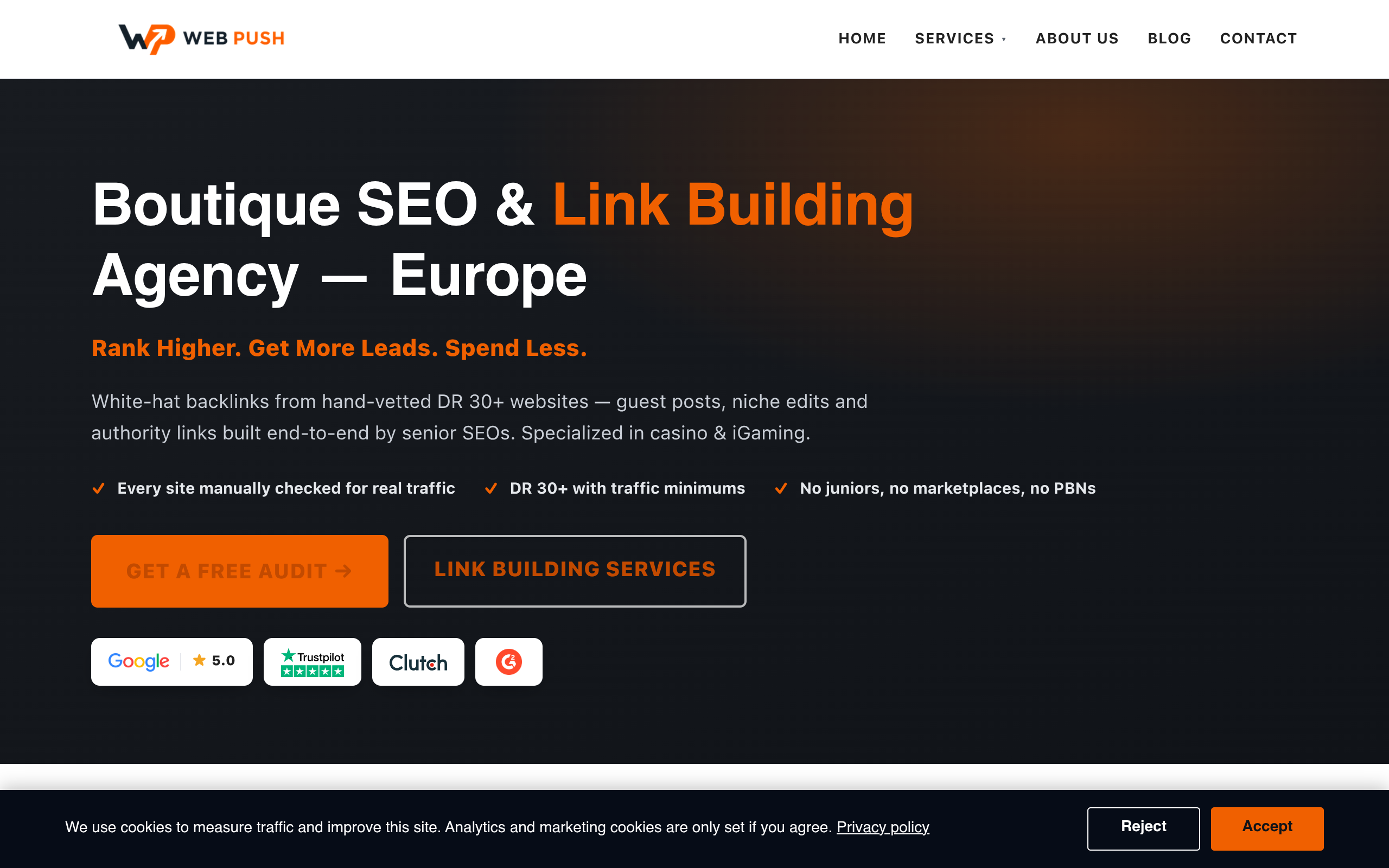
Web Push is a boutique, senior-led link-building agency. Its link building services cover white-hat guest posts, niche edits, authority links, digital PR and linkable assets, with white-label fulfillment for agencies. The company states that placements are hand-vetted on DR 30+ publishers with real organic traffic and that it does not use link farms or PBNs; buyers should still request campaign-level evidence for each proposed site.
Where the package fits
Web Push is designed for buyers who want a smaller, senior-led process rather than a fully self-serve marketplace. SaaS, e-commerce and B2B teams can use it for editorial guest posts, niche edits and authority campaigns. Its gambling-friendly inventory is particularly relevant to casino, betting and iGaming brands, where a generic publisher list often creates avoidable rejection and compliance problems.
- Best for: European brands, agencies needing white-label fulfillment, and gambling campaigns requiring suitable publishers.
- Standout: a combined offer of guest posts, niche edits, digital PR and linkable assets.
- Does not suit: buyers who want a huge self-serve catalog or the lowest possible unit price without manual publisher review.
Burden, pricing and checks
Implementation burden is moderate and consultative. Provide target pages, brand context, restricted subjects, preferred markets and anchor guidance; Web Push handles prospecting and placement coordination, while the buyer approves the direction and final deliverables. The commercial model is custom or campaign based, so request current pricing and confirm content inclusion, turnaround, replacement rules, white-label reporting and whether a niche edit is appropriate for the target page.
The best use case is a campaign where publisher relevance matters more than raw link count. An agency might brief 10 SaaS placements across German and English markets, while an iGaming brand might require gambling-friendly publishers and conservative anchor handling. Neither should be treated as a universal package; ask for the actual publisher shortlist and evidence of organic traffic before approval.
Comparison
The table compares the same buying dimensions across all seven providers. “Control” describes how much selection and approval work remains with the buyer; “commercial model” is intentionally broad where current prices vary by brief, market and inventory.
| Provider | Core delivery | Buyer control | Implementation burden | Commercial model |
|---|---|---|---|---|
| FATJOE | Productized link building and supporting content services | Moderate; confirm targets, pages and package inclusions | Moderate | Service orders or packages; verify current quote |
| Stellar SEO | Managed outreach and campaign-led link building | Moderate; strategic input and approvals | Moderate at setup, lower during execution | Custom or campaign based |
| LinkBuilder.io | Focused outreach and editorial link acquisition | Moderate; content and publisher rules require input | Moderate | Custom or campaign based |
| Authority Builders | Marketplace-style placement selection | High; buyer evaluates listed opportunities | Higher | Placement or inventory based |
| uSERP | Managed authority campaigns and content-led outreach | Moderate; asset and angle approvals | Moderate | Campaign based or custom |
| Outreach Monks | Guest posts, blogger outreach and fulfillment | Moderate; brief and quality review | Moderate | Package, placement or campaign based |
| Web Push | Guest posts, niche edits, authority links, digital PR and linkable assets | Moderate to high; hand-vetted shortlist and brief alignment | Moderate | Custom campaign or white-label fulfillment |
How to choose the right link building package
Start with the page and audience, not the number of links. A new SaaS comparison page, an e-commerce category page and a casino landing page need different prospecting logic. Write the campaign objective in one sentence: “earn relevant editorial references to this research asset,” “support this category page with commercial-safe mentions,” or “build visibility in German-language B2B publications.” If the objective cannot be stated clearly, a package will encourage activity without a useful measurement plan.
Match the buying model to your internal capacity
- Choose a marketplace model when your team can inspect publishers, manage briefs and perform its own QA.
- Choose managed outreach when you have strategy and approvals in-house but not the prospecting and follow-up workload.
- Choose a campaign-led provider when the link needs an asset, story or research angle behind it.
- Choose white-label fulfillment when your agency owns the client relationship and needs predictable delivery without exposing the supplier.
- Choose a boutique specialist when geography, language, sensitive verticals or publisher fit matter more than maximum order volume.
For agencies, the commercial calculation includes more than the supplier’s invoice. Add account management, client approval time, content editing, replacement handling and reporting. An illustrative starting policy might be to approve a small pilot across several relevant publisher types before committing to a larger quarterly package. That is a planning example, not a universal performance benchmark.
Audit the placement before approving the order
Request the proposed domain or a sufficiently detailed publisher profile before publication where the service allows it. Check whether the site has a coherent audience, recent original content, sensible navigation and outbound links that look editorial rather than manufactured. Review the exact article context and destination page. A “high authority” site can still be a poor fit if its readers are unrelated or if every article is an obvious paid placement.
- Relevance: would a real reader plausibly benefit from the linked page?
- Visibility: does the publisher appear to attract organic or referral visitors beyond a toolbar metric?
- Placement: is the link surrounded by useful, original content rather than a thin list of links?
- Anchors: can the campaign use branded, natural and descriptive anchors without forcing exact-match repetition?
- Durability: what happens if the article is removed, the link disappears or the publisher changes its policy?
Paid placements also need correct handling. Google’s spam policies discuss link spam and manipulative linking practices; the relevant lesson for a buyer is to avoid treating purchased links as a shortcut around editorial value. Ask the provider how sponsored relationships, advertorials and editorial guest posts are distinguished, and have legal or compliance reviewers involved for regulated verticals.
Use a decision rule instead of chasing a headline package
For a SaaS or B2B brand with a strong research asset, shortlist uSERP, LinkBuilder.io or Stellar SEO and compare the proposed campaign idea, not just the promised deliverable. For a multi-client agency seeking repeatable fulfillment, compare FATJOE and Outreach Monks on white-label workflow, inventory transparency and replacement terms. For a hands-on buyer wanting to select individual sites, investigate Authority Builders. For European, multilingual or gambling-friendly campaigns, include Web Push and ask for a real shortlist before comparing unit economics.
Before signing, obtain written answers on publisher approval, content ownership, link replacement, reporting and sensitive-niche acceptance. Those terms determine whether a package is usable for a client, not the number printed in its name. If a provider refuses to explain how sites are screened or will not identify what the report contains, downgrade it regardless of its advertised authority range.
Web Push is worth considering when you need senior-led outreach, hand-vetted placements, gambling-friendly inventory or white-label delivery rather than a self-serve catalog. Explore Web Push after defining your target pages, markets and publisher exclusions so the proposed campaign can be judged on fit and evidence.
Authored with NotFair SEO