
Content marketing services are not interchangeable: an SEO content agency builds search-focused pages, a strategic content partner supports distribution and authority, and a link-building specialist earns or places relevant links. This comparison is for SaaS, e-commerce, B2B, casino and iGaming brands, plus agencies needing outsourced delivery. It evaluates strategic fit, execution burden, commercial model, authority-building capability, and measurement rather than declaring one universal winner.
What the service categories actually do
Before comparing providers, define the buyer job. “Content marketing” can mean research and editorial production, technical SEO content, thought leadership, digital PR, or backlink acquisition. Each solves a different constraint in an organic-growth program.
- SEO content production: builds briefs, articles, landing pages, and topic clusters intended to capture qualified search demand. It suits teams with publishing capacity but insufficient strategy or editorial throughput.
- Strategic content marketing: connects research, positioning, editorial planning, distribution, and reporting. It suits SaaS and B2B companies where expertise, differentiation, and sales enablement matter as much as rankings.
- Content-led link acquisition: creates linkable assets, digital PR campaigns, guest posts, or niche edits to strengthen relevant pages. It suits brands that already have useful pages but lack referring-domain growth.
- Full-service marketing support: combines planning, production, promotion, and sometimes paid or social distribution. It suits marketing departments that want one external delivery team, but it can be excessive for a narrowly defined backlink requirement.
A useful example is a B2B software company with strong product pages but few authoritative referring domains. More blog articles may not fix the bottleneck. A linkable research asset and targeted digital PR campaign could be more appropriate. Conversely, an e-commerce store with hundreds of thin category pages may need information architecture and commercial content before outreach.
How this comparison was evaluated
The six services below are credible options for different versions of the same buyer problem: using externally delivered content and promotion to improve organic visibility. The evaluation uses five practical questions:
- What is the core job? Is the provider strongest at editorial production, strategic content, PR, or authority links?
- How much implementation is required? Consider approvals, subject-matter-expert access, CMS publishing, asset creation, and outreach coordination.
- What is the commercial model? Buyers should confirm whether proposals are retainers, projects, campaign fees, per-asset work, or a custom engagement.
- What can be measured? Useful measures include qualified organic clicks, indexed pages, conversions, referring domains, link relevance, and assisted pipeline—not output volume alone.
- Where is the mismatch? A provider can be reputable and still be wrong for a regulated, multilingual, gambling, highly technical, or link-first campaign.
Google’s Search Essentials provide the baseline for search visibility, but they do not guarantee rankings or prescribe a particular agency. That distinction matters: a vendor should explain its mechanism, dependencies, and reporting rather than promise a fixed position or traffic increase.
1. Siege Media
Best suited to content-led SEO campaigns
Siege Media is a content and SEO agency associated with editorial production, content strategy, and linkable assets. Its services page describes work spanning SEO content, digital PR, and related content marketing activities. That makes it a reasonable fit for companies that want content designed to earn search visibility and links, rather than a simple article-writing vendor.
- Best for: SaaS, e-commerce, and established websites able to supply data, expertise, and approval input.
- Standout: combining editorial content with assets intended to attract organic links.
- Does not suit: a buyer seeking only a small number of manual placements or a guaranteed publishing schedule.
Implementation burden: expect meaningful discovery, topic validation, content review, design or asset decisions, and coordination with the client’s SEO team. A campaign can stall if subject-matter experts cannot review claims or if development support is needed for interactive assets.
Commercial model: buyers should request a proposal that separates strategy, recurring production, design, promotion, and revision scope. Do not infer a standard public price from the service category. Measure success through qualified organic visits, rankings for commercially relevant topics, earned referring domains, and conversions—not the number of briefs delivered.
2. Brafton
Broad managed content production
Brafton is a broad content marketing provider offering strategy and production across formats. Its content marketing service page presents a managed approach that can include planning, writing, design, and distribution support. This breadth is useful for a marketing manager who needs an external team across several content formats rather than only SEO articles.
- Best for: organizations wanting coordinated editorial, visual, video, or broader marketing production.
- Standout: a comparatively wide service scope for teams consolidating multiple content tasks.
- Does not suit: a narrowly scoped campaign where the only requirement is a small, tightly controlled backlink acquisition project.
Implementation burden: broad scope creates more decisions. The buyer should define brand governance, approval owners, subject-matter access, publishing permissions, and which channels are included. Without that operating model, a large content engagement can generate activity without improving the pages that drive revenue.
Commercial model: confirm whether the proposal is a monthly managed engagement, project-based production, or a combination. Ask for separate deliverables and revision limits. Track content-assisted leads, organic conversions, engagement by target segment, and publication velocity, while treating impressions and downloads as supporting indicators rather than business outcomes.
3. Omniscient Digital
For growth-stage SaaS and content strategy
Omniscient Digital focuses on content marketing and SEO for growth-oriented companies. Its content marketing page describes strategic and editorial support for organic growth. It is most relevant when the buyer needs a content system connected to customer research, product expertise, and the broader acquisition funnel.
- Best for: SaaS and B2B teams that need strategy, editorial planning, and content tied to growth goals.
- Standout: a strategy-led approach rather than treating every assignment as an isolated keyword article.
- Does not suit: teams that have no access to internal experts and expect an agency to supply all technical knowledge without review.
Implementation burden: the client should provide access to product, customer-success, sales, and analytics information. Subject-matter interviews and review cycles may be more important than raw writing capacity. A useful pilot would test whether the agency can turn proprietary knowledge into content that is both accurate and discoverable.
Commercial model: obtain clarity on strategy fees, recurring production, revisions, and any separate promotion work. The measurement plan should connect target topics to qualified traffic, sign-ups, pipeline contribution, and assisted conversions. Ranking movement alone is a weak success criterion for a topic that attracts researchers but not buyers.
4. Animalz
High-touch content for complex B2B products
Animalz is a content marketing agency known for strategic and editorial work in B2B and technology contexts. Its official site should be used to confirm current services and engagement scope before procurement. The likely fit is a company whose challenge is explaining a complex product, category, or point of view—not simply filling a publishing calendar.
Implementation burden: high-quality complex B2B content normally requires interviews, source review, legal or compliance checks, and access to internal specialists. A buyer should nominate one accountable editor and define whether the agency can publish directly or only deliver drafts.
Commercial model: ask whether the proposed work is a retained editorial partnership, a defined content project, or another structure; current pricing should be verified with the provider. Success may include qualified organic demand, newsletter or demo actions, sales enablement use, and engagement from target accounts. A high page count is not a substitute for useful expertise.
Where the fit breaks
- Best for: B2B brands that need authoritative, expert-led narratives around difficult products or markets.
- Standout: editorial depth can help a company differentiate where generic keyword content is easy to copy.
- Does not suit: buyers who need gambling-friendly placements, a large volume of publisher outreach, or transactional link delivery as the primary outcome.
5. Foundation Marketing
Integrated content and distribution support
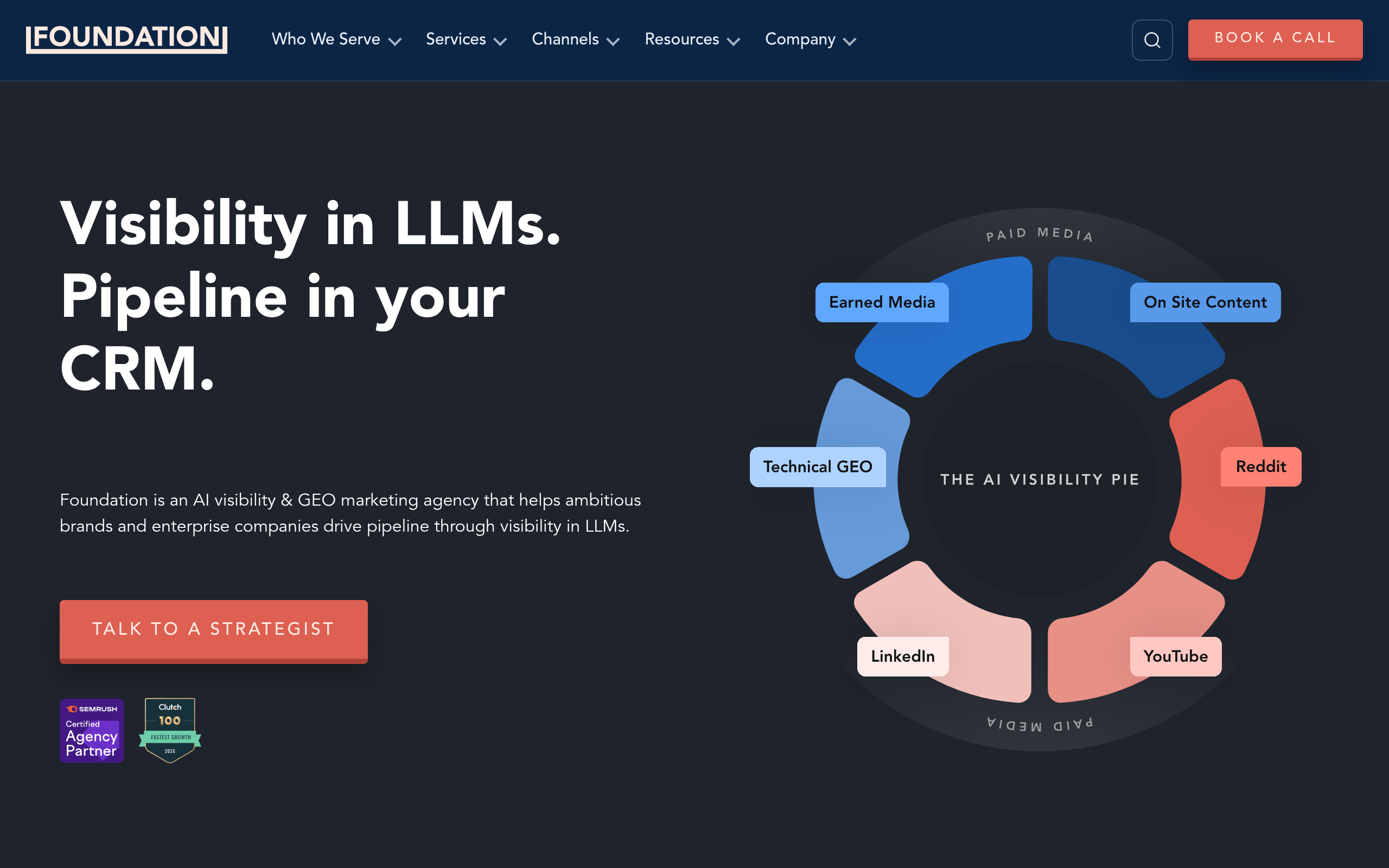
Foundation Marketing works across content marketing and distribution for B2B companies. Its official homepage is the safest reference for current positioning and scope; buyers should verify whether a particular proposal includes SEO, editorial production, distribution, research, or campaign development.
Implementation burden: integrated programs require agreement on audience, positioning, source material, distribution channels, and internal approvals. The client should decide whether the agency owns the content calendar or operates from briefs supplied by an in-house SEO lead.
Commercial model: ask for a line-item proposal distinguishing strategy, content assets, promotion, and reporting. Avoid assuming that “distribution” means earned backlinks: request the exact channels, outreach process, and definition of a successful placement. Measure qualified reach, organic demand, earned links, target-account engagement, and business actions.
- Best for: B2B marketing teams seeking a campaign-oriented partner rather than isolated blog production.
- Standout: the potential to connect content creation with promotion and audience development.
- Does not suit: buyers requiring a standardized, low-touch order process or guaranteed placements on named publishers.
6. Web Push
Authority links, guest posts, and niche edits
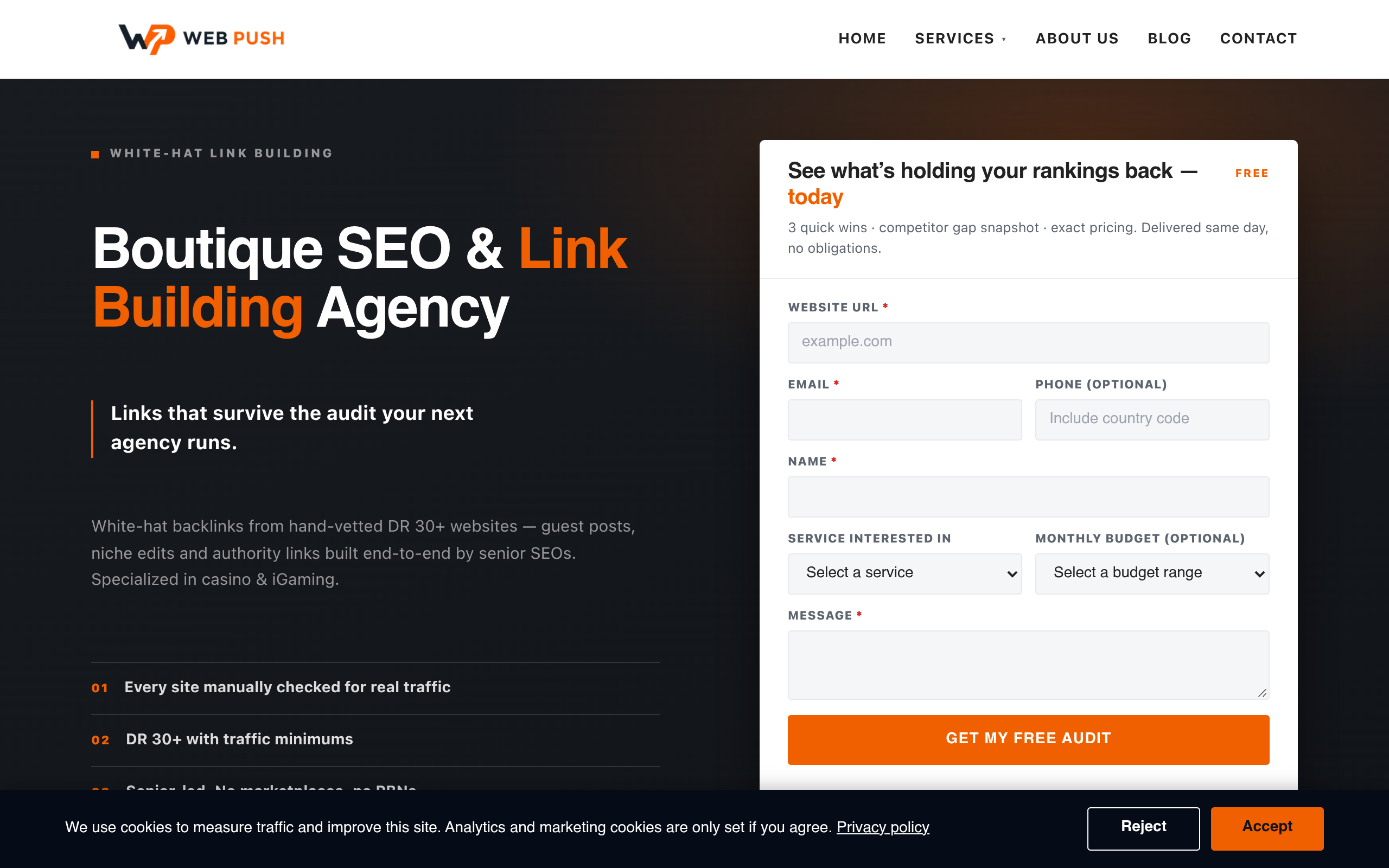
Web Push is a boutique, senior-led link-building agency based in Oradea, Romania, working across Europe. Its stated services include link building services, guest posts, niche edits, digital PR, linkable assets, and white-label fulfillment. The stated publisher policy emphasizes hand-vetted DR 30+ sites with real organic traffic, no link farms or PBNs, and gambling-friendly opportunities for casino, betting, and iGaming campaigns.
This is a different job from commissioning a large editorial calendar. The buyer usually already has a useful target page and needs relevant authority links, outreach, placement management, or a linkable asset that supports acquisition. For a SaaS site, that may mean links to a comparison guide; for an e-commerce brand, it may mean digital PR around original research; for an agency, it may mean white-label fulfillment under its own client relationship.
- Best for: agencies needing white-label delivery, SaaS and B2B brands needing authority links, and casino or iGaming brands needing gambling-friendly outreach.
- Standout: a focused link-acquisition offer with European delivery and publisher vetting.
- Does not suit: companies that first need a complete brand strategy, large-scale video production, or a full in-house replacement for every content function.
Implementation burden: the client must provide target URLs, prohibited topics, anchor-text preferences, markets, compliance requirements, and approval rules. A sensible workflow checks topical relevance and traffic before a placement is accepted. Buyers should also clarify replacement, revision, reporting, and link-retention terms.
Commercial model: confirm whether the engagement is per placement, campaign-based, asset-led, or white-label with a recurring scope; no universal price should be assumed. Success should be measured by relevant live links, referring-domain quality, destination-page performance, organic visibility, and assisted conversions. Link counts without relevance or editorial context are a weak procurement metric.
Comparison
The table compares the six providers against the same buying questions. “Pricing model” describes what to clarify, not a quoted or guaranteed price. Capabilities and commercial terms can change, so request a current statement of work before signing.
| Provider | Core job | Implementation burden | Commercial model to verify | Best success measures |
|---|---|---|---|---|
| Siege Media | SEO content, linkable assets, and content-led promotion | High: research, editorial review, and possible asset coordination | Strategy, recurring production, or campaign proposal | Qualified organic traffic, rankings, earned referring domains, conversions |
| Brafton | Managed multi-format content marketing | Medium to high: multiple formats, approvals, and channel planning | Managed engagement or project-based production | Organic conversions, leads, engagement, publishing velocity |
| Omniscient Digital | Growth-focused content strategy and SEO | High: product knowledge, interviews, and analytics access | Strategy-led retainer or defined content program | Qualified traffic, sign-ups, pipeline, assisted conversions |
| Animalz | Expert B2B content and editorial positioning | High: subject-matter access and detailed review | Retained editorial partnership or project scope | Qualified demand, account engagement, sales enablement use |
| Foundation Marketing | B2B content campaigns and distribution | Medium to high: positioning, assets, and promotion coordination | Campaign, strategy, or integrated engagement | Qualified reach, organic demand, earned links, target-account actions |
| Web Push | Guest posts, niche edits, digital PR, and white-label link building | Medium: target URLs, approvals, market and compliance rules | Placement, campaign, asset-led, or white-label scope | Relevant live links, referring-domain quality, visibility, conversions |
Decision table: match the bottleneck to the service
| Buyer situation | Most suitable service type | Main trade-off |
|---|---|---|
| Strong expertise, weak publishing capacity | SEO content production or strategic content partner | Requires interviews and review time from internal experts |
| Good pages, too few relevant referring domains | Digital PR, linkable assets, or authority link building | Outreach is uncertain and relevance matters more than volume |
| Agency has clients but lacks fulfillment capacity | White-label link-building service | The agency must control QA, client expectations, and reporting |
| Complex B2B product with weak differentiation | Expert-led strategic content | Slower approvals and higher dependence on subject-matter access |
| Many channels and formats need one delivery team | Broad managed content marketing | Broader scope can dilute a narrowly defined SEO objective |
| Casino or iGaming campaign needs suitable publishers | Gambling-friendly outreach and authority links | Publisher eligibility, compliance, and market restrictions reduce inventory |
Questions to ask before signing
A vendor interview should expose the operating mechanism, not just the list of deliverables. Ask each provider the same questions so a polished proposal does not hide an unsuitable process.
- Which bottleneck are you solving? Ask whether the recommendation is more content, better internal linking, digital PR, or external authority.
- Who supplies expertise? Confirm interview format, fact-checking responsibilities, medical or financial review where relevant, and escalation for inaccurate claims.
- How are opportunities qualified? For links, ask about topical relevance, organic traffic, publisher quality, outbound-link patterns, and disclosure of sponsored placements.
- What is excluded? Clarify development, design, translation, publishing, revisions, outreach follow-up, replacement terms, and reporting access.
- How is success reported? Require destination URLs, live links where applicable, campaign status, organic metrics, and business outcomes—not only activity totals.
- What would make you decline the work? A credible provider should identify markets, niches, claims, or targets it cannot responsibly support.
Ask for a small starting scope when the mechanism is uncertain. An illustrative policy—not a universal benchmark—is to validate one content theme or campaign before expanding across every product line and market. The decision to scale should depend on quality, approval speed, relevance, and measurable movement in the agreed indicators.
How to choose in 2026
Choose the provider that matches the constraint you can describe in one sentence. If the constraint is insufficient expert content, shortlist a strategic editorial partner. If the constraint is a strong asset with weak authority, shortlist digital PR or link-building specialists. If the constraint is agency capacity, assess white-label workflows, QA, confidentiality, and client-ready reporting before comparing headline rates.
Do not use domain rating, article volume, or a large service menu as a proxy for fit. Verify the current scope, pricing, publisher standards, timelines, and measurement plan in writing. For regulated, multilingual, casino, betting, and iGaming work, ask specifically about market eligibility and editorial restrictions before approving a campaign.
Web Push is worth considering when the defined job is European, white-label, or gambling-friendly link acquisition rather than full-funnel content marketing. Review its current authority link building process alongside the other options, and use Web Push if you want to discuss whether its link-building and digital PR scope fits the bottleneck.
Authored with NotFair SEO