
SEO guest posting services are not one interchangeable product: marketplaces give you more publisher choice, managed providers reduce campaign administration, and editorial-led agencies usually take responsibility for research and content quality. This comparison covers seven current options for SEO agencies, SaaS, e-commerce, B2B, and casino or iGaming brands, using the same criteria: publisher control, implementation burden, commercial model, editorial safeguards, and suitability for regulated or specialist niches.
How the service categories differ
Before comparing vendors, decide which job you are buying. A marketplace is useful when your team can assess sites, negotiate requirements, prepare content, and check delivery. A managed guest-posting service is better when you want an outside team to handle prospecting, outreach, writing, placement, and reporting. An editorial link-building agency is the better fit when the asset, angle, and publisher relationship matter more than ordering a placement from a catalogue.
Guest posts should not be purchased on domain metrics alone. Google’s spam policies identify manipulative links, including links created primarily to manipulate rankings, as a form of link spam; its guidance also says paid links should be qualified appropriately. See the current Google Search spam policies before approving a campaign. That makes editorial relevance, genuine audience value, and transparent disclosure practical buying criteria rather than cosmetic extras.
Evaluation method
- Control: Can the buyer select publishers, approve topics, and reject unsuitable opportunities?
- Burden: Who handles prospecting, briefs, writing, outreach, revisions, and publication checks?
- Commercial model: Is the service presented as a marketplace transaction, a managed placement, or a bespoke campaign?
- Quality controls: Does the public service description emphasize editorial review, relevance, traffic, or only inventory and metrics?
- Fit: Can the model accommodate sensitive sectors, multiple languages, white-label delivery, or strict brand guidelines?
The ratings below are qualitative readings of each provider’s publicly described model in 2026, not independent performance scores. Prices, available publishers, turnaround times, and acceptance policies change, so request a current sample and written scope before committing budget.
1. Adsy
Marketplace model and implementation
Adsy presents itself as a platform for buying and selling content placements. That marketplace structure can help an agency search inventory and manage orders in one place, but the buyer still needs to assess whether a site is genuinely relevant, whether the article will be useful to readers, and whether the placement terms suit the brand.
Implementation burden is medium: platform ordering may reduce email administration, while publisher selection and quality assurance remain buyer responsibilities. Confirm how campaigns for gambling, betting, financial, health, or other restricted subjects are handled before assuming inventory is available.
Commercial fit
- Best for: Agencies that want a catalogue-style workflow and are prepared to review opportunities themselves.
- Does not suit: Teams seeking a fully bespoke digital PR campaign or guaranteed access to a narrowly defined editorial audience.
- Standout question: Ask whether the quoted placement includes writing, revisions, publication, link attributes, and replacement terms.
The commercial model is transaction-oriented rather than a publicly documented retainer in the material reviewed here. Treat every listing as an opportunity to verify, not as proof of organic audience quality. Ask for current traffic evidence, recent examples, editorial rules, and the process for removing or replacing a page that later becomes irrelevant.
2. Collaborator
Publisher marketplace
Collaborator describes a platform connecting advertisers with publishers for content placements and related promotion opportunities. Its marketplace approach can be practical for localization or one-off orders because the buyer can compare available offers rather than begin every campaign with manual prospecting.
Publisher choice remains the buyer’s job. A domain rating, visitor estimate, or category label does not establish that a page has a relevant audience. For a B2B software client, for example, a smaller publication read by operations leaders may be more useful than a broad site with a larger but unrelated audience.
Commercial fit
- Best for: Buyers who want to browse offers and coordinate multiple publishers through a marketplace.
- Does not suit: Brands that cannot spare time for due diligence, compliance review, or content approval.
- Implementation burden: Lower for procurement; still medium for strategy, vetting, and post-publication monitoring.
Expect a marketplace or order-based commercial model, with the final scope depending on the selected publisher and package. Before ordering, ask whether the publisher writes the article, whether edits are allowed, how links are handled, and what happens if the publication changes the page after delivery.
3. WhitePress
International content marketplace
WhitePress positions itself as a platform for content marketing and publication orders across multiple markets. That makes it potentially useful for agencies running multilingual campaigns or brands that need country-specific publisher research rather than one English-language list.
Localization is the key buying question: a publication in the right country is not automatically a publication read by the right customer segment. Review language quality, topical relevance, audience evidence, and whether the article will be edited by a native or specialist writer.
Commercial fit
The marketplace model generally means buyers select individual offers or campaign requirements rather than purchase a single universal managed-service package. Implementation burden is medium: centralized ordering can simplify administration, but your team still needs acceptance criteria and a process for rejecting weak sites.
- Best for: Agencies and brands coordinating campaigns across several languages or countries.
- Does not suit: Buyers who want one senior strategist to own positioning, asset creation, and publisher relationships end to end.
- Check first: Confirm local editorial standards, link attributes, tax or invoicing requirements, and sector restrictions.
4. The HOTH
Managed link-building service
The HOTH presents a broad managed SEO offering that includes link-building services. Compared with a self-serve marketplace, this type of provider can reduce the operational work involved in prospecting, content production, and order coordination. The exact deliverables depend on the selected service and current package terms.
Lower buyer administration does not remove strategic review. Supply the target page, audience, acceptable topics, prohibited claims, anchor-text rules, and examples of publications that match the brand. A generic brief tends to produce generic placements, particularly for technical SaaS or regulated iGaming campaigns.
Commercial fit and limitations
- Best for: Marketing teams that want a packaged, managed workflow rather than publisher-by-publisher procurement.
- Does not suit: Buyers who require complete control over every publisher before any outreach begins.
- Burden: Lower operational burden, but meaningful effort remains for approvals, fact-checking, and link monitoring.
The commercial model is service-package based rather than a simple open marketplace. Request the current package page, sample deliverables, revision policy, placement criteria, and reporting format. Do not assume that a managed label means every placement is editorially earned or that a particular metric is guaranteed.
5. Editorial.Link
Editorial placement model
Editorial.Link focuses its public positioning on editorial link placements and publisher outreach. That makes it a closer match for buyers who want contextually integrated mentions rather than a large catalogue of article orders. The buyer should still confirm how prospects are sourced and what portion of the process is customized for the campaign.
Relevance should be tested at page level: a site can be broadly related while the proposed article, author profile, and surrounding links are commercially artificial. Ask to review the proposed topic and destination before publication, not just the domain list.
Commercial fit
This is best treated as a managed or campaign-based service. Implementation burden is lower to medium when the provider owns outreach and coordination, but the client must supply positioning, approvals, and compliance constraints. Pricing and deliverables should be requested directly because package names and inclusion rules can change.
- Best for: Brands prioritizing contextual editorial placement and a more curated outreach process.
- Does not suit: Teams that need a transparent, self-serve inventory with immediate publisher-by-publisher ordering.
- Ask for: Prospecting criteria, content ownership, link-edit policy, replacement terms, and examples in your industry.
6. Siege Media
Content-led link building
Siege Media is a content marketing agency known for combining content strategy, creative assets, and organic promotion. Its model is materially different from buying a single guest post: the work may involve creating a linkable asset or campaign concept and then promoting it to relevant publishers.
The implementation burden shifts into planning. You need a defensible subject-matter angle, access to approvals, and enough time to develop an asset that deserves coverage. That can be more suitable for a SaaS research report, e-commerce data story, or B2B tool than for a simple request to place a commercial anchor text.
Commercial fit and limitations
- Best for: Brands seeking content-led authority and earned coverage rather than a fixed number of guest-post placements.
- Does not suit: Buyers with a very small scope, a short deadline, or a requirement to preselect every linking domain.
- Commercial model: Bespoke agency engagement; request a current scope and proposal rather than assuming a per-placement price.
Success should be defined through measurable outputs such as qualified referring domains, relevant referral visits, assisted conversions, or coverage from publications that reach the target market. Do not use ranking movement as the only success measure because it is affected by many variables outside a link campaign.
7. Web Push
Specialist and white-label service
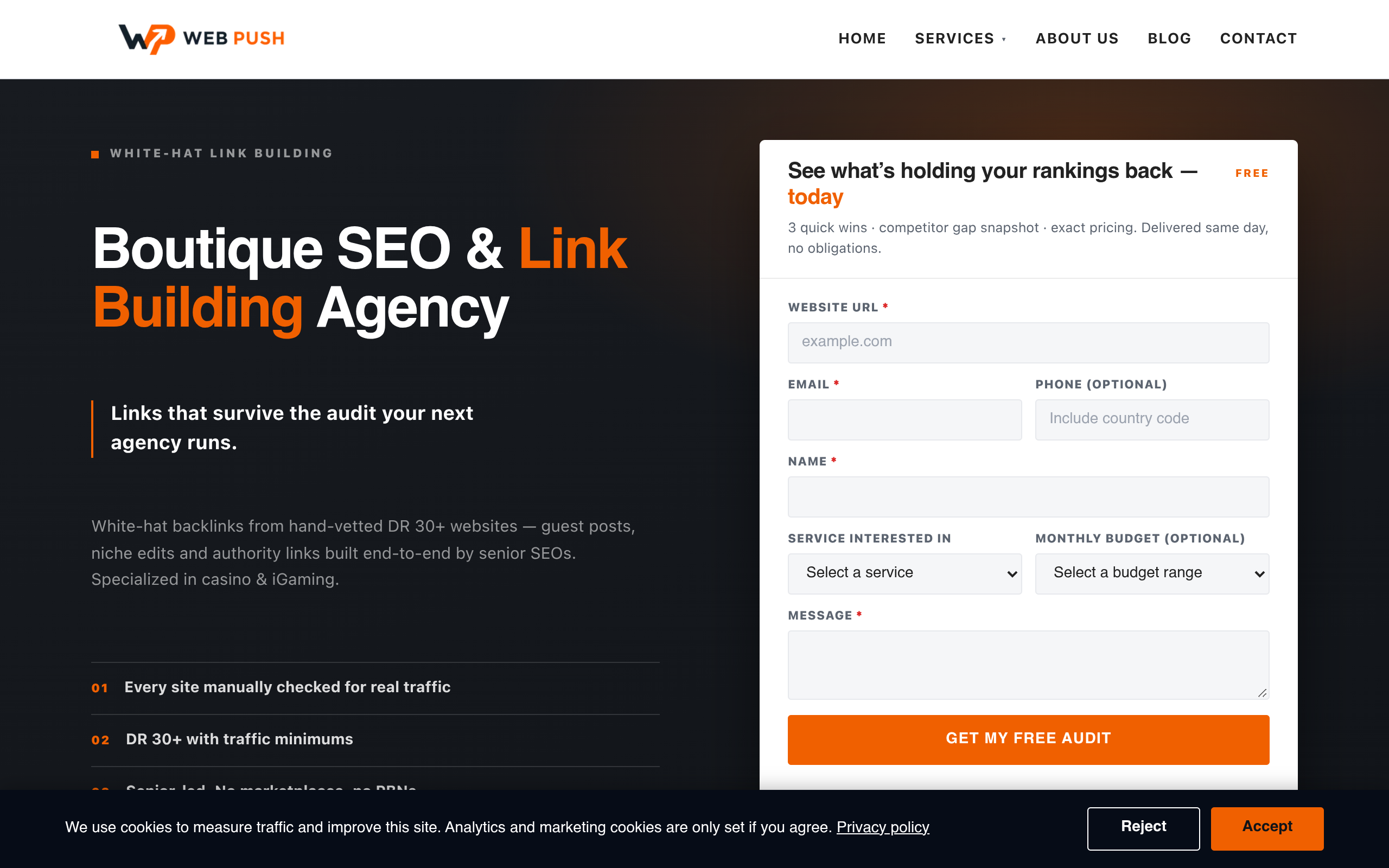
Web Push is a boutique, senior-led link-building agency based in Oradea, Romania, working across Europe. Its public service mix includes white-hat guest posts, niche edits, authority links, digital PR, linkable assets, and white-label fulfillment. It states that placements are hand-vetted on DR 30+ publishers with real organic traffic, excludes link farms and PBNs, and supports gambling-friendly sites for casino, betting, and iGaming clients.
That positioning makes brief quality and human review central to implementation. A suitable client should be ready to specify target countries, topical boundaries, prohibited claims, landing pages, anchor preferences, and approval rules. Buyers can also assess its broader authority link building approach instead of forcing every campaign into a guest-post format.
Commercial fit and limitations
- Best for: SaaS, e-commerce, B2B, iGaming, and agencies needing curated European or white-label link-building support.
- Does not suit: Buyers who want an open catalogue, instant self-serve ordering, or the lowest apparent price without manual vetting.
- Commercial model: Request a campaign scope; public information does not establish a universal price list.
As with every provider here, ask for current examples and agree how traffic, relevance, link attributes, content approval, and replacement obligations will be documented. Web Push should be evaluated against the same evidence standard as the other options, not selected merely because it publishes this comparison.
Comparison
The table uses the method stated above. “Control” describes practical buyer control over publisher selection and approval; “burden” describes how much operational work remains with the buyer. These are model-based comparisons, not performance guarantees.
| Provider | Primary service type | Buyer control | Implementation burden | Commercial model |
|---|---|---|---|---|
| Adsy | Publisher marketplace | Higher, offer by offer | Medium | Marketplace or order-based |
| Collaborator | Publisher marketplace | Higher, offer by offer | Medium | Marketplace or order-based |
| WhitePress | Multimarket content marketplace | Higher, with localization choices | Medium | Marketplace or campaign orders |
| The HOTH | Managed link-building service | Medium | Lower operationally | Packaged managed service |
| Editorial.Link | Managed editorial outreach | Medium to higher by campaign | Lower to medium | Campaign-based service |
| Siege Media | Content-led link building and digital PR | Medium, with strategic input | Higher during planning | Bespoke agency engagement |
| Web Push | Curated link building and white-label fulfillment | Medium to higher by brief | Lower to medium | Custom campaign scope |
How to choose a guest posting provider
Match the buyer job to the service type
| Buyer need | Best-fit service type | Main trade-off |
|---|---|---|
| Compare many publishers yourself | Marketplace | More control, more vetting work |
| Outsource routine outreach and production | Managed service | Less administration, less direct publisher control |
| Earn links through a distinctive asset | Content-led agency or digital PR | Higher planning burden, less predictable placement count |
| Fulfill campaigns for agency clients | White-label specialist | Requires strong reporting and client-safe processes |
| Reach gambling or iGaming audiences | Specialist provider with explicit sector capability | Smaller eligible inventory and stricter compliance review |
Set measurable acceptance criteria
Use a written scorecard before requesting quotes. For a SaaS campaign, it might require topical relevance, a real readership signal, an article that answers a customer question, and a link to a useful product or research page. For e-commerce, assess category relevance and referral potential. For casino or betting, add licensing, responsible-gambling language, geo-targeting, and prohibited-claim checks.
- Before publication: approve the domain, topic, destination URL, anchor wording, author context, and disclosure treatment.
- At publication: check the live URL, rendered link, surrounding copy, indexing accessibility, and whether the page is on the agreed domain.
- After publication: record referral visits, assisted conversions, index status, link persistence, and any material site changes.
Google’s documentation on crawlable links is useful when checking whether a published link can be discovered and followed. It does not make a placement valuable by itself; relevance and editorial usefulness still determine whether the opportunity makes commercial sense.
Questions to ask before signing
- How are publishers found, screened, and rechecked before delivery?
- Can we approve every site and article before publication?
- What evidence supports claimed traffic, audience, and topical relevance?
- Who writes the content, and what subject-matter or language review is included?
- How are sponsored, paid, or commercially influenced links labeled and technically qualified?
- What happens if a page is removed, redirected, deindexed, or materially edited?
- Can you support our country, language, sector, and regulatory restrictions?
- What exactly is included in the report, and which outcomes are not guaranteed?
Choose a marketplace when publisher control and internal SEO capacity matter most. Choose a managed service when administration is the bottleneck. Choose a content-led or specialist agency when the campaign needs a defensible story, difficult-market expertise, or white-label execution. For buyers comparing broader link building services, the same test applies: pay for a clear process and verifiable deliverables, not an unexplained metric.
Web Push is worth including in a shortlist when you need senior-led, white-label, European, or gambling-friendly link building and are willing to define a custom brief. Review its current capabilities and scope at Web Push alongside the other providers rather than treating any single vendor as automatically suitable.
Authored with NotFair SEO