
Link building seo is the practice of earning or placing relevant links from other websites to improve a page’s discoverability, authority, and ability to compete in organic search. It is not a volume contest. For a SaaS team, agency, e-commerce brand, B2B company, or iGaming operator, the useful question is whether a link makes a target page more credible and easier to find—not whether a spreadsheet contains more referring domains.
A sound program connects four things: a page worth citing, a publisher whose audience makes sense, an editorial reason for the link, and a measurement plan that separates visibility from business impact. This guide explains the mechanics, the failure points, and a workable operating model for in-house teams and agencies buying white-label fulfillment.
What Link Building SEO actually includes
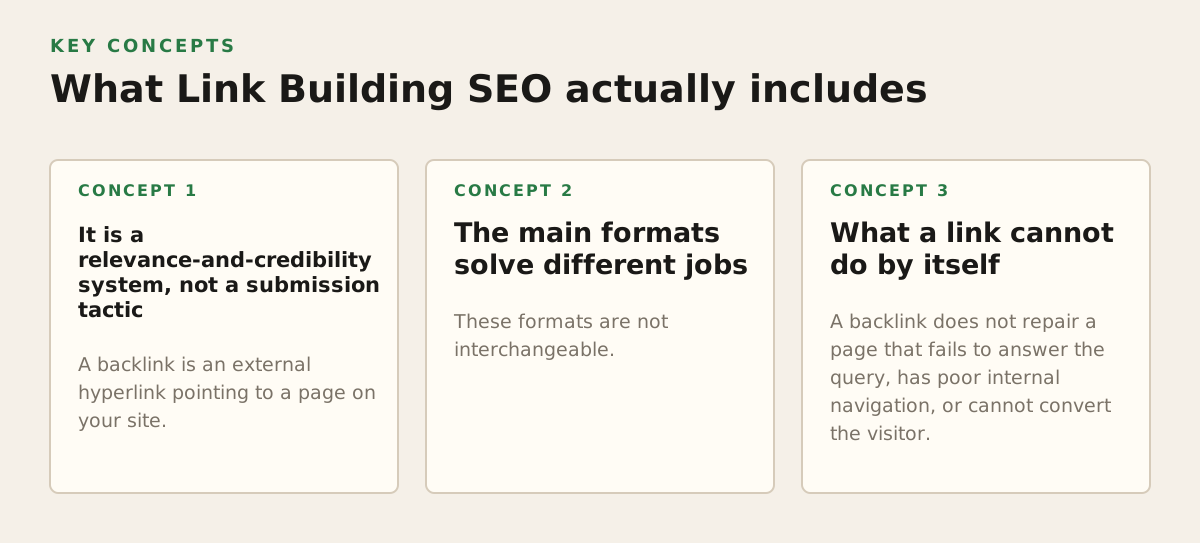
It is a relevance-and-credibility system, not a submission tactic
A backlink is an external hyperlink pointing to a page on your site. Link building is the process of earning that reference through useful content, editorial outreach, digital PR, partnerships, expert contributions, or carefully vetted edits to existing pages. The SEO component is the strategic layer: selecting pages, topics, anchors, publishers, and timing so the links support a search objective without creating an unnatural pattern.
The asset comes before the outreach. A product page may deserve links because it solves a specific problem, while a research report may attract citations because it contains original data. A generic “best tools” article with no distinct evidence gives a publisher little reason to add a reference. Conversely, a strong asset can still fail if it targets an audience unrelated to the publisher.
Google’s guidance describes links as one way its systems discover pages and recommends creating compelling, useful content that people want to share. It also warns against tactics intended primarily to manipulate rankings, including buying links that pass ranking credit or using large-scale article campaigns with keyword-rich links. See Google’s [SEO Starter Guide](https://developers.google.com/search/docs/fundamentals/seo-starter-guide) and [spam policies](https://developers.google.com/search/docs/essentials/spam-policies), both current in 2026.
The main formats solve different jobs
- Guest posts: a genuinely useful article contributed to a relevant publication, with a restrained contextual reference where it helps the reader.
- Niche edits: an addition or revision to an existing page when the destination genuinely fills a content gap.
- Digital PR: a campaign, statistic, expert comment, or newsworthy angle designed to earn coverage from journalists and publishers.
- Authority links: editorial references from credible sites whose topical relevance and audience justify the placement.
- Linkable assets: original research, calculators, templates, glossaries, visual explainers, or tools that give other writers a reason to cite a page.
- White-label fulfillment: an agency supplies the strategy, client communication, or reporting while a specialist partner handles prospecting, outreach, placement, and quality control under the agency’s process.
These formats are not interchangeable. A casino brand may need publishers comfortable with regulated gambling topics; a B2B software company may benefit more from expert commentary and industry research; an e-commerce store may need category education, comparison content, and digital PR rather than a series of generic homepage links.
What a link cannot do by itself
A backlink does not repair a page that fails to answer the query, has poor internal navigation, or cannot convert the visitor. It also does not guarantee a ranking change. Treat it as one input in a broader system that includes technical accessibility, content quality, internal links, brand demand, and the competitiveness of the search results.
Anchor text deserves particular restraint. A natural link may use a brand name, URL, product name, descriptive phrase, or a short reference such as “this comparison.” Repeating an exact commercial phrase across placements can make the campaign look engineered and can reduce editorial credibility. The safest anchor is the one a real editor would choose for clarity.
Why link building matters to organic growth
Links create discovery paths and editorial context
Search engines need ways to discover and interpret pages. A relevant link can provide both: a crawler can follow a path to a new resource, while the surrounding text gives context about why that resource matters. This is especially useful for deep product documentation, newly published research, regional landing pages, or content that has few internal entry points.
Google’s documentation says links help its systems find new pages and recommends making important pages reachable through crawlable links. Its [Google Search Central documentation on crawling](https://developers.google.com/search/docs/crawling-indexing/overview) is a useful reference for separating discovery from ranking: a page being found does not mean it will be indexed or perform well.
Relevance is the bridge between a link and a business outcome. A link from a publication read by the target market can send qualified referral traffic, support brand familiarity, and place a company inside the conversation around a category. A high-metric site with no connection to the topic may deliver none of those benefits, even if its domain score looks impressive in a prospecting tool.
It supports pages that have commercial importance
Many teams publish links only to blog posts because those pages are easier to pitch. That can create an authority gap around the pages that matter commercially. A better structure uses informational assets as the outreach surface while linking naturally to a relevant category, feature, service, or solution page when the reader needs the next step.
For example, an HR software company could promote a report on onboarding delays, then earn contextual references to its onboarding workflow page. An online retailer could create a materials guide that attracts editorial citations and internally connect it to relevant product categories. A betting operator might publish responsible-gaming resources or a jurisdiction-specific guide, subject to applicable laws and publisher policies, rather than forcing promotional anchors into unrelated articles.
Use a link only when the destination improves the reader’s understanding. That rule protects against a common mistake: choosing a target URL because it has commercial value while ignoring whether the paragraph gives the visitor a reason to click.
Authority is not a single metric
Third-party metrics such as domain rating, authority scores, estimated traffic, and topical classifications can help prioritize a large prospect list. They are not Google measurements and should never be treated as proof of ranking value. A site can have a strong metric and declining readership, or modest authority and a highly relevant audience.
Assess a publisher through several lenses:
- Does it publish consistently for a real audience?
- Do recent pages receive search visibility or meaningful engagement signals?
- Are the site’s topics coherent, or does it accept every industry?
- Does it have clear editorial standards and identifiable authors?
- Are outbound links selective, contextual, and useful?
- Would the placement still make sense if search engines did not exist?
Web Push positions its placements around hand-vetted DR 30+ publishers with real organic traffic, rather than link farms or PBNs. That is a qualification starting point, not a promise that every placement will produce a particular ranking result. The final decision should still consider topical fit, page quality, audience, outbound-link patterns, and the client’s risk tolerance.
How a defensible link building process works
1. Start with a page-and-query map
Before prospecting, define what the campaign is trying to support. Map a small set of target pages to search themes, audience problems, conversion roles, and acceptable link destinations. This prevents the outreach team from accumulating links without improving the site’s strategic pages.
An illustrative starting map might look like this:
| Business | Target page | Useful outreach asset | Likely publisher context |
|---|---|---|---|
| SaaS | Workflow automation page | Time-saving benchmark report | Operations, productivity, or software publication |
| E-commerce | Technical product category | Buying and maintenance guide | Trade, home, or specialist consumer site |
| B2B | Industry solution page | Original survey or expert briefing | Professional association or industry media |
| iGaming | Regulated-market resource | Educational market guide | Gambling-friendly industry publication |
The table is an illustrative planning example, not a universal campaign template. Some pages will need content improvements before they are promoted. Others may be too commercial for direct outreach and should receive internal links while an informative companion asset earns external citations.
2. Build and qualify the prospect list
Prospecting is not just finding websites that mention a keyword. Search for publications, journalists, resource pages, associations, newsletters, and specialist communities that already cover the subject. Then verify each candidate manually.
- Record the publication’s topic, country, language, and audience.
- Review several recent articles rather than one attractive page.
- Check whether the site accepts contributions and under what editorial conditions.
- Inspect outbound links for obvious paid-link patterns, irrelevant clusters, or excessive commercial anchors.
- Confirm that the proposed topic adds something the publication does not already have.
- Log the target page, proposed angle, contact route, status, and rejection reason.
Traffic quality beats an impressive toolbar number. Use organic visibility estimates as directional evidence, then examine current pages, indexing patterns, audience fit, and editorial consistency. For a local SaaS campaign, a regional business publisher with a real professional audience may be more useful than a globally broad site whose visitors have no reason to buy.
3. Match the pitch to the publication
Good outreach is a fit argument, not a request for “a backlink.” The message should show that you understand the publication, identify a reader problem, propose a specific contribution, and disclose the relevant brand relationship when necessary. Give the editor enough information to reject or refine the idea quickly.
A practical pitch contains:
- A short observation about a recent article, recurring topic, or audience question.
- One proposed angle with a clear reader benefit.
- The author’s relevant expertise or evidence source.
- A note on originality, supporting data, or visual material.
- A transparent statement about the brand and any requested citation.
For agencies, maintain separate client factsheets. The factsheet should include approved claims, prohibited claims, target markets, acceptable destinations, preferred terminology, regulatory sensitivities, and examples of useful evidence. This reduces revision cycles and keeps a white-label team from improvising unsupported claims.
4. Produce the placement for the reader first
A contributed article should stand on its own. It needs a clear thesis, credible explanation, useful examples, and a logical structure. A niche edit should improve the existing paragraph rather than interrupt it with a conspicuous commercial insertion. Digital PR should offer a reason for journalists to cover the story now: new evidence, a timely development, a strong expert interpretation, or a genuinely useful resource.
Decide the link details after the editorial context is clear. The destination should answer the question raised by the sentence. The anchor should describe the destination without looking like an instruction to a ranking system. If the editor prefers a brand mention or URL, that may be a better outcome than insisting on a keyword anchor.
Google’s spam policy identifies links created primarily to manipulate rankings as a problem and lists examples such as excessive link exchanges, automated link creation, and advertorial links that pass ranking credit without appropriate qualification. Review the [link spam section of Google’s Search Essentials](https://developers.google.com/search/docs/essentials/spam-policies#link-spam) before setting campaign rules in 2026.
5. Verify, document, and monitor
Quality control happens before publication and after publication. Before approval, check the page, surrounding copy, link destination, anchor, rendering, author details, and whether the placement is actually live on the agreed URL. After publication, record the date, status, target page, anchor, publisher, language, market, and any agreed disclosure or attribute.
Google Search Console’s [Links report](https://support.google.com/webmasters/answer/9049606) can show which sites link to your property and which pages receive links, but Google explains that the report is not a complete list of every link. Use it as one monitoring input alongside your own placement log, analytics, ranking data, and referral traffic.
- Check the live page and destination manually.
- Confirm the link is present in the intended paragraph.
- Check that the page is accessible and not replaced by a thin or unrelated page.
- Annotate the publication date in the reporting system.
- Track referral sessions and assisted conversions where analytics is configured.
- Review target-page impressions, clicks, and query coverage over an appropriate observation period.
Where link building breaks down
Buying volume instead of editorial fit
The first failure mode is treating placements as inventory. Packages that promise a fixed number of links often encourage rushed prospecting, recycled content, weak sites, and irrelevant destinations. The operational output may look complete while the strategic output is poor.
Warning signs include:
- Every site accepts every industry, including unrelated regulated niches.
- Publisher names are hidden until payment or delivery.
- Articles contain several unrelated outbound links and awkward anchors.
- Traffic claims are not tied to a visible source or recent page evidence.
- The provider focuses on domain metrics but avoids showing the actual placement context.
- There is no process for rejecting a site that fails manual review.
A safer procurement policy is to approve the publisher and topic before production, not after. For white-label work, the agency should retain the right to reject sites for irrelevance, suspicious outbound-link behavior, poor editorial quality, or regulatory mismatch.
Ignoring commercial, legal, and regulated-market constraints
Casino, betting, and iGaming campaigns require more than a topical keyword match. The publisher may have rules about gambling content, market eligibility, age restrictions, responsible-gaming language, affiliate disclosures, and destination types. A placement that is acceptable in one country or publication may be unsuitable in another.
Use a written approval matrix covering:
- Permitted countries and languages.
- Allowed product and brand claims.
- Restricted terms and promotional language.
- Whether the destination may be a homepage, product page, informational resource, or affiliate page.
- Required responsible-gaming or commercial disclosures.
- Who gives final compliance approval.
Do not use “gambling-friendly” to mean “anything goes.” It should mean the publication is willing to cover the subject within its editorial and legal boundaries. The same discipline applies to health, finance, supplements, and other sensitive verticals.
Misreading performance data
Link acquisition is often evaluated too quickly or with the wrong success measure. A new placement may be indexed before the target page has enough supporting content, while a ranking change may reflect seasonality, a sitewide update, new competitors, or changes to the search results.
Separate leading indicators from business outcomes:
- Delivery indicators: approved publishers, live pages, topical fit, and target-page coverage.
- Search indicators: impressions, clicks, query distribution, and indexed status.
- Commercial indicators: qualified referral visits, assisted conversions, leads, sales, or pipeline.
- Risk indicators: removed links, irrelevant placements, manual actions, unnatural patterns, or editorial complaints.
Do not promise a fixed ranking lift from a fixed number of links. Instead, define a review window and a decision rule—for example, whether to improve the target page, change the asset angle, broaden the publisher set, or stop a tactic that is attracting poor-fit placements. Any timeline or threshold should be presented as an internal starting policy, not a universal benchmark.
How practitioners apply it by audience and operating model
For SEO agencies: separate strategy from fulfillment
An agency can keep strategy, client relationships, and reporting in-house while using a specialist partner for research, outreach, content production, and placement checks. The arrangement works only when responsibilities are explicit.
Define who owns:
- Keyword and target-page selection.
- Client approvals and regulated-topic review.
- Publisher qualification and rejection.
- Content briefs, revisions, and fact checking.
- Link attributes, anchor decisions, and destination changes.
- Replacement policy if a placement disappears.
- Monthly reporting and interpretation.
White-label does not mean invisible quality control. Ask for a placement log that your team can audit, consistent naming conventions, screenshots or live URLs where appropriate, and enough editorial detail to explain why each link exists. If the partner cannot explain the audience and purpose of a placement, the agency will struggle to defend it to a client.
Web Push provides link building services for brands and agencies, including guest posts, niche edits, authority links, digital PR, and white-label fulfillment. The relevant internal process is described on the [link building services](link building services) page.
For SaaS and B2B: turn expertise into citation-worthy material
SaaS and B2B teams often have valuable knowledge trapped in sales calls, implementation data, customer questions, and subject-matter expertise. Convert that knowledge into assets with a clear citation reason:
- A benchmark built from a documented survey methodology.
- A technical glossary that resolves confusing terminology.
- An implementation checklist with decision points.
- A calculator that makes a recurring estimation easier.
- An anonymized process comparison with transparent assumptions.
- An expert briefing that interprets a change in the industry.
Pitch the problem, not the product. “How teams reduce handoff errors” is a stronger editorial starting point than “Why our platform is best.” A product link can appear when it is the logical resource for readers who want to implement the method, but the article must remain useful without the click.
For e-commerce: support categories without manufacturing recommendations
E-commerce brands need authority around commercial categories, yet direct product promotion is often difficult to place editorially. Build content around genuine buying decisions: materials, compatibility, maintenance, sizing, safety, environmental trade-offs, or use cases. Then connect the guide to a category page where the reader can act.
Be precise with claims. If a guide says a material lasts longer, explain the conditions and evidence. If a product is described as sustainable, define the basis of that statement. Unsupported superlatives create editorial and compliance problems and make publishers less willing to work with the brand again.
For casino and iGaming: qualify the market before the publisher
Begin with jurisdiction, language, brand type, and permitted destination. A gambling-friendly publication should be evaluated for audience fit and editorial standards just as carefully as any other publisher. Build a shortlist that distinguishes industry news, educational resources, affiliate publications, sports media, and general business outlets; each category has different expectations and risks.
Use neutral, informative angles where appropriate: market education, technology, payments, fraud prevention, safer play, sports data, or regulatory change. Avoid forcing commercial anchors into a story that does not support them. Maintain documented approval for every market-specific claim and make sure the client, agency, and publisher agree on the acceptable wording before production.
For authority campaigns: earn the linkable asset first
When a brand wants higher-authority coverage, the asset must offer more than a rewritten explanation. It might supply an original dataset, a useful framework, a specialist quote, or a resource that journalists and editors can cite repeatedly. Outreach should then be segmented: journalists receive a concise story angle, specialist editors receive a practical contribution, and resource-page owners receive a clear explanation of the gap their audience currently faces.
Authority work is usually selective rather than mechanical. One strong editorial relationship can be more valuable than many weak placements, particularly when the target audience is narrow. If the campaign requires a larger volume, preserve the same qualification standard instead of lowering it to meet a delivery number.
Teams that need a more focused program can use authority link building as a separate workstream, with higher scrutiny on publisher relevance, editorial context, and the strength of the asset being cited. See the [authority link building](authority link building) service page for that specialization.
Set a starting policy, then improve it with evidence
An illustrative starting policy for a new campaign—not a universal benchmark—could be to map three to five priority pages, prepare two distinct outreach angles for each, and review every proposed publisher against a written checklist before content is commissioned. A team might also label placements by purpose: discovery, topical authority, referral traffic, brand visibility, or commercial support.
At the end of each reporting cycle, keep the tactics that produce credible editorial opportunities and qualified visitors. Improve or stop tactics that produce generic sites, forced anchors, irrelevant referral traffic, or repeated editorial objections. The objective is not to make the backlink spreadsheet larger; it is to build a defensible set of references that supports the pages and audiences the business actually cares about.
Web Push can help brands and agencies plan and execute white-hat guest posts, niche edits, digital PR, linkable assets, and vetted authority placements across Europe, including gambling-friendly publishers for eligible casino and iGaming campaigns. Explore Web Push when you need a senior-led link acquisition process with publisher review and white-label delivery options.
Authored with NotFair SEO