
A white label seo report has one job: help an agency and its client decide what to keep, change, investigate, or stop. That is harder than exporting rankings and backlink counts. A fulfillment partner may be responsible for prospecting and placements, while the agency owns strategy, the client owns commercial priorities, and analytics data arrives on a different schedule. This guide gives those teams a practical reporting system for linking activity to decisions without exposing supplier details or burying the account manager in unqualified metrics.
The central choice is whether the report is an operational control panel or a branded monthly document. It should be both, but not in the same layer. Use a private delivery view for placement checks, anchor distribution, indexing, and exceptions; use a client-facing view for qualified visibility, landing-page progress, commercial outcomes, and the next allocation decision. Google describes Search Console’s Performance report around clicks, impressions, click-through rate, and average position, so those measures are useful inputs—but they do not, by themselves, prove that a purchased placement created revenue. Google’s Search Console documentation explains the report’s core metrics and dimensions.
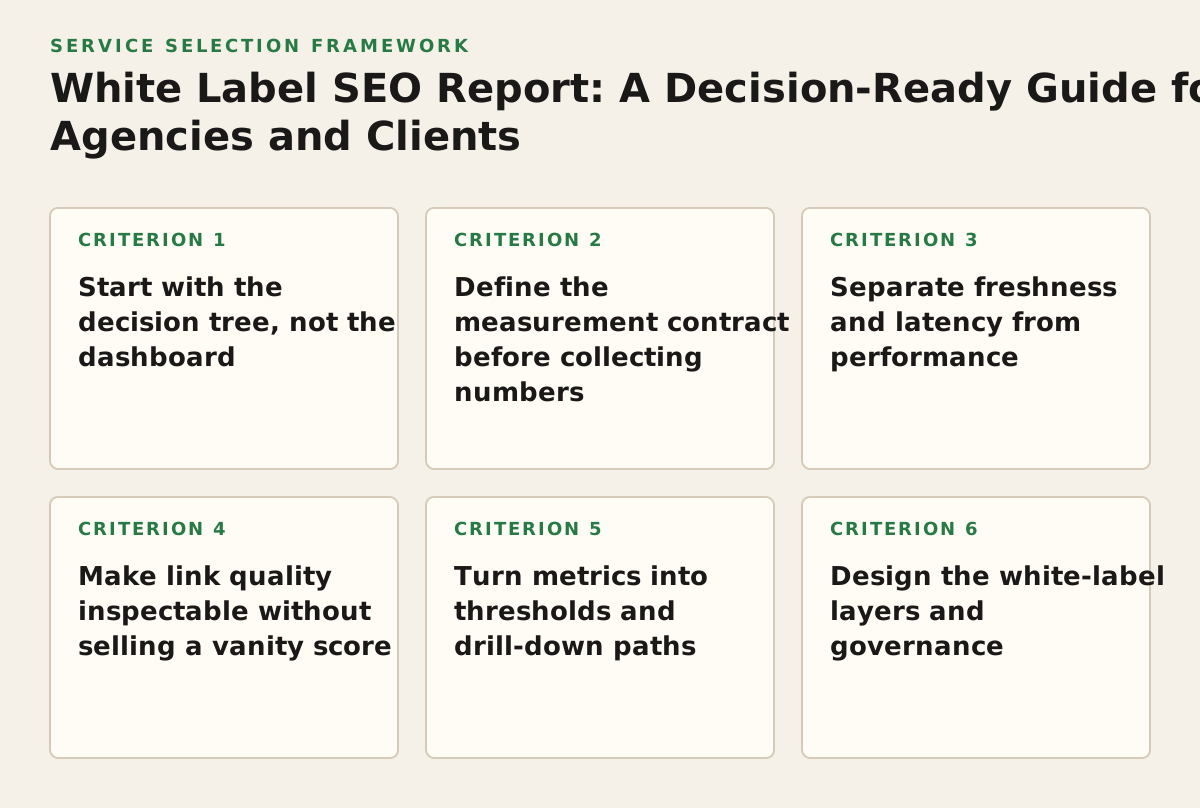
1. Start with the decision tree, not the dashboard
When it applies: Use this principle whenever an agency serves several account types—SaaS, e-commerce, B2B, or iGaming—and needs one white-label format without pretending their goals are identical.
Why it works: Every metric should answer a decision for a named owner. A marketing director may decide whether to fund another quarter. An SEO strategist may decide which page deserves links. A fulfillment manager may decide whether a placement is acceptable. If all three see the same undifferentiated scorecard, the report becomes a meeting transcript rather than a management tool.
Assign each signal to a decision owner
- Client or marketing director: Is organic growth supporting priority products, markets, or leads?
- SEO strategist: Which target pages and query groups need authority, content, internal-linking, or technical work next?
- Account manager: What should be explained this month, and what approval is needed?
- Link-building lead: Are delivered placements compliant, relevant, indexed, and aligned with the brief?
- Analyst: Is a change real, delayed, seasonal, tracking-related, or caused by a reporting definition?
Build the report around a short decision tree: What changed? Does it matter to the agreed objective? What evidence explains it? Who acts by when? This keeps activity metrics—such as outreach attempts or published links—from masquerading as business outcomes.
Failure mode: A single “SEO health score” hides conflicting signals. For example, more referring domains may coincide with declining qualified clicks because links point to informational pages while the commercial category remains invisible.
Implementation example: For a B2B software client, put “non-brand demo-page clicks and qualified organic conversions” in the executive layer. Put “new relevant referring domains to solution pages” in the strategist layer. Put “publisher URL, target URL, anchor, live status, index check, and rel attribute” in the fulfillment layer. The same campaign then has three views, not three contradictory reports.
2. Define the measurement contract before collecting numbers
When it applies: Use a measurement contract before the first campaign report, especially when a white-label agency combines data from Search Console, analytics, rank tracking, CRM exports, and a link inventory.
Why it works: Most reporting arguments are definition arguments. “New links” might mean links ordered, links published, live links discovered, or links still present at the end of the period. “Traffic” might mean sessions, users, landing-page sessions, or clicks from search. Write the meaning, source, time zone, attribution rule, and owner beside every important field.
A minimum contract for each metric
- Name and definition: State exactly what is counted and what is excluded.
- Source and extraction date: Record the platform, property, filters, and last refresh.
- Grain: Specify whether the row represents a domain, URL, query, page, campaign, or month.
- Comparison: Use a declared baseline such as previous period, year over year, or a pre-campaign average.
- Owner and action: Identify who investigates and what threshold triggers that investigation.
For search visibility, preserve the distinction between impressions, clicks, CTR, and average position rather than combining them into an invented “visibility” number. Search Console also supports dimensions such as queries and pages, which makes drill-down possible when a top-line metric changes. The official Search Console API documentation describes the query structure and dimensions available for analysis.
For behavior and outcomes, document the analytics property, conversion event, reporting window, and attribution model. Google Analytics defines attribution settings and reporting concepts separately from Search Console, so a search click and a later conversion should not be presented as though they were the same event. Google’s Analytics attribution documentation is a useful reference when agreeing how credit is assigned.
Failure mode: Changing a definition mid-quarter makes a chart look improved while destroying comparability. A common example is switching from “all organic sessions” to “non-brand landing-page sessions” without marking the break.
Implementation example: Define “delivered placement” as a live, manually reviewed URL containing the agreed link, on a relevant publisher, with the target page reachable and the record dated by first live confirmation. “Retained placement” means the same URL still passes that check at the next scheduled review. Those are separate measures and should never share one label.
3. Separate freshness and latency from performance
When it applies: Use this principle when clients expect a placement published yesterday to appear in rankings or conversions today, or when platforms update on different schedules.
Why it works: A report can be accurate and still be too early to support a conclusion. Freshness tells the reader when data was last updated. Latency tells the reader how long a signal normally takes to become decision-ready. Put both beside the metric so a flat line is not misread as failure.
Show a freshness panel
- Data through: The latest date represented in the dataset.
- Refreshed at: When the report or extract was last updated.
- Expected delay: A plain-language note such as “conversion data may continue changing after the reporting period.”
- Completeness flag: Complete, partial, delayed, or under investigation.
- Decision status: Ready for action, monitor, or do not interpret yet.
Use an illustrative starting policy rather than a universal benchmark: placement QA can be checked shortly after publication, indexing can be checked on a scheduled cadence, and organic landing-page trends can be reviewed only after enough comparable data exists. The exact windows should reflect the site, market, seasonality, and campaign objective. Never present those windows as guaranteed ranking timelines.
Failure mode: Reporting “no impact” when the actual issue is a data gap. Search Console data, analytics processing, CRM imports, and manual placement verification may have different cutoffs.
Implementation example: Add a status beside each monthly outcome: “fresh,” “partial through 28 February 2026,” or “comparison invalid because tracking changed.” If the client asks whether a new authority placement worked after five days, answer with the decision status—“too early for a performance conclusion; placement QA complete”—rather than forcing a positive or negative story.
4. Make link quality inspectable without selling a vanity score
When it applies: Use this layer when the agency is accountable for guest posts, niche edits, authority links, digital PR, or gambling-friendly placements and the client needs confidence in what was delivered.
Why it works: A domain rating or similar third-party score can help sort prospects, but it cannot establish relevance, editorial context, traffic quality, or whether a link is useful to a reader. A defensible report exposes the evidence behind acceptance instead of presenting one composite score as proof.
Google’s spam policies identify link spam as links created primarily to manipulate rankings, including buying or selling links that pass ranking credit. That makes editorial relevance, disclosure, and the link’s intended user value important parts of governance—not just supplier preference. Google Search Central’s link spam policy gives the official framework for this risk.
Use a placement record with review gates
- Publisher relevance: Explain the relationship between the site’s audience and the client’s topic.
- Organic evidence: Record the agreed traffic or visibility checks without implying that a third-party estimate is exact.
- Editorial fit: Note whether the link sits in useful surrounding content or an obviously manufactured block.
- Destination fit: Confirm that the target URL genuinely answers the surrounding topic.
- Link state: Record live status, redirect behavior, rel attributes, and last verification date.
- Risk notes: Flag irrelevant language, excessive commercial anchors, sudden site-wide patterns, or inaccessible pages.
Failure mode: Optimizing for the largest available authority metric leads to expensive placements on sites that have little topical connection or no meaningful audience for the client.
Implementation example: For an iGaming brand, a placement on a sports, finance, or entertainment publisher may be relevant only if the article serves that publication’s audience and follows the agreed legal and editorial constraints. The report should show the topic rationale, target URL, link context, and review outcome—not merely “high authority.” For a SaaS campaign, an expert contribution to a workflow or operations publication may be more useful than a generic marketing site with a higher score.
For agencies that need a deeper fulfillment layer, this evidence can sit alongside an authority link building workflow, while the client-facing page keeps only the decisions and approved evidence needed for trust.
5. Turn metrics into thresholds and drill-down paths
When it applies: Use this structure when a report must lead to an action rather than a passive discussion of whether a line moved.
Why it works: A threshold is not a prediction. It is a pre-agreed trigger for investigation. Label thresholds as illustrative starting policies, then adjust them after the account has a stable baseline.
| Decision and owner | Signal and starting policy | Drill-down | Action triggered |
|---|---|---|---|
| Client: continue or reallocate budget | Qualified organic conversions trend below the agreed baseline for two comparable periods | Segment by brand/non-brand, landing page, market, device, and conversion event | Hold expansion; approve diagnosis with SEO, analytics, and commercial owners |
| SEO strategist: choose the next target page | Priority page gains impressions but qualified CTR remains below its baseline | Inspect query intent, SERP features, title, snippet, content match, and competitors | Test page positioning or content before ordering more links |
| Link-building lead: accept or remediate delivery | Any required placement field is missing, or a live URL fails the agreed QA check | Review publisher, target URL, anchor, link state, and verification date | Request correction, replacement, or documented exception |
| Account manager: escalate data quality | Refresh is late or a definition changed during the reporting period | Check source status, filters, tracking changes, and extraction logs | Mark the comparison invalid and communicate the limitation |
| Content lead: improve asset promotion | Digital PR asset earns attention but relevant referral engagement stays weak | Review referring page context, audience fit, referral landing page, and CTA | Improve the asset or distribution plan rather than simply adding volume |
The threshold should include a direction, duration, segment, and action. “Traffic down” is not a threshold. “Non-brand organic sessions to the three priority category pages are below the established monthly baseline for two complete periods, excluding tracking outages” is closer to an operational rule.
Failure mode: Overreacting to one noisy month. Seasonality, algorithm changes, launches, migrations, and tracking defects can all create a short-term movement that does not justify changing link strategy.
Implementation example: If impressions rise for a target page but CTR falls, first inspect query mix and page-level snippets. If qualified conversions fall while clicks remain stable, inspect lead quality, forms, sales acceptance, and page experience. The action is not automatically “buy more links”; the signal points to a different diagnostic path.
6. Design the white-label layers and governance
When it applies: Use this model when an agency must preserve its brand relationship while coordinating an external fulfillment team.
Why it works: White-label reporting fails when private operational detail is either exposed without context or removed so aggressively that the agency cannot audit delivery. Maintain a source-of-truth inventory and publish a deliberately edited client layer.
A reusable role-based template
- Executive page: objective, outcome trend, material risks, decisions required, and next-period priorities.
- Strategy page: target pages, query groups, content gaps, link rationale, and recommended interventions.
- Delivery page: ordered, in-progress, live, rejected, replaced, and retained placements with QA fields.
- Analytics page: definitions, date ranges, filters, data freshness, attribution notes, and validation warnings.
- Action register: decision, owner, due date, status, evidence, and the next review date.
Assign governance explicitly: the account lead approves the client narrative; the SEO lead approves strategic interpretation; the fulfillment lead certifies placement records; the analyst owns definitions and extraction notes; the client approves priorities and exceptions. A monthly report without a named owner for each layer is a document, not a control system.
Failure mode: The fulfillment partner reports completed links while the account team reports planned links, creating an apparent delivery gap that is really a lifecycle mismatch.
Implementation example: Use one placement ID from brief to live verification. The private inventory can include publisher notes and rejected prospects; the client report can show approved live placements, the strategic rationale, and any exception requiring approval. This lets an agency offer coherent link building services without making the client decipher internal workflow states.
7. Remove dashboard anti-patterns and validate the system
When it applies: Use this review before presenting a new report template or when clients repeatedly ask questions the dashboard was supposed to answer.
Why it works: Reporting systems drift. New tools add duplicate metrics, filters change silently, and the team starts optimizing for what is easy to display. A short anti-pattern review protects decision quality.
Anti-patterns to eliminate
- Metric wallpaper: dozens of tiles with no owner, threshold, or action.
- Unlabeled comparisons: month-on-month numbers used where year-on-year or a campaign baseline is more appropriate.
- Blended traffic: brand and non-brand, countries, devices, and landing-page types merged into one trend.
- False precision: exact-looking third-party authority or traffic estimates treated as audited facts.
- Activity as outcome: outreach volume and published links presented as proof of commercial impact.
- Frozen narrative: automated commentary that says “positive growth” even when the priority segment declined.
Run a validation loop every reporting cycle. First, select three decisions the previous report was supposed to support. Second, record whether an owner actually made each decision. Third, inspect which metric, drill-down, or definition was used. Fourth, log unanswered questions and revise the template. Fifth, check whether the next report shows the resulting action and outcome.
Failure mode: Measuring report consumption—such as page views or presentation attendance—instead of whether the report changed prioritization, approvals, remediation, or budget allocation.
Implementation example: If the last report showed declining non-brand clicks but the meeting still ended with a generic request for “more links,” the system failed to guide action. Add the required drill-down—priority page, query group, CTR, content status, and link history—and require the next meeting to record one of three decisions: content intervention, technical investigation, or link-plan change.
A useful report does not merely make uncertainty look organized. It identifies what is known, what is delayed, what is disputed, and what the team will do next.
Implement the system in five sequenced steps
Do not begin by designing colors or choosing a dashboard platform. Build the reporting operating system in this order:
- Write the decision brief. For each account, name the commercial objective, priority pages or products, target markets, owners, approval points, and decisions expected each month.
- Freeze the measurement contract. Define every headline metric, source, date range, comparison, attribution rule, freshness note, and exclusion. Version the contract when a definition changes.
- Create the evidence inventory. Give every placement, target URL, query group, conversion event, and action a stable identifier. Separate planned, live, verified, retained, rejected, and replaced states.
- Build role-based views. Keep the executive page concise, the strategist page diagnostic, the delivery page auditable, and the analytics page transparent about limitations. Add thresholds and action owners beside signals.
- Run the validation loop for three reporting cycles. Review which decisions changed, which signals were ignored, where freshness caused confusion, and which definitions required explanation. Remove metrics that never influence an action.
For an agency outsourcing fulfillment, the safest starting policy is to require a private QA view before any placement enters the client narrative, then publish only verified evidence and decision-relevant interpretation. That protects the agency’s relationship, gives SaaS, e-commerce, B2B, and iGaming clients a clear audit trail, and keeps authority acquisition tied to relevance rather than volume.
Web Push can support that workflow with hand-vetted guest posts, niche edits, digital PR, authority links, and white-label fulfillment across relevant publishers, including gambling-friendly options for casino and iGaming campaigns. If your team needs the delivery layer behind a decision-ready report, explore what Web Push offers through Web Push.
Authored with NotFair SEO