
Strong pr pitch examples do more than sound polished: they help a marketing manager decide which story to send, which journalist to approach, and what outcome is realistic. This guide gives SaaS, e-commerce, B2B, casino and iGaming teams, plus white-label SEO agencies, a working system for making that decision. You will see pitch structures for original data, expert commentary, reactive stories, and linkable assets, along with the constraints that make each format succeed or fail.
The practical question is not “How do we write a clever email?” It is which story deserves outreach, which publication has a reason to cover it, and whether the requested result is coverage, a citation, a followed link, or simply brand visibility. A pitch cannot rescue a weak angle or an irrelevant recipient. It can, however, make a genuinely useful story easier to understand, verify, and publish.
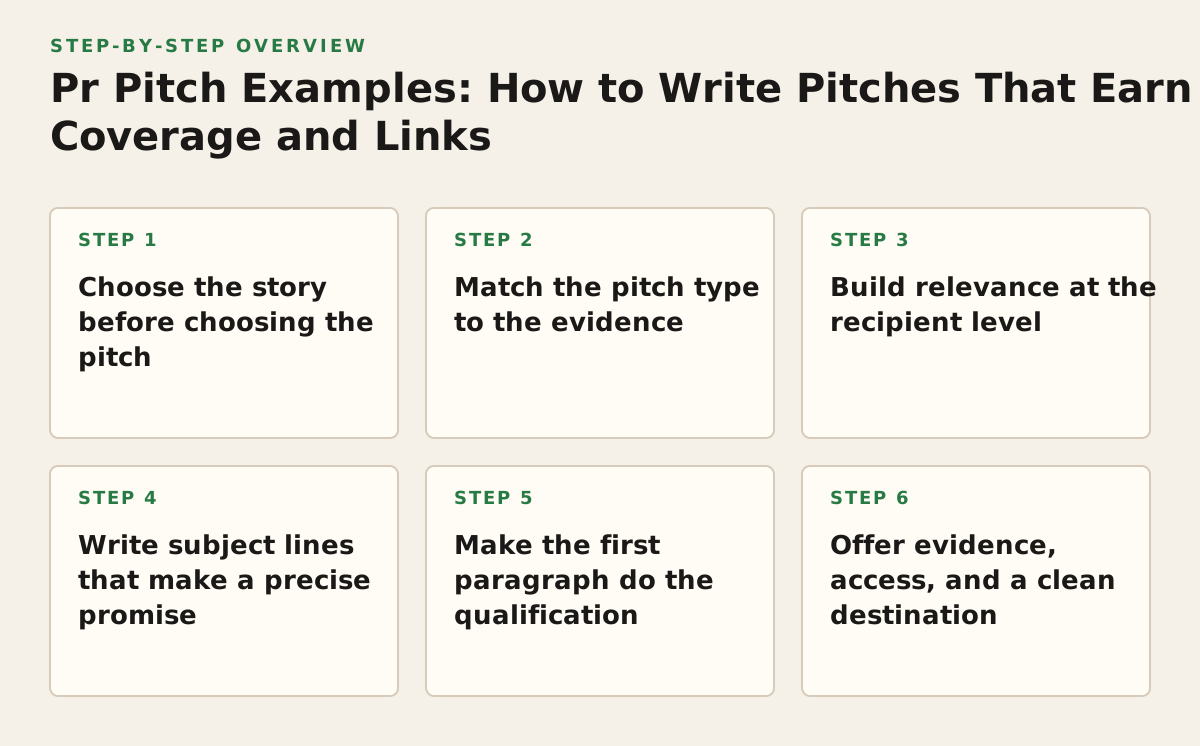
1. Choose the story before choosing the pitch
Use this principle when a team has an asset it wants to promote but has not yet established why a journalist or editor would care. The asset might be a survey, pricing analysis, industry forecast, interactive tool, research report, or expert-led article. Start with the editorial problem, not the URL you want to promote.
Why it works: journalists serve a defined audience and deadline. A pitch becomes more persuasive when it identifies a timely question and supplies material that helps answer it. Google’s Search Essentials advise creating helpful, reliable, people-first content rather than content made primarily to manipulate rankings; that is a useful standard for digital PR assets as well as ordinary SEO content. See Google’s Search Essentials for the broader guidance.
Before drafting, write a one-sentence editorial proposition:
- Audience: who would read the resulting story?
- Tension: what changed, conflicts with expectations, or remains uncertain?
- Evidence: what can you prove with data, documents, or named expertise?
- Usefulness: what can the reader do with the information?
- Destination: which page deserves a citation if the story is published?
Worked example: e-commerce research
Weak proposition: “We published a guide to reducing cart abandonment.”
Stronger proposition: “A review of publicly available checkout journeys from major European retailers shows that delivery-cost disclosure varies sharply before payment, giving consumer editors a concrete comparison to investigate.”
The second idea offers a possible story, a method, and a reason for a specific beat to care. It also avoids promising that the publisher must link to a commercial guide. If the research is genuinely useful, the guide can be offered as background rather than treated as the entire news event.
Failure mode: pitching an asset because it took a long time to produce. Effort is not newsworthiness. A 70-page report with no new finding is harder to place than a two-page dataset that answers a live question.
Implementation rule
Create three possible headlines before writing any email. If all three sound like product copy, pause outreach and improve the asset or change the angle. For a B2B software client, for example, possible angles might include:
- “The workflow delays that cost small finance teams the most time”
- “Why remote approval processes are becoming a reporting risk”
- “What 50 procurement pages reveal about software transparency”
Only after one angle survives this test should you select a journalist, publication, and pitch format.
2. Match the pitch type to the evidence
Different stories need different email structures. Use a data-led pitch when you have a defensible finding, a reactive pitch when a current event creates a narrow opening, and an expert pitch when a credible person can explain consequences or next steps. A resource pitch is appropriate when the asset is unusually useful to a particular audience and can be cited as a reference.
Why it works: the format tells the recipient what kind of editorial decision they are being asked to make. It prevents a common mistake in agency outreach—sending a generic “great content” message to every beat.
| Story type | Use it when | Lead with | Best destination | Typical failure |
|---|---|---|---|---|
| Original data | You have a transparent method and a distinct finding | The strongest result and why it matters now | Research page, dataset, or chart | Hiding the result behind a form |
| Expert commentary | A named specialist can explain a developing story | The exact question they can answer | Expert bio or supporting evidence | Offering vague “insights” |
| Reactive pitch | A current event directly affects the target audience | Speed, relevance, and a usable quote | Short evidence page or statement | Forcing an unrelated brand angle |
| Resource pitch | The asset saves the publication research or production time | What the resource contains and who can use it | Guide, calculator, map, or visual | Calling promotional copy a resource |
| Local or sector analysis | The same issue has meaningful geographic or industry differences | The comparison relevant to that beat | Report with methodology | Making unsupported rankings |
Example: a data-led pitch
Subject: New checkout analysis: where delivery costs appear across European retail sites
Hi [Name],
I noticed your recent coverage of online retail transparency. We reviewed [method and sample] to see when shoppers are shown delivery charges before payment. The clearest finding is [one result], which may be useful for your reporting on checkout expectations.
The data, methodology, and screenshots are here: [URL]. [Expert name], [role], can explain how disclosure affects the customer decision without speculating beyond the sample.
Would this be useful for a future piece? I can send the underlying table or answer questions about the method.
Best,
[Name]
Failure mode: using a data pitch without disclosing the sample, date, or limitations. A journalist may still be interested, but the missing context creates unnecessary verification work and makes a commercial motive look stronger than the evidence.
3. Build relevance at the recipient level
Use this principle when a campaign has a broad media list or when an agency is fulfilling outreach for several clients. Relevance is not merely matching a publication category. It means identifying a specific recent article, recurring column, audience concern, or geographic focus that connects to the proposed story.
Relevance beats volume because a journalist evaluates the pitch in seconds. A technology reporter may cover SaaS, but that does not mean they want a product-led survey. A consumer editor may cover gambling regulation, but a casino brand’s promotional announcement is unlikely to fit unless the story has independent public-interest value.
Research each prospect using a repeatable evidence sheet:
- Publication and section
- Author and current beat
- Two recent, genuinely related articles
- Audience or geographic focus
- Whether the proposed asset adds evidence, a source, or a useful comparison
- Any stated preference about submissions, exclusives, embargoes, or contact method
Google Trends can help a team inspect whether a topic has rising or regional search interest, but interest is not proof of editorial demand. Treat it as a topic validation signal, not as a reason to claim that a story is newsworthy. The official tool is available at Google Trends.
Personalized pitch example
Subject: A regional angle for your reporting on sports-betting advertising
Hi [Name],
Your March 2026 article examined how betting promotions are changing around major sporting events. We have prepared a comparison of ad disclosures across [specific markets], with screenshots, dates, and a methodology note.
The useful angle may be the difference between [specific contrast], rather than another general piece about betting growth. The comparison is here: [URL]. If the regional scope is relevant to your upcoming coverage, [expert] can comment on how operators communicate the restriction without making claims about consumer behavior that the data cannot support.
Would a short data table help?
For casino and iGaming campaigns, the story must be separated from the commercial landing page. Responsible marketing, regulatory context, public data, and transparent methodology are generally more defensible angles than “best casino” or “new betting site” claims. The pitch should make the editorial value clear without asking a news desk to function as an affiliate channel.
Failure mode: personalizing the first sentence while leaving the rest of the email generic. Mentioning a recent article does not create relevance if the proposed asset answers a different question.
4. Write subject lines that make a precise promise
Use this principle when open rates or reply rates are weak, but do not treat a subject line as a substitute for story quality. A good subject line helps the recipient understand the pitch’s topic, format, and possible use. It should be specific enough to qualify interest and restrained enough not to resemble spam.
Subject lines work when they reduce uncertainty. “Interesting research for you” tells the recipient nothing. “Survey: how procurement teams document AI suppliers” identifies the subject and evidence type. Specificity earns the first look; the body must then substantiate the promise.
Useful subject-line patterns
- Data + finding: “Data: delivery fees appear late on many retail checkouts”
- Beat + evidence: “For your remote-work coverage: a comparison of approval delays”
- Expert + timely question: “Comment available: what the new EU rule changes for SaaS buyers”
- Local angle: “A 2026 comparison of energy costs across [region]”
- Resource: “A public dataset for your coverage of [topic]”
Do not imply an exclusive if you are sending the same pitch to many publications. Do not use “urgent” unless there is a real deadline. Do not conceal the commercial connection when it materially affects how the story should be assessed. The Federal Trade Commission’s guidance on disclosures explains why commercial relationships should be communicated clearly in promotional contexts; the relevant principles are outlined in the FTC’s Disclosures 101 guidance.
Implementation example
Suppose a client has produced a calculator showing the potential cost of unused software seats. Avoid: “You’ll love this new tool.” Use: “Calculator: estimate the cost of unused SaaS seats.” The second line states what the resource does without promising a result the recipient cannot verify.
Failure mode: optimizing for curiosity with an exaggerated or incomplete claim. If the body immediately qualifies the subject line, trust is lost before the recipient reaches the evidence.
5. Make the first paragraph do the qualification
Use this principle when the pitch receives opens but few replies, or when recipients respond with basic questions that should have been answered in the initial email. The opening paragraph should establish why this person, why this topic, and why now—without reproducing the entire report.
A practical opening has four parts:
- Reference the recipient’s beat or relevant work.
- State the asset or evidence in plain language.
- Give the most useful finding or editorial angle.
- Explain what the recipient can do with it.
Keep the request modest. “Would the data be useful for a future article?” is easier to answer than “Can you publish our research and link to our homepage?” The second request combines coverage, publication control, and SEO value into one demand.
Example for a B2B software story
Hi [Name],
I’m reaching out because your coverage focuses on how mid-market companies manage procurement. We analyzed publicly available vendor security and pricing pages to identify which details are easiest for buyers to compare before requesting a demo. The clearest finding is that [specific finding]. It may give you a concrete way to examine transparency without relying on vendor claims alone.
The methodology and comparison table are here: [URL]. We can provide the source list and put you in touch with [qualified expert] for questions about the buyer workflow.
This format gives the journalist a reason to continue without claiming that the asset is automatically publishable. It also creates a distinction between editorial usefulness and link acquisition. If a citation is appropriate, the journalist decides how to use it. Your job is to make the source accurate, accessible, and worth referencing.
Google’s documentation describes links as a way for users and search engines to discover related pages, while its SEO guidance emphasizes making content accessible and useful. Those principles support building a page that stands on its own rather than pitching a link as the primary product. See Google’s SEO Starter Guide.
Failure mode: leading with the client’s credentials instead of the recipient’s editorial need. “We are a leading provider” may be true, but it does not tell the journalist what changed or what evidence is available.
6. Offer evidence, access, and a clean destination
Use this principle when the pitch has a credible angle but the asset is difficult to verify or cite. A journalist needs to know what is available immediately: the source page, methodology, downloadable data, contact person, images where relevant, and any restrictions on use.
Reduce verification friction without burying the recipient in attachments. Put the core evidence on a stable public page. Link to the exact chart or section where possible. Name the research date, sample, exclusions, and limitations. If the story depends on an expert, provide their full name, role, and a short description of what they can substantiate.
Minimum evidence checklist
- A descriptive page title and a clear publication date
- Methodology that explains sources, sample selection, and calculations
- Original files or tables when disclosure is safe and practical
- Definitions for ambiguous terms such as “top,” “average,” or “best”
- A contact who can answer factual questions promptly
- Clear separation between findings and interpretation
For an iGaming data project, that might mean linking to the official regulatory documents used in the analysis, recording the date each operator page was checked, and avoiding a claim that a screenshot proves current compliance everywhere. For an e-commerce campaign, it might mean preserving the URLs and dates behind a product comparison rather than presenting a static graphic with no audit trail.
When a placement is paid or otherwise commercially arranged, link attributes and disclosure matter. Google explains the recommended use of rel="sponsored" for paid links and rel="nofollow" in certain cases in its documentation on qualifying outbound links. This is especially relevant when an SEO agency is coordinating publisher relationships: do not promise a particular link attribute unless the publisher’s policy and the arrangement support it.
Failure mode: sending a PDF as the only source. PDFs can be useful, but an inaccessible attachment slows review, hides the methodology from search, and may be blocked by a recipient’s security settings. Use a public HTML page as the canonical evidence source and offer the PDF as a convenience.
7. Follow up with new information, not pressure
Use this principle when a worthwhile pitch receives no response. Silence can mean the story is not relevant, the timing is wrong, the message was missed, or the recipient does not accept unsolicited material. A follow-up should improve the decision by adding a new fact, a sharper angle, or a useful asset.
A reasonable starting policy for an illustrative campaign is one short follow-up after several business days and a final close-out message later if the topic remains relevant. This is a starting policy, not a universal benchmark; breaking news, embargoes, holidays, and publication schedules change the appropriate timing.
Follow-up examples
Follow-up one: Hi [Name]—adding one detail in case it helps: the largest difference in our comparison appears in [specific category], not the overall average. The source table is here: [URL]. If this is outside your current beat, no problem.
Close-out: I’ll close the loop after this message. If you cover [topic] later, the methodology and data will remain available here: [URL]. Please let me know if a different contact handles this subject.
Do not keep emailing a journalist who has asked not to be contacted, and do not rotate through multiple addresses at the same publication to manufacture attention. Repeated low-relevance outreach can damage the client’s reputation and the agency’s deliverability.
Track outcomes beyond links:
- Relevant replies
- Requests for data, comment, or clarification
- Published coverage
- Unlinked mentions
- Referral visits and assisted conversions where measurable
- New journalist relationships or beat intelligence
- Whether the resulting link points to the evidence page or a commercial page
Search Console’s Links report can help site owners inspect which pages and sites Google associates with their site, although it is not a complete record of every link on the web. The official explanation is available in Google Search Console’s Links report documentation.
Failure mode: treating non-response as an invitation to send the same pitch repeatedly. The second message should either make the story more useful or end the sequence respectfully.
How agencies can turn these examples into a repeatable workflow
For a white-label SEO agency or in-house team managing several campaigns, the main challenge is consistency without flattening every story into the same template. Build a brief that separates information the client must provide from decisions the outreach team owns.
Client inputs
- Approved claims and evidence
- Named subject-matter experts
- Target markets and prohibited markets
- Commercial disclosures or regulatory constraints
- Priority pages and acceptable destination URLs
- Brand terminology and review contacts
Outreach-team decisions
- Editorial angle and pitch type
- Publication and journalist selection
- Subject line and opening paragraph
- Whether to offer an exclusive, embargo, or first look
- Follow-up timing and stop conditions
- How to record coverage, citations, and link attributes
Keep the asset and the outreach list separate from the start. A strong report may fit business, consumer, local, or specialist publications through different angles. One universal email usually indicates that the segmentation work has not been done.
For brands seeking authority placements, a campaign can support broader authority link building when the underlying asset is genuinely reference-worthy and the target pages are chosen for users, not only metrics. For teams that need ongoing execution across guest posts, digital PR, and editorial outreach, define the deliverables through a clear link building services brief before the campaign starts.
Implementation plan: build and send the campaign in sequence
Use the following sequence for a new campaign in 2026. The order matters because changing the story after outreach begins creates inconsistent claims and weakens trust.
- Set the commercial and editorial objective. Decide whether the primary outcome is coverage, expert commentary, citations, referral traffic, brand awareness, or a combination. Do not call every outcome a backlink campaign.
- Audit the asset. Check the method, sources, date, limitations, page accessibility, and whether the destination deserves independent attention. Remove unsupported superlatives and ambiguous rankings.
- Write three angles. Create one broad editorial angle, one specialist angle, and one local or sector angle where the evidence supports it. Select the angle with the clearest audience benefit.
- Choose the pitch format. Use data, expert, reactive, resource, or local analysis based on the evidence available. If the asset does not support the format, change the asset rather than overstating it.
- Build a small, qualified prospect list. Record the beat, recent relevant work, audience, contact preference, and reason the story fits. Exclude recipients who cannot reasonably use the material.
- Draft the subject line and opening. State the topic, evidence, and useful finding. Make the first paragraph understandable without opening an attachment or scrolling through background.
- Prepare the evidence pack. Publish the methodology, source table, expert details, and contact information. Confirm that the destination page works on desktop and mobile and does not hide essential evidence behind a form.
- Run a compliance and accuracy review. Check advertising, gambling, financial, health, geographic, and data-protection considerations relevant to the story. Confirm that commercial relationships and paid placements are represented accurately.
- Send in controlled batches. Use small, relevant groups so that a weak angle can be corrected before the entire list receives it. Record the exact version sent to each segment.
- Follow up once with value. Add a new finding, source, quote, or narrower angle. Then close the sequence if there is no response or the recipient declines.
- Document the result. Record coverage, links, mentions, referral traffic where available, and lessons about the beat. Update future targeting based on evidence rather than vanity metrics.
- Reuse the learning, not the email. A successful angle can inspire a new story, but copying the same pitch to a different topic or beat usually removes the relevance that made the first version useful.
When the team needs publisher selection, manual prospecting, or campaign fulfillment beyond its internal capacity, Web Push provides hand-vetted guest posts, niche edits, authority links, digital PR, linkable assets, and white-label support through its Web Push.
Authored with NotFair SEO