
PR package examples are useful when a marketing manager must decide what to commission, what to pitch, and which outcomes are realistic. A “package” should not mean a pile of press releases or a spreadsheet of untargeted contacts. It should be a defined combination of newsworthy assets, audience research, media outreach and measurement built around one business objective.
This guide helps SaaS, e-commerce, B2B, casino and iGaming teams choose between campaign types before spending time on production. It also gives agencies a practical way to scope white-label delivery. The central decision is simple: which story can earn attention from a relevant audience and create a durable search asset? The examples below show when each package applies, why its mechanism works, where it fails, and how to execute it without confusing publicity with guaranteed rankings.
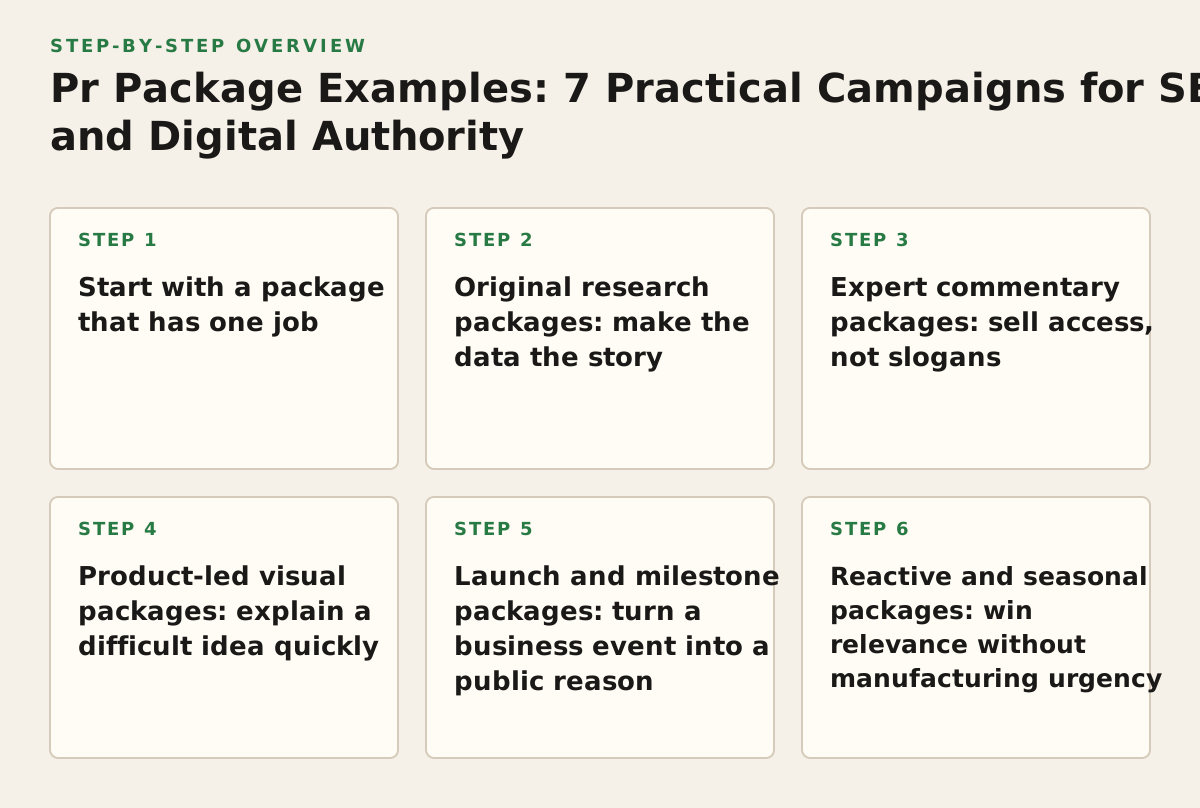
1. Start with a package that has one job
Many PR campaigns underperform before outreach begins because the brief contains several incompatible goals. A company may ask for brand awareness, referral traffic, investor credibility, product launches, rankings and links at the same time. Those goals can coexist, but they require different stories, publications and calls to action.
Choose one primary job for the campaign and make the other outcomes secondary. For example, a research campaign may primarily earn editorial coverage, while a product launch may primarily explain a new capability to prospective customers. This distinction changes the asset, the pitch and the success criteria.
Useful package jobs
- Earn editorial mentions for a credible brand or subject-matter expert.
- Give journalists a reliable source of original data for a specific beat.
- Turn a complicated product capability into a visual, quotable explanation.
- Support a commercial page with relevant contextual references rather than forced anchor text.
- Create a reusable asset that sales, partnerships and content teams can distribute.
Search visibility should be treated as a consequence of useful coverage, not as permission to manufacture links. Google’s Search Essentials identify link spam, manipulative links and content created primarily to manipulate rankings as violations; the official spam policies are the appropriate baseline for campaign approval, not a vendor’s promise of “authority.” Google’s spam policies explain the risk in more detail.
Failure mode: defining success as “get 50 links.” That target encourages irrelevant placements, repeated commercial anchors and thin stories. A journalist does not need a link-building objective; they need a reason to cite, quote or reference something useful.
Implementation example: a B2B software company launches a campaign with the primary job “become a source for operations journalists.” The brief specifies one audience, three questions the research will answer, five approved spokespeople and a secondary goal of earning relevant references to the company’s methodology page. It does not promise a ranking increase or a fixed number of links.
2. Original research packages: make the data the story
Research-led PR is appropriate when a brand can collect, license or analyse information that answers a timely question. It is especially useful for SaaS, e-commerce and B2B companies with access to anonymised internal trends, customer surveys, public datasets or a specialist point of view.
The mechanism is straightforward: original data reduces the journalist’s research burden. A reporter can use a clear finding, methodology note and expert interpretation as the starting point for a story. The strongest packages do not merely publish a large number; they explain what was measured, what was excluded and why the finding matters.
What to include
- A narrowly defined research question tied to a recognisable audience.
- A methodology page stating the sample, date range, geography, definitions and limitations.
- Three to five headline findings, each supported by a chart or downloadable table.
- A short press briefing with quotable interpretation, not just raw statistics.
- A media list segmented by beat, geography and likely use case.
Failure mode: presenting a small or biased sample as a universal market truth. A survey of a company’s own customers can still be useful, but it should be labelled as customer research rather than an industry census. If sensitive information is involved, obtain legal and privacy review before publication; the package should never depend on exposing personal data.
Implementation example: an e-commerce platform analyses anonymised checkout behaviour by product category and publishes a seasonal “cart friction” report. The landing page includes definitions, a CSV download, accessible charts and a contact for methodology questions. Outreach is divided into retail, payments, UX and regional business desks. A pitch leads with one finding relevant to that desk instead of sending the complete report to everyone.
For measurement, connect the campaign page to a properly configured analytics setup and annotate outreach dates. Do not interpret every referral session as a media win: a journalist may cite the report without generating immediate traffic, while a syndicated story may produce visits but little commercial intent.
3. Expert commentary packages: sell access, not slogans
Commentary packages work when a company has people who can explain an active issue quickly and credibly. This is a good fit for cybersecurity SaaS, financial technology, logistics, employment software, legal technology and other B2B categories where journalists need informed reaction to news.
The value is speed plus defensible expertise. A journalist working to a deadline may need a clear explanation, a relevant example and a named expert. A generic statement such as “businesses must adapt” does not help. A useful response explains the mechanism, identifies an implication and acknowledges uncertainty.
Build the expert inventory
- List each spokesperson’s subject areas, geography, language and approved credentials.
- Define topics they can discuss and topics requiring legal, compliance or executive approval.
- Prepare short biographies, headshots, pronunciation notes and direct contact details.
- Create response templates with space for a specific opinion and supporting evidence.
- Set a response service level that the team can actually maintain.
Failure mode: using the package as disguised product promotion. A commentary pitch that spends half its space on features will be ignored when the journalist needs analysis. The remedy is to separate the expert’s interpretation from the product: mention the company only in the biography or a final context sentence unless the product is directly relevant.
Implementation example: a warehouse software provider creates a commentary package for supply-chain reporters. Its operations director can respond to regulation, delivery delays and inventory planning, but cannot comment on competitors or customer-specific incidents. Each response includes one practical consequence, one caveat and a link to a public methodology page where relevant.
A useful outreach record includes the journalist’s question, date sent, response status, quotation supplied, publication and any correction request. This protects the client from repeating stale commentary and gives a white-label agency a clean handoff process.
4. Product-led visual packages: explain a difficult idea quickly
Visual PR is appropriate when a subject is hard to understand through prose alone. Examples include a data-flow diagram, an interactive calculator, a map, a timeline, a comparison tool or a process visualisation. The product may be the source of the expertise, but the asset must be useful to people who are not buyers.
The mechanism is compression of complexity: a good visual lets a publisher explain a process in fewer words while giving readers something to inspect or share. It can also support guest contributions and contextual editorial links when the visual genuinely adds evidence to the article.
Operational requirements
- Define the question the asset answers before choosing the format.
- Make the core result understandable without animation, hover states or audio.
- Provide a static version and descriptive text for accessibility and republishing.
- Document every source, calculation and update date.
- Offer an embeddable or downloadable version only when the licensing terms are clear.
Failure mode: creating an impressive design with no editorial reason to use it. A branded infographic about a broad topic is not automatically newsworthy. Test the concept by writing the headline a publisher could use and naming the audience that would care. If neither is specific, return to the research question.
Implementation example: a SaaS company creates a calculator showing how response-time delays affect a support team’s workload. The page explains the assumptions, allows users to change inputs and includes a text summary of the result. Outreach targets customer-service and operations publications with a short explanation of why the model helps their readers, rather than asking them to “share an infographic.”
Keep commercial destinations separate from the evidence asset. A useful resource can reference a product page where context supports it, but the primary landing page should remain readable and defensible if the brand logo is removed.
5. Launch and milestone packages: turn a business event into a public reason
A launch, funding announcement, partnership or expansion can support PR when it changes something meaningful for a defined audience. The announcement itself is usually the starting point, not the entire package. Editors need the implication: who can now do something different, what has changed in the market, or why the development matters locally or within a specialist sector.
The strongest launch package combines announcement, proof and access. Proof might be a technical explanation, customer use case, executive interview or public documentation. Access could be a demonstration, a founder briefing or a local expert available for questions.
Package components
- A concise announcement page with verified facts and an accurate date.
- A newsroom version with boilerplate, executive biography and media contact.
- A short briefing deck or technical note for specialist reporters.
- Approved screenshots, product footage or diagrams with usage permissions.
- Separate pitches for trade, regional, business and specialist publications.
Failure mode: announcing an internal milestone as if it were a market event. A new office, feature or partnership may matter to the business but not to an external audience. Add public consequence, customer evidence or a credible subject expert; otherwise use the event as owned content rather than forcing media outreach.
Implementation example: a Romanian B2B platform expands into a German-speaking market. Its package includes the verified launch date, local-language product documentation, an interview with the regional lead and data about the operational problem it solves. German outreach focuses on the local business implication, while Romanian outreach addresses the company’s expansion story. The same facts are adapted to each audience rather than machine-translated into one generic pitch.
Do not promise that coverage will contain a followed link. If a publisher chooses to use a link, its editorial policy controls the attribute and placement. Google documents how publishers can qualify links using rel="sponsored", rel="ugc" and nofollow; that makes link qualification a publisher decision rather than a deliverable to guarantee. Google’s guidance on qualifying outbound links sets out those options.
6. Reactive and seasonal packages: win relevance without manufacturing urgency
Reactive PR packages are built around a predictable calendar, recurring report or public conversation. They suit brands with a genuine subject-matter expert and a team capable of approving comments quickly. Seasonal packages may address tax deadlines, holiday shopping, travel demand, sports events, regulatory dates or annual planning cycles.
The mechanism is timing matched to existing demand. A journalist is more likely to need expert context when an audience is already asking questions. But timing alone is not a strategy; the response must add interpretation, data or practical guidance.
Prepare before the trigger
- Create a 90-day calendar of relevant dates, reports and recurring news moments.
- Assign an owner for monitoring and a backup approver.
- Draft evidence-backed viewpoints without pretending to know the future.
- Prepare a one-page expert profile and a current contact route.
- Set stop conditions for tragedies, sensitive incidents and rapidly changing facts.
Failure mode: exploiting a serious event for attention. If the subject involves death, crime, public health or personal hardship, a promotional angle can damage trust and create legal or reputational exposure. A responsible package may instead provide a qualified expert, public information or a correction to misinformation without inserting a sales message.
Implementation example: an online payments company prepares a seasonal fraud-prevention briefing before a major shopping period. The content explains common consumer risks, separates observed data from general advice and provides a media contact. Outreach begins when relevant coverage appears, but the team withdraws any point that depends on an unverified claim.
For casino, betting and iGaming clients, add a stricter review layer. Advertising and media rules differ by jurisdiction and channel. Google’s current advertising policy includes gambling-related requirements and restrictions, so a campaign should be checked against the target country, audience, creative and destination before outreach or paid amplification. Google Ads’ gambling and games policy is a useful official starting point, not a substitute for local legal advice.
7. Responsible iGaming and regulated-market packages
Gambling-friendly PR requires a different risk calculation from ordinary product publicity. The commercial goal may be sportsbook awareness, casino brand trust, affiliate visibility or a safer-gambling initiative, but the story must respect licensing, age restrictions, jurisdiction and responsible-marketing requirements.
A strong package leads with public-interest relevance and verified expertise. Possible angles include the economics of regulated betting, technology that supports identity checks, research into fan engagement, responsible-gambling education or analysis of a sports sponsorship’s local impact. The angle should not encourage vulnerable people to gamble or imply guaranteed winnings.
Controls to include
- Confirm the target country and whether the brand is licensed or otherwise permitted to operate there.
- Review age-gating, responsible-gambling language and destination-page requirements.
- Separate editorial education from promotional offers and affiliate calls to action.
- Document the source of odds, market data and sports or event references.
- Route claims through compliance or legal review before pitching.
Failure mode: buying generic links on sites that happen to accept gambling content. Relevance, audience quality and regulatory fit matter more than a domain metric. A placement on an unrelated or low-quality site can create brand risk and may not help a user understand the subject.
Implementation example: a sportsbook commissions a public report on how fans consume live match statistics. The package excludes betting predictions and promotional odds, uses transparent methodology and includes responsible-gambling information. Outreach targets sports-business, data and technology publications in jurisdictions approved by counsel. Any commercial landing page is kept distinct from the research resource.
For teams seeking contextual placements rather than a full campaign, a carefully scoped authority link building programme can complement digital PR. The same standards should apply: relevant publishers, real audiences, transparent review and no promise that a particular link attribute or ranking outcome will be delivered.
How to select the right PR package
Use the following framework before commissioning creative work. The scores are a decision aid, not a market benchmark. A team can score each criterion from zero to three, where zero means “not ready” and three means “strong.” The package with the highest total is not automatically correct; a legal or evidence red flag should stop the campaign regardless of score.
| Criterion | Question to ask | 0–1 score suggests | 2–3 score suggests |
|---|---|---|---|
| Distinctiveness | Does the idea offer a finding, tool or opinion that is not interchangeable? | Rework the angle before production. | Proceed to asset and headline development. |
| Evidence | Can every important claim be sourced, explained or qualified? | Use commentary or an owned article until evidence improves. | Research or visual package is viable. |
| Audience fit | Can you name the publications and readers who need this? | Do not build a broad media list yet. | Segment outreach by beat and geography. |
| Spokesperson access | Can an approved expert answer questions promptly? | Avoid reactive PR and use a planned campaign. | Commentary or reactive package is viable. |
| Compliance | Are claims, data, licensing and target markets reviewable? | Pause for legal or compliance clarification. | Document controls and proceed. |
| Reuse value | Can the asset support sales, content, partnerships or future pitches? | Reduce scope or choose a more durable asset. | Plan repurposing after launch. |
For a white-label agency, add delivery fields: client approver, language, target countries, publisher exclusions, link policy, reporting format and revision limits. This prevents a creative brief from becoming an unbounded fulfilment request.
Outreach, links and measurement: make the package operational
Outreach should be a relevance exercise, not a mail-merge exercise. Build a prospect list from the story backward: identify the beat, find journalists or editors who have covered the subject, read their recent work and record the precise reason the asset fits. Keep a separate list for regional, trade, national and specialist publications.
A practical outreach sequence
- Prepare the landing page, source notes, media folder and approved talking points.
- Build a segmented list and remove contacts whose remit clearly does not fit.
- Send a short first pitch with one specific finding or angle.
- Follow up only when there is a useful new detail, correction or deadline.
- Respond quickly to questions and keep claims consistent across spokespeople.
- Record coverage, citations, referral traffic, brand mentions and qualified enquiries.
Failure mode: treating publication placement as the only output. Coverage without relevance may produce little business value, while a useful unlinked mention can still build recognition and future journalist access. Report the result by outcome: relevant coverage, referral visits, assisted conversions where measurable, expert invitations, brand-search signals and qualified conversations.
Use Google Search Console’s links report as one diagnostic input, not as a complete valuation of a campaign. Google describes the report as a sample of links to and from a site, which means it should not be treated as an exhaustive inventory or a precise count of every earned mention. Google’s Search Console links report documentation explains its intended use.
For paid placements, sponsorships or influencer-style endorsements, disclosure is a separate obligation from SEO. The US Federal Trade Commission’s guidance says endorsements and material connections should be disclosed clearly and conspicuously when applicable; teams operating elsewhere should check the relevant local rules. The FTC’s advertising and marketing guidance provides the official US reference.
When the package includes placements sourced by an agency, inspect the publisher rather than relying only on a domain score. A workable review includes:
- Evidence of real, relevant organic readership.
- Recent editorial activity and an identifiable site owner or publisher.
- Topic fit, language fit and geography fit.
- Reasonable outbound-link patterns and no obvious link-farm behaviour.
- Clear labelling for sponsored content where required.
Web Push’s link building services are relevant when an internal team needs vetted guest posts, niche edits, authority links or digital PR support, including white-label fulfilment for agencies. The brief should still define the audience, acceptable publishers and campaign job before placement research begins.
A sequenced implementation plan for 2026
Use this order to move from idea to accountable execution. The sequence is deliberately conservative: it protects the asset from being built before the audience, evidence and approvals are clear.
- Write the decision brief. State the primary job, audience, target markets, commercial context, secondary outcomes and prohibited claims. Choose one package type rather than combining every format.
- Run an evidence and risk review. List each planned claim, source, owner and limitation. For iGaming, include jurisdiction, licensing, age, responsible-marketing and destination-page checks.
- Score the concept. Use the selection table for distinctiveness, evidence, audience fit, spokesperson access, compliance and reuse value. Stop or revise any concept with a material red flag.
- Design the smallest useful asset. Build the methodology page, briefing, calculator, research report or newsroom material that answers the audience’s question. Add accessibility, source notes and update dates before outreach.
- Prepare the people and approvals. Confirm the spokesperson, backup contact, response time, legal reviewer and final sign-off. Create language-specific versions where the audience requires them.
- Build a segmented prospect list. Group contacts by publication type, beat, location and likely use. Record the reason each contact fits; remove contacts who cannot plausibly use the story.
- Pitch with one relevant reason. Lead with the finding, expert view or public consequence. Do not bury the story under company history, keyword-rich anchor text or a catalogue of services.
- Manage responses and corrections. Keep a live log of questions, supplied quotes, publication status, links, disclosures and corrections. Withdraw claims that become outdated or cannot be verified.
- Measure after a defined review window. Report relevant coverage, mentions, qualified referral traffic, enquiries, reuse and publisher quality. Treat ranking movement as an observed SEO signal, not a promised campaign output.
- Repurpose only what earned its reuse. Turn strong findings into an expert article, sales briefing, regional version or follow-up pitch. Do not recycle the same press release across unrelated sites.
The best package is usually the one the team can defend six months later: a clear audience, a credible asset, a transparent outreach record and publishers chosen for relevance rather than a vanity metric. For brands that need senior-led digital PR alongside vetted guest posts, niche edits and gambling-friendly placements, Web Push can help plan and fulfil the campaign through Web Push.
Authored with NotFair SEO