
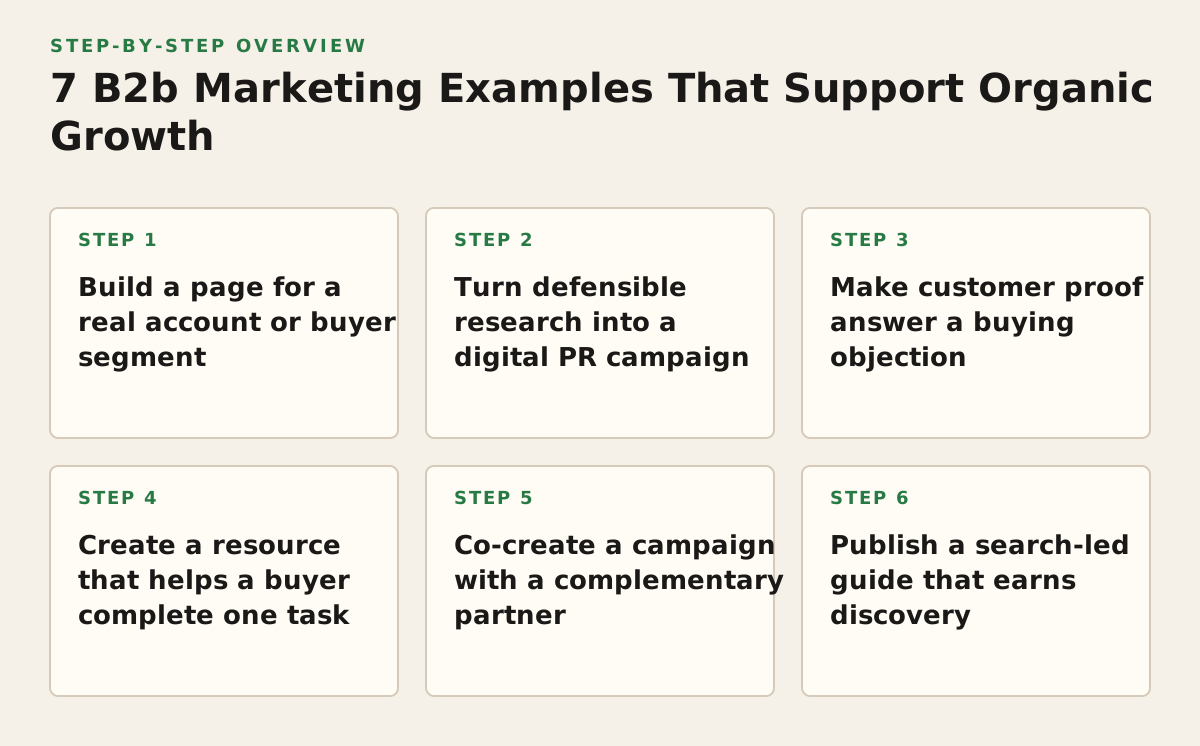
B2B marketing examples worth adapting include account-focused pages, original research, customer proof, practical resources, partner campaigns, search-led guides, and expert contributions to relevant publications. For marketing managers and SEO teams, the useful choice is the example that fits a specific buyer problem, has evidence behind it, and leads to a measurable next step—not simply the format with the broadest reach. These seven patterns show when each applies, where it can fail, and how to make a first version useful to buyers.
1. Build a page for a real account or buyer segment
Use this when a defined group of companies shares a buying problem that a general product page does not explain clearly. This is especially relevant when sales and marketing are pursuing named accounts or a narrow B2B segment. Salesforce’s overview of account-based marketing describes coordinating marketing and sales around selected accounts; the practical point is to agree on the account and buying group before creating tailored material.
Illustrative example: A SaaS company serving multi-market retailers creates a page about keeping product information consistent across regions. It explains the workflow, names the teams involved, answers an implementation concern, and offers a relevant next step. A page for a different sector should change the problem and supporting evidence, not just replace “retailer” with another industry label.
Make relevance specific, not superficial
- Choose a shared problem that affects the segment’s work, rather than relying on company size or industry alone.
- Use substantiated proof such as approved customer details, product documentation, or a clearly described process.
- Connect the page to follow-up so sales knows what question or resource to offer next.
Why it works: buyers can quickly judge whether the offer fits their situation. Failure mode: producing near-duplicate pages that add little beyond a changed heading. Google’s guidance on helpful, people-first content is a useful editorial test: the page should serve an audience need, not exist only to capture a search variation. Start with one distinct use case and ask sales whether the page helps prospects explain their requirements.
2. Turn defensible research into a digital PR campaign
Use this when your team has access to a useful dataset, a repeatable customer question, or a subject where buyers lack a practical reference point. Research can give sales, editorial outreach, and content teams a shared asset—but only if the method and limitations are visible.
Illustrative example: An e-commerce platform analyses anonymised support themes to identify recurring catalogue-management challenges. Its report states what was reviewed, the period covered, and what the support data cannot establish about the wider market. The team also creates a short findings summary that editors and customers can assess without reading the entire report.
- Define the question first so the analysis does not become a hunt for a dramatic headline.
- Describe the evidence, including source, method, date, and limitations.
- Prepare a concise asset such as a chart or briefing that accurately represents the findings.
- Pitch the audience value—why the finding matters to a publication’s readers, not just to your brand.
Why it works: a clearly explained finding gives a journalist, customer, or sales representative something concrete to discuss. Failure mode: presenting a small or self-selected dataset as representative of an entire industry. If the evidence is not strong enough for a finding, create a transparent synthesis of public sources instead and link to the material used.
Keep outreach earned, not engineered
Before pitching, check that the asset is genuinely useful even if no publication links to it. Google’s link spam policies describe manipulative link schemes as a policy concern, so the campaign should pursue editorial interest rather than require or trade for links. A report is not newsworthy simply because it has been published; the pitch needs a specific finding and a credible explanation of its limits.
3. Make customer proof answer a buying objection
Use this when prospects understand the category but need evidence about a particular risk: implementation effort, workflow change, data quality, or internal adoption. A customer story is more useful when it answers one of those questions than when it reads like a general endorsement.
Illustrative example: A B2B software company interviews a customer that replaced a manual reporting process. The story covers the old workflow, the criteria used to select a solution, what changed during implementation, and which outcomes the customer is willing to substantiate. If the customer requires anonymity, explain that clearly rather than implying independent verification.
- Choose one decision question and structure the story around it.
- Separate direct customer statements from the company’s interpretation.
- Explain approved metrics with their time period and measurement basis.
- Offer a useful next step, such as a technical explainer or a discussion of the same implementation concern.
Why it works: a prospect can compare the customer’s decision process with their own. Failure mode: presenting one customer’s outcome as typical or filling a story with unqualified superlatives. To adapt the pattern, ask what nearly prevented the purchase and what the customer would investigate before choosing again. Those details can help another buyer assess fit even when no headline metric is available.
4. Create a resource that helps a buyer complete one task
Use this when a buyer can make progress before speaking to sales—for example, by assessing a process, preparing an internal discussion, or comparing options. A practical resource should provide value on its own rather than hide the answer behind a form.
Illustrative example: An SEO team creates a worksheet for evaluating potential publisher placements. It prompts users to record topical fit, likely reader relevance, editorial standards, and the reason a placement could help the audience. A short guide explains which answers need human review and why one score cannot guarantee a search outcome.
Design the exchange around the asset
For a downloadable version, decide whether a form is worth the friction. LinkedIn’s official Lead Gen Forms overview describes forms used with its advertising products to collect lead information. That capability does not make every download a sales-ready lead: request only information the team can use, explain the follow-up, and let visitors understand the resource’s scope before submitting details.
Why it works: the worksheet solves a small, recognisable task and reveals which questions matter to the user. Failure mode: making a generic template that gathers contacts but does not connect to the team’s expertise or next step. Keep the output understandable and avoid asking for personal information that is unnecessary to deliver it.
If the resource is promoted through paid search or social campaigns, define the action to measure before launch. Google Ads documentation on conversion tracking explains how advertisers can measure actions after an ad interaction. A download can be a useful signal, but it should be checked against later engagement rather than treated as proof of pipeline impact.
5. Co-create a campaign with a complementary partner
Use this when another organisation serves the same buyers and can contribute expertise your team should not claim alone. A partner may add a practical perspective, specialist knowledge, or access to an audience, but the campaign needs a shared reader problem to hold it together.
Illustrative example: A SaaS company and a specialist consultancy run a working session on preparing for a data migration. The software team explains product-side considerations; the consultancy addresses planning and organisational handoffs. They publish a shared checklist afterward, with each party reviewing its own claims and agreeing how attendee questions will be followed up.
- Agree on the audience and question before selecting a format or promoting the partnership.
- Assign ownership for registration, content approval, recording, and follow-up.
- Give attendees a useful takeaway that does not depend on purchasing either partner’s offer.
- Review engagement separately from qualified follow-up so registrations alone do not define success.
Why it works: each party adds a perspective that improves the session for the buyer. Failure mode: selecting a partner for reach and ending up with competing pitches and little practical advice. Draft the central audience question first. If the partners cannot answer it together, revise the topic or choose a different collaborator.
6. Publish a search-led guide that earns discovery
Use this when buyers repeatedly look for explanations, comparisons, or process guidance before contacting a provider. A guide can help a qualified reader understand the decision and connect that information need to a relevant next step. Google’s SEO Starter Guide provides guidance on making content understandable to search engines and useful to people; search visibility alone does not demonstrate that a page answers the buyer’s question.
Illustrative example: An agency serving B2B marketing teams publishes a comparison of guest posts, niche edits, and digital PR. It defines each approach, describes the trade-offs in editorial fit and control, and lists questions to ask when assessing a proposed placement. A separate service page explains the agency’s offer, keeping promotional claims distinct from the comparison.
- Answer the comparison directly before introducing a sales offer.
- Explain trade-offs so a reader can identify when an option is unsuitable.
- Use distinct pages only when they add distinct value, not to target every wording variation.
Why it works: the guide supports an early buying decision and gives sales a shared vocabulary for discussing options. Failure mode: producing interchangeable pages or dressing promotion up as independent advice. Review the page against actual buyer questions and update or consolidate it if it no longer adds a clear answer.
7. Earn expert contributions in relevant publications
Use this when your subject experts can contribute practical knowledge to a publication whose audience overlaps with your buyers. This is a useful pattern for B2B brands and SEO agencies when expertise—not a link—is the reason to contribute.
Illustrative example: A marketing lead writes a guest article for a publication read by e-commerce operators, explaining how to assess whether a proposed publisher reaches the right audience. The article provides a review checklist and a worked, hypothetical assessment. Any author biography or link follows the publication’s editorial rules; the article is not a disguised placement pitch.
Make the contribution worth publishing
- Pitch a narrow, useful argument supported by the author’s relevant expertise.
- Follow the publication’s standards for sourcing, disclosure, and links.
- Keep the reader’s task central and remove claims that exist only to promote the author’s company.
Why it works: readers receive useful expertise in a context they already choose to read. Failure mode: treating guest contributions as a volume tactic or making the link the article’s primary purpose. Adapt the pattern by writing the reader takeaway in one sentence before pitching; if it cannot stand without a company mention, the idea needs more substance.
Prioritise the example that fits your constraint
Use this framework to compare ideas before committing production time. It is a decision aid, not a forecast of traffic or revenue.
| Decision factor | Question to answer | Good fit when |
|---|---|---|
| Buyer need | What task or decision does this address? | The audience and problem are specific. |
| Evidence | What can we substantiate or demonstrate? | Claims have support and limitations are clear. |
| Distribution | How will the intended audience encounter it? | There is a credible channel, partner, or publication. |
| Follow-up | What should an interested buyer do next? | The action fits the content and sales process. |
| Measurement | What observable signal indicates progress? | The team can separate engagement from business impact. |
Implement one campaign in a controlled sequence
Choose the pattern that addresses the clearest current bottleneck: relevance, proof, practical utility, partner reach, or organic discovery. Then proceed in order:
- Name one buyer and one decision. Write down the audience, the question they need to resolve, and what would help them move forward.
- Match the format to the evidence. Use customer proof only with approval; use research only when its method can be explained; create a worksheet only when the task is repeatable.
- Set claim boundaries. Record what the asset can establish, what it cannot, and who must approve customer-specific or sensitive details.
- Plan distribution before production. Identify the channel, owner, partner responsibilities, and follow-up process. Make editorial outreach depend on audience value, not a promised link.
- Choose a primary signal and a quality check. Track a relevant action, then check whether the people taking it match the intended audience and progress to a meaningful next step.
- Review and revise. Ask sales what questions surfaced, inspect where readers disengaged, and decide whether to improve, extend, or stop the campaign based on your own evidence.
For teams assessing link acquisition as part of a broader B2B plan, Web Push describes its work through authority link building and link building services. If that is the specific gap you are addressing, you can review Web Push and verify that the approach fits your audience, editorial standards, and campaign goals.
Authored with NotFair SEO