
b2b link building is the work of earning relevant links to a business website by giving publishers a useful reason to reference its content. For a B2B team, that means choosing a page that helps a specific audience, finding publications that cover the problem, and proposing a contribution that fits their readers. The aim is not to collect links at any cost; it is to build editorially appropriate citations and assess them against the campaign’s real objective.
What B2b Link Building is—and what it is not
A B2B link campaign connects a useful page on your site with an external publication whose readers may benefit from it. The destination might be original research, a technical explanation, a practical guide, or another resource that supports a point in an article. The publisher chooses whether and how to include it. Relevance and reader value are the basis for a sound placement; a link is not automatically valuable just because it is live.
This work can include earning a citation in an existing article, contributing expert material, creating research that publications may reference, or developing an educational resource with a partner. These approaches differ in effort and editorial control. A guest contribution gives you a chance to explain a topic in context, while a citation request asks an editor to consider an existing page. Neither guarantees acceptance, and neither should require the publisher to mislead readers.
Link building is not simply a contest to acquire links from sites with high third-party authority scores. Those scores are screening signals from external tools, not proof of readership, subject fit, editorial quality, or future search performance. Nor does a link guarantee rankings, qualified leads, or sales. Keep SEO indicators separate from business outcomes: a relevant placement may be valuable for referral discovery or credibility even if it produces little measurable traffic.
Google identifies practices such as buying or selling links for ranking purposes, excessive link exchanges, and automated link creation as link spam. Paid placements may be used for advertising, but Google says those links should be qualified appropriately. Review Google’s link spam policies before setting up a program that involves payment, reciprocal arrangements, or scaled outreach.
Why relevance matters to B2B teams
A link can help people discover a resource and help search engines find pages. Google’s SEO starter guide recommends making links crawlable and using descriptive anchor text so people and Google can understand what the linked page is about. That supports a practical standard for B2B campaigns: the link should fit the surrounding discussion and describe its destination clearly, rather than being inserted to carry a preferred keyword. See Google’s SEO starter guide for its guidance on links and anchor text.
In B2B, topical relevance is also about the reader’s work. A specialist operations publication may be a better fit for a workflow guide than a larger general business site that rarely covers operations. The more general publication is not automatically unsuitable; the question is whether that particular article reaches people who have a reason to use the resource. Assess the article and its audience, not just the publisher’s overall profile.
Set the intended outcome before prospecting, because different goals change what counts as a useful placement:
- Discovery: introduce a practical resource to people who are researching a problem.
- Referral: attract visits from a publication’s readers, while recognizing that traffic depends on the article and its audience.
- Credibility: contribute a well-supported explanation or evidence that makes a discussion more useful.
- Search visibility: earn editorially appropriate links without treating any one placement as a guaranteed ranking input.
These aims can overlap, but they are not interchangeable. For example, an in-depth technical citation may support discovery even if the page has a specialized audience, while a broad guest article may attract readers without producing sales-ready visits. Decide which outcome matters most and report the others separately rather than recasting every live link as a business result.
How to build a B2B link campaign
Start with a page that deserves a citation
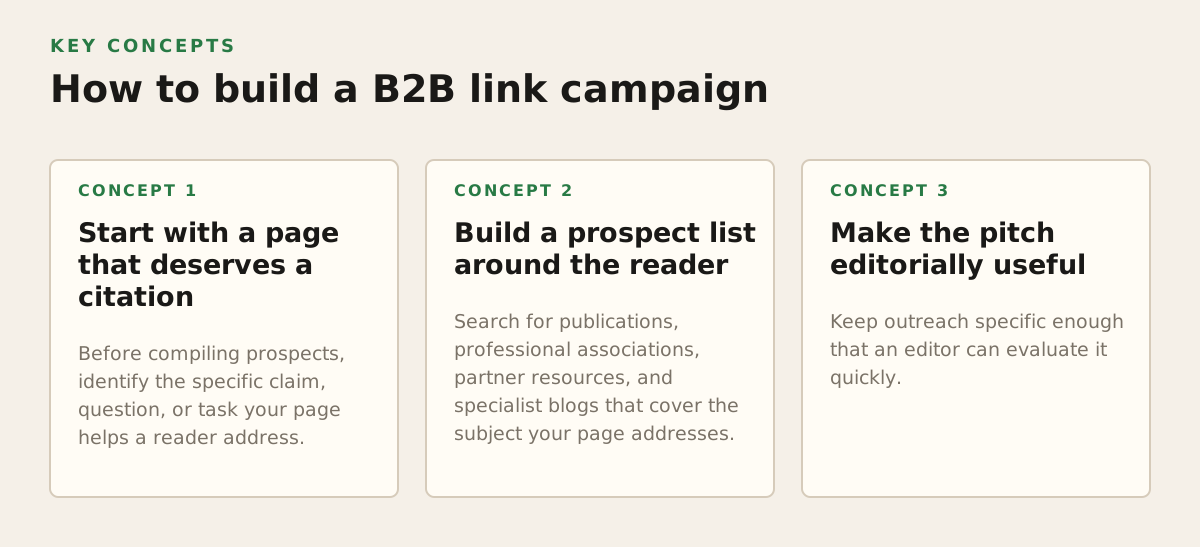
Before compiling prospects, identify the specific claim, question, or task your page helps a reader address. Ask what an editor could point to that is more useful than a product description. Potential foundations include transparent research, a detailed implementation guide, an explanation of a technical process, or a tool that helps a reader complete a defined task. These are examples, not a formula: choose a format your team can support with accurate content.
Improve the destination before outreach if its value is unclear. Explain who it is for, make important claims traceable to evidence, and show how any findings were produced. A narrow dataset should be described as narrow rather than presented as representative of an entire market. If the page has a commercial purpose, make that apparent without turning an educational resource into an unsupported sales pitch. A strong destination gives the publisher a reason to consider the reference; a larger prospect list cannot compensate for a page that adds nothing.
For a SaaS company, a useful destination might explain a workflow or integration concept that buyers need to understand, provided the page accurately describes what the product does. For an agency working for a client, it could be a subject-matter guide that answers a question relevant to that client’s market. In each case, the resource has to stand on its own for readers who are not ready to buy.
Build a prospect list around the reader
Search for publications, professional associations, partner resources, and specialist blogs that cover the subject your page addresses. Look for a specific article, section, or resource page where the information could help. Record why each prospect fits, rather than relying on a domain score or a list exported without editorial review.
A practical prospect record can include the publication, relevant article, intended reader, the resource you would propose, and any visible contributor or editorial guidelines. That makes the decision reviewable by a teammate and exposes weak fits before outreach begins. Useful prospecting patterns can include:
- A technical publication explaining a problem that your documentation clarifies in greater depth.
- An industry association page that curates tools or educational resources for its members.
- A specialist article that discusses a business issue your transparent research can help quantify.
- A partner’s learning resource where a neutral guide adds context for shared customers.
These are ways to identify possible fits, not claims that the publishers will accept a pitch or add a link. Check the current page and standards before contacting an editor. A site’s past acceptance of contributions does not establish that every proposed topic or link is appropriate now.
Make the pitch editorially useful
Keep outreach specific enough that an editor can evaluate it quickly. Refer to the relevant article or coverage area, identify the reader need, and explain what your proposed contribution or resource adds. If you are suggesting an existing page, state where it could fit and why it supports the discussion. Avoid generic praise, repeated templates that ignore the publication, and claims that a link is missing unless you can explain the actual gap.
Do not present a commercial request as neutral editorial advice. If payment, a sponsorship, or another material relationship is involved, handle it transparently and agree on the appropriate link treatment. Do not make exact-match anchor text a condition of a placement: the publisher’s editorial judgment and the reader’s understanding come first. Google’s documentation on crawlable links explains how links should be implemented so that they can be crawled; it is not a reason to dictate wording that does not fit the article.
Assess link quality and keep reliable records
Review the actual publication and live page, not just a prospect spreadsheet. Third-party metrics can help prioritize manual checks, but they do not establish whether a link is editorially suitable or useful to the intended audience. Apply a consistent review to each placement:
- Subject fit: Does the publication cover the topic, and does this page reach a plausible audience for the destination?
- Editorial context: Does the link support a relevant point, or is it isolated in an unrelated bio, footer, or list?
- Publisher quality: Is the content written for readers, with a clear editorial purpose and identifiable authorship where appropriate?
- Destination accuracy: Does the linked page substantiate or explain the nearby claim?
- Commercial treatment: Is a paid or otherwise qualified link labeled appropriately for its context?
- Ongoing condition: Is the page accessible, and has its content or link changed since publication?
Google advises using rel="sponsored" or rel="nofollow" for advertising and sponsorship links; it also describes rel="ugc" for user-generated links. The details are in Google’s guidance on qualifying outbound links. Track a paid placement as paid, rather than reporting it internally as an ordinary earned editorial citation because it appears in an article.
Reader-facing disclosure is a separate check. In the United States, the FTC explains that a material connection between an endorser and a brand may need clear disclosure, depending on the circumstances. Review the FTC’s endorsement guidance and seek appropriate advice for the situation. A search-engine link attribute does not by itself settle whether a reader-facing disclosure is needed.
Keep a record of the live URL, destination page, anchor text, publisher, date, placement type, and any required qualification or disclosure. Google Search Console’s Links report can help site owners inspect links Google has found, but it should not be treated as a complete, real-time record of every placement. Google describes the report’s scope and limitations in its Search Console Links report documentation.
Where campaigns fail—and how to prevent avoidable risk
Volume targets can reward the wrong work
If a team evaluates a campaign mainly by the number of placements, it can reward easy inventory over relevance and editorial quality. That is a problem for in-house marketers and agencies alike: a delivery report may look complete while the links point to weak destinations or appear in contexts that do not reach likely readers. Define what counts as an acceptable placement before outreach, including topic fit, page context, destination, and link treatment.
Weak assets create a different failure mode. When a page offers no distinct value, outreach often falls back on generic claims or repeated requests for keyword-rich links. Improve the resource, choose a better destination, or do not pitch it. More follow-up does not make an unconvincing page more citeable.
Misaligned expectations need an operating policy
Agencies and clients should agree on the trade-offs before work begins. For example, a demand for a fixed volume of placements on narrowly defined publications may conflict with a requirement that every link be earned editorially. Clarify what happens when a publisher declines, changes a link, or offers a sponsored option; also decide which placements are excluded from the campaign’s definition of earned links.
For white-label fulfillment, the agency still needs enough placement information to audit the work and report it accurately to its client. In-house teams should retain the same evidence so a future team member can understand why a publisher was selected. If a supplier cannot provide the live placement and enough context to review it, the team cannot reliably verify that the work met its own criteria.
Third-party authority metrics can obscure these issues. A strong score does not make unrelated content relevant, and a smaller specialist publication may be a closer editorial fit. Treat metrics as prompts for review, not as proof of quality or a guarantee of rankings. Use observable page-level criteria and keep the reason for each placement on record.
Choose a process your team can defend
Before launching, write down the audience, eligible destination pages, acceptable publisher types, outreach standards, link qualification rules, and reporting fields. Pilot the workflow with a manageable set of prospects and review the actual decisions: which pages were pitched, why each publication fit, and whether the final context matched the proposal. The appropriate scope depends on your content, editorial capacity, and risk tolerance; there is no universal placement quota that makes a campaign sound.
At review time, compare results with the original goal. Check whether links remain live and appropriately qualified, whether the content served a real reader need, and whether any referral or relationship value emerged. Do not retrofit a success story to whichever metric happened to move. If outside fulfillment is appropriate, Web Push describes its work as link building for brands and agencies; review link building services and authority link building to understand the relevant service pages, then use Web Push to discuss whether the approach fits your campaign.
Authored with NotFair SEO