
Broken link building services find relevant pages that link to unavailable resources and ask their publishers to consider a suitable replacement. They can fit an SEO agency, SaaS company, ecommerce brand, or other marketing team with a genuinely relevant resource to promote. Before hiring, establish which type of broken-link work the provider will do, what your team must supply, how placements will be judged, and how the fee handles work publishers may decline.
Choose the broken-link service that fits your situation
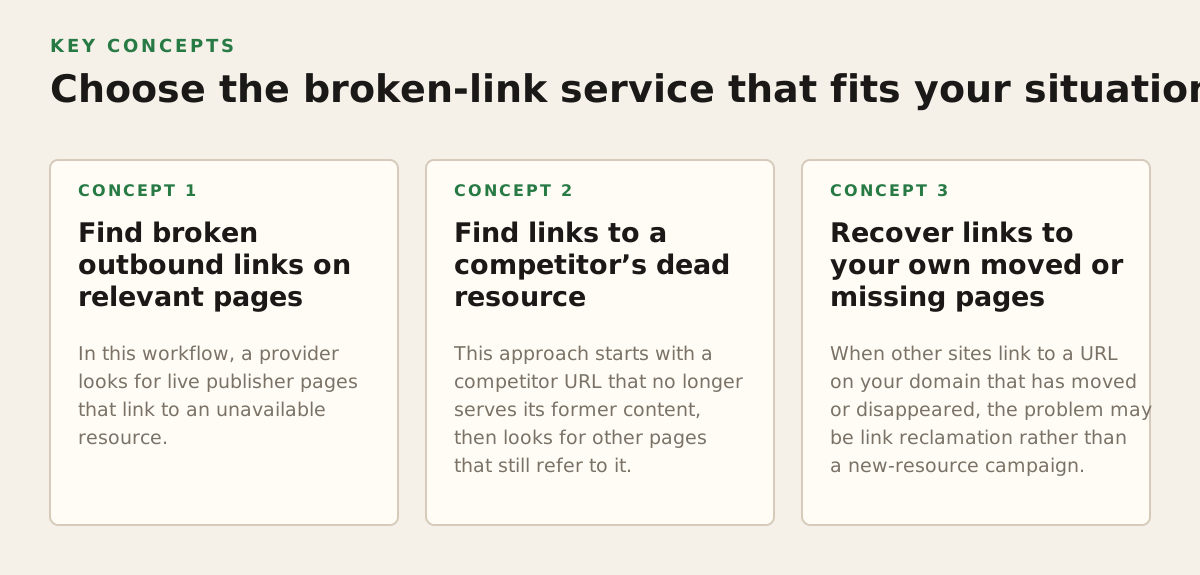
The phrase can describe several distinct jobs. A provider’s proposal should say which one it covers, what counts as an opportunity, and whether content creation or technical fixes are included. Otherwise, a broad prospect list can make routine outreach look like a specialized service.
Find broken outbound links on relevant pages
In this workflow, a provider looks for live publisher pages that link to an unavailable resource. It assesses whether one of your existing pages is a sound substitute, then contacts the publisher to suggest considering a correction. It is most suitable when your resource addresses the same need as the missing one—not merely when it shares a keyword or general subject.
For example, a SaaS company with current setup documentation might be a plausible replacement for a missing guide to the same integration task. A general product page is less likely to be a useful substitute just because it belongs to the same company. The publisher decides whether to make a change, so this is an outreach opportunity, not a guaranteed placement.
Find links to a competitor’s dead resource
This approach starts with a competitor URL that no longer serves its former content, then looks for other pages that still refer to it. It can help a team identify a topic for a replacement resource, but it does not establish that the old page’s value can be reproduced. Before outreach, review both the linking page’s context and what the unavailable page covered. If your team needs to build or improve a resource first, include that work and approval time in the plan.
Recover links to your own moved or missing pages
When other sites link to a URL on your domain that has moved or disappeared, the problem may be link reclamation rather than a new-resource campaign. The right response could be restoring the page, redirecting the old URL where appropriate, or asking a publisher to correct the link. Coordinate with whoever manages your site before paying for outreach: fixing the source URL may address the problem more directly.
Keep adjacent work distinct. Unlinked brand-mention outreach and ordinary guest-post pitching may be useful in their own right, but neither is automatically broken-link building. Ask the provider to label each opportunity type separately in its scope and report.
Check the research, qualification, and outreach workflow
A useful campaign moves through identification, human review, approval, contact, and verification. Ask for the handoffs in writing. The goal is not simply to collect URLs; it is to make sure the proposed replacement is appropriate, the publisher page is worth contacting, and your team can inspect what was done.
Verify that the link is actually broken
A status code is one clue, not a complete qualification decision. A 404 response means the server cannot find the requested resource, but the provider still needs to inspect whether the destination is relevant and whether the error appears temporary or access-related; see MDN’s explanation of HTTP 404. The HTTP specification describes 410 Gone separately, so a provider should report what it observed rather than treating all errors as interchangeable (RFC 9110, section 15.5.11).
Ask how ambiguous cases are handled: for example, a destination that loads for the provider but not for a crawler, a page blocked by a login, or a domain that redirects somewhere unrelated. A useful record identifies the destination URL, the referring page, the check date, and the observed issue. Where the evidence is uncertain, the provider should flag the case for review rather than call it a confirmed opportunity.
Qualify both sides of the proposed replacement
The referring page should be live, relevant to your audience, and suitable for your brand. Your proposed page should answer the same question or provide a comparable resource. A publisher’s resource list citing a missing research report might make sense for a current, well-sourced report; a sales page with no equivalent information would be a weaker fit. Have a subject-matter reviewer assess cases where accuracy, regulated wording, or product claims matter.
Set the exclusions before research begins. For casino, betting, and iGaming teams, define acceptable publisher types, markets, and content contexts explicitly. For agencies fulfilling work under a client’s name, agree who approves prospects and copy, who communicates with the client, and how campaign notes are handed over. Do not assume that a provider’s broad topical filter covers a client’s compliance or brand requirements.
Keep outreach specific and reviewable
Outreach should explain the broken destination and why the suggested resource may help the publisher’s readers. It should ask the publisher to consider an update, not imply an obligation to link. Google’s spam policies describe link spam as including practices intended to manipulate search rankings; use that guidance when reviewing proposed tactics, payment arrangements, and any incentive tied to links.
Before authorizing a full campaign, review a small sample of prospects and proposed messages. This is a practical way to expose differences in how your team and the provider interpret relevance. Keep the approved criteria and rejected examples in a shared record, so the same borderline cases do not have to be debated repeatedly.
- A publisher tutorial links to a missing setup guide, and your current documentation covers that same task.
- A resource page cites an unavailable report, and your team has a comparable report with clear sourcing.
- A site links to an old URL on your domain, and the correct page now exists at a new address.
- A dead link appears in a context your brand cannot use, even if the topic appears relevant at first glance.
Compare service types against the buyer’s actual need
Use the decision table to distinguish the work before comparing proposals. A provider may combine approaches, but each should have its own scope, approval path, and reporting. The trade-offs matter: a technically fixable URL, for example, may not need a publisher outreach campaign at all.
| Buyer need | Service type to consider | Main trade-off |
|---|---|---|
| Promote a useful existing page that closely replaces missing content | Broken outbound-link prospecting | Publishers choose whether to update; weak topic matching makes the suggestion less credible. |
| Find sites that still cite a competitor’s unavailable resource | Competitor dead-page reclamation | A replacement may require content work and may not match the original resource’s usefulness. |
| Address links pointing to a moved or missing page on your own site | Own-link reclamation | A site-side correction or redirect may be the better first step; outreach cannot replace technical diagnosis. |
| Build links without a suitable replacement resource | Another separately scoped link-building approach | Assess that work on its own merits rather than accepting a broken-link label for ordinary pitching. |
Evaluate a proposed placement on the page itself, not just on a domain score. Google explains that links help it discover pages and recommends making links crawlable and understandable; that guidance supports inspecting the link and its context, not assuming that a placement will improve rankings (Google Search Central: Make your links crawlable).
- Relevance: Does the referring page address the same audience or need as the proposed destination?
- Publisher suitability: Does the page appear useful to readers, and does its context fit your brand and client rules?
- Placement integrity: Is the link present in the stated context, and does the report describe it accurately?
- Risk controls: Can the provider explain how it handles paid placements, link attributes, excluded sites, and disputed placements?
For white-label buyers, add a delivery check: can your team audit the referring page, destination, and outreach status before the report reaches the client? A concise, verifiable report is more useful than a large list of prospects that leaves the agency to reconstruct what happened.
Compare pricing models and define the budget scope
Providers may quote a fixed campaign fee, a retainer, a per-placement amount, or a hybrid. These models distribute uncertainty differently, so compare the work and incentives rather than assuming one structure is inherently better. A fixed fee may pay for research and outreach even when publishers decline. A per-placement arrangement makes the definition of a qualifying placement especially important. A retainer needs clear responsibilities, reporting, and review points.
Normalize proposals before comparing totals. One quote may cover research and outreach only; another may include content production, client approvals, or follow-up. Ask which tasks create additional fees and what happens when prospects are rejected, publishers do not respond, or a live link later changes. Replacement, monitoring, and cancellation terms are matters to agree in the contract, not features to assume.
For budget planning, distinguish the campaign fee from internal effort. Your team may need to prepare a replacement resource, check technical issues, review publisher suitability, approve outreach, and assess the final report. The workload depends on how much usable content already exists and how strict your approval requirements are; ask the provider to identify those dependencies rather than supplying a budget figure without a defined scope.
- What research, outreach, follow-up, content, and monitoring are included?
- Is payment tied to activity, accepted prospects, live placements, or a combination?
- How does the agreement define a qualified prospect and a reportable placement?
- What happens if your team rejects a prospect or a link disappears after delivery?
- Which content, technical changes, approvals, and client communications are your responsibility?
Set measurable success criteria and reporting requirements
Separate work completed from outcomes that neither party fully controls. A provider can report prospects reviewed, outreach sent, publisher responses, and links verified as live. A buyer can judge whether the resulting placements meet agreed standards. Neither a count of emails nor a count of links alone establishes business impact.
Define the fields required in the delivery log before launch. At minimum, ask for the referring page, destination page, surrounding context, date checked, placement status, and any reported link attribute. Include a reason when a prospect or placement fails your criteria. Google Search Console’s Links report documentation can help you inspect links Google associates with your site, but use it as one reference rather than a substitute for the campaign’s own record.
If you want to study organic performance, agree in advance which pages or query groups matter and what other site changes should be tracked. Links are only one possible influence on search performance, so do not treat a placement count as proof of ranking or revenue impact. A provider should describe what it will measure and avoid promising results it cannot control.
- Activity: qualified prospects reviewed and outreach actions reported.
- Delivery: links confirmed live and checked against your written acceptance criteria.
- Quality: share of reviewed placements accepted, with reasons for rejection recorded.
- Business context: agreed page or query observations, interpreted alongside other site changes.
Interview the provider before approving a campaign
Ask questions that require the provider to show its reasoning, not just describe its process in broad terms. An anonymized example or a sample report can reveal whether the team distinguishes a relevant replacement from a convenient URL.
- “Can you walk us through a sample prospect?” Ask to see the dead destination, the live page linking to it, why your resource fits, and what could disqualify the opportunity.
- “How do you verify a broken link?” Ask how the team handles temporary errors, access restrictions, redirects, and unclear cases, and what evidence appears in the report.
- “When do we approve prospects and outreach?” Confirm who sees the target URLs and copy, how exclusions are applied, and how changes to criteria are recorded.
- “What exactly counts as delivery?” Request the report fields and definitions for live links, redirects, attributes, and later removals.
- “How does the fee affect your choices?” Ask what is billable, how a placement dispute is resolved, and whether the model rewards volume over suitability.
- “Which tactics do you refuse?” Ask how the provider handles paid or otherwise commercially arranged placements, and be wary of guaranteed rankings or evasive answers about publisher relationships.
Red flags include treating every dead URL as qualified, offering a ranking guarantee, reporting only a domain metric, or resisting review of individual pages. For an agency, reluctance to explain handoffs or provide auditable client reporting is another reason to pause. Prefer a scoped pilot or reviewable first batch only if the commercial terms make its limits clear; do not treat a proposed volume or timetable as an industry benchmark.
Web Push publishes information about link building services and authority link building. To discuss whether a specific broken-link workflow fits your requirements, contact Web Push.
Authored with NotFair SEO