
Buying backlinks for SEO is the process of paying for legitimate work that helps a relevant publisher discover, evaluate, and sometimes reference your content—not simply paying for a URL that passes ranking signals. The distinction matters. A useful campaign may pay for research, content production, outreach, editorial review, digital PR, or access to a publication’s audience. It should not depend on automated placements, private blog networks, spun articles, or pages created only to manipulate search results.
For an SEO agency, SaaS company, e-commerce brand, B2B marketer, or casino and iGaming operator, the practical question is therefore not “How many backlinks can we buy?” It is: which editorial opportunities are worth funding, what evidence supports their quality, and how should the risk be controlled?
What Buying Backlinks For SEO actually means
A backlink is a hyperlink from one website to another. It can send referral visitors, help people discover a page, reinforce a relationship between two businesses, and provide context around a cited resource. Search engines may also use links as one input when discovering and evaluating pages, but no link is a guaranteed ranking lever.
Buying a backlink becomes problematic when the payment is primarily for manipulating organic rankings and the placement has no credible editorial reason to exist. Google’s spam policies explicitly include buying or selling links that pass ranking credit, excessive link exchanges, and large-scale article campaigns with keyword-rich links among link spam examples. See Google’s official spam policies for the current guidance available in 2026.
That does not mean every paid publishing arrangement is automatically deceptive. A publisher may charge for reviewing a contributed article, producing a sponsored feature, or distributing a piece of research. The important implementation question is how the link is qualified and whether the page is useful without the SEO transaction. Google’s documentation on qualifying outbound links identifies rel="sponsored" for paid or sponsored links, rel="ugc" for user-generated content, and rel="nofollow" when the publisher does not want to endorse or associate the link.
Four arrangements that are often confused
- Editorial outreach: you propose a genuinely useful resource, expert contribution, or data point to a relevant publisher. The publisher decides whether it fits.
- Guest posting: you provide an article or collaborate on one for a publication whose audience overlaps with your market. The topic and link should serve the article first.
- Niche editing: a publisher updates an existing, relevant page with a reference to a resource that improves the page. The edit must be real and contextually defensible.
- Sponsored placement: you pay for exposure or publication under agreed commercial terms. Disclosure and link qualification should reflect the arrangement.
These formats can overlap. A paid contribution can still be useful to readers, while an unpaid editorial link can still be low quality if it appears on an irrelevant or abandoned site. Payment is not the only quality variable; relevance, editorial judgment, audience value, transparency, and link attributes all matter.
For teams buying fulfillment rather than doing outreach internally, the deliverable should be defined as a process and a standard, not a raw number of links. A credible brief might specify relevant publishers, minimum organic-traffic evidence, topical boundaries, acceptable anchor language, review rights, and what happens when a proposed placement fails inspection.
Why links matter—and what they cannot do
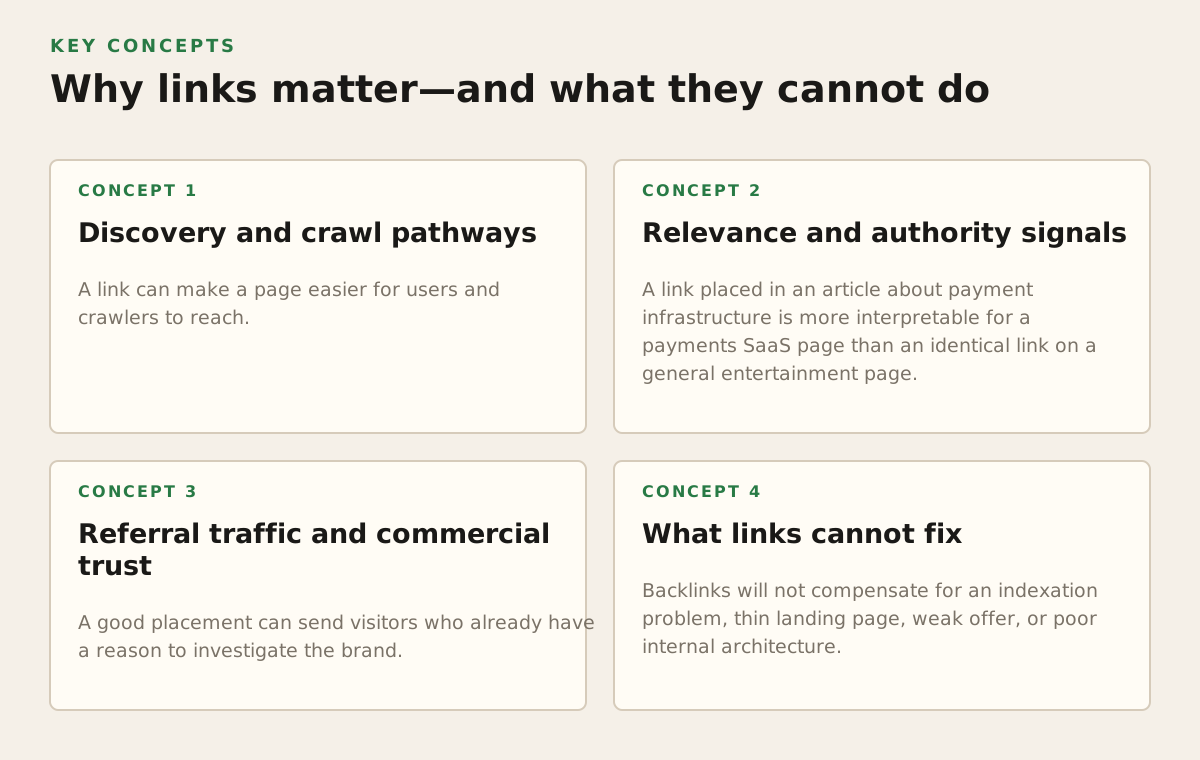
Links can contribute to organic growth through several mechanisms, but each mechanism has a different time horizon and different evidence requirement. Treating them as interchangeable leads to poor buying decisions.
Discovery and crawl pathways
A link can make a page easier for users and crawlers to reach. Google recommends that links be crawlable, normally using an anchor element with an href attribute, and explains how descriptive anchor text helps communicate the linked page’s subject in its documentation on crawlable links. That is a technical baseline, not a promise of ranking improvement.
For a new B2B report, a deep link from a relevant publication may create a discovery route that a homepage-only campaign would miss. For a large e-commerce site, links to a category guide or buying resource may support discovery of informational assets, while product pages still require strong internal linking, accessible rendering, and useful content.
Relevance and authority signals
A link placed in an article about payment infrastructure is more interpretable for a payments SaaS page than an identical link on a general entertainment page. Relevance exists at several levels:
- Topic relevance: the publication regularly covers the subject.
- Audience relevance: its readers could plausibly become customers, partners, or sources.
- Page relevance: the surrounding article naturally introduces the destination.
- Geographic or language relevance: the market matches the site’s expansion plan.
Third-party metrics such as Domain Rating, Domain Authority, or estimated organic traffic can help prioritize a prospect list, but they are not search-engine scores. A DR 60 site with no meaningful readership in your market may be less valuable than a DR 35 specialist publication that reaches the right decision-makers. Metrics are screening tools, not proof of editorial quality.
Referral traffic and commercial trust
A good placement can send visitors who already have a reason to investigate the brand. This is particularly relevant for SaaS comparison content, B2B thought leadership, e-commerce buying guides, and iGaming content aimed at a defined licensed market. Referral value is measurable with analytics, tagged campaigns where appropriate, and assisted-conversion analysis.
Traffic should not be used as a vanity substitute for fit. A large audience that cannot buy your product, operate in your jurisdiction, or understand your language may create visits without commercial value. Conversely, a specialist publication may deliver few clicks but introduce a partnership, journalist inquiry, or qualified lead. Decide whether the campaign is for discovery, authority, referral demand, or all three before selecting publishers.
What links cannot fix
Backlinks will not compensate for an indexation problem, thin landing page, weak offer, or poor internal architecture. Google’s Search Essentials describe broad technical, spam, and key best-practice requirements; they are a better starting point for diagnosing a site than immediately ordering placements. Review the official Search Essentials guidance before treating link acquisition as the primary constraint.
Before funding outreach, check:
- Whether the target URL is indexable and returns the intended status code.
- Whether the page satisfies the search intent behind its target query.
- Whether important pages are reachable through internal links.
- Whether the page has a clear conversion path for the intended audience.
- Whether the brand can support claims with evidence, especially in regulated sectors.
How a defensible backlink campaign works
A reliable campaign is a chain of decisions. Each stage removes a different failure mode. Skipping prospect qualification to reach a monthly link count usually creates a larger cleanup problem later.
1. Start with an asset and a business objective
Choose the page or asset before choosing the publisher. A linkable asset could be an original dataset, a practical calculator, a technical guide, a research-backed comparison, a glossary, or a genuinely useful tool. A commercial page can also be promoted, but it is harder to place naturally unless it answers a clear editorial need.
State the intended outcome in operational terms:
- Increase qualified organic visibility for a non-brand topic.
- Earn referral visits from a specific industry audience.
- Support a product category entering a new European market.
- Give sales teams a credible research asset to share.
- Build topical coverage around a SaaS feature or B2B problem.
For a casino or betting brand, add compliance constraints before outreach: permitted geographies, approved terminology, licensing context, responsible-gambling language, and prohibited claims. Gambling-friendly does not mean every placement is appropriate. A relevant publisher still needs to fit the brand’s market and legal review process.
2. Build a publisher qualification model
Do not accept a spreadsheet of domains without examining the pages where links would actually appear. A publisher-level metric can hide a weak section, expired audience, or commercial placement pattern. Inspect recent articles, author pages, category structure, outbound links, and evidence of real readership.
An illustrative starting policy—not a universal benchmark—could require the following before approval:
| Check | Approval question | Reason |
|---|---|---|
| Topical fit | Would the article make sense without the client link? | Reduces forced placements and irrelevant associations. |
| Organic visibility | Does the site show credible, non-brand search activity? | Separates active publishers from metric-only domains. |
| Editorial pattern | Do recent posts show varied authors, topics, and sources? | Reveals scaled guest-post inventory. |
| Outbound links | Are links selective, descriptive, and contextually placed? | Limits association with link-selling pages. |
| Audience and market | Does the readership match the language and geography? | Improves referral and commercial relevance. |
Web Push describes its placements as hand-vetted on DR 30+ publishers with real organic traffic, excluding link farms and PBNs. That stated standard is a useful example of how a provider should frame its inventory, but the buyer should still request the proposed URLs and review them against the campaign brief. A threshold is a filter, not a guarantee.
3. Match the format to the opportunity
Use guest posts when a new article can answer a publication’s audience question. Use niche edits only when an existing page genuinely benefits from the added reference and the publisher controls the content. Use digital PR when the asset has a newsworthy angle, data, expert access, or a strong public-interest hook. Use an authority link building when the campaign needs selective coverage from authoritative, contextually relevant publications rather than volume.
For agencies, white-label fulfillment introduces an additional decision: whether the supplier handles strategy, prospecting, writing, negotiation, quality assurance, or only one production stage. Define ownership clearly. If the reseller cannot inspect domains before client approval, the supplier’s quality control is effectively the agency’s reputation risk.
4. Make the link editorially natural
Anchor text should describe the destination without making an unnatural promise. Brand anchors, naked URLs, partial-match phrases, and ordinary language are usually easier to integrate than repeated exact-match commercial terms. The surrounding sentence should explain why the resource is useful.
Consider this difference:
- Forced: “Companies should use the best affordable CRM software for small businesses, available here.”
- Natural: “Teams comparing implementation options can use the vendor’s CRM migration checklist to map data fields before switching.”
- Editorial citation: “The report’s methodology and underlying dataset are documented in the research notes.”
The destination must fulfill the promise made by the anchor and surrounding copy. If the article discusses a neutral research method but the link leads to a sales page with no supporting material, both reader trust and placement quality suffer.
5. Record evidence before and after publication
Maintain a placement record containing the domain, live URL, target URL, anchor, publication date, link attribute if visible, article topic, language, country, and quality notes. This is particularly important for white-label campaigns, where the agency may need to explain every placement to its client.
Measure outcomes in layers:
- Delivery: Was the approved page published and is the link live?
- Quality: Does the page remain indexable, relevant, and free from obvious spam signals?
- Visibility: Did the target page and topic cluster gain impressions or coverage over an appropriate period?
- Business value: Did referral users engage, convert, request information, or assist a later conversion?
Do not attribute every ranking movement to a link order. Search demand, competitors, internal changes, content updates, seasonality, and technical events can move performance at the same time. Use a documented comparison window and avoid declaring success from one short-term position change.
Where backlink buying breaks down
The most dangerous campaigns are not always the obviously cheap ones. A polished site can still sell placements at scale, and a high metric can still coexist with irrelevant content. Risk assessment must look at patterns, not just presentation.
Link farms, PBNs, and de-indexed inventory
A network becomes suspect when many domains share thin templates, identical ownership clues, recycled content, unnatural interlinking, or a common commercial purpose of selling ranking links. A private blog network may have attractive metrics while offering little independent audience value. Avoid any provider that promises guaranteed ranking positions or unlimited authority without showing the actual publication process.
Over-optimized anchors and repetitive destinations
If every placement uses the same money keyword and points to one commercial URL, the pattern is easy to interpret as manufactured. Variation should not be a disguise for manipulation; it should reflect how real writers cite resources. A campaign for a multilingual brand should also avoid translating anchors mechanically when the local phrase does not sound natural.
Irrelevant or risky topical adjacency
A general site may accept articles about finance, health, casinos, software, and home improvement in the same week. That breadth is not automatically disqualifying, but it requires scrutiny. For regulated verticals, proximity to misleading claims, unlicensed operators, adult content, or questionable financial advice can create brand and compliance exposure beyond SEO.
For gambling and iGaming campaigns, ask:
- Is the publisher permitted or suitable for the intended country and language?
- Does the article avoid promises of guaranteed winnings or misleading bonuses?
- Can legal and responsible-gambling reviewers approve the copy?
- Does the surrounding site contain content that conflicts with the operator’s standards?
- Is the link pointing to an informational resource, an approved landing page, or a restricted commercial destination?
Paid content without appropriate disclosure
Disclosure obligations depend on the jurisdiction, relationship, and nature of the promotion. In the United States, the Federal Trade Commission’s official endorsement guidance explains principles for making material connections clear in advertising and endorsements. That is not a universal legal answer for every European market, so brands should route sponsored content through local counsel or compliance review where necessary.
SEO teams should separate two questions: whether a page can generate referral and brand value, and whether a link should pass ranking credit. If the publisher is paid for the placement, the link attribute and disclosure should be agreed before publication, not changed after a client notices the arrangement.
Vendors that sell a number instead of a process
A monthly promise such as “50 backlinks” says little about relevance, editorial review, replacement policy, or retention. Before contracting, ask for:
- A sample approval workflow with real URLs redacted only where necessary.
- The criteria used to reject publishers.
- Who writes, edits, fact-checks, and approves content.
- How the supplier handles a removed link or changed page.
- Whether the client can veto a domain without penalty.
- What reporting shows beyond domain metrics.
Any provider refusing to disclose the basic nature of its process is asking you to buy opacity. That may be unsuitable for a marketing manager accountable for brand safety or an agency that must defend its work to multiple clients.
How practitioners should apply the model
The correct campaign design depends on the audience, asset, market, and risk tolerance. A SaaS company entering Germany should not use the same brief as an English-language casino affiliate, and a white-label agency needs more operational controls than a single in-house brand.
For SaaS and B2B companies
Prioritize problem-led assets over generic product announcements. A migration checklist, implementation benchmark, integration guide, or original survey gives an editor a reason to cite the page. Build a target list around the job the reader is trying to complete, not only around the software category.
An illustrative campaign sequence could be:
- Publish a detailed resource explaining a costly operational problem.
- Prepare three angles for different audiences, such as technical, finance, and operations.
- Offer expert commentary or a useful data point to relevant trade publications.
- Use guest contributions to answer adjacent questions without turning every article into product copy.
- Track referral engagement, assisted conversions, and mentions separately from rankings.
This approach usually creates fewer forced links and more opportunities for genuine editorial context. It also gives sales and customer-success teams assets they can use outside search.
For e-commerce brands
Do not limit outreach to product URLs. Editors are more likely to cite buying guides, original trend data, sizing resources, repair instructions, or category explainers. Earn links to those assets, then strengthen internal links to relevant collections and products.
Seasonality changes the timing. A retailer promoting a holiday guide after the buying period has passed may still earn evergreen value, but it has missed the strongest editorial window. Build content and outreach calendars around the publication cycle, inventory realities, and the time required for editorial review.
For casino, betting, and iGaming brands
Begin with market and compliance mapping. Decide which countries, languages, product categories, and pages are permitted. A gambling-friendly publisher is only useful if its audience and editorial standards fit the operator, affiliate, supplier, or B2B technology provider.
Prefer informative angles that can withstand scrutiny: payment-method explainers, safer-play resources, regulatory education, odds mathematics, data studies, or technology analysis. Avoid unsupported claims about winnings, “risk-free” outcomes, or guaranteed returns. For an affiliate, distinguish clearly between editorial comparison and commercial promotion; for an operator, confirm that the destination and wording have passed the relevant internal review.
For agencies buying white-label fulfillment
Write the supplier brief as though another agency will audit it. Specify target markets, excluded topics, preferred languages, client vertical, acceptable anchor patterns, review stages, reporting fields, and replacement expectations. Keep client approval before publication when the brand is regulated or especially reputation-sensitive.
Use a simple traffic-light system:
- Green: relevant topic, credible organic activity, clean editorial pattern, approved destination, and natural article angle.
- Amber: acceptable relevance but incomplete traffic evidence, unusual commercial density, or unclear disclosure requirements; hold for review.
- Red: PBN indicators, guaranteed rankings, scraped content, irrelevant placement, excessive exact-match anchors, or refusal to share the live URL before reporting.
Reporting should make the client’s decision easier, not bury weaknesses under screenshots. Include the live link, target page, anchor, publisher rationale, publication date, market, and a concise quality note. If a placement is removed, redirected, noindexed, or materially edited, log the event and apply the agreed remediation.
When to choose a different tactic
Backlink acquisition is not always the next best investment. If the site has unresolved technical errors, weak information architecture, no worthwhile assets, or no capacity to review claims, fix those constraints first. Digital PR may be better than routine guest posting when the brand has original data and a newsworthy narrative. Internal linking and content consolidation may outperform another external placement when authority already exists but is poorly distributed.
For teams that need a broader operating model, link building services can cover prospecting, content, outreach, and quality control; the right scope depends on which parts your team can reliably own.
Recommended policy: buy the work required to earn relevant editorial attention, not a guaranteed quantity of ranking links. Approve publishers individually, use transparent link qualification where payment is involved, protect regulated brands with compliance review, and judge the campaign by page quality, audience fit, referral value, and durable organic progress together.
Web Push provides senior-led guest posts, niche edits, authority links, digital PR, linkable assets, and white-label fulfillment across Europe, including gambling-friendly publisher options; Web Push is the natural next step if you need a vetted campaign built around those standards.
Authored with NotFair SEO