
Guerilla marketing examples worth adapting use surprise, participation or an unexpected setting to make an audience notice and share a message. For SaaS, ecommerce and B2B teams, the practical choice is whether a public activation can reach the right people more effectively than a conventional campaign—and whether you can execute it safely, get permission and measure what happens after the attention.
The four campaigns below show distinct mechanics: a public trigger, a staged surprise, a behavior-changing installation and a coordinated mass event. They are historical examples, not templates to copy literally. The aim is to borrow the mechanism, then fit it to your audience, brand and risk tolerance. “Guerrilla” is also used loosely: a campaign can be unconventional without being low-cost, unplanned or genuinely guerrilla.
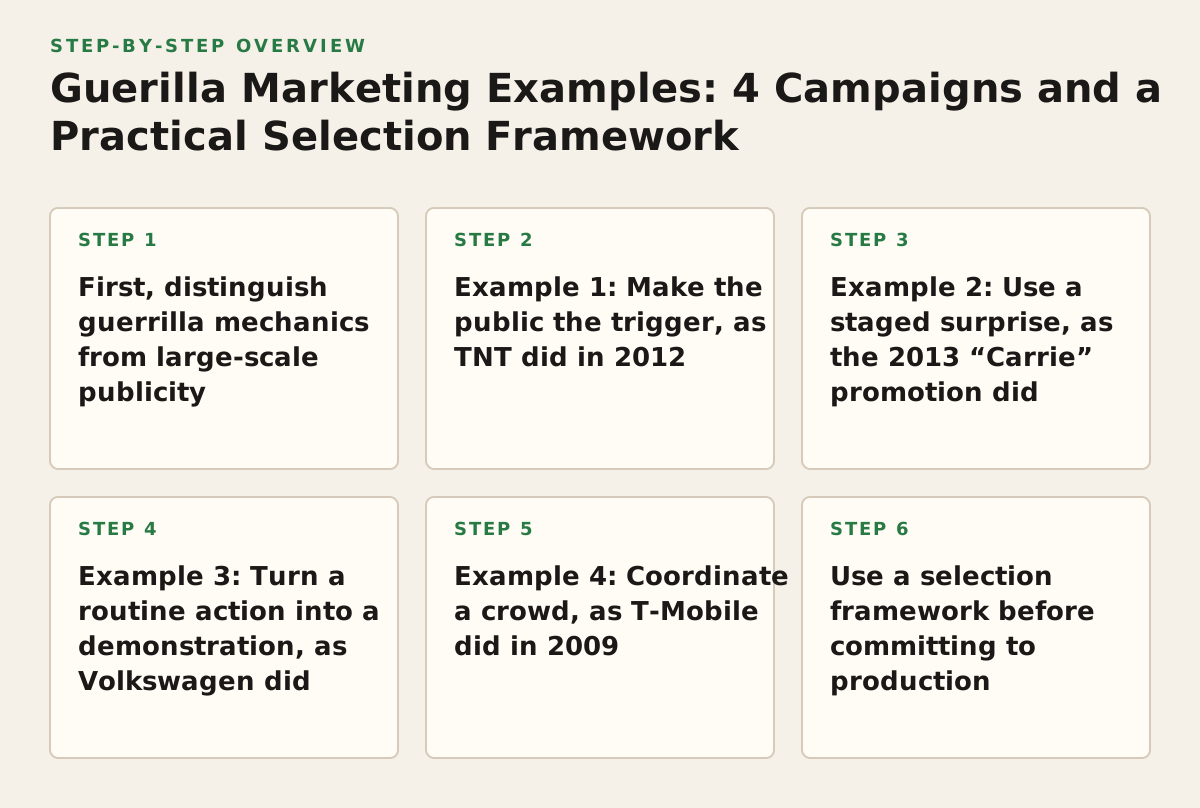
First, distinguish guerrilla mechanics from large-scale publicity
A useful working definition is an unexpected, context-sensitive encounter designed to earn attention or participation beyond the placement itself. It may happen in a physical space, online or across both. The label is less important than identifying what makes the idea work: its setting, audience action, reveal, and reason people might pass it on.
Do not treat every successful campaign as a guerrilla example. Red Bull Stratos was a highly produced brand event; the Ice Bucket Challenge was a social fundraising phenomenon; and “Dumb Ways to Die” was a public-awareness campaign. They may offer lessons in reach or participation, but they are not clean examples of guerrilla execution. Classify the mechanism, not the campaign’s fame.
Use four questions to assess a candidate idea
- Is the setting part of the idea? If the creative works unchanged as a standard display ad, the location may be incidental.
- Does the audience do something? A useful action can be a press, choice, contribution, photo or conversation—not just a view.
- Can the encounter travel? A clear visual or story gives witnesses a reason to explain it to someone who was not there.
- Is the surprise fair? Confusion, humiliation, obstruction or perceived danger can turn attention into backlash.
This distinction matters to organic-growth teams. Earned coverage is not a placement guarantee, and a stunt that produces mentions does not automatically produce relevant links or qualified demand. Plan for a credible story and a useful destination, then assess whether publishers and prospects actually respond.
Example 1: Make the public the trigger, as TNT did in 2012
TNT’s “A Dramatic Surprise on a Quiet Square” placed a large button in a Belgian town square. When someone pressed it, performers staged an escalating action around them. The public square and the passerby’s choice were central to the reveal, making this a clearer guerrilla-style activation than a conventional brand spot. The campaign video documents the setup and performance (TNT’s campaign video).
Why this mechanism works—and where it breaks
The participant creates the opening scene. That makes the event easier to retell: someone pressed a button, then something unexpected happened. The format is useful when a product has a simple, demonstrable promise—speed, convenience, discovery or a surprising result.
Failure mode: an unexplained button can feel like a safety risk, while performers or equipment can block access to a public place. The joke may also be legible to onlookers but irrelevant to the intended buyer.
Adaptation example: a project-management SaaS brand could invite conference attendees to press a “handoff” button that reveals a deliberately tangled task board becoming a clear workflow. Keep the action inside a permitted event area, explain participation before recording, and connect the reveal to a product demonstration rather than asking strangers to infer the benefit.
Example 2: Use a staged surprise, as the 2013 “Carrie” promotion did
To promote the film “Carrie,” Sony Pictures arranged a staged telekinetic incident in a coffee shop, with actors and practical effects surprising customers. The hidden setup, visible reaction and escalating spectacle formed the content of the promotion itself; it was not simply a film trailer placed in an unusual channel. The Sony Pictures video of the Carrie coffee-shop stunt shows the format.
Choose the reveal before you design the prank
This pattern can work when a brand story depends on a visible before-and-after or a memorable demonstration. It is a poor fit when the product requires lengthy explanation or when the surprise relies on making people fear they are in danger.
- Write the audience’s likely first interpretation of the scene. If it is “I might be hurt,” redesign it.
- Make the brand or product connection clear at the reveal, not only in the later edit.
- Decide how you will handle consent for identifiable footage and how someone can decline participation.
Failure mode: the video can overshadow the offer, or the people involved can feel tricked once cameras and brand intent become clear. A B2B adaptation might stage a “before and after” of a messy data handoff at an opt-in industry event, using consenting participants and a clearly marked demonstration zone. The reveal should illustrate a real workflow problem, not imply that a fictional stunt proves a product’s performance.
Example 3: Turn a routine action into a demonstration, as Volkswagen did
Volkswagen’s “Piano Staircase,” part of its Fun Theory campaign, transformed a staircase into playable piano keys. The idea invited people to take the stairs by making the ordinary route more engaging. The Fun Theory project page presents the installation as a behavior-change experiment. Its guerrilla-style value lies in putting the message into the activity itself, rather than only describing it in an advertisement.
This is most applicable when your audience already performs a routine that your product can make easier, clearer or more rewarding. An ecommerce brand might create an opt-in event display where shoppers sort sample products using a simple preference quiz, then see a tailored recommendation. A SaaS team could let conference visitors experience a short workflow challenge before showing how its software organizes the same steps.
Make the interaction useful, not just photogenic
- Choose one behavior that connects directly to the product or campaign message.
- Keep the action short enough to understand without staff explaining every step.
- Offer a non-digital alternative if the activation collects responses or directs people to a device.
Failure mode: a playful installation can attract participants without changing what they understand or do next. Define the intended response in advance—such as requesting a demo, trying a feature or remembering a message—and provide a clear next step. Do not present a sponsored activation as independent evidence that a product causes a particular outcome.
Example 4: Coordinate a crowd, as T-Mobile did in 2009
T-Mobile’s 2009 Liverpool Street station dance brought a large group of dancers into a busy London railway station, where commuters could encounter the performance unexpectedly. The T-Mobile Dance campaign video illustrates how choreography, a recognizable public setting and a reveal can turn an event into shareable campaign material. This is closer to a planned public spectacle than a small, covert intervention, but it demonstrates a useful guerrilla principle: the audience encounters the message in a place where it was not expecting an ad.
For a marketing team, the transferable element is coordinated participation—not the crowd size. A B2B brand could invite customers and staff to contribute one short answer to a live industry question at a conference booth, then assemble the responses into a visual display. That is more credible than staging a “spontaneous” event that is actually a fully controlled brand production.
Failure mode: a public performance can interrupt commuters, venue operations or accessibility. Another risk is confusing reach with relevance: a striking event may be watched by many people who will never buy the product. Secure venue approval, keep routes clear, and make the audience or business question specific enough to judge whether the attention is useful.
Use a selection framework before committing to production
Choose the mechanic that fits your objective, not the one that looks most dramatic in a brainstorm. Score candidate ideas against the criteria below before commissioning production. Treat the scoring as an internal comparison tool, not a forecast of coverage, traffic or sales.
| Decision factor | Ask this | A stronger fit looks like | Warning sign |
|---|---|---|---|
| Audience fit | Will likely participants include buyers, users or relevant intermediaries? | A trade event, customer community or location they already visit | The idea depends on a large but unrelated crowd |
| Message clarity | Can a witness explain the point in one sentence? | The interaction visibly demonstrates one benefit or issue | The stunt needs a long caption to make sense |
| Permission and safety | Who controls the place, filming and participant experience? | Named approvals, clear access, consent and a stop plan | “We’ll ask forgiveness later” is part of the concept |
| Shareability | Can someone who was absent understand the story? | A strong reveal plus a simple explanation and useful landing page | The idea only works for people at the scene |
| Business value | What action would make the campaign useful after attention? | A relevant demo, resource, conversation or measurable brand response | Views are the only success measure |
| Reputation risk | Could the surprise embarrass, frighten or exclude someone? | Participants can opt in, opt out or understand the reveal promptly | Confusion or distress is treated as proof of impact |
For a campaign intended to support SEO, separate coverage goals from link goals. A news mention may not link; a link may not send qualified referral traffic. Build a useful page or asset that gives a publisher a real reason to cite it, and evaluate relevance and editorial context rather than chasing raw link counts. Google’s spam policies describe link spam practices to avoid, including manipulative link schemes; publicity should not be conditional on followed links.
If creators or participants receive compensation or another material benefit to endorse a product, account for disclosure obligations. The U.S. Federal Trade Commission explains disclosure expectations for social media endorsements in its Disclosures 101 guide. Requirements vary by market, so have local counsel review the campaign where it will run.
Sequence the work from objective to follow-up
- Set one business objective. Decide whether the campaign is meant to prompt product trials, start sales conversations, build awareness in a defined market or earn editorial attention. Pick one primary outcome; record secondary signals separately.
- Choose the audience and setting. Identify where that audience can encounter the idea without creating disruption. For a B2B campaign, a relevant conference or partner venue may beat a busy city square. Confirm who has authority to approve the activity.
- Write the mechanism in one sentence. State what a person sees, what they do, what changes and what the brand wants them to understand. If this takes a paragraph, simplify before developing creative.
- Review safety, consent and accessibility. Check the venue’s rules, filming approach, participant choice, crowd flow and fallback plan. If the concept depends on misleading people about danger or restricting access, change the concept.
- Build the distribution path. Prepare the landing page, press materials and spokesperson before launch. For digital PR, make the underlying resource useful on its own; a campaign page should add context, evidence or data instead of merely repeating an announcement. Teams planning earned authority can connect that work to authority link building and their wider link building services program.
- Define measurement before launch. Track the chosen outcome alongside attendance or engagement. For coverage, record relevant mentions, referral visits and editorial links separately; do not treat one as a proxy for the others.
- Review and follow up. Check participant feedback and coverage, correct misunderstandings, and document what to change before repeating the format. Reuse the mechanism only if it reached the intended audience without unacceptable operational or reputational costs.
For a campaign that needs credible editorial links as well as attention, Web Push can help assess the link-building and digital PR work around the idea. Keep the activation responsible and newsworthy on its own merits; links should follow editorial judgment, not be the price of participation.
Authored with NotFair SEO