
A guest post is an original article contributed to another website in exchange for editorial value, usually with a relevant link to the contributor’s site. Done properly, it is not an article-for-link transaction disguised with different language: it is a useful contribution published on a legitimate site whose audience, subject matter, and editorial standards make the citation sensible.
That distinction matters to SEO agencies, SaaS marketers, e-commerce teams, B2B companies, and casino or betting brands. A placement can look successful in a spreadsheet while delivering little value if the publisher has no real audience, the article is interchangeable, or the backlink exists only because money changed hands. The practical job is to create a contribution that deserves publication and to select a page where the resulting reference is credible, relevant, and sustainable.
What a Guest Post actually is
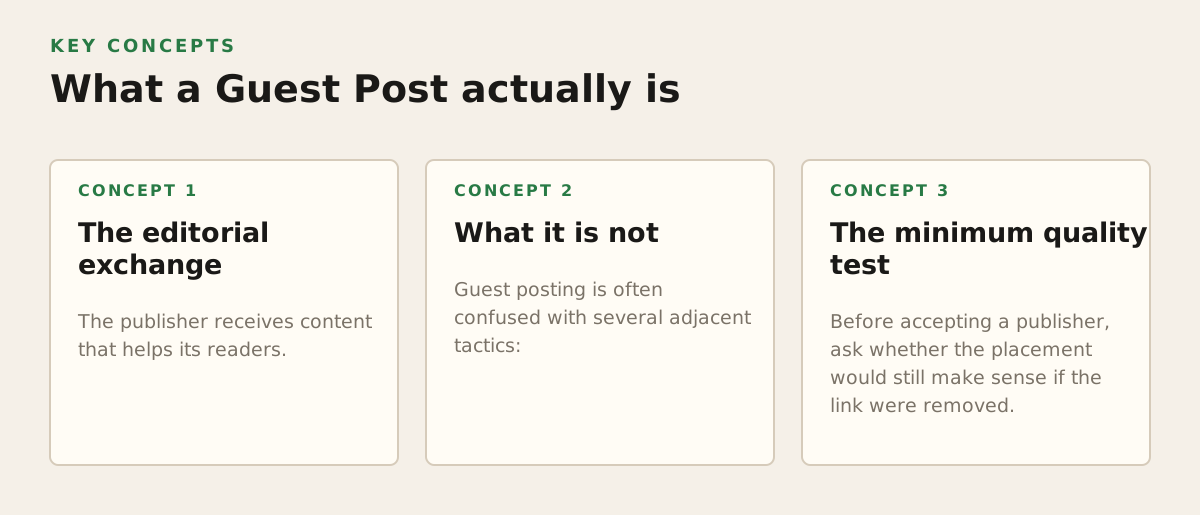
At its strongest, guest posting has three connected parts: a useful piece of content, a credible publishing environment, and a natural reason to cite the contributor. Remove any one of them and the activity becomes weaker. A well-written article on a completely unrelated domain is not strong editorial marketing. Nor is a relevant article on a site that publishes hundreds of near-identical paid pages with no discernible readership.
The editorial exchange
The publisher receives content that helps its readers. The contributor receives exposure, expertise positioning, referral potential, and sometimes a link. The link is a consequence of the article’s usefulness, not the only reason the article exists.
Google’s guidance distinguishes ordinary editorial links from links that may need qualification, including paid links and user-generated links. Its documentation recommends using rel="sponsored" for advertisements or paid placements and rel="ugc" for user-generated content; publishers can use rel="nofollow" when they do not want to endorse or associate a link. The current guidance is documented in Google’s outbound-link qualification guidance.
That does not mean every contributed article should be treated as advertising. It does mean the commercial arrangement and the publisher’s disclosure policy should be understood before publication. A brand paying for guaranteed placement should not assume that calling the article “editorial” makes it editorial in substance.
What it is not
Guest posting is often confused with several adjacent tactics:
- Content syndication: republishing an existing article across multiple sites, usually with canonical or attribution considerations.
- Digital PR: creating a story, study, expert comment, or data asset intended to attract coverage from journalists and publishers.
- Niche editing: securing a contextual mention inside an existing article rather than submitting a new article.
- Directory submission: placing a business listing in a structured directory, where editorial depth is usually limited.
- Paid advertising: buying visibility or traffic rather than earning a citation through a contributed resource.
These methods can support one another, but they have different production requirements and risk profiles. A B2B company may use a contributed tutorial to explain a technical workflow, a digital PR asset to generate broad coverage, and a niche edit to add a relevant product reference to an established guide. Treating them as interchangeable makes campaign reporting less useful.
The minimum quality test
Before accepting a publisher, ask whether the placement would still make sense if the link were removed. A strong answer sounds like: “This audience needs the explanation, our company has relevant expertise, and the article adds something the site does not already have.” A weak answer sounds like: “The domain has a high metric and accepts our anchor text.”
For operational purposes, define a qualifying placement as one that has:
- A clear topical relationship to the target page or audience.
- Visible evidence of human-edited content and a coherent publishing history.
- A page that can be discovered and understood without relying on the backlink alone.
- A contributor or brand that can credibly stand behind the claims.
- Anchor text and destination selection that do not distort the reader’s expectations.
Why Guest Posts matter to organic growth
A contributed article can support more than a ranking objective. Its value usually comes from a combination of relevance, authority, referral exposure, and brand association. The balance changes by business model. A SaaS company may care about qualified referral visits and category education. An e-commerce brand may value a link to a buying guide or expert resource. A B2B firm may want recognition among a narrow professional audience. An iGaming operator may need gambling-friendly publishers that understand regulatory and market context.
Links are signals in a broader system
Google describes links as one way its systems discover pages and understand relevance, but it also warns against link spam and manipulative schemes. The applicable policy is set out in the Google Search spam policies. The practical implication is not that every contributed article is forbidden; it is that scale, intent, quality, and the way links are obtained matter.
A backlink cannot compensate for a poor target page. If the destination has unclear positioning, thin information, slow user experience, or no meaningful conversion path, acquiring more referring domains may simply send more visitors into a dead end. Link acquisition should therefore follow page strategy, not replace it.
Audience value changes the commercial case
Consider four different objectives:
- SaaS: publish a practical integration, workflow, or operations guide where readers are already researching the problem.
- B2B: contribute a method, benchmark framework, or procurement checklist to a respected industry publication.
- E-commerce: earn a citation to a genuinely useful comparison, sizing guide, research page, or expert buying resource.
- Casino and iGaming: work only with publishers whose content policies, geography, language, and gambling tolerance align with the campaign.
These objectives should not be judged by the same immediate metric. A specialist B2B publication may send little traffic but put a brand in front of a valuable buying committee. A consumer site may send more visitors while generating fewer relevant leads. A publisher’s apparent reach is not a substitute for understanding who reads the specific page.
Authority is contextual, not just numerical
Third-party scores such as Domain Rating or Domain Authority can help sort a prospect list, but they are not Google rankings and do not prove that a site is trusted by its audience. A high score can coexist with declining traffic, irrelevant topics, excessive outbound links, or a history of accepting low-quality contributions.
For that reason, a sensible publisher-vetting model combines metrics with observable evidence:
- Organic traffic appears on pages related to the site’s stated niche.
- Recent articles have distinct authors, useful detail, and consistent editing.
- The site has a clear audience rather than a collection of unrelated commercial categories.
- Outbound links are selective and contextually placed.
- Existing contributors and cited sources are credible for the subject.
- The target page is indexable and not buried behind an obviously artificial site structure.
These are decision criteria, not guarantees. Search visibility can change, pages can be removed, and a publisher can alter its standards after a placement. The right response is to document the assessment at the time of outreach and review important placements periodically.
How a high-quality Guest Post campaign works
A reliable campaign is a sequence of editorial decisions, not a bulk order of domains. The central workflow is strategy, prospecting, qualification, pitching, production, review, and measurement. Each stage prevents a different failure.
1. Start with the destination page
Choose the pages that deserve references before searching for publishers. A useful destination might be a detailed comparison, a research-led guide, a product education page, or a tool that solves a specific problem. Avoid forcing every placement to a commercial product page when a genuinely helpful informational asset would make a more natural citation.
Map each page to an audience problem and an acceptable linking context:
- For a project-management SaaS page, the context might be workflow design for distributed teams.
- For an e-commerce guide, it might be choosing materials, sizes, or maintenance methods.
- For a B2B service page, it might be evaluating vendors or building an internal process.
- For an iGaming resource, it might be responsible marketing, payments, market education, or game mechanics, subject to publisher and jurisdictional rules.
This mapping reduces random anchor-text requests and gives writers a reason to mention the destination. It also helps an agency explain the campaign to a client without presenting links as isolated units.
2. Build and qualify the publisher list
Use several discovery methods: competitor backlink research, industry associations, expert networks, journalists’ bylines, conference sites, specialist blogs, and manual search. Then remove prospects that fail basic relevance or quality checks. A list of 200 weak domains is less useful than a smaller list where each site has a defensible editorial fit.
Record the following in a prospecting sheet:
- Domain and relevant section.
- Primary topic, audience, language, and geographic focus.
- Evidence of organic visibility or active readership.
- Recent publication date and article quality.
- Linking policy, disclosure requirements, and commercial terms.
- Suggested article angle and likely destination page.
- Risk notes, including excessive sponsored content or unrelated categories.
Web Push’s authority link building approach is relevant when the campaign needs stronger editorial authority than a broad list of generic sites can provide. The important principle is selectivity: hand-vetted DR 30+ publishers with real organic traffic are a starting filter, not a promise that every domain is appropriate for every campaign.
3. Pitch a useful angle, not a keyword
Editors respond more readily to a clear reader benefit than to a request for a particular anchor phrase. A credible pitch includes the proposed headline, the reader problem, the unique information the contributor can provide, the likely structure, and any commercial relationship that needs disclosure.
For example, a weak pitch might offer “an SEO article with one do-follow link.” A stronger pitch might propose “How B2B teams can audit content decay before changing their information architecture,” supported by a practical audit sequence and examples. The link can be introduced where the reader needs a deeper explanation, but it should not determine the article’s entire thesis.
4. Match the article to the publication
Do not send one generic article to every site. Match terminology, examples, depth, spelling, and editorial tone to the publication. A technical SaaS audience may expect diagrams or implementation detail. A consumer publication may need plain-language explanations. A German-language placement requires more than translating English sentences; terminology and local commercial context may change the argument.
Before drafting, confirm:
- Who the article is for and what decision it helps them make.
- What the publisher has already covered and where the gap exists.
- Which claims need primary sources, original data, or expert review.
- Whether the target page is genuinely relevant to the proposed section.
- What link attributes or disclosure language the publisher requires.
5. Review the live placement, not only the draft
Publication is not the end of quality control. Check that the final URL resolves, the article is accessible, the link points to the agreed destination, the surrounding copy remains accurate, and the page has not been placed in an unrelated category. Also record the publication date, anchor text, link attribute, and whether the page is discoverable through the site.
Google Search Console’s Links report can help site owners inspect links that Google has associated with their site, although it is not a complete list of every link on the web. The official Search Console links report documentation explains the report’s purpose and limitations. Use it as one monitoring input rather than as a real-time delivery or value score.
Illustrative campaign decisions
The following are illustrative starting policies, not universal benchmarks. They show how a team can turn vague quality preferences into repeatable decisions:
- Review 40 prospects, reject 18 for weak topical fit, shortlist 12, and pitch 10 after manual checks.
- For a SaaS campaign, prepare 3 article angles for 2 buyer personas rather than one generic topic for all publishers.
- Use 4 destination pages across 12 placements so the campaign does not point every link at one URL.
- Reject a domain if 7 of its last 10 posts are unrelated commercial pages, even if its third-party authority metric is high.
- Run a 30-day and 90-day review of published URLs to identify removals, redirects, changed anchors, or major editorial changes.
Where Guest Posting breaks down
Most problems are predictable. They arise when the commercial objective overwhelms the editorial one, when scale removes judgment, or when reporting treats publication as proof of value. Understanding the failure modes makes it easier to set boundaries with clients, publishers, and fulfillment partners.
Link-first content
The clearest warning sign is an article that exists only to carry an exact-match anchor. The topic becomes unnatural, the introduction feels generic, and the link is inserted where a reader would not need it. Exact-match anchors can also create an artificial-looking profile when repeated across many placements.
Prefer descriptive, varied references that tell the reader what they will find. The anchor should follow the sentence’s meaning. If the destination is a technical guide, “our explanation of crawl-budget planning” may be more honest than a commercial keyword that the article never discusses.
Publisher dilution
A site can begin with a focused audience and later become a marketplace for unrelated placements. Watch for rapid category expansion, thin contributor pages, repeated author bios, templated articles, and large volumes of outbound commercial links. A previously approved domain should not be treated as permanently safe.
Set a rejection policy before outreach begins. For example, a team may reject a publisher when:
- The proposed article has no meaningful connection to the site’s audience.
- The site’s recent content is dominated by unrelated money topics.
- The editor cannot explain its disclosure or link policy.
- The placement requires unsupported claims, hidden sponsorship, or misleading author credentials.
- The article would be difficult to defend to a client, regulator, or reader.
Commercial disclosure and regulated sectors
Disclosure obligations depend on the jurisdiction, relationship, and format. The U.S. Federal Trade Commission’s Disclosures 101 guidance explains that endorsements involving a material connection should be clearly disclosed in contexts covered by its rules. A contributor and publisher should obtain appropriate legal advice for their markets rather than assuming a small author bio resolves every issue.
Casino, betting, and iGaming campaigns need additional care. A gambling-friendly publisher still needs to be relevant by market and topic. Check whether the article discusses operators, bonuses, responsible gambling, payments, or game information, and whether the proposed claims are lawful and supportable in the target jurisdiction. Do not use a general business placement to bypass a publisher’s gambling restrictions.
Unverifiable claims and manufactured expertise
Guest articles often fail editorial review because they make claims that cannot be substantiated. This is especially common in financial services, health, cybersecurity, gambling, and software performance topics. Do not invent survey results, customer counts, rankings, or performance improvements to make a draft sound authoritative.
Use a source hierarchy appropriate to the claim:
- Official documentation for product behavior, platform rules, or technical specifications.
- Government or regulator sources for legal and compliance requirements.
- Original research with a transparent method for data claims.
- Named subject-matter experts for interpretation and practical experience.
- Carefully qualified language when evidence is directional rather than conclusive.
Credibility is easier to lose than to manufacture. A modest, sourced statement is usually more publishable than an impressive but unsupported promise.
Measuring the wrong outcome
Counting published links alone can reward low-quality behavior. A more useful report separates production metrics from business and visibility signals:
| Layer | What to record | What it helps decide |
|---|---|---|
| Delivery | Accepted pitches, published URLs, link attributes, live status | Whether the workflow functioned |
| Quality | Topical fit, publisher evidence, page relevance, editorial depth | Whether the placement should be retained in the portfolio |
| Visibility | Impressions, clicks, indexed status, referring-page changes | Whether discovery and search exposure are occurring |
| Business | Qualified referral visits, assisted conversions, enquiries, branded search observations | Whether the activity supports commercial goals |
Do not attribute every ranking movement to one link. Rankings respond to many changing variables, including content, competition, crawling, internal linking, and algorithmic systems. Reporting should describe what happened and what was plausibly influenced, not claim causation that the evidence cannot establish.
How practitioners apply Guest Posts at scale
Scaling does not mean removing human judgment. It means making good judgment repeatable while keeping unsuitable opportunities out of the pipeline. This is where agencies and in-house teams need documented standards, clear ownership, and enough flexibility for different industries.
For white-label SEO agencies
A white-label provider should give the agency a process that can survive client scrutiny. The agency needs to know how publishers are screened, how topics are approved, what information is needed before drafting, and how live URLs are checked. A simple delivery sheet should include:
- Client, market, language, and prohibited topics.
- Approved destination URLs and preferred context.
- Anchor guidance, including phrases to avoid.
- Publisher URL, topical category, and quality notes.
- Draft status, editor feedback, publication date, and live link.
- Any disclosure, rel attribute, or removal policy agreed with the publisher.
This is the operational difference between outsourcing writing and outsourcing a defensible campaign. An agency can use link building services when it needs fulfillment across guest posts, niche edits, authority links, and related outreach while retaining a client-facing strategy.
For SaaS and B2B teams
Prioritize expertise that is difficult to fake. Engineers, product specialists, customer researchers, and operators can contribute workflows, implementation lessons, checklists, and informed critiques. The best topics often sit one step before the product: the reader is diagnosing a problem, comparing approaches, or planning a change.
A practical editorial calendar might divide contributions among:
- Problem education, such as process design or technical diagnosis.
- Decision support, such as evaluation frameworks and comparison criteria.
- Implementation, such as migration planning or measurement setup.
- Original insight, such as anonymized patterns from customer research.
- Expert commentary that strengthens a wider digital PR campaign.
Keep proprietary information protected. A useful article does not need to disclose customer identities, confidential conversion data, internal security details, or unverified product claims.
For e-commerce businesses
E-commerce teams should avoid making every placement a disguised product pitch. Useful contributions can answer pre-purchase questions, explain product care, compare materials, or present original research into a customer problem. A link to a category or product page may be appropriate when the article clearly prepares the reader to make that purchase; otherwise, a guide or resource is usually a better destination.
Coordinate guest articles with internal content. If the publication covers the same topic as an existing guide, decide whether the external article should introduce the subject, provide a specialist angle, or cite a deeper resource. This creates a coherent journey rather than two pages competing to say the same thing.
For casino, betting, and iGaming brands
Begin with market and publisher eligibility, not anchor text. Document the intended country, language, product category, permitted claims, and responsible-gambling requirements. A publisher that accepts one type of gaming content may reject another, and a site suitable for industry commentary may not be appropriate for operator acquisition pages.
Use conservative editorial standards:
- Do not promise winnings or imply guaranteed outcomes.
- Do not present bonuses, odds, or availability without checking current terms and market applicability.
- Make commercial relationships and sponsorship treatment clear where required.
- Prefer educational, analytical, or industry topics when a direct operator promotion would be unsuitable.
- Review every claim for jurisdiction, age restrictions, and responsible-marketing expectations.
For digital PR-led campaigns
A guest contribution can extend a digital PR idea after the initial coverage, but it should not imitate journalism or pretend to be independent reporting. If a company created a dataset, publish the method, limitations, and ownership clearly. If an executive is quoted, make the role and connection visible. If a journalist wants a short expert comment, do not turn it into an undisclosed promotional article.
In 2026, the durable recommendation is to build fewer, more defensible placements around assets and expertise that people would reference without an incentive. Set a starting policy—such as requiring topical fit, manual publisher review, a useful destination page, and a 90-day live-link check—and change it only when documented evidence justifies the change. The policy is illustrative, but the discipline is not.
Web Push can help teams turn that standard into a managed campaign through Web Push, including hand-vetted guest posts, niche edits, authority links, digital PR, linkable assets, and white-label fulfillment for agencies.
Authored with NotFair SEO