
The main link building types are earning editorial mentions, pitching guest contributions, requesting links from relevant existing pages, and creating newsworthy or useful assets that attract coverage. They describe different ways to acquire links, not guaranteed SEO outcomes. Choose based on the audience and pages you need to reach, then assess each placement for relevance, editorial independence, and policy risk—not just a publisher’s authority score.
What Link Building Types actually describe
The phrase covers two related but distinct questions: how a link is acquired and what kind of placement it appears in. A guest post is an acquisition method and a content format; the resulting link may sit in an author bio or within the article. A digital PR campaign is a way to earn coverage; its links may appear in a news story, interview, or data-led feature. Treating every label as a separate kind of backlink can make comparisons confusing.
There is a further distinction between the link’s acquisition and its HTML attributes. A link might be editorially placed but tagged as sponsored, or it might be a standard link. Google advises using rel="sponsored" for advertisements or paid placements and allows nofollow as another way to qualify links. Those attributes describe how a link should be treated; they do not turn a weak or irrelevant page into a useful placement. See Google’s guidance on qualifying outbound links.
For SEO teams, that means evaluating a proposed link on more than one axis:
- Acquisition route: Was it earned through useful content, requested through outreach, or purchased as a placement?
- Page context: Does the linking page genuinely relate to the destination and its readers?
- Editorial control: Did the publisher make an independent decision about the content and link?
- Link treatment: Is the link qualified appropriately when it is sponsored or otherwise paid?
These questions help separate a defensible campaign from one that merely produces a count of referring domains. Google’s link spam policy identifies buying or selling links for ranking purposes, including exchanges of goods or services for links, as a policy concern. It also discusses excessive link exchanges and automated link creation. Review the Google Search spam policies before choosing a tactic, especially when payment or a required backlink is involved.
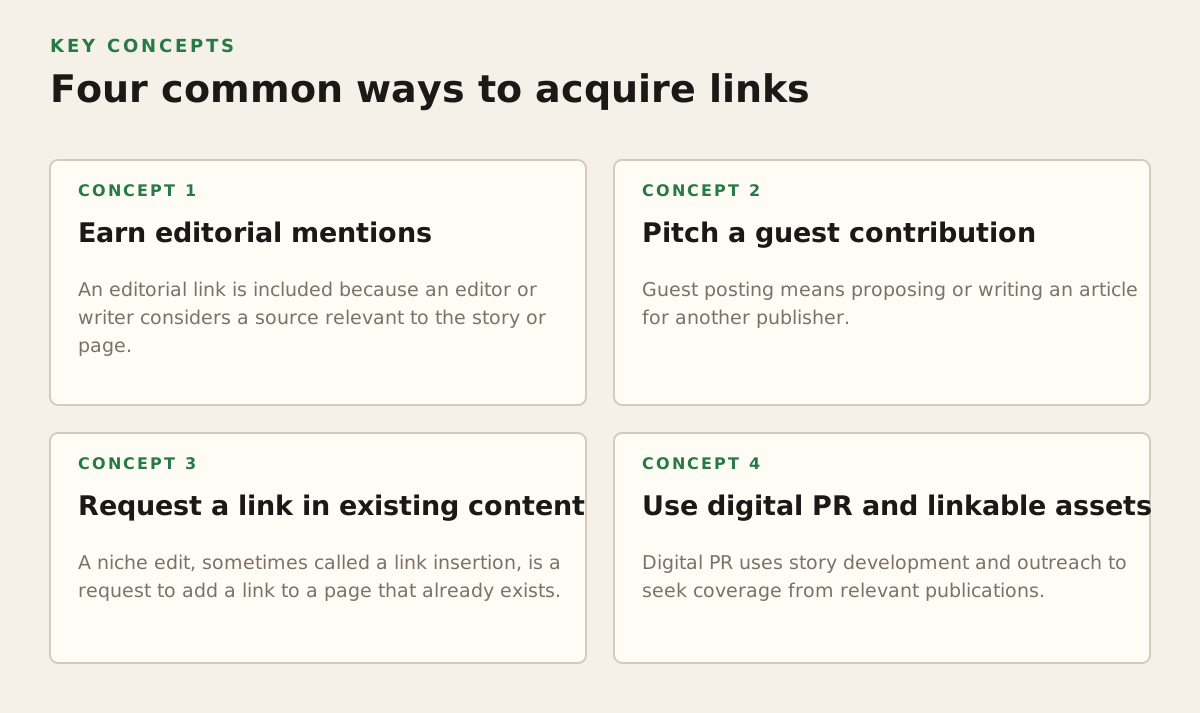
Four common ways to acquire links
Earn editorial mentions
An editorial link is included because an editor or writer considers a source relevant to the story or page. A company may earn one through original research, a clear explanation of a technical topic, a useful tool, or a knowledgeable spokesperson. The defining feature is not a particular format: it is that the publisher chooses whether the material merits a citation.
This route suits teams with something genuinely useful to reference. A SaaS company might publish a carefully documented analysis of a problem its customers face. An e-commerce brand might offer a practical buying resource that an independent guide could cite. A B2B company might provide a subject-matter expert for a relevant article. These are potential reasons for coverage, not promises that a publisher will link.
Pitch a guest contribution
Guest posting means proposing or writing an article for another publisher. It can help a business explain a topic to a relevant audience, but the contribution should stand on its own rather than exist only to place a backlink. Pitch a subject the publication’s readers need, follow its editorial requirements, and make any company connection clear where required.
Be wary of offers that guarantee a followed link in exchange for payment or require a link back as a condition of publication. Google’s policies discuss links that pass ranking credit in paid articles or guest posts as a potential link spam issue when they are not appropriately qualified. A publisher may charge for advertising or sponsored content, but the arrangement and link treatment should be transparent; do not describe a paid placement as independently earned editorial coverage.
Request a link in existing content
A niche edit, sometimes called a link insertion, is a request to add a link to a page that already exists. The request may be editorial—for example, a resource has become unavailable and a more useful replacement exists—or it may involve payment. The format alone does not tell you whether the link is appropriate. Check whether the page’s topic and surrounding paragraph support the destination, and establish whether compensation is involved.
For a link-reclamation request, point to a specific broken or outdated reference and explain how the suggested destination helps the page’s readers. Do not assume that a publisher owes a link because your brand was mentioned, or that an insertion is legitimate simply because the article is old. Relevance and editorial choice matter more than the age of the page.
Use digital PR and linkable assets
Digital PR uses story development and outreach to seek coverage from relevant publications. A campaign might offer original data, a timely expert explanation, or a useful resource that supports a journalist’s reporting. It overlaps with editorial link earning, but places greater emphasis on finding a story angle and distributing it to appropriate media contacts.
An asset is not linkable merely because it took effort to produce. Before investing in one, ask what question it answers, who would cite it, and what evidence makes it useful. For example, a B2B team could develop a detailed glossary or a practical methodology; a specialist iGaming brand may need to focus outreach on publishers willing to cover its category. Audience fit is a prerequisite, not a result that can be assumed from a broad media list.
- Use guest contributions when you can offer a publication-specific perspective.
- Use a link reclamation request when you can identify a relevant, fixable omission.
- Use digital PR when a credible story, resource, or expert angle gives an editor a reason to cover the subject.
- Use editorial outreach when you can explain why a particular page would benefit its readers from citing your resource.
Placement formats and link attributes are separate choices
The acquisition route does not determine the placement’s value. A link can appear in an article, an author biography, a resource list, a news story, or a partner page. The useful question is whether the placement makes sense in context and serves people who might actually use it. A link embedded naturally in a relevant explanation may be more useful to the reader than a prominent link on a page with no meaningful connection.
Anchor text—the clickable words—should also make sense in its sentence. Google’s documentation says crawlable links generally use an <a> element with an href attribute, and recommends descriptive anchor text that helps people understand the destination. That is a technical and usability consideration, not a reason to insist on an exact-match commercial phrase. See Google’s guidance on crawlable links.
For each proposed placement, review the page rather than relying solely on a spreadsheet metric:
- Subject match: Does the page’s topic connect naturally to your brand, resource, or destination?
- Reader value: Would the link help the publication’s audience understand or do something?
- Page quality: Is the page coherent and maintained, rather than a thin container for outbound links?
- Commercial disclosure: Is payment, sponsorship, or another material relationship handled transparently?
- Link destination: Does the target page deliver what the surrounding text suggests?
If a placement is paid or sponsored, link attributes and disclosure deserve particular care. Google’s link-qualification guidance explains the use of rel="sponsored" and rel="nofollow"; the U.S. Federal Trade Commission also explains that material connections in endorsements may need clear disclosure. Requirements depend on the circumstances and applicable law, so consult the FTC’s endorsement guidance and get qualified advice where needed. A disclosure does not by itself resolve every search-policy question.
Choose Link Building Types by campaign goal
Start with the job the campaign needs to do. A team seeking relevant visitors may prefer coverage that reaches a defined audience, even if the placement is not the most obvious SEO target. A team supporting a key product or category page needs to consider whether the target is genuinely useful to the linking page’s readers. An agency fulfilling work for a client also needs a repeatable review process that catches poor-fit sites before outreach begins.
Match the approach to the evidence you can offer:
- Need credible category coverage? Explore digital PR or expert outreach if you have a relevant story, data source, or spokesperson. If you do not, develop the substance before pitching.
- Need to reach a specific professional audience? Consider a guest contribution when you can provide original, publication-ready expertise that fits the outlet.
- Found a relevant page with an outdated reference? Make a focused link-reclamation request and explain the reader benefit. Accept that the editor may decline.
- Need support for a specialist or regulated niche? Verify that the publisher accepts the category and that the subject and link fit its editorial rules. Do not infer acceptance from a general marketing offer.
- Considering a paid placement? Clarify the commercial arrangement, disclosure, and link attributes before agreeing. Do not count an undisclosed paid link as an earned editorial mention.
For casino, betting, and iGaming teams, suitability needs an additional check: a publisher must be willing to cover gambling-related subjects, and the proposed page must fit its audience and editorial standards. The business description for Web Push identifies gambling-friendly placements as part of its focus, but a particular publisher’s acceptance, placement terms, or link treatment still needs to be confirmed before a campaign proceeds.
For agencies managing fulfillment, keep client goals and publisher selection distinct. A client may want authority links, but that does not make a high domain score sufficient evidence of audience fit, editorial quality, or policy compliance. If you need a clearer view of the different approaches, Web Push’s overview of authority link building provides a relevant next step.
Build a review process that protects quality
Before outreach, identify the page or resource you want to support and the readers it should help. Then create a short acceptance checklist for prospects. This keeps teams from changing standards mid-campaign to accommodate a convenient placement, and gives white-label partners a practical basis for reporting decisions to clients.
A useful workflow is:
- Set the purpose: Name the audience, target page, and reason a relevant publisher might cite or feature it.
- Qualify prospects: Review the actual linking page, its context, and its likely readers—not only a domain-level metric.
- Choose the method: Select a pitch, guest contribution, reclamation request, or PR angle that fits the publisher and the available material.
- Agree the terms: Clarify editorial control, payment, disclosure, and link attributes before work is commissioned or published.
- Check the live placement: Confirm that the content is accurate, the destination works, and the link appears as agreed.
Measure more than the number of placements. Record the source page, destination, acquisition route, commercial terms, and any follow-up needed. For a campaign built around audience reach, note whether the coverage reached the intended readers; for an SEO-focused campaign, keep link counts separate from any claim that rankings or traffic changed because of those links. That distinction supports better decisions without treating correlation as proof.
The right mix is the one your team can justify page by page: useful to the publisher’s audience, transparent about commercial relationships, and aligned with the campaign’s goal. Web Push describes its work as white-hat guest posts, niche edits, authority links, and digital PR for brands and agencies; review its link building services if you want to discuss a campaign. For another perspective on choosing a responsible approach, visit Web Push.
Authored with NotFair SEO