
A marketing plan template should turn a business goal into a prioritized audience, channel, budget, measurement, and execution plan. Use the copyable worksheet below to record those decisions, then adapt the worked example to your own pipeline, organic growth, or backlink-acquisition needs.
The key decision is not which channels belong in every plan; it is which few deserve resources now, given your buyer, evidence, constraints, and ability to execute. A SaaS team improving non-brand search visibility, for example, may prioritize useful comparison content and digital PR, while an e-commerce team may put more effort into product-category content and authority links.
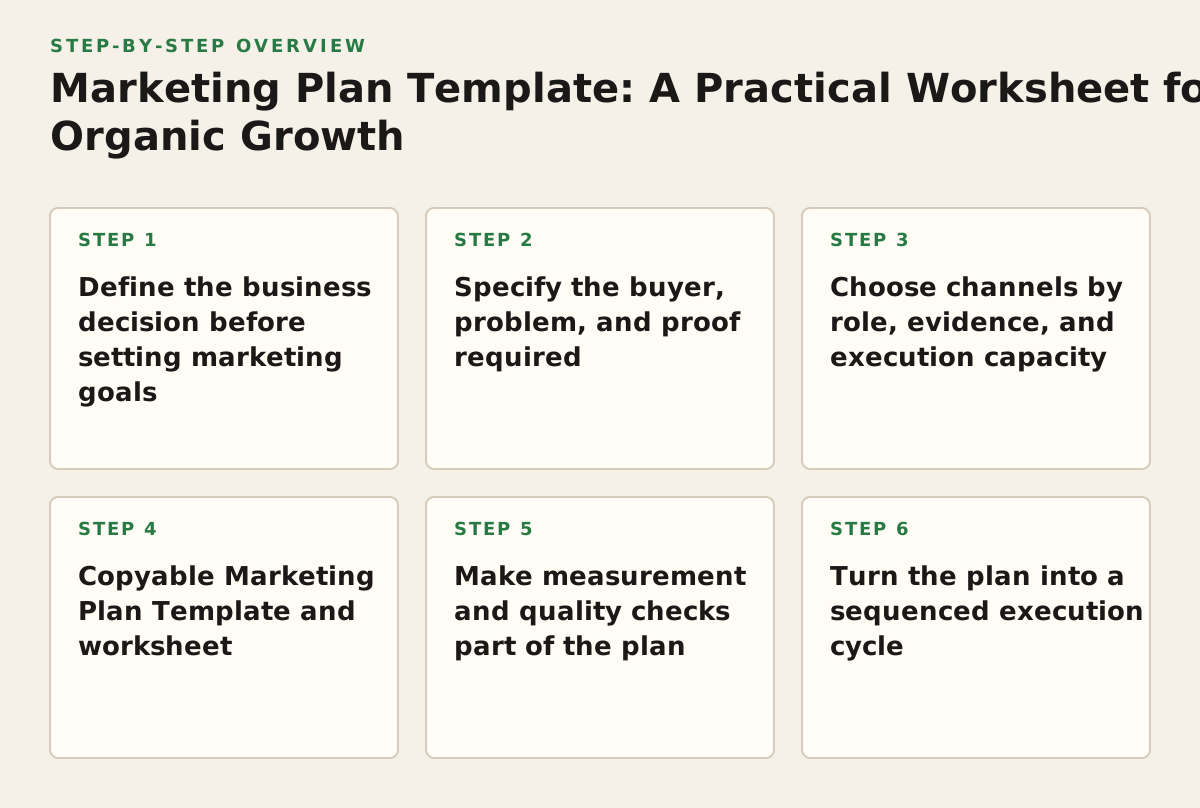
1. Define the business decision before setting marketing goals
Start with a business outcome, not a channel wish list. This section matters when a plan has to justify investment to a founder, finance lead, or client. A goal such as “do more SEO” does not say what should change; a goal tied to qualified leads, sales, or retention gives the team a reason to choose one activity over another.
Connect the goal to a measurable outcome
Write down the business result, the marketing contribution you expect, and the period in which you will review progress. Separate outcomes the team can influence directly—such as publishing a set of pages—from results it can only influence, such as sales. For an organic growth plan, possible measures include non-brand clicks to priority pages, qualified organic enquiries, or assisted conversions. Choose measures that map to the actual job, rather than treating raw traffic as proof of business impact.
Google’s guidance encourages content that is useful to people rather than created primarily to manipulate search rankings; use that standard when deciding whether an SEO activity supports the buyer as well as visibility (Google Search Central’s helpful-content guidance).
- Business outcome: What should the company or client be able to do better?
- Marketing objective: What change can marketing credibly contribute to?
- Review date: When will you assess evidence and decide whether to continue?
Failure mode: setting a target without a baseline, owner, or review date. The plan then rewards activity rather than learning. For example, a B2B team might set a starting objective to increase qualified organic demo requests from a defined product page, record the current baseline, and review the result after an illustrative 90-day planning cycle. That period is a starting policy, not a universal benchmark.
2. Specify the buyer, problem, and proof required
This section applies whenever different audiences have different buying triggers—especially agencies serving clients in multiple verticals, SaaS companies selling to several roles, and iGaming marketers working across markets. It works because channel and content choices depend on what a specific buyer needs to believe before taking action. A generic “business decision-maker” description rarely tells a writer what to explain or a media planner where to reach them.
Write a usable audience brief
Describe the audience by role or business type, the problem they are trying to solve, the alternative they use now, and the evidence that would reduce their concern. Add market or language constraints if they affect publisher selection, content, or campaign delivery. The U.S. Small Business Administration recommends examining demand, market size, location, saturation, and alternatives as part of market research; those questions can help keep an audience brief grounded in the actual market (SBA market research and competitive-analysis guidance).
- Buyer: e.g., SEO agency owner responsible for client fulfillment.
- Job: deliver relevant placements without building an in-house outreach operation.
- Objection: uncertainty about publisher quality, relevance, or reporting.
- Proof: transparent vetting criteria, clear placement details, and a reviewable process.
Failure mode: defining the audience by age or broad industry alone, then producing content that does not answer a buying question. A more operational example is a B2B marketing manager evaluating external link acquisition: the plan should address publisher relevance, organic traffic quality, internal review, and how placements will be reported. For casino or betting brands, include the target geography and gambling-friendliness requirement before outreach begins; otherwise, a seemingly suitable publisher may be unusable.
3. Choose channels by role, evidence, and execution capacity
Use this decision when stakeholders propose more channels than the team can operate well. A channel earns a place when it reaches the defined buyer, supports the objective, and has an owner with enough capacity to execute and measure it. It is often better to fund a small number of connected activities than to spread effort across SEO, paid media, social, email, and PR without a clear handoff.
Assign each channel a job
For each candidate, state the role it plays: create demand, capture existing demand, build trust, or support conversion and retention. Then record the evidence behind the choice and the constraint that could make it fail. For example, organic content can address recurring buyer questions, while relevant editorial coverage may earn referral attention and links. Paid search may help capture active demand, but only if the landing page and follow-up process can handle it.
For SEO, separate useful editorial work from attempts to buy ranking signals. Google’s spam policies identify link spam as a violation, so reject schemes whose purpose is to manipulate rankings rather than earn relevant editorial references (Google Search Central’s link-spam policy). A plan can include outreach, guest contributions, or digital PR, but should define relevance and editorial standards before pursuing placements. Teams assessing authority link building should treat publisher fit and real audience value as selection criteria, not rely on a metric alone.
Make a clear keep, test, or defer decision
Mark each channel as keep when it has evidence and capacity, test when an assumption needs validation, or defer when it lacks a viable owner or measurement path. This makes trade-offs visible. A common failure is continuing a channel because it has always been in the plan, even when the audience or business goal has changed.
Example: an e-commerce marketer with limited editorial capacity could keep product-page improvements, test a focused digital PR campaign around a genuinely useful asset, and defer a new social channel until someone owns its publishing and reporting. If outreach is part of the plan, define the publisher profile and review steps before sourcing opportunities. Web Push describes its link building services as hand-vetted placements on DR 30+ publishers with real organic traffic, rather than link farms or private blog networks.
4. Copyable Marketing Plan Template and worksheet
Copy this section into a planning document and complete every input before assigning work. The channel and investment rows make the worksheet a prioritization framework, not just a campaign brief. If you do not know an answer yet, write the assumption and how you will validate it rather than leaving the decision implicit.
| Field | Prompt or question | Your answer |
|---|---|---|
| Planning scope | What business, product, market, language, and planning period does this plan cover? | [Enter scope and dates] |
| Business outcome | What business result should marketing support, and why does it matter now? | [Describe the outcome] |
| Audience and job | Who is the priority buyer, what are they trying to do, and what blocks the decision? | [Describe buyer, need, and obstacle] |
| Offer and proof | What action should the buyer take, and what evidence would make that action credible? | [Enter offer and proof] |
| Baseline and objective | What is the current baseline, target measure, source, and review date? | [Enter measure, baseline, target, source, date] |
| Channel decisions | For each channel, what job does it do, what evidence supports it, and is it keep, test, or defer? | [Channel — role — evidence — decision] |
| Planned investment and allocation | What is the total planned budget or resource envelope? How will money or team capacity be allocated by channel, including production, media, tools, and external support? | [Total: ___; channel allocations: ___; currency or units: ___] |
| Execution and ownership | What deliverable is due, who owns it, what dependency exists, and when will it be reviewed? | [Deliverable — owner — dependency — date] |
| Risks and guardrails | What could invalidate the plan, and what quality, legal, brand, or market checks apply? | [List risks and checks] |
| Decision rule | What evidence would make you continue, change, or stop an activity? | [State the decision rule] |
Filled example: illustrative B2B SaaS plan
Scope: English-language plan for one SaaS product, using an illustrative 90-day review cycle. Outcome: support more qualified sales conversations from organic search. Audience: in-house marketing managers comparing ways to improve search visibility; concerns include quality control and internal workload. Offer and proof: request a discovery conversation; support the offer with a clear process explanation and relevant examples. Measure: qualified organic enquiries from priority pages, with the current baseline recorded before work starts. Channels: keep product-led content; test digital PR and relevant editorial outreach; defer a new paid channel pending a landing-page owner. Illustrative investment allocation: 100 planning units in total, allocated as 40 to content production, 25 to outreach and PR, 20 to paid search testing, and 15 to analytics and conversion improvements. These units are a made-up planning example, not a recommended budget split. Ownership: marketing lead approves briefs; content owner drafts; SEO lead reviews relevance and reporting. Decision rule: review qualified enquiries, page engagement, and execution quality together before reallocating effort.
Adapt the fields to your operating model: an agency can use “client and delivery owner” instead of “product,” while a casino marketer should specify eligible markets and publisher suitability. Record budget as money, hours, or another consistent resource unit, and make allocations add up to the total. Do not force a precise forecast where evidence is missing; label assumptions and schedule a validation step.
5. Make measurement and quality checks part of the plan
This section matters whenever several people or vendors contribute to the same campaign. A measurement plan works by agreeing in advance what counts as evidence and how activity will be identified. Without that agreement, a team can publish content, run paid campaigns, and secure coverage yet be unable to tell which work contributed to qualified demand.
For campaign links, use consistent UTM parameters so analytics reports can distinguish source, medium, and campaign. Google Analytics documents these campaign URL parameters and recommends consistent tagging conventions (Google Analytics URL builders and campaign parameters). For organic search, record the query and page measures you will review in Search Console’s performance reporting rather than treating a single rank check as the whole result (Search Console Performance report guidance).
- Document the baseline and data source before launch.
- Use one naming convention for campaigns, sources, and media.
- Review leading indicators and business outcomes separately.
- Agree how missing, delayed, or unattributed data will affect decisions.
Failure mode: changing several channels at once and attributing the result to whichever report looks most favorable. Instead, note major changes and interpret results alongside seasonality, sales-cycle length, and tracking limits. For an editorial link campaign, track target pages, placement status, publisher fit, and referral or search observations; do not promise a ranking outcome from an individual link.
6. Turn the plan into a sequenced execution cycle
A plan becomes useful when it controls what happens next. Apply this sequence when teams have agreed on priorities but work is still stuck between strategy and delivery. It reduces rework by resolving dependencies before production and creates a review point for changing investment. Treat the timing below as a starting policy for 2026 planning, not an industry rule.
- Confirm the decision: approve the business outcome, buyer, baseline, and market constraints.
- Lock the resource envelope: enter the available budget or capacity, allocate it by channel, and make the totals reconcile.
- Prepare the work: assign owners, briefs, quality checks, tracking conventions, and dependencies before launch.
- Run the first cycle: execute the keep activities and the smallest useful tests; record deviations from the plan.
- Review evidence: compare results with the stated measures and decision rules, including execution quality and data gaps.
- Reallocate deliberately: continue, revise, or stop activities and document why before the next cycle.
For link acquisition, the preparation step should include target-page relevance, publisher vetting, editorial standards, and reporting expectations. For paid activity, record the spend limit and who can change it; Google Ads explains that campaign budgets govern spend, so define the budget owner and review process before launch (Google Ads budget guidance).
When execution capacity or publisher access is the bottleneck, use external support only where the plan specifies the quality bar and reporting needed. Web Push is a senior-led link-building agency offering guest posts, niche edits, authority links, digital PR, and white-label fulfillment for agencies; see Web Push if that support fits your plan.
Authored with NotFair SEO