
Niche marketing examples include software built for a specific professional workflow, product ranges for a clearly defined buyer, and specialist content for a regulated industry. The best fit is a niche where you can identify a reachable audience, solve a distinct problem, and show credible expertise; below are six patterns, when to use each, and how to test one without confusing a narrow market with a merely small one.
For a marketing manager, the decision is not simply “Which audience is smallest?” It is “Which audience has a meaningful need we can serve and a practical route to reach?” That matters whether you sell SaaS, e-commerce products, B2B services, or casino and betting solutions. The examples below are illustrative patterns, not claims about specific companies. Adapt them to your offer, evidence, and customer research.
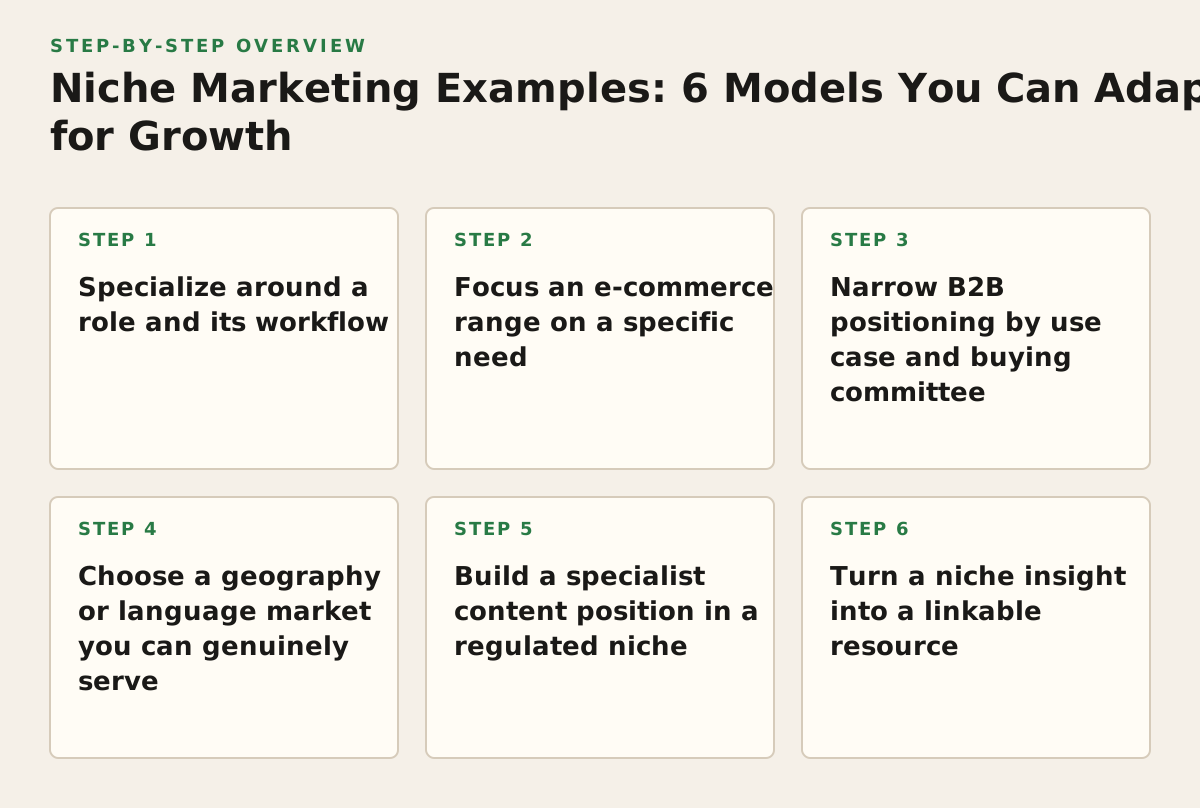
1. Specialize around a role and its workflow
When it applies: Your product or service is useful across industries, but one job title repeatedly faces a costly, specialized task. This can suit SaaS, agencies, and B2B providers whose broad positioning makes their value hard to distinguish.
Why it works: A role-based niche gives you a concrete way to describe the problem, buying triggers, and evaluation criteria. “Reporting software” is broad; “reconciliation workflow for finance teams at subscription businesses” points to a specific user and task. It also gives sales and content teams a common brief.
Example pattern: workflow-specific SaaS
Imagine a project management platform targeting compliance teams at regional lenders. Its niche message could focus on collecting review evidence, assigning approvals, and tracking unresolved issues—not on generic productivity. A useful landing page would show the workflow and explain which team owns each step.
- Adapt: Interview users in one role about the task immediately before and after using your product.
- Build a page around the actual workflow, with a concrete example and clear product limitations.
- Create supporting content answering the questions that arise during implementation and vendor evaluation.
Failure mode: Treating a job title as proof of a market. If buyers in that role have different needs, budgets, or approval paths, the message will still feel generic. Segment further by workflow or organization type before expanding your campaigns.
2. Focus an e-commerce range on a specific need
When it applies: Your store competes in a crowded product category and can serve a defined use, material preference, environment, or buyer constraint better than a general catalog can.
Why it works: A focused range helps shoppers understand why products belong together and which one fits their situation. It can also create a coherent editorial plan: comparison guides, care advice, use-case pages, and product education. Use market research to check demand and alternatives rather than assuming that a passionate audience is large or reachable. The U.S. Small Business Administration recommends examining demand, market size, location, saturation, and competitor offerings as part of market research (SBA market research and competitive analysis).
Example pattern: products for a constrained environment
An outdoor retailer could organize a collection for apartment-dwelling cyclists who need compact storage and weather-resistant gear. The niche is not “people who like cycling”; it is buyers managing space and exposure to the elements. Product pages can explain dimensions, storage options, and care requirements so that the positioning is useful rather than decorative.
- Group products around the buyer’s constraint, not just an internal merchandising category.
- Show fit, compatibility, and trade-offs in product descriptions.
- Use customer questions and returns feedback to identify missing guidance.
Failure mode: Building the whole range around a label that customers do not use or search for. Validate the wording in customer interviews, on-site search, and query research before investing in a large content or inventory expansion.
3. Narrow B2B positioning by use case and buying committee
When it applies: Your B2B offer can serve multiple sectors, but the strongest sales conversations share a particular use case, buying trigger, or set of decision-makers.
Why it works: Use-case positioning connects the problem to the people who must approve a solution. A cybersecurity consultancy, for example, could focus on helping multi-location healthcare groups prepare for vendor reviews. That message gives an operations lead, technical reviewer, and procurement contact different reasons to engage.
Example pattern: a specific trigger, not an industry label
A fictional analytics consultancy might target manufacturers consolidating data after an acquisition. Its content could explain how to map reporting definitions across business units, what information to gather before a project, and where a unified dashboard will not solve conflicting processes. The niche is the transition and its operational problem—not “manufacturing” by itself.
- Document the trigger that makes a buyer start looking for help.
- Map who initiates, evaluates, approves, and uses the solution.
- Publish proof that matches the use case, while distinguishing documented outcomes from illustrative examples.
Failure mode: Writing one landing page for the executive sponsor and expecting it to answer every evaluator’s questions. Create role-specific supporting material, but keep the core offer consistent. If each role requires a different service, you may have separate segments rather than one niche.
4. Choose a geography or language market you can genuinely serve
When it applies: Your service depends on local availability, language, regulation, cultural context, or relationships with publishers and partners in a particular region.
Why it works: Local focus makes operational promises testable: where you can deliver, which language you support, and what local knowledge informs your work. It can also guide research into regional demand. The U.S. Census Bureau provides data by subjects such as geography, population, and business, which can help investigate a U.S. market rather than relying on a vague impression of local demand (Census Bureau data portal).
Example pattern: localized B2B link outreach
A SaaS company entering the German market could prioritize German-language resources written for its actual buyer, local industry publications, and relevant regional events. A content brief should specify language, audience, terminology, and the evidence needed for a useful contribution. For link acquisition, relevance and publisher quality matter more than a country label alone; an unrelated local site is not automatically a sound placement.
Failure mode: Translating a global page and calling the result localization. Adapt examples, search language, support expectations, and distribution. If the team cannot review the language or serve the market after acquisition, pause the expansion or use qualified local support.
5. Build a specialist content position in a regulated niche
When it applies: Buyers need context before acting, and inaccurate or oversimplified claims can damage trust. This often applies to finance, health, gambling, betting, and other high-scrutiny categories.
Why it works: Specific, carefully reviewed content can clarify terms, explain processes, and answer questions that generic marketing avoids. For a casino or betting brand, a useful niche might be responsible information for a defined market and audience—not sensational claims about winning or unsupported assurances. Use appropriate subject-matter review and make the audience and jurisdiction clear.
Example pattern: answer a narrow question with clear boundaries
A betting operator could develop a guide explaining how to read market terminology for a particular sport, with definitions, worked examples, and prominent responsible-gambling information. The guide should avoid implying guaranteed outcomes. If creators or publishers receive compensation to discuss a brand, make the relationship clear; the U.S. Federal Trade Commission’s guidance explains disclosure expectations for endorsements and material connections (FTC disclosures guidance).
Failure mode: Using “expert content” as a veneer for promotional claims. Set an editorial review process, cite substantiated claims, and separate education from offers. A narrow audience does not remove legal, platform, or publisher requirements.
6. Turn a niche insight into a linkable resource
When it applies: You understand a specific audience well enough to produce an asset that other relevant sites could cite, discuss, or use—not just a page asking for a backlink.
Why it works: A focused resource gives outreach a genuine reason to exist. Examples include an original survey with a transparent method, a practical comparison framework, or an explainer that organizes complex public information for one professional audience. Google’s guidance on helpful content emphasizes creating useful, people-first pages, while its spam policies identify manipulative link practices as a risk; build the asset for readers and avoid treating paid or arranged links as editorial endorsements (Google’s helpful content guidance; Google Search spam policies).
Example pattern: a practical niche benchmark
A B2B payments company could publish a checklist for finance teams evaluating payment-reconciliation workflows. The checklist should state what it covers, who it is for, and where its recommendations stop. A supporting article can explain the methodology and invite relevant trade publications or professional communities to review it.
- Choose a question that repeatedly blocks a real decision.
- Use original evidence or clearly attribute and organize public information.
- Pitch the resource to publishers with an audience match, not merely a high authority metric.
Failure mode: Producing a thin infographic or generic report and expecting outreach to create demand. Before production, ask a small set of relevant editors, partners, or customers whether the proposed angle would help their audience. For planned authority link building, assess the publisher’s topical fit, real readership, and editorial standards—not a metric in isolation.
Use this framework to select which niche to test
Compare candidate niches using evidence you can gather before committing a full campaign. This is a prioritization aid, not a universal scoring model; a weak signal in a critical area can outweigh several convenient positives.
| Decision factor | Evidence to collect | Proceed when… | Warning sign |
|---|---|---|---|
| Problem clarity | Customer interviews, sales objections, support questions | Buyers describe a recurring problem in their own words | The segment is defined only by an industry name or demographic |
| Reachability | Relevant publishers, communities, search queries, partner routes | You can name credible channels that reach the intended buyer | The plan depends on broad paid reach or irrelevant placements |
| Offer fit | Product requirements, delivery constraints, buyer expectations | Your team can deliver the specific promise consistently | Serving the segment requires unsupported claims or exceptions |
| Commercial case | Sales conversations, repeat-purchase behavior, procurement needs | There is a plausible path from the problem to a buying decision | Interest is high but no buyer, budget owner, or purchase trigger is identifiable |
| Content potential | Unanswered questions, available evidence, expert access | You can add useful knowledge beyond a product pitch | Every planned page repeats the same sales message |
For each candidate, record the evidence, the unresolved assumption, and the cheapest next test. If you are an agency selecting a segment for a client, keep the client’s audience definition separate from your own prospecting criteria. If you are planning link building services, that distinction helps keep publisher selection aligned with the campaign’s intended readers.
Implement the niche in a sequenced 2026 plan
- Write a one-sentence hypothesis. Name the audience, the problem, and why your offer is suited to it. Avoid claims such as “best” unless you can substantiate them.
- Check demand and alternatives. Interview prospective buyers, review existing solutions, and investigate relevant search language or public market data. Record what would disprove the opportunity.
- Test the message before scaling. Put the positioning in front of sales prospects, existing customers, or a small relevant audience. Look for whether they recognize the problem and understand the offer—not just whether they praise the wording.
- Build one complete proof path. Create a focused landing page, a useful supporting resource, and evidence appropriate to the audience. For regulated niches, define review and disclosure checks before publication.
- Choose distribution that matches the niche. Use the channels where the intended audience already evaluates suppliers or shares expertise. For earned links, vet relevance, editorial standards, and real audience fit; reject link schemes that trade relevance for volume.
- Review and refine on a set cadence. Compare qualified inquiries, audience feedback, content engagement, and delivery friction against the original hypothesis. Expand only when the offer and route to market remain credible; otherwise, revise the niche or stop the test.
For a 2026 campaign that needs specialist publisher outreach, Web Push offers hand-vetted link building and digital PR for SaaS, e-commerce, B2B, and gambling-friendly campaigns; see Web Push.
Authored with NotFair SEO