
Choosing an seo link building agency is not simply a matter of comparing the number of backlinks in a proposal. The real decision is which acquisition method fits your pages, market, risk tolerance, internal capacity, and reporting requirements. This guide helps SEO agencies, SaaS teams, e-commerce marketers, B2B companies, and casino or iGaming brands evaluate providers without confusing activity with progress.
A good engagement should answer five practical questions: which links are being pursued, why those links should support the business, how publishers are vetted, what the client must supply, and how success will be measured. It should also make failure visible early. A placement on an irrelevant site, a link pointing to the wrong page, or an article published without meaningful editorial standards can consume budget without improving the authority or visibility of the target page.
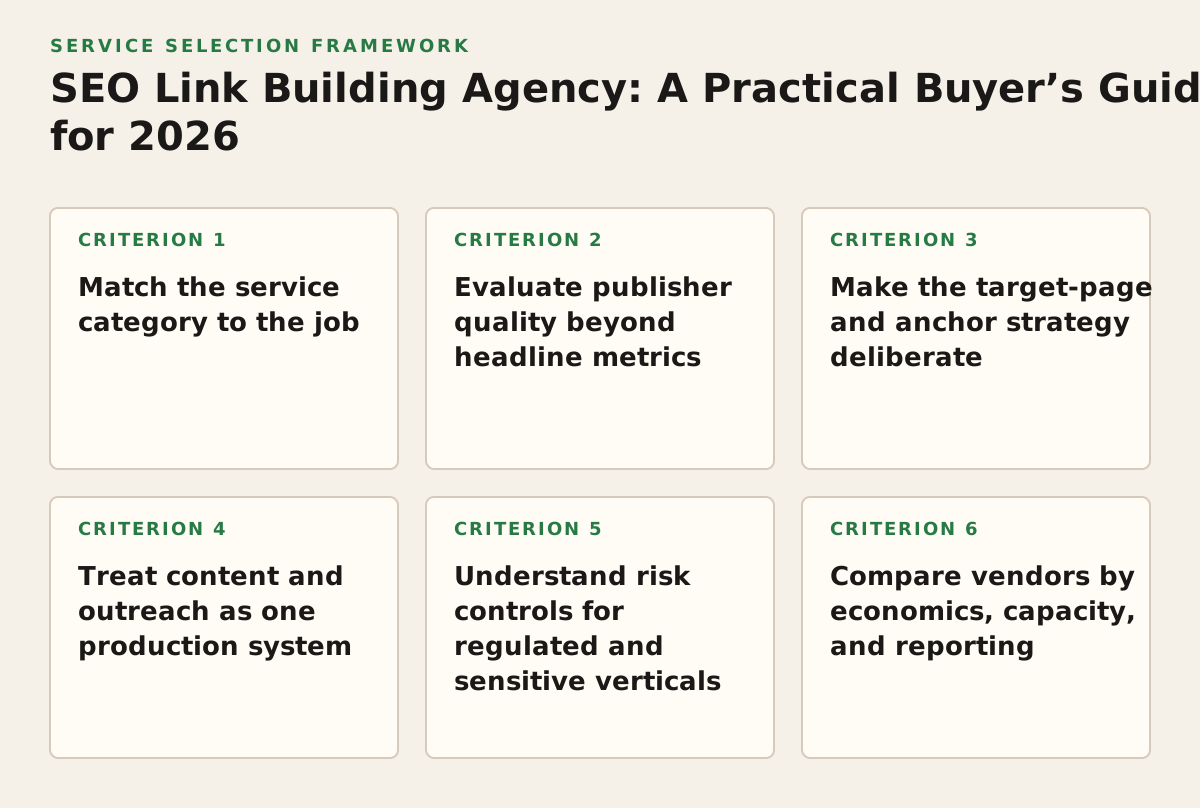
1. Match the service category to the job
“Link building” covers several different delivery models. They overlap, but they are not interchangeable. A service that suits a SaaS comparison page may be a poor fit for a regulated betting brand or an agency that needs fulfillment under its own name.
| Buyer need | Best-fit service type | Why it fits | Main trade-off |
|---|---|---|---|
| Promote a useful asset, research report, tool, or original viewpoint | Digital PR and linkable assets | Creates a reason for journalists, editors, or industry publishers to reference the page | Requires a genuinely interesting story, data source, or creative asset; coverage is less predictable |
| Build relevant contextual links to established commercial or informational pages | Guest posts | Allows control over topic, anchor context, destination, and publisher relevance | Needs content planning, editorial review, and tolerance for publisher lead times |
| Add a brand or resource to an existing relevant article | Niche edits | Uses an already indexed page with an established topical context | Availability is limited, and the existing article may change or lose visibility |
| Strengthen important pages with carefully selected authoritative references | Authority link building | Prioritizes publisher quality, topical fit, and strategic page selection over raw volume | Usually demands more research and stronger justification for each target |
| Deliver campaigns for agency clients without hiring an internal team | White-label link building | Outsources prospecting, outreach, content coordination, and placement management | Requires precise briefs, service-level expectations, and a clear client-facing reporting process |
When each model applies
- Guest posting is useful when you can contribute a credible article to a relevant publication and need control over the destination page.
- Niche edits can suit a mature resource page where an added reference would be genuinely useful to readers, not merely inserted for ranking purposes.
- Digital PR is appropriate when the business has data, expertise, a point of view, or a campaign that can earn attention beyond SEO.
- White-label fulfillment fits agencies that own strategy and client relationships but need reliable production capacity behind the scenes.
- Authority links are appropriate when a small set of high-priority pages deserves deeper publisher research and more selective outreach.
The failure mode is buying a package before defining the job. For example, an e-commerce company may order generic guest posts when its best opportunity is a digital PR campaign around original product data. A B2B software company may chase links to a pricing page when a research guide would be more naturally cited.
Implementation example: a SaaS team launching an integration directory could split its campaign into three tracks: guest posts explaining the operational problem, niche edits on existing integration guides, and a digital PR asset showing anonymized usage patterns. Each track has a different prospect list and success criterion. Treating all three as “links delivered” would hide the strategic difference.
2. Evaluate publisher quality beyond headline metrics
Domain Rating, Domain Authority, and similar third-party metrics can help sort a prospect list, but they do not establish that a site is valuable, editorially credible, or relevant to your audience. A provider should explain how it checks the publisher rather than presenting a spreadsheet of scores.
Google’s documentation says links can help it discover pages and understand relevance, while its spam policies warn against links created primarily to manipulate rankings. Review the Google Search Essentials spam policies when assessing whether a proposed tactic is defensible in the long term. The practical implication is that editorial purpose matters: a link should make sense in the surrounding content, not exist only because a buyer paid for a URL.
What to inspect on every publisher
- Topical alignment: Does the site regularly publish on the subject, audience, geography, or business context you need?
- Organic visibility: Does it receive search traffic for real topics, or is its apparent authority concentrated in a few unrelated pages?
- Editorial consistency: Are articles edited, attributed, structured, and written for readers?
- Outbound-link behavior: Are there excessive commercial links, casino links, payday-loan links, or unrelated sponsored articles?
- Indexation: Are recent articles discoverable in search, and do important sections appear to be excluded?
- Audience geography: Does the publisher reach the market that matters to the client, especially for local, German, Romanian, or other European campaigns?
- Placement permanence: What happens if the publisher redesigns the site, removes the article, or changes its editorial policy?
A useful provider should be willing to show sample URLs before publication, describe its vetting rules, and explain what happens when a prospect fails review. Ask whether the team checks traffic trends, not just a single metric captured on one date. Also ask how it handles sites with strong metrics but obvious signs of paid-link saturation.
Failure mode: accepting a high-metric site that has no topical relationship to the client. This can produce a technically live backlink while offering little referral value, weak editorial credibility, and a poor answer to the question, “Why would this publication mention us?”
Implementation example: for a Romanian B2B software campaign, create three publisher tiers before outreach: Romanian business publications, European SaaS or operations sites, and broader marketing publications. Record topical fit, estimated organic visibility, language, audience location, outbound-link pattern, and editorial notes. A lower-metric local business publication may outrank a higher-metric general site in the campaign queue because it better matches the buyer and market.
3. Make the target-page and anchor strategy deliberate
Backlinks should support a page architecture, not accumulate as disconnected wins. Start by identifying pages that can convert, assist conversion, or attract links naturally. Then decide which pages need authority, which need relevance, and which should not be promoted yet because their content is too thin.
Google’s guidance on crawlable links emphasizes descriptive anchor text and links that are discoverable in normal HTML. That does not mean every link should use an exact commercial keyword. It means the link and its context should help users and search engines understand the destination.
Build a target-page brief
- Page URL and search intent.
- Primary audience and business purpose.
- Topics the referring article must cover naturally.
- Preferred destination and acceptable alternatives.
- Anchor guidance, including brand, URL, descriptive, and partial-match options.
- Pages or claims that must not be promoted until updated.
- Internal links the destination page needs before external promotion.
Use anchor diversity as a control, not a quota. A provider promising a fixed percentage of exact-match anchors is giving a simplistic answer to a contextual problem. Anchor choices should follow the sentence, publication style, brand language, and reader expectation. For commercial pages, branded or descriptive anchors will often be more natural than forcing a keyword into every placement.
Failure mode: directing most links to a homepage because it is the easiest URL to approve. The homepage may gain authority, but the pages competing for valuable non-brand queries remain under-supported. The opposite failure is pushing links to a weak landing page that does not satisfy the intent earned by the referring article.
Implementation example: an e-commerce brand has a category page for sustainable office furniture, a buying guide, and a calculator for estimating workspace requirements. The guide and calculator may be the best initial outreach destinations because they provide useful editorial references. Once they attract relevant authority, some internal equity can support the category page through clear internal linking.
For more specialized campaigns, define the quality bar before the first prospect is contacted. A strategy centered on authority link building should specify which page types, topics, markets, and publisher characteristics justify a higher-effort placement.
4. Treat content and outreach as one production system
Placement quality depends on the relationship between prospecting, topic selection, writing, editing, and outreach. Separating these into disconnected handoffs creates predictable problems: an article written for a site that later rejects it, a link forced into an irrelevant paragraph, or a topic that duplicates the client’s existing content without adding a useful angle.
Set the workflow before ordering placements
- Brief the business: document products, regulated claims, prohibited topics, approved terminology, target markets, and competitors that must not be referenced.
- Map content gaps: identify subjects where the client can offer useful expertise rather than rewriting a generic article.
- Prospect by fit: shortlist publishers whose audience and editorial pattern support the proposed topic.
- Confirm the opportunity: validate topic, destination, link attributes, language, and publication expectations before drafting.
- Review for accuracy: check claims, examples, screenshots, statistics, brand positioning, and legal or compliance sensitivities.
- Record the outcome: save the live URL, target URL, anchor, publication date, publisher notes, and any agreed replacement or correction policy.
For white-label work, add a second layer of documentation. The agency buying fulfillment needs a client-ready status format, but the delivery partner also needs internal fields that protect quality: rejected prospects, editorial restrictions, content revisions, and reasons for replacing a placement.
Failure mode: outsourcing content without giving the writer access to a subject-matter brief. The result is often grammatically correct but commercially vague, with unsupported claims or an anchor that reads unnaturally. A publisher may accept it, yet the article contributes little to brand credibility.
Implementation example: a cybersecurity SaaS company can supply a one-page expert brief covering its threat model, customer terminology, prohibited promises, and three anonymized use cases. The writer then creates a publication-specific article about incident-response workflows rather than a generic “top cybersecurity trends” piece. The link becomes a relevant reference because the surrounding argument is useful on its own.
Content requirements should also reflect the publisher. A German-language article needs more than translation if its examples, formality, and search vocabulary are designed for English-speaking buyers. A casino or betting campaign requires extra care around responsible-gambling language, jurisdictional restrictions, and whether a publisher genuinely accepts gambling-related content.
5. Understand risk controls for regulated and sensitive verticals
Casino, betting, iGaming, finance, health, and other sensitive sectors need a narrower publisher and content policy than a general B2B campaign. The objective is not to hide the vertical. It is to ensure the placement is lawful, editorially appropriate, and aligned with the market in which the brand operates.
For paid or sponsored placements, ask how the provider handles disclosure and link attributes. Google’s outbound-link qualification guidance describes rel="sponsored" for advertisements or paid placements and rel="ugc" for user-generated content. The provider should explain the expected treatment rather than implying that every paid link will be presented as an ordinary editorial citation.
The U.S. Federal Trade Commission’s endorsement guidance also addresses clear disclosure of material connections in endorsements and promotional content. Legal duties differ by jurisdiction and campaign, so a vendor should not replace the client’s legal review. It should, however, flag where publication, disclosure, or wording needs approval.
Ask for vertical-specific controls
- Which countries and languages does the publisher serve?
- Does the site clearly permit gambling, betting, or affiliate content?
- Are licensing, age, responsible-gambling, or promotional claims reviewed by the client?
- Will the content use neutral educational language where direct promotion is unsuitable?
- Are disclosures and link attributes agreed before publication?
- What categories of publisher are automatically excluded?
- How are brand-safety incidents escalated and documented?
Failure mode: treating “gambling-friendly” as a loose label. A site may have accepted one gambling article but still lack the audience, jurisdiction, or editorial environment appropriate for a regulated operator. Conversely, placing betting content on a general business site without checking policy can create a brand-safety issue even if the URL has attractive metrics.
Implementation example: an iGaming operator expanding into a new European market can create a pre-approval matrix with columns for jurisdiction, language, permitted product claims, publisher category, disclosure requirement, and legal sign-off. Outreach begins only after a site passes the matrix. This adds work upfront but prevents unsuitable placements from becoming late-stage compliance disputes.
6. Compare vendors by economics, capacity, and reporting
Pricing is meaningful only when you understand what the fee includes and what remains your team’s responsibility. A low quote may exclude content, revisions, publisher vetting, replacement handling, or reporting. A higher quote may reflect deeper research or senior review, but the vendor should be able to connect that effort to a defined deliverable.
Questions about pricing and commercial structure
- Is the engagement priced per placement, monthly retainer, campaign, content asset, or a combination?
- Does the fee include prospecting, outreach, writing, editing, publication coordination, and reporting?
- Are publisher fees, journalist contributions, design, data work, or translation separate?
- What happens when an approved prospect rejects the draft or changes its terms?
- Is there a minimum commitment, and what is the cancellation or pause process?
- Are replacement terms limited by time, publisher type, or cause of removal?
- Will the client see the proposed URL before publication?
- How are taxes, currency conversion, and cross-border payments handled?
Do not invent a universal budget threshold. Use an illustrative starting policy instead: reserve a defined test allocation, agree on the number of pages and markets involved, run the campaign for a fixed review period, and expand only if quality and leading indicators meet the written criteria. The amount depends on the client’s margins, market, page value, and available internal capacity.
Measurement should separate delivery from outcome. A monthly report can show placements delivered, but management also needs to see whether target pages were crawled, indexed, gaining impressions, attracting referral visits, and moving for relevant queries. Google Search Console’s Performance report documentation explains how search metrics such as clicks, impressions, click-through rate, and average position are presented. Use those measures carefully: rankings fluctuate, and a link cannot be assigned sole credit for a change in a competitive search result.
Failure mode: accepting a report that lists only domain metrics and live URLs. That proves delivery, not strategic value. It also makes it impossible to distinguish a useful placement from a technically active link on a publisher that no longer reaches the intended audience.
Implementation example: an agency buying white-label fulfillment can define three reporting layers: a client-safe summary, an account-manager worksheet with targets and statuses, and a quality-audit log containing rejected prospects and reasons. The contract can then specify which layer is delivered, which fields are confidential, and who owns client communication.
7. Use measurable success criteria without promising rankings
Link building is affected by content quality, internal linking, technical accessibility, competition, seasonality, algorithmic changes, and the quality of the page being promoted. A responsible provider cannot guarantee a particular ranking position from a fixed number of placements.
Set measurement at three levels:
- Quality metrics: relevance, publisher editorial standards, organic visibility, audience geography, link context, destination, and attribute.
- Delivery metrics: approved prospects, accepted topics, published URLs, revision rate, replacement rate, and time from approval to publication.
- Business and search metrics: impressions, qualified organic sessions, assisted conversions, leads, revenue where properly attributable, and visibility for the intended topic set.
Use a baseline taken before the campaign begins and annotate other major SEO changes, such as a site migration, content rewrite, internal-linking project, or technical fix. Google’s Search Console documentation describes Search Console as a tool for monitoring search performance and diagnosing issues; it should be part of the measurement process, not treated as proof that one supplier caused every subsequent movement.
Define acceptance criteria in writing
- The publisher must match the agreed topic, audience, language, and market.
- The page must be publicly accessible and indexable unless a different objective is explicitly agreed.
- The article must pass factual, editorial, brand, and legal review.
- The link must point to the approved destination and use an acceptable contextual anchor.
- The report must include the live URL, date, anchor, destination, and relevant publisher notes.
- The replacement policy must state what happens if the page is removed or materially changed.
Failure mode: using ranking movement as the only pass/fail measure. That encourages a provider to chase easy keywords, ignore commercially important pages, or overstate causation. A better decision rule combines placement quality, operational reliability, and directional search or business evidence over an agreed observation period.
Implementation example: a B2B company can review a quarterly campaign by asking whether approved pages earned relevant impressions, whether referring sites sent qualified visitors, whether the content attracted natural mentions, and whether the publisher mix still matches the market. If delivery is high but relevance is declining, the campaign should be corrected even before rankings reveal the problem.
8. Interview the agency before signing
A short interview can reveal more than a polished sample report. Ask the provider to reason through your actual pages, not just describe a standard package. The best answers include constraints, rejection criteria, and situations in which the agency would advise against a placement.
Vendor interview checklist
- How do you define a qualified publisher for our industry and target country?
- Which metrics do you use, and what would make you reject a site with strong metrics?
- Can we review publisher URLs and topics before publication?
- Who writes and edits the content, and how is subject-matter accuracy checked?
- How do you handle regulated claims, gambling content, disclosures, and link attributes?
- What proportion of the work is performed by your team versus subcontractors?
- How do you prevent the same publisher or article pattern from appearing across our competitors?
- What is included in the quoted fee, and which costs can arise later?
- What happens when an article is rejected, delayed, removed, or edited after publication?
- What will the report show, and can we see a redacted example?
- How do you protect confidential client information in a white-label arrangement?
- Which pages would you prioritize first, and what would you leave out?
Request a sample prospect record containing the URL, topical rationale, audience notes, quality checks, proposed topic, destination, and risk flags. A provider that cannot show its decision process may still deliver placements, but you will have less control over quality and less evidence when a client questions the work.
Red flags include guaranteed rankings, guaranteed traffic, unlimited authority claims, a refusal to disclose live URLs after publication, “do-follow only” promises without context, PBN or link-farm language, bulk offers with no relevance criteria, copied content, and a report that hides the destination or anchor. Another warning sign is pressure to approve a large order before the provider has reviewed the site, pages, market, and compliance requirements.
A useful test is simple: ask the agency to name one reason it would reject a potential placement. If the answer is “we can place anything,” the quality-control process is probably too weak for a serious campaign.
Implementation plan: move from audit to controlled scale
Use the following sequence when selecting and onboarding an SEO link-building partner. It keeps strategy, procurement, production, and measurement connected.
- Audit the assets first. List the pages that can earn attention, support commercial intent, or need authority. Fix obvious content, internal-linking, and technical weaknesses before buying external promotion.
- Choose the campaign job. Decide whether the immediate need is publisher contributions, existing-page references, digital PR, authority placements, or white-label capacity. Do not combine every service into one undifferentiated target.
- Write the acceptance policy. Define topical fit, countries, languages, publisher exclusions, content requirements, anchor guidance, link attributes, disclosure rules, and replacement terms.
- Shortlist vendors by process. Interview providers using the checklist above. Prefer transparent workflows, realistic limitations, relevant examples, and reporting that separates delivery from outcomes.
- Run a controlled initial allocation. This is an illustrative starting policy, not a universal benchmark: begin with a bounded set of target pages and publishers, then review quality and operational friction before expanding.
- Review every placement. Check the URL, article, context, anchor, destination, indexability, audience fit, and brand safety. Reject a placement that fails the agreed policy, even if it is already available.
- Measure in context. Track delivery, referring traffic, Search Console visibility, target-page performance, and business actions. Annotate other SEO work so the review does not overclaim causation.
- Scale the parts that remain defensible. Expand publisher categories, languages, or service types only when quality controls survive higher volume. If relevance or editorial standards fall, reduce scope rather than lowering the acceptance bar.
For agencies, this sequence can become a repeatable fulfillment product under your own client relationship. For SaaS, e-commerce, B2B, and iGaming teams, it provides a way to choose between guest posts, niche edits, digital PR, and selective authority placements based on the page and business objective rather than a generic link quota.
Web Push provides hand-vetted guest posts, niche edits, authority links, digital PR, linkable assets, and white-label link building services for European and international campaigns, including gambling-friendly publisher opportunities where appropriate. If you need a partner to assess publisher fit and manage the delivery process, Web Push
Authored with NotFair SEO