
Buying seo link building services is not simply a matter of ordering a number of backlinks. The real decision is which links can support a defined business priority, which publisher and page standards are acceptable, and how much review your team can absorb. An SEO agency may need invisible fulfillment under its own brand; a SaaS company may need links to a comparison page; an iGaming operator may need gambling-friendly publishers without creating compliance or reputation problems.
This guide helps marketing managers, agency owners, and organic-growth leads compare guest posts, niche edits, authority links, digital PR, and linkable assets. It covers the mechanism behind each service, implementation burden, pricing questions without pretending there is one universal rate, measurable success criteria, warning signs, and questions to ask before signing. The objective is a defensible acquisition process, not a large spreadsheet of URLs.
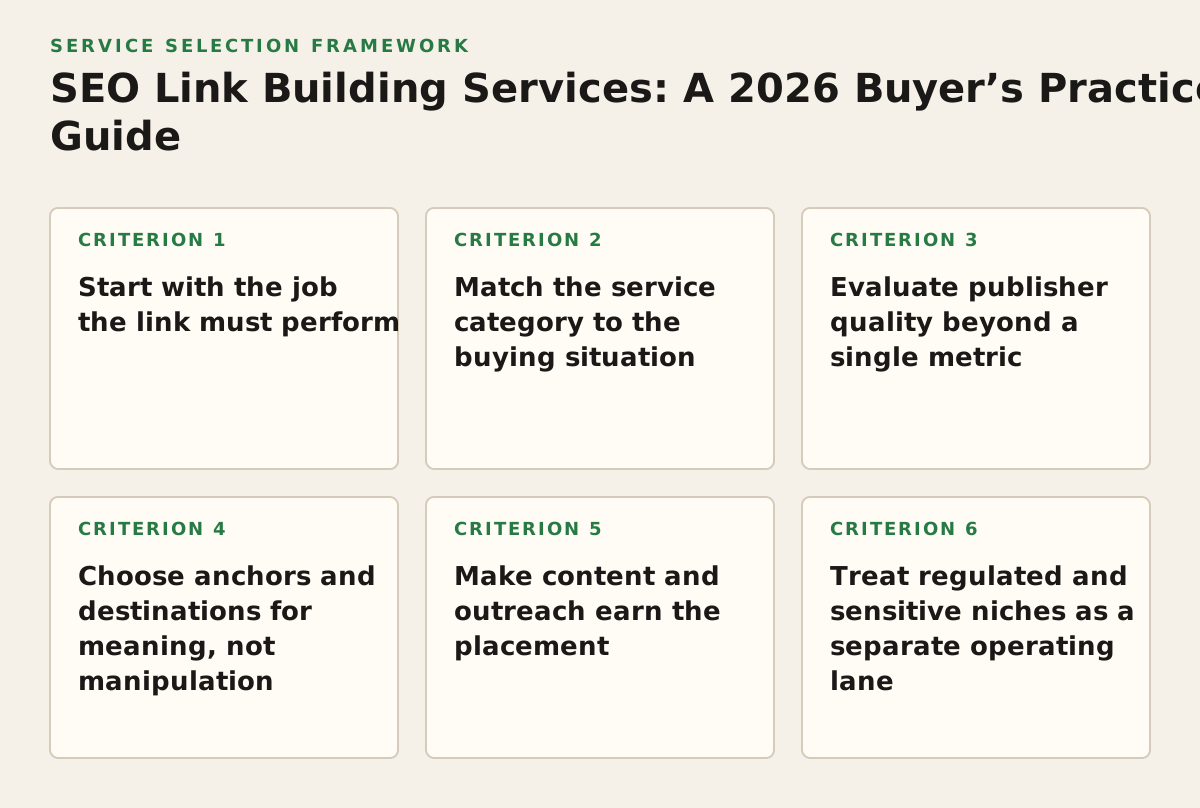
1. Start with the job the link must perform
A backlink can serve several jobs, and confusion starts when a buyer evaluates every placement by the same standard. A commercial landing page may need topical authority and qualified referral traffic. A new research asset may need editorial citations. A local service company may need geographically relevant mentions. A white-label agency may need predictable fulfillment, clear client-safe reporting, and no direct contact between the supplier and its customer.
Define the target page first, then state the intended audience, topic, geography, and commercial distance from conversion. A link to a product page is not automatically better than a link to a guide: it depends on whether the publisher can reference the page naturally and whether the page deserves the citation.
A practical brief
- Business outcome: qualified organic visits, assisted conversions, visibility for a topic cluster, or authority for a new category.
- Target URL: the exact page, its current purpose, and whether it can accept editorial context.
- Audience and market: language, country, industry, and exclusions such as competitors or regulated claims.
- Link role: citation, expert reference, resource recommendation, brand mention, or commercial navigation.
- Constraints: anchor-text policy, landing-page readiness, legal review, publisher categories, and reporting requirements.
Failure mode: setting a target such as “50 high-authority links” before choosing pages and audiences. That encourages suppliers to fill an inventory quota, often with links that are technically live but strategically irrelevant.
Implementation example: a B2B software company launching an integration page might brief ten relevant topics, such as workflow automation and data handoffs, rather than demand a fixed anchor. The provider can then find editorial contexts where the integration genuinely solves a reader problem. Success is assessed through relevant referring domains, indexed placements, referral engagement, and movement in the target topic—not the raw number of published URLs.
2. Match the service category to the buying situation
Different services solve different production problems. The labels overlap in the market, so ask what is actually delivered: outreach, content, editorial placement, an existing-page insertion, a newsworthy asset, or a completed campaign managed under another agency’s brand.
| Buyer need | Best-fit service | Why it works | Trade-off and delivery burden | Useful success measures |
|---|---|---|---|---|
| Earn a contextual mention on a relevant new article | Guest posting | Creates a purpose-built article and controlled editorial context | Requires topic approval, writing, revisions, and publisher quality checks | Relevant referring domains, indexed links, referral visits, page-level visibility |
| Strengthen an existing resource that already fits a page | Niche edit | Places a reference inside an established article with existing context | Less control over surrounding copy; page can change or disappear | Contextual relevance, page stability, referral engagement, link survival |
| Support a high-value page with a strong editorial citation | Authority link building | Prioritizes publisher quality, topical fit, and defensible placement standards | Usually needs narrower prospecting and more internal review | Quality of referring domains, topical alignment, organic impressions, conversions |
| Create attention and links around something genuinely useful or newsworthy | Digital PR | Gives journalists, editors, and specialist publications a reason to cite the asset | Heavier research, creative, outreach, timing, and approval burden; outcomes vary | Qualified coverage, links, brand mentions, referral traffic, journalist relevance |
| Obtain fulfillment without adding delivery staff | White-label link building | Outsources research, content, outreach, and reporting under an agency workflow | Requires process documentation, quality control, and client-safe communication | On-time delivery, approval rate, placement quality, retention, margin protection |
For a focused explanation of how a provider may combine prospecting, outreach, content, and placement review, see link building services. Treat the category as a starting point, not a guarantee: a “guest post” can be highly editorial or a thin article placed on a weak site, while a niche edit can be useful or irrelevant depending on the page.
Failure mode: buying one service for every URL because its name is familiar. A newsworthy data study does not need to be forced into a guest-post order, and an already useful article does not necessarily need a new replacement article.
Implementation example: an e-commerce brand with a seasonal buying guide could use niche edits for existing evergreen articles, guest posts for supporting educational topics, and digital PR for original trend data. Each stream gets a separate approval queue and measurement plan instead of being reported as one undifferentiated backlink total.
3. Evaluate publisher quality beyond a single metric
Domain Rating, Domain Authority, traffic estimates, and similar scores can help sort prospects, but none proves that a placement is editorially sound. A publisher may have a respectable score while accepting every topic, carrying excessive sponsored content, or receiving traffic unrelated to your market. Conversely, a smaller specialist publication may be more useful because its audience and subject matter match the buyer.
Use a multi-signal qualification check before approving a domain or URL:
- Does the site publish consistently for a recognizable audience?
- Are recent articles specific, edited, and internally coherent rather than templated?
- Does organic traffic appear relevant to the target country and subject?
- Are outbound links selective, descriptive, and connected to the article?
- Does the site show signs of a paid-link marketplace, such as unrelated categories, repeated commercial anchors, or identical author patterns?
- Can the proposed page be crawled, indexed, and reached through the site’s normal navigation?
Google’s Search Essentials identify manipulative linking and link schemes as spam risks, while its guidance on crawlable links explains why links should use normal HTML and descriptive destinations; those are useful baseline checks, not a promise that any individual link will rank a page (Google Search spam policies; Google’s crawlable links guidance).
Ask whether the link is intended to be editorial, paid, or sponsored. If a commercial arrangement affects how a link should be marked, the provider should explain its policy rather than hiding it. Google documents rel="sponsored" for paid links and rel="ugc" for user-generated links, so a vendor that cannot discuss link attributes clearly is creating avoidable governance risk (Google guidance on qualifying outbound links).
Failure mode: accepting a publisher because it meets a minimum score while ignoring topical mismatch. A casino brand does not gain useful authority from a general site with no gambling, finance, entertainment, or adjacent audience context merely because its metric is high.
Implementation example: create a prospect scorecard with separate fields for topical fit, audience geography, estimated organic visibility, editorial quality, outbound-link behavior, placement type, and risk notes. Require a human reviewer to approve the URL and surrounding article before publication. A score can prioritize review; it should not replace it.
4. Choose anchors and destinations for meaning, not manipulation
Anchor text influences how a reader understands a link, but forcing an exact commercial phrase across many placements produces unnatural copy and can create a pattern that reviewers dislike. The safer operating principle is to earn links because the destination is useful, then allow the surrounding sentence to determine whether the brand, URL, partial phrase, or generic wording is most natural.
Build an anchor policy with guardrails, not a rigid quota. It should specify:
- Which pages are approved and what each page helps the reader do.
- Which brand names, product names, URLs, and descriptive phrases are acceptable.
- Which exact-match commercial terms require exceptional justification or are not permitted.
- How to handle regulated sectors, including gambling claims, financial language, health statements, and age-sensitive audiences.
- Who approves deviations when the publisher’s editor requests a different wording.
Use a simple “sentence test”: if the anchor were removed, would the sentence still make sense? If the destination does not add information to the paragraph, change the article or choose another page. The best target is often a genuinely useful guide, calculator, study, category explanation, or glossary page that an editor can reference without turning the article into an advertisement.
For local campaigns, relevance may involve service, city, and problem rather than a repeated exact-match anchor. A business seeking local SEO support can use that resource to improve local search visibility for an Orlando service business through SEO support, while keeping its link acquisition brief focused on useful local citations and service-area content.

Failure mode: treating anchor diversity as a numerical camouflage exercise. Replacing one exact phrase with a predetermined list of awkward variants still produces poor copy and does not solve a weak destination.
Implementation example: for a SaaS reporting platform, approve the brand name, the product URL, “reporting workflow,” and a natural phrase such as “how teams consolidate campaign data.” A writer selects the wording that fits the paragraph. The SEO lead reviews relevance and commercial intent, not whether every anchor bucket has been filled.
5. Make content and outreach earn the placement
Guest posts and digital PR succeed when the publisher receives something its audience can use. That can be a well-researched explainer, original data, a subject-matter expert, a visual resource, or a timely interpretation of a real event. Outreach is not a substitute for the asset: a large prospect list cannot make a weak article newsworthy or a generic pitch relevant.
Separate the production stages
- Audience research: document what the publication covers, who reads it, and which formats it accepts.
- Angle selection: connect the client’s expertise or evidence to a reader problem without starting from the desired anchor.
- Editorial outline: define claims, sources, examples, exclusions, and the natural destination for any reference.
- Quality review: check originality, factual support, brand safety, language, and commercial tone.
- Pitch and revision: let the editor accept, reshape, or reject the angle; do not treat publication as automatic.
- Post-publication audit: confirm the URL, rendered link, indexability, context, and reporting record.
For digital PR, distinguish a press release from a linkable asset. A release can announce something; an asset gives another publisher a reason to cite, interpret, or build upon the information. A survey, public dataset, expert methodology, or original comparison may work, but only if the research question and collection method are credible.
Failure mode: writing one generic article, swapping the title and anchor, and sending it to dozens of unrelated sites. Editors see little value, readers receive repetitive material, and the client inherits a weak brand association.
Implementation example: a B2B cybersecurity company could create a practical guide to vendor questionnaire preparation, supported by anonymized expert commentary and a downloadable checklist. A guest post explains one workflow for a relevant operations audience; a PR pitch offers the methodology and key findings to specialist publications. The target page is cited only where it expands the explanation.
6. Treat regulated and sensitive niches as a separate operating lane
Casino, betting, iGaming, finance, health, and other sensitive sectors need stricter publisher and content controls. The issue is not merely whether a site accepts the category. Review jurisdiction, licensing language, age-related presentation, responsible-gambling wording, promotional claims, payment references, and whether the publisher’s audience is appropriate for the brand.
Write sector exclusions into the brief before prospecting begins. For gambling clients, that may include sites aimed at minors, unlicensed-market content, misleading “guaranteed win” language, bonus claims without terms, or publishers whose editorial environment conflicts with the operator’s brand. The brand’s legal or compliance team should own final claims approval; the link provider should not improvise it.
Paid relationships also need transparency. The U.S. Federal Trade Commission explains that material connections in endorsements may need clear disclosure, and its guidance stresses that disclosures should be understandable and placed where audiences can see them (FTC disclosure guidance). The exact obligation depends on the market and arrangement, so ask the provider how it handles sponsored content, disclosures, and link attributes in each target country.
For international work, language quality is part of risk management. A translated article that uses the wrong betting terminology, currency, licensing vocabulary, or cultural reference can create reputational damage even if the backlink is technically live. Use native review for German or Romanian campaigns rather than assuming machine translation is publication-ready.
Failure mode: treating a “gambling-friendly” inventory label as evidence of suitability. A site can accept gambling content while having the wrong jurisdiction, poor editorial standards, or an audience that creates compliance concerns.
Implementation example: an iGaming brand can create a two-stage approval: first, compliance reviews the market, claims, landing page, and publisher category; second, SEO reviews topical fit, traffic relevance, link placement, and indexability. The provider supplies the proposed article and live URL, but the brand retains sign-off over regulated language.
7. Compare vendors on process, evidence, and commercial terms
Service evaluation should reveal how work is done when a placement fails, not just how attractive the sales sample looks. Ask for a redacted workflow, sample report, replacement policy, content approval steps, and a clear definition of what counts as delivery. A supplier that refuses to describe basic controls leaves you unable to manage client or brand risk.
Vendor interview checklist
- How are prospects sourced, screened, and rechecked before publication?
- Can the buyer approve the domain, page, topic, and anchor before the article goes live?
- What happens if the publisher changes the article, removes the link, redirects the URL, or adds a nofollow or sponsored attribute?
- Are links placed on existing pages, new articles, or both—and how are those types reported?
- Who writes the content, what review process is used, and can the buyer request revisions?
- How are sensitive niches, local markets, language requirements, and regulated claims handled?
- What is included in the delivery unit: prospecting, writing, outreach, edits, publication, monitoring, and reporting?
- Can the provider fulfill under a white-label process without contacting the end client?
- How are rejected prospects and unsuccessful outreach recorded?
- Which outcomes are the provider willing to measure, and which are explicitly outside its control?
Pricing-model questions matter more than a headline rate. Determine whether the quote is per placement, per campaign, per approved domain, per content asset, or a retainer with a variable output. Ask whether writing, revisions, publisher fees, outreach, monitoring, replacements, taxes, and account management are included. Do not compare a managed campaign with a bare placement as though they were the same product.
Set a budget as an illustrative starting policy, not a universal benchmark. For example, an agency might reserve separate monthly envelopes for testing, approved placements, and digital PR production, then reallocate after reviewing quality and operational load. The correct amount depends on target markets, page value, approval speed, content complexity, and the opportunity cost of internal staff.
Red flags include:
- Guaranteed ranking positions or guaranteed traffic lifts from a fixed number of links.
- Vague “authority” claims with no URL-level evidence or qualification method.
- Unwillingness to disclose placement pages before approval.
- Large lists of unrelated sites presented as interchangeable inventory.
- Exact-match anchor promises without a documented risk policy.
- Reports that show published URLs but omit link attributes, target pages, dates, or replacement terms.
- Pressure to skip legal, brand, or client review to meet a publication quota.
Google Search Console’s documentation describes links as one part of how Google discovers and understands pages, but it does not promise a ranking result from purchasing a service; use that distinction when a vendor presents causation as certainty (Google Search Console documentation).
Failure mode: selecting the cheapest apparent unit while ignoring review time, rejected placements, content revisions, and monitoring. The invoice may be low, but the campaign can consume senior staff hours and weaken client trust.
Implementation example: an agency can run a short, controlled pilot with pre-approved publisher criteria, a fixed review window, and a written replacement policy. It should score each delivered placement for relevance, editorial quality, destination fit, indexability, and reporting completeness before expanding the relationship.
8. Measure links as a portfolio, not as isolated trophies
Links influence a wider system: discoverability, topical associations, referral paths, brand credibility, and the ability of important pages to compete. Measurement should therefore combine delivery quality with business outcomes. Rankings and organic traffic are affected by content, technical health, competitors, seasonality, and search features, so avoid attributing every movement to one placement.
A useful measurement layer
- Delivery: approved domain, live URL, placement type, target page, anchor, attribute, publication date, and replacement status.
- Quality: topical relevance, audience geography, editorial context, organic visibility, outbound-link pattern, and brand safety.
- Discovery: whether the page is accessible, indexable, and still live after a defined review period.
- Engagement: referral sessions, engaged visits, assisted conversions, and branded-search interactions where tracking is available.
- SEO indicators: impressions, clicks, query coverage, and page-level visibility for the target topic.
- Commercial outcome: qualified leads, revenue contribution, pipeline influence, or a credible intermediate action.
Establish a baseline before outreach: target-page impressions, clicks, rankings for a selected query set, organic conversions, and existing referring domains. Use annotations for publication dates and compare groups carefully. A newly launched product page with no useful content cannot be evaluated fairly against an established guide with years of accumulated signals.
Failure mode: reporting only the number of links or a third-party authority score. That rewards volume even when links are irrelevant, removed, unindexed, or unable to bring a suitable visitor.
Implementation example: a SaaS team can group placements by target cluster, record publication dates in its analytics and SEO tools, and review the groups at agreed intervals. It can then decide whether to increase guest-post production, improve the destination content, shift toward digital PR, or stop a publisher segment that produces no relevant engagement.
Sequence the implementation before expanding spend
Use the following order to turn the categories into an operating system. The sequence deliberately puts page readiness and risk control before outreach volume.
- Define the commercial job. Choose the priority market, target pages, audience, conversion path, and acceptable time horizon. Separate brand, local, SaaS, e-commerce, B2B, and regulated objectives instead of combining them in one brief.
- Audit the destinations. Improve thin, outdated, confusing, or overly commercial pages before asking publishers to cite them. Prepare useful evidence, examples, data, or tools that make a reference worthwhile.
- Choose the service mix. Select guest posts for controlled contextual education, niche edits for suitable existing pages, authority link building for high-value editorial placements, and digital PR for genuinely newsworthy assets. Add white-label requirements if another agency owns the client relationship.
- Write acceptance rules. Document topical fit, geography, language, publisher exclusions, link attributes, anchor policy, regulated claims, minimum editorial standards, and replacement conditions.
- Interview and pilot providers. Ask the checklist questions, inspect sample reporting, agree who approves what, and begin with a controlled test. Treat any budget or volume as an illustrative starting policy that can be changed after quality review.
- Run production with gates. Approve prospects, review outlines, check content, verify publication, and record the complete URL-level evidence. Do not let an outreach team bypass the compliance or brand gate to protect a quota.
- Monitor and decide. Recheck live links, indexability, referral quality, target-page visibility, and business actions. Keep publishers that meet the brief, repair destinations that underperform, and stop segments that create risk or no useful signal.
- Scale only the repeatable lane. Expand the service type, market, or publisher pool only when quality standards, turnaround, reporting, and client communication remain stable under higher demand.
For teams that want a senior-led review of publisher fit and campaign design, Web Push offers white-hat guest posts, niche edits, authority links, digital PR, linkable assets, and white-label fulfillment across its publisher markets, including gambling-friendly inventory. Explore Web Push when you are ready to compare a managed campaign with your internal delivery capacity.
Authored with NotFair SEO