
Link building companies are not interchangeable, even when their landing pages use the same language about authority, outreach and editorial placements. A SaaS marketing manager may need a small number of highly relevant links to support a product-led content strategy; an agency may need a dependable white-label fulfillment partner; an iGaming brand may need publishers that accept gambling-related content without creating compliance or reputation problems.
This comparison is for buyers choosing an external partner to acquire editorial backlinks through outreach, guest posts, digital PR, niche edits or related campaigns. It does not rank link indexes, native advertising platforms, SEO software or automated submission tools. The common buyer job is: earn relevant links from real websites without taking over every prospecting, negotiation and production task internally.
The evaluation uses four criteria:
- Placement quality: Does the model emphasize relevant, genuine publishers rather than volume alone?
- Strategic depth: Can the provider connect link acquisition to content, digital PR, brand positioning or a defined search objective?
- Implementation burden: How much briefing, content review, prospect approval and project management remains with the buyer?
- Commercial clarity: Is the buying model understandable, and can the service fit a recurring or white-label workflow?
There is also an important boundary around the word “quality.” Google’s documentation says links intended primarily to manipulate rankings can fall under its spam policies, while its guidance on crawlable links explains the technical conditions that allow links to be discovered. That makes editorial relevance and legitimate acquisition more useful buying criteria than a large promised link count. See Google’s Search Essentials spam policies and its crawlable links guidance before approving any supplier.
1. The HOTH
The HOTH is a broad SEO fulfillment provider with link building, content and related services. It is a practical option for agencies and in-house teams that want a recognizable supplier with standardized ordering rather than a small consultancy built around one senior strategist.
Where the model works
The HOTH’s main advantage is service breadth and repeatability. A buyer can investigate its current link-building offerings, content options and ordering process on the official site before committing. That structure can help an agency turn a vague client request into a recurring deliverable: define target pages, select a service, provide anchors and URLs, then review delivered placements.
The trade-off is that a standardized catalog may not provide the same degree of publisher-by-publisher tailoring as a boutique campaign. Buyers should ask how prospects are sourced, whether domains can be approved before placement, how topical relevance is checked, and what happens if a link is removed.
Verdict, implementation and commercial model
- Best for: Agencies and growing brands that value a broad, structured fulfillment menu.
- Does not suit: Buyers requiring intensive senior-level strategy for every individual placement.
- Standout: A recognizable supplier with several SEO services under one commercial relationship.
Implementation burden: Low to moderate if the buyer accepts the provider’s workflow; higher if every domain, anchor and draft needs manual approval. The buyer still needs a link map, target-page priorities, brand rules and an acceptance checklist.
Commercial model: Verify the current package, minimum order and replacement policy directly with The HOTH. Treat any displayed product structure as a service menu, not proof that every campaign receives identical inventory. Pricing and availability can change, so request a proposal tied to geography, niche and target URL.
2. Loganix
Loganix is a digital marketing provider that offers link building alongside other SEO services. It is a sensible candidate for teams that want to combine backlink acquisition with supporting work such as content or local search, provided the buyer keeps the campaign objective specific.
Strengths for structured campaigns
Loganix can suit a buyer who wants productized SEO fulfillment without assembling several specialist vendors. Its official site should be the reference point for current link-building formats, ordering details and available services. This can reduce procurement friction for an agency handling several clients with similar operational needs.
The key question is not whether a provider offers guest posts or niche edits; most established suppliers do. Ask whether the proposed publishers are relevant to the client’s market, whether traffic and indexing are checked, and whether the provider will reject a domain that technically meets a metric but has an unsuitable audience. For a B2B software company, a technology or operations publication may be more defensible than a generic high-metric blog.
Verdict, implementation and commercial model
- Best for: Agencies and businesses wanting link acquisition within a wider digital marketing relationship.
- Does not suit: Teams that want an entirely bespoke PR campaign with no standardized service boundaries.
- Standout: Potentially convenient for buyers consolidating several SEO tasks with one provider.
Implementation burden: Moderate. The provider can handle prospecting and production, but the client must supply positioning, priority pages, prohibited topics, target countries and approval rules. Without those inputs, a campaign can produce links that are technically acceptable but commercially irrelevant.
Commercial model: Confirm whether the current proposal is per link, a package, a monthly engagement or a custom campaign. Loganix’s service mix means the scope needs to state exactly what is included: research, writing, outreach, placement, reporting, revisions and replacement terms. Do not infer current pricing from old reviews or cached pages.
3. Siege Media
Siege Media is a content marketing agency known for combining search-focused content with creative assets and link acquisition. Its fit is strongest when links are not an isolated purchase but part of a broader content system designed to earn attention and references.
When content-led outreach is the right mechanism
Siege Media is worth considering for brands with substantial content ambitions: SaaS companies building category education, e-commerce businesses creating original research, or B2B firms that can support useful data-led resources. Its official link-building page is the appropriate place to verify how the current service is described.
The mechanism is different from ordering a fixed number of placements. A campaign may begin with audience research, an asset concept, design or development, outreach and subsequent promotion. That can create a stronger reason for a publisher to link, but it also makes the work more dependent on approvals, original inputs and a realistic editorial angle.
Verdict, implementation and commercial model
- Best for: Brands prepared to invest in content assets that can attract editorial references.
- Does not suit: Buyers seeking a fast, low-involvement order for a predetermined number of links.
- Standout: The connection between creative content production and link earning.
Implementation burden: Moderate to high. Stakeholders must approve research questions, claims, design, legal language and target audiences before outreach begins. A useful example is an e-commerce brand commissioning a category study: it must validate the methodology and make the findings publishable before asking journalists or editors to cite it.
Commercial model: Expect a custom proposal rather than assuming a simple per-placement rate. Ask for separate scope lines for strategy, content, design, outreach and reporting. The model can be commercially inefficient for a site that only needs a few contextual links to existing pages.
4. Page One Power
Page One Power focuses on link building and content marketing for organizations that want a more consultative acquisition process. It is a candidate for companies where relevance, outreach quality and a defensible campaign narrative matter more than maximizing monthly placement volume.
Strategic fit and constraints
The provider’s link-building services page should be checked for the current scope, process and deliverables. The model is attractive when the buyer wants manual outreach and editorial context rather than a marketplace-style list of available domains.
That approach has a predictable consequence: campaign speed depends on the quality of the underlying story. A fintech company with proprietary data, a technical SaaS guide or a genuinely useful industry resource gives outreach a reason to exist. A thin commercial page with no evidence, research or audience value is harder to place naturally, regardless of the agency selected.
Verdict, implementation and commercial model
- Best for: B2B and content-led brands that want a deliberate, relationship-based campaign.
- Does not suit: Buyers judging success only by the cheapest cost per delivered URL.
- Standout: A clear emphasis on link acquisition as a strategic marketing activity.
Implementation burden: Moderate. The client should prepare brand expertise, subject-matter access, legal restrictions and a ranked list of pages. Expect more collaboration during ideation than with a simple placement order, particularly when the campaign depends on earning coverage for an original resource.
Commercial model: Request a campaign-specific proposal and clarify whether content creation, prospecting, outreach, placement monitoring and reporting are separate components. Ask how the agency handles unsuitable prospects and whether the buyer can review target domains before an outreach wave begins.
5. Editorial.Link
Editorial.Link is positioned around editorial link placements and outreach. It may appeal to agencies and brands that want a narrower specialist service rather than a full content marketing retainer.
Best use cases
This type of specialist can be useful when the buyer already has publishable content and needs help with prospect research, editor outreach and placement execution. For example, a B2B company may have a well-researched integration guide but lack the relationships and time to identify relevant publications across several European markets.
The buyer must still distinguish a real editorial placement from a page created primarily to sell links. Ask for sample domains, topical categories, estimated organic visibility, publishing standards and the policy for sponsored or paid content. Google’s explanation of link spam makes that diligence important: a commercial arrangement should not be disguised as an editorial recommendation. Current policies should be checked in Google’s official link spam documentation.
Verdict, implementation and commercial model
- Best for: Agencies and brands with existing assets that need outreach and editorial placement support.
- Does not suit: Teams needing full-funnel content strategy, interactive assets or a large creative department.
- Standout: A focused proposition for buyers prioritizing editorial-style placements.
Implementation burden: Moderate. The client must provide usable destination pages, acceptable anchor language, markets, industries and exclusions. If the provider supplies the content, review the process for factual accuracy, tone and commercial disclosure before publication.
Commercial model: Confirm whether pricing is per placement, by campaign or through a recurring plan. Ask what “editorial” means in the contract, whether domains are pre-approved, and what reporting includes. Verify current capabilities and pricing directly because the homepage alone does not establish a fixed package.
6. Web Push
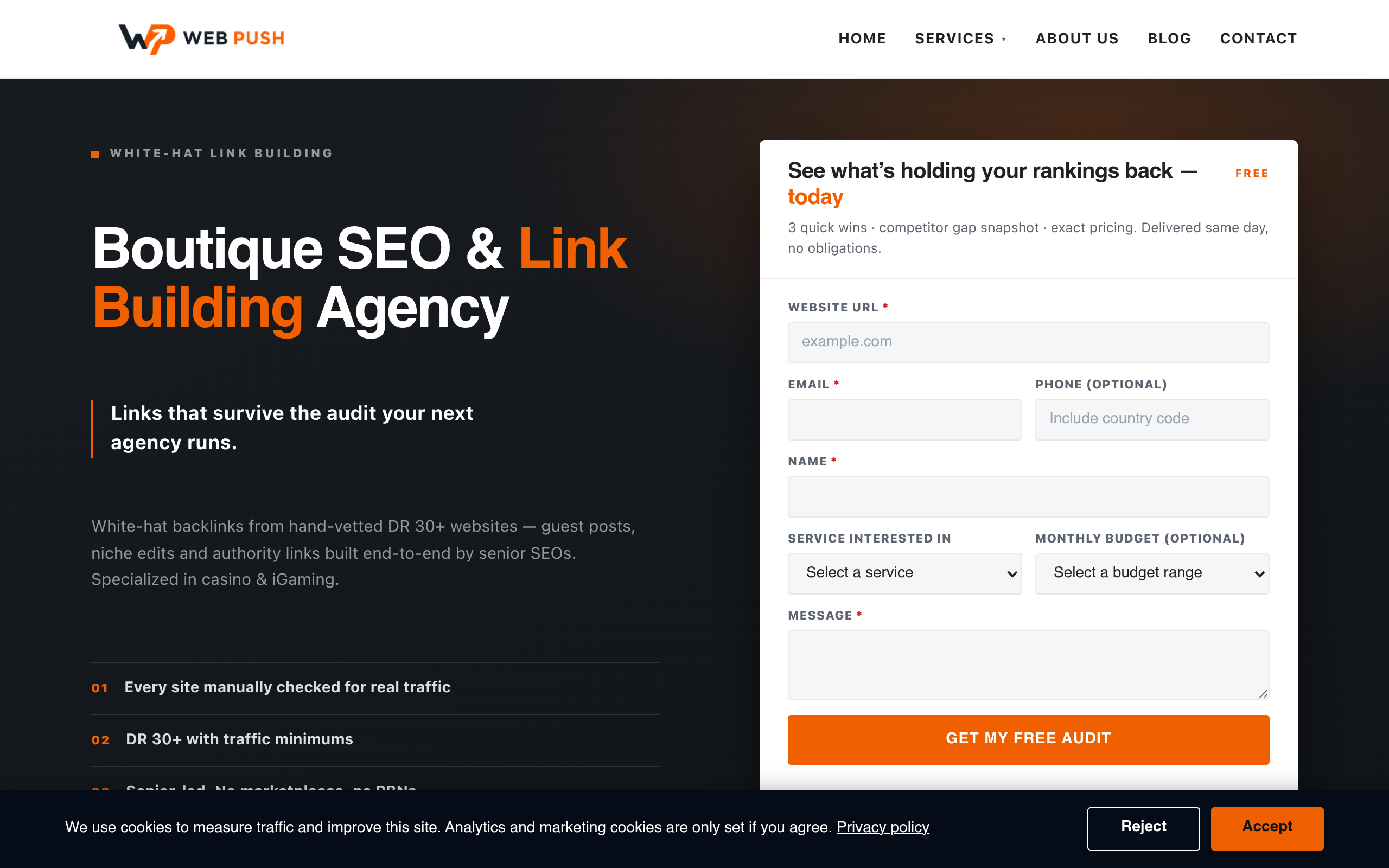
Web Push is a boutique, senior-led link building agency based in Oradea, Romania, working across Europe. It provides white-hat guest posts, niche edits, authority links, digital PR and linkable assets to SaaS, e-commerce and B2B brands, as well as white-label fulfillment for agencies. It also works with gambling-friendly publishers for casino, betting and iGaming campaigns.
Where Web Push fits—and where it does not
The operating proposition is hand-vetted placements on DR 30+ publishers with real organic traffic, with no link farms or PBNs. Buyers can explore the agency’s authority link building approach and its broader link building services before requesting a scope. The practical fit is strongest when a client needs human review of publisher relevance, geography and industry suitability rather than an anonymous inventory feed.
For an agency, the white-label model can reduce the need to hire outreach staff or manage every publisher relationship internally. For an iGaming brand, the gambling-friendly inventory is a meaningful filter: a generalist provider may accept the campaign in principle but still struggle to find suitable publishers that will carry the topic and link safely.
Web Push is not the best fit for a buyer that wants guaranteed rankings, automated bulk submissions, the lowest possible unit price or an entirely self-service dashboard. Link acquisition cannot guarantee a ranking outcome, and a careful campaign may reject more domains than a volume-led service.
Verdict, implementation and commercial model
- Best for: European SaaS, e-commerce, B2B and iGaming brands needing vetted editorial links or white-label fulfillment.
- Does not suit: Buyers optimizing only for volume, automation or the lowest quoted cost per link.
- Standout: Senior-led review combined with gambling-friendly and agency-oriented delivery.
Implementation burden: Moderate. Web Push can manage research, outreach and placement execution, but the buyer should provide target URLs, approved topics, countries, anchor preferences, compliance restrictions and client reporting requirements. A short qualification brief is especially important for casino and betting campaigns, where publisher acceptance and wording constraints vary substantially.
Commercial model: Request a tailored quote rather than assuming a universal rate. Clarify whether the proposal covers content, outreach, publisher review, link monitoring, replacements, digital PR assets or white-label reporting. For agencies, the commercial discussion should also define client confidentiality, delivery cadence and who owns communication with the end client.
Comparison
The table compares the same practical dimensions across all six providers. “Model” describes the likely buying shape, not a guaranteed current price. Confirm live scope, inventory and terms with each provider before procurement.
| Provider | Primary strength | Best-fit buyer | Implementation burden | Commercial model to verify |
|---|---|---|---|---|
| The HOTH | Broad, structured SEO fulfillment | Agencies and brands wanting a standardized service menu | Low to moderate | Packages, per-service orders or custom scope |
| Loganix | Link building within a wider digital marketing offer | Teams consolidating SEO services | Moderate | Per-link, package or recurring engagement |
| Siege Media | Creative content and link earning | Content-led SaaS, e-commerce and B2B brands | Moderate to high | Custom campaign or retainer proposal |
| Page One Power | Consultative outreach and strategic acquisition | Brands with strong resources and subject expertise | Moderate | Custom link-building campaign |
| Editorial.Link | Focused editorial placement support | Buyers with assets needing outreach execution | Moderate | Per-placement, campaign or recurring plan |
| Web Push | Vetted European, white-label and gambling-friendly fulfillment | Agencies, SaaS, B2B, e-commerce and iGaming brands | Moderate | Tailored quote by market, publisher and deliverables |
How to choose the right link building company
Start with the campaign constraint, not the provider’s favorite format. If the business has no useful asset, no expert available for review and no realistic reason for an editor to cite the page, buying placements alone will not solve the underlying problem. Choose a partner that can help create the missing asset or revise the campaign premise.
Match the provider to the buyer job
- White-label agency fulfillment: Prioritize predictable communication, client-safe reporting, approval workflows and replacement terms. The ability to deliver quietly under your brand may matter more than a creative portfolio.
- SaaS or B2B authority building: Look for topical relevance, expert review and content that demonstrates genuine utility. A technically high-metric domain with no audience overlap is a weak substitute.
- E-commerce growth: Ask whether the campaign can support category pages, buying guides, data assets and digital PR without forcing every link to use commercial anchor text.
- Casino, betting or iGaming: Confirm gambling acceptance, target geographies, responsible-gaming language, publisher policies and whether the placement can be disclosed appropriately.
- European expansion: Check language capability and whether publisher selection reflects the country where the brand actually needs recognition, not just the country where the agency is located.
Use a procurement checklist
Before signing, request a sample of the reporting format and ask the provider to answer these questions in writing:
- How are prospects screened for relevance, traffic quality, indexing and audience fit?
- Can the client approve domains or target publications before outreach?
- Who writes the content, and who is responsible for factual and regulatory review?
- What happens if a page is removed, deindexed or materially changed?
- Are paid or sponsored relationships disclosed where required?
- Which metrics are reported, and which outcomes are explicitly not guaranteed?
Do not treat domain authority or domain rating as a standalone acceptance rule. A better starting policy is to require a relevant audience, a credible publishing history, visible organic activity and a sensible reason the target page belongs in the article. The exact threshold should be an illustrative starting policy, adjusted by niche and market rather than presented as a universal benchmark.
Finally, separate a placement campaign from a digital PR campaign in the brief. A placement-led project optimizes for relevant opportunities and dependable execution. Digital PR optimizes for a compelling story, timely distribution and editorial attention, with less control over exactly which publications link. Both can be valuable, but they carry different timelines, approval burdens and reporting expectations.
For most agencies, the practical choice is between a broad fulfillment partner and a specialist that can protect quality through tighter vetting. For brands with difficult verticals or multiple European markets, prioritize publisher acceptance, local relevance and transparent rejection criteria over the largest promised inventory. If that points toward a senior-led campaign with white-label delivery, gambling-friendly options and vetted authority placements, Web Push explains its approach at Web Push.
Authored with NotFair SEO