
Marketing campaign examples are useful when they show the mechanism behind the result, not just a polished headline. This comparison is for SEO agencies, SaaS and e-commerce teams, B2B marketers, and casino or iGaming brands choosing a partner for campaigns designed to earn editorial coverage and authoritative links. The buyer job is specific: select a credible campaign partner for organic authority acquisition, rather than compare unrelated ad platforms, email tools, or analytics software.
The six providers below fall into three practical categories. Web Push and Page One Power are link-building specialists; Fractl and Siege Media are content-led digital PR and authority-building firms; Brafton and Foundation offer broader content and growth-marketing programs that can include link acquisition. That distinction matters because a research-led campaign, a controlled guest-post program, and a full content operation have different timelines, approval processes, and risks.
The evaluation uses four criteria: campaign fit for the buyer job, implementation burden for the internal team, commercial model transparency, and the likely route from asset or outreach to a qualified editorial placement. Claims about a provider’s current services should still be confirmed in a proposal. For campaign planning, launch coordination, and measurement across channels, use Marketing tools when you need to choose tools for planning, launching, and measuring marketing campaigns rather than a link-building partner.
1. Web Push
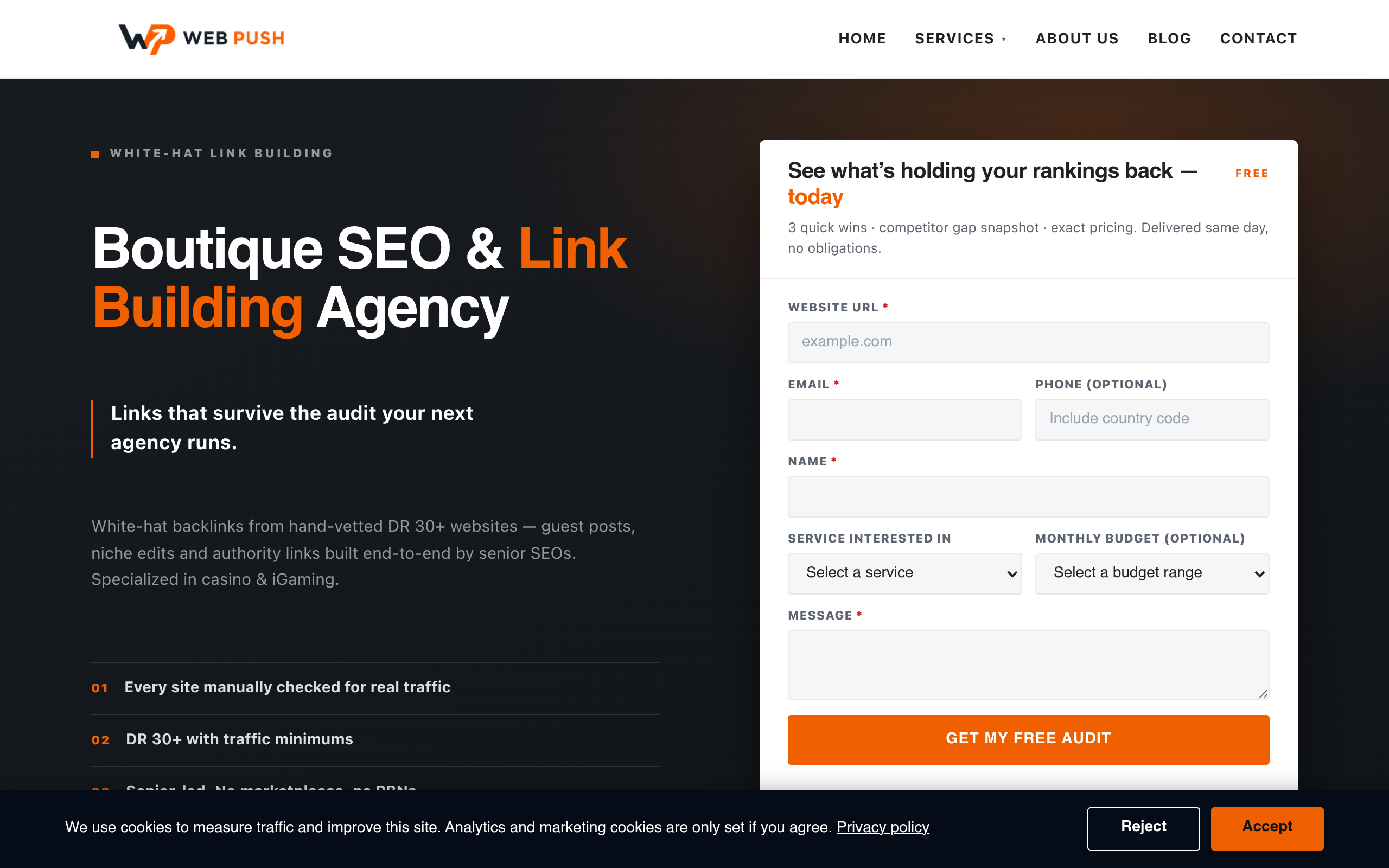
For current product details, see the official Web Push website.
Best campaign use and mechanism
Web Push is a senior-led link-building agency based in Oradea, Romania, serving European and international brands in English, German, and Romanian. Its strongest fit is a campaign where the deliverable is hand-vetted authority links: white-hat guest posts, niche edits, digital PR, or a linkable asset supported by outreach. The service is especially relevant when an agency needs white-label fulfillment or when a gambling, betting, or iGaming brand needs publishers that are open to its category.
A workable example is a SaaS company publishing a study about onboarding friction. Web Push can help turn the study into outreach angles, identify relevant publishers, and secure contextual placements. An e-commerce brand might instead need niche edits into existing articles, while a casino operator may prioritize gambling-friendly sites and careful anchor-text controls. The mechanism is different in each case, so the brief should specify target pages, acceptable topical neighborhoods, exclusions, and whether the objective is referral traffic, ranking support, or both.
Operational and commercial fit
- Best for: Agencies needing white-label delivery and brands requiring editorial placements on real-traffic publishers.
- Does not suit: Teams seeking a self-serve ad dashboard, instant links, or guaranteed ranking positions.
- Standout: A combined menu of guest posts, niche edits, authority links, digital PR, and linkable assets.
- Implementation: The client still needs to supply priorities, landing pages, compliance constraints, and approval feedback; the agency handles prospecting and placement coordination.
The commercial model is service-based and should be scoped around campaign type, publisher requirements, quantity, and difficulty rather than treated like a fixed software subscription. Ask whether the proposal separates publisher cost, strategy, content, outreach, and reporting. A starting policy might require traffic evidence, topical relevance, and human editorial review for every placement; that is an illustrative procurement policy, not a universal industry threshold.
Web Push is a poor fit for a company that only wants broad brand awareness without linkable assets or a defined SEO destination. It is also unsuitable for buyers demanding PBNs, link farms, or guaranteed metrics. Google’s current search guidance describes manipulative link practices as spam, so a campaign brief should reject paid links that pass ranking credit without appropriate qualification and should document editorial rationale; see the Google Search spam policies for the governing principles.
2. Fractl
Best campaign use and mechanism
Fractl is a recognized content marketing and digital PR agency whose official site presents campaign development, research, creative production, and promotion as connected workstreams. Its natural fit is a research-led linkable asset: original data, a visual story, or a strong editorial concept designed to give journalists and publishers a reason to cite the brand. Review its current service descriptions at Fractl’s services page before procurement, because campaign formats and scope can change.
Consider a B2B cybersecurity company commissioning an annual breach-preparedness survey. The campaign needs research design, a defensible methodology, a clear news hook, visual assets, a media list, and a response plan when journalists ask for methodology details. Fractl is better aligned with that kind of earned-media program than with a buyer who simply wants a predictable number of contextual guest posts every month.
Operational and commercial fit
- Best for: Brands with a credible story, proprietary data, and enough internal access to subject-matter experts for research validation.
- Does not suit: Small teams needing low-touch, repeatable placements against a narrow list of commercial pages.
- Standout: The combination of creative concepting, content production, and digital PR outreach.
- Implementation: Expect substantial briefing, fact-checking, approvals, and coordination between brand, legal, data, and PR stakeholders.
The commercial model is a bespoke agency engagement, not a transparent per-link menu. Pricing depends on research, design, production, outreach complexity, and campaign scope; do not infer a current fee from an old case study. Ask for the expected approval calendar, rights to underlying research, reporting definitions, and what happens if the initial angle does not earn sufficient media interest.
Fractl does not suit a regulated advertiser that cannot approve public claims quickly, or a business whose only acceptable outcome is a link to a product page. A newsworthy asset can attract coverage without producing the exact anchor text or destination a ranking team wants. The buyer should therefore score brand visibility separately from target-page links and avoid treating media mentions as interchangeable with relevant editorial backlinks.
3. Siege Media
Best campaign use and mechanism
Siege Media is a content marketing agency known for SEO content, link building, and digital PR-oriented campaigns. Its fit is a content-led organic growth program where strategy, asset creation, optimization, and promotion need to work together. A SaaS team could commission a comparison resource supported by original examples; an e-commerce brand might build a seasonal data asset that earns links while also supporting category content.
The advantage of this model is continuity: the team can connect an asset to the surrounding information architecture instead of publishing an isolated PR stunt. The trade-off is that the client must decide whether it wants a single campaign, ongoing content production, or a broader organic-growth engagement. Review the current offering on the official Siege Media site and request a scope that names research, writing, design, promotion, and measurement separately.
Operational and commercial fit
- Best for: Marketing teams that want content strategy and link acquisition planned as one organic-search system.
- Does not suit: Buyers who already have finished assets and only need narrowly defined publisher outreach.
- Standout: The ability to connect linkable content with broader SEO content decisions.
- Implementation: Internal subject-matter review, brand approvals, analytics access, and content-priority decisions are usually required.
Siege Media uses a bespoke agency pricing model. A proposal should make clear whether design, development, promotion, revisions, and ongoing optimization are included. It should also distinguish content production from distribution: a beautifully designed asset is not automatically a campaign, and outreach without a credible audience angle may not create useful coverage.
It is not a strong fit for a casino brand requiring a publisher inventory explicitly screened for gambling acceptance unless that requirement is confirmed before contracting. It may also be excessive for a local B2B company seeking a small number of regional citations. Before signing, ask for examples in the same market, the intended publisher profile, and how the team handles a campaign that receives attention but few links to the commercial URL.
4. Page One Power
Best campaign use and mechanism
Page One Power is a link-building agency focused on acquiring links through content, outreach, and relationship-based promotion. Its most direct use is a structured authority-link campaign for a site that already has useful pages but lacks relevant referring domains. A B2B software company might nominate four comparison and integration pages, then build supporting editorial relationships around the topics those pages genuinely answer.
This is a more focused buying decision than hiring a full content department. The buyer should provide a target-page map, competitor and SERP context, prohibited industries, preferred geographic markets, and anchor-text boundaries. The partner then needs to explain how it qualifies prospects, creates or adapts content, and verifies that a placement is live and relevant.
Operational and commercial fit
- Best for: SEO teams with defined target pages that need a dedicated link-acquisition process.
- Does not suit: Brands that have not fixed thin, outdated, or commercially confusing destination pages.
- Standout: A specialist focus on link acquisition rather than a broad menu of marketing channels.
- Implementation: Lower creative burden than a major PR campaign, but the client still needs to approve prospects, topics, and content.
Page One Power’s commercial model is agency-led and quote-based. Confirm whether the engagement is organized around a monthly retainer, a defined campaign, or another scope structure; do not assume a price from third-party commentary. The official link-building services page is the right place to verify the current service description, while the proposal should define replacement policy, reporting cadence, and quality controls.
It does not suit an organization seeking a large-scale national PR launch, a paid-media buying program, or a self-service marketplace. It is also a poor choice if the procurement team evaluates only domain-rating numbers. A link can be topically wrong despite a strong metric, whereas a modest publisher may send qualified referral traffic and reinforce the page’s subject.
5. Brafton
Best campaign use and mechanism
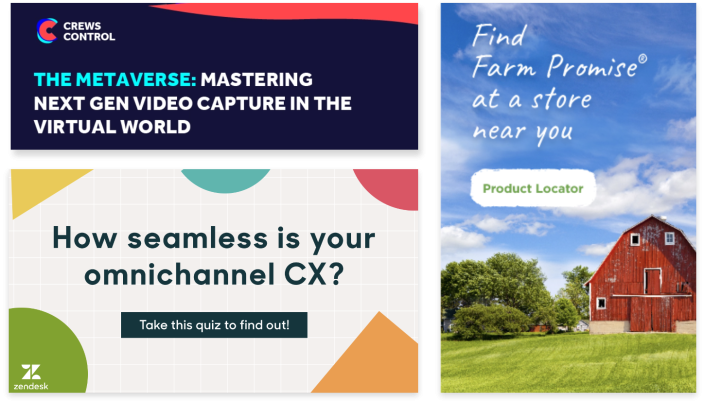
Brafton is a broad content marketing agency offering strategy, production, SEO, and related marketing services. It belongs in this comparison because some buyers want an integrated content operation rather than a specialist link-building vendor. A mid-market software company could use that model for pillar content, supporting articles, video or design work, conversion paths, and promotion, with links treated as one outcome of a larger content program.
The campaign example here is a product-led knowledge hub: research customer questions, create an authoritative guide, produce supporting assets, optimize internal links, and promote the most useful resource. That approach can be sensible when the website has a content backlog and weak ownership between marketing, SEO, and creative teams. It is less sensible when the only job is securing a handful of relevant editorial placements.
Operational and commercial fit
- Best for: Organizations needing strategy and recurring content production across several formats.
- Does not suit: Specialist buyers who want a tightly controlled outreach-only engagement.
- Standout: Breadth across content and marketing deliverables.
- Implementation: Requires editorial governance, subject-matter access, CMS coordination, and clear ownership of approvals.
Brafton’s pricing is custom and depends on the combination of services, production volume, formats, and strategic involvement. Verify the current scope through the official Brafton homepage and insist on a line-item statement of work. Ask specifically whether promotion means editorial outreach, social distribution, paid amplification, or a mixture; those activities have different costs and do not produce the same type of link.
Brafton does not suit a gambling operator that needs guaranteed gambling-friendly publisher acceptance unless that specialist capability is expressly demonstrated. It may also be too broad for a lean team with one urgent commercial page. A wider content program can consume internal review capacity, so calculate the client-side hours required before comparing its quote with a specialist outreach engagement.
6. Foundation
Best campaign use and mechanism
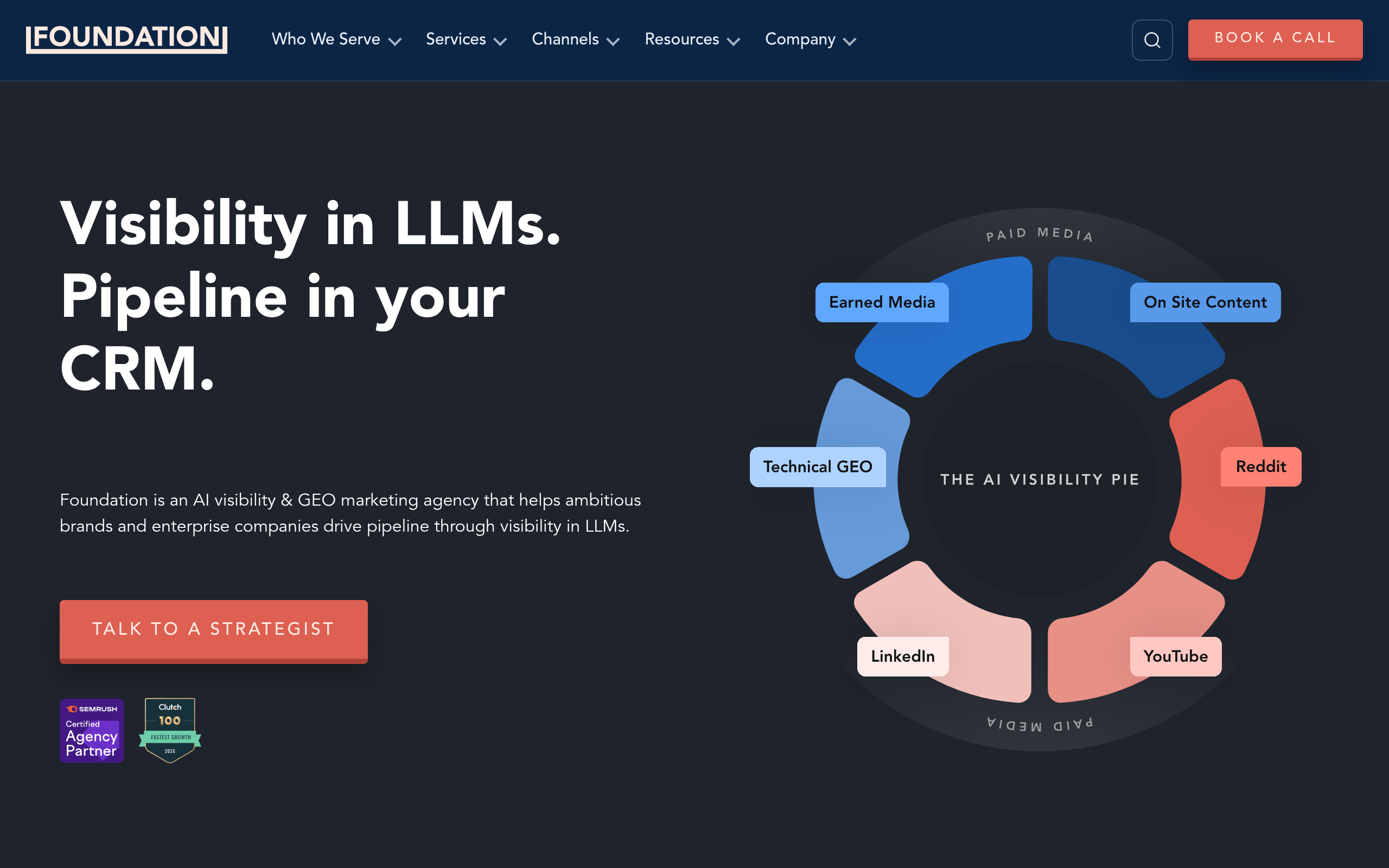
Foundation is a content marketing and growth consultancy associated with B2B and SaaS content programs. Its fit is a strategic content system in which audience research, distribution, and organic growth are planned together. A SaaS company entering a crowded category could use a category education campaign: map the buyer’s research journey, publish an original framework, develop supporting articles, and distribute the work through relevant communities and editorial outreach.
The value is strategic coherence when the organization does not know which audience, message, or content format deserves investment. The buyer should not confuse that with a guaranteed placement service. Ask whether the proposed work includes direct publisher outreach, partner co-marketing, content optimization, or only strategy and production. Verify current capabilities on the Foundation website before treating it as a direct substitute for a link-building specialist.
Operational and commercial fit
- Best for: B2B and SaaS teams that need a content-growth strategy tied to distribution and commercial positioning.
- Does not suit: Buyers requiring a fixed publisher list, gambling-specific inventory, or a purely transactional link quota.
- Standout: Strategic planning for content programs rather than isolated asset production.
- Implementation: High involvement from product marketing, sales, subject experts, and leadership is likely necessary.
The commercial model is bespoke consulting and agency work. Establish whether the engagement is a strategy project, a recurring retainer, or a production-and-distribution program, and define the handoff between Foundation and any outreach provider. Pricing should be evaluated against the decision value it creates, not against a per-placement rate that may describe a different job.
Foundation is not the right fit for a local contractor comparing paid-search approaches, a retailer needing product-feed management, or a casino brand that has not confirmed category acceptance. For local construction lead generation and reputation or Google Business Profile considerations, Google Ads for builders helps compare paid search campaign approaches for local construction businesses; that is a different acquisition problem from earning editorial links.
Comparison
The table treats every provider as a possible answer to the same question: who should help create and distribute an authority-building campaign? “Placement control” means how directly the buyer can specify publisher, topic, and destination; “internal burden” reflects approvals and strategic participation, not the provider’s quality.
| Provider | Primary campaign job | Placement control | Internal implementation burden | Commercial model |
|---|---|---|---|---|
| Web Push | White-label links, niche edits, guest posts, digital PR, and linkable assets | High when requirements are defined | Low to medium; brief, approvals, and target-page input required | Custom service scope based on campaign and publisher requirements |
| Fractl | Research-led digital PR and earned-media assets | Medium; coverage is editorially determined | High; research, legal, data, and creative approvals | Bespoke campaign engagement |
| Siege Media | SEO content, linkable assets, and content-led promotion | Medium to high, depending on scope | Medium to high; content strategy and subject review | Custom agency engagement |
| Page One Power | Focused relationship-based link acquisition | High when target pages and prospect rules are supplied | Low to medium; prospect and content approvals required | Quote-based link-building engagement |
| Brafton | Integrated content marketing and recurring production | Medium; links are one part of a broader program | High; cross-functional editorial and CMS coordination | Custom scope across selected services |
| Foundation | B2B and SaaS content-growth strategy and distribution | Medium; confirm direct outreach in scope | High; positioning, subject experts, and leadership input | Bespoke consulting or agency engagement |
Use the table as a screening tool, not a ranking of universal winners. A publisher relationship campaign and a data-led PR launch can both earn links, but their cost drivers and failure modes differ. A PR campaign may fail because the angle is not timely; a placement campaign may fail because the destination page is weak or the publisher list is too broad.
How to choose a partner for your campaign
Start with the asset and destination
Choose the partner only after identifying what deserves a citation. The destination might be a research report, category guide, integration page, calculator, comparison page, or educational resource. If the proposed target is a thin sales page, ask whether the campaign should first create a genuinely useful supporting asset. Google’s crawlable-link guidance explains why descriptive, relevant links help users and search engines understand destinations; it is available in the official documentation on crawlable links.
- Use a PR-led partner when the story depends on original data, a timely finding, or broad editorial interest.
- Use a link-building specialist when target pages and publisher criteria are already clear.
- Use a broader content agency when research, production, optimization, and distribution lack internal ownership.
- Use a white-label provider when an agency needs reliable fulfillment without exposing the subcontractor to its client.
Interrogate the proposal
Do not accept “high authority” as a complete quality description. Ask for the qualification process and the evidence that a publisher has a real audience. A sensible review may include topical relevance, estimated organic visibility, editorial standards, outbound-link patterns, traffic geography, gambling acceptance where relevant, and whether the page is indexed. Metrics are screening signals, not proof of value.
Request answers to these practical questions:
- What is the unit of work? A researched asset, an approved prospect, a live placement, or a media mention?
- Who owns the content? Confirm usage rights, source data, revisions, and removal or replacement terms.
- What happens when outreach fails? Look for a documented angle-refresh or prospect-replacement process.
- How are links reported? Require URL, target page, surrounding topic, publication date, and any relevant qualification notes.
- What is excluded? Clarify paid amplification, development, translation, legal review, and publisher fees.
Match the partner to risk and geography
For European campaigns, language and market context can change the quality of a placement. A German-language B2B asset needs German editorial relevance, not merely a translated paragraph on an English site. A Romanian e-commerce campaign may need local publishers and locally meaningful data. A betting or casino brand should obtain written confirmation of acceptable categories before content production begins.
For agencies, the best choice is often the provider whose reporting can be passed to the end client without rewriting every claim. For in-house teams, prioritize approval discipline and a realistic content calendar. An illustrative starting policy could be one pilot campaign with a defined asset, target-page set, publisher exclusions, and a review after the first reporting cycle; it is not a guaranteed timeline or performance benchmark.
Choose by the failure you can afford
If the business cannot tolerate public claims being delayed, avoid making a data-heavy PR launch the first test. If it cannot tolerate irrelevant links, choose a specialist with explicit publisher qualification rather than a broad content retainer. If the team lacks a usable asset, do not buy outreach first. And if the agency needs discreet delivery, make white-label reporting, client confidentiality, and approval ownership contractual rather than assumed.
For teams that want a focused, senior-led campaign with hand-vetted publishers, multilingual European support, and options spanning guest posts, niche edits, digital PR, and authority links, Web Push may be a sensible shortlist candidate. Review its authority link building and broader link building services offerings against the same brief, exclusions, and reporting requirements used for every provider above; when the scope fits, Web Push can help turn the chosen campaign example into a properly qualified authority-building program.
Authored with NotFair SEO