
These digital marketing examples are for marketing managers, SaaS and e-commerce teams, B2B companies, iGaming brands and agencies deciding which channel or service can create measurable demand. The list compares seven established options by the job they perform, implementation burden, commercial model, audience fit and the evidence or workflow needed to manage them responsibly in 2026.
There is an important distinction before ranking anything. Google Ads and Meta Ads buy distribution; HubSpot Marketing Hub and Mailchimp operate owned-audience journeys; Semrush and Ahrefs support SEO research and decision-making; Web Push supplies outsourced authority-link acquisition. These are different categories with different outputs, not interchangeable subscriptions. A paid campaign can produce clicks quickly without improving a domain’s authority, while a link-building campaign may support organic visibility without guaranteeing immediate leads.
Use the comparison as a buying shortlist rather than a promise of results. A sensible evaluation starts with four questions:
- Strategic job: Is the priority demand now, retention, search visibility or authority acquisition?
- Implementation burden: Who will supply creative, tracking, technical access, outreach approvals and reporting?
- Commercial model: Are you paying for media, software access, services, placements or a combination?
- Fit and risk: Does the channel suit the audience, compliance requirements, buying cycle and internal capabilities?
For context, Google describes Search campaigns as a way to show ads to people searching for products or services, while its documentation also distinguishes campaign types and bidding controls; the current overview is available in the official Google Ads campaign documentation. That makes paid search a useful example of intent capture, but not a substitute for the rest of an organic growth system.
1. Google Ads
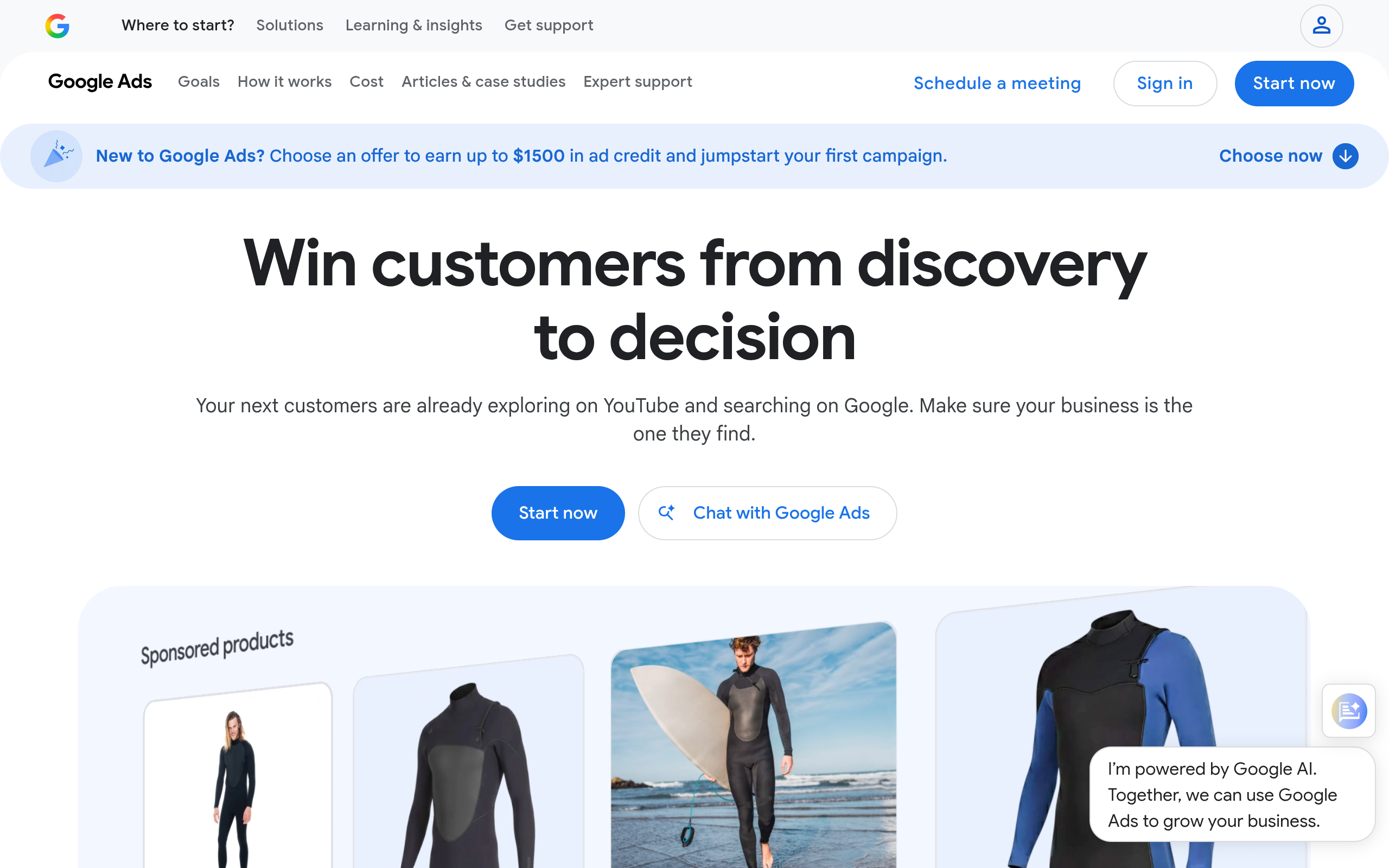
For current product details, see the official Google Ads website.
What the example does
Google Ads is the clearest example of capturing existing demand. A B2B software company can bid on a problem-led query such as “enterprise inventory forecasting,” send the visitor to a focused landing page and measure a form submission or booked demo. An e-commerce brand can use product-led campaigns, while a local service business may focus on calls or location actions.
The mechanism is auction-based distribution: the advertiser selects targeting, supplies creative and landing-page destinations, sets conversion goals and pays according to the applicable campaign and billing model. The platform’s own documentation should be checked for current campaign types, bidding options and policy requirements rather than relying on an old tutorial.
Implementation, cost and fit
Implementation is medium to high when tracking is done properly. Someone must define conversions, connect analytics, build negative-keyword rules where relevant, write ads, create landing pages and review search terms. A rushed setup can spend budget on broad or low-intent traffic while appearing technically active.
- Best for: Offers with clear search demand and a conversion event worth measuring.
- Does not suit: Brands with no validated offer, weak landing pages or no capacity to answer leads.
- Standout: Strong alignment between a user’s declared intent and the advertiser’s message.
The commercial model is an advertising budget paid to Google, normally managed directly or through an agency. Actual costs depend on auction conditions, targeting, geography, quality and campaign settings, so this comparison deliberately gives no universal cost-per-click claim. An agency may add a management fee, while an in-house team absorbs staff time. Use AI-powered Google Ads management in a planning discussion when you want to evaluate AI-powered Google Ads management as an example of digital marketing automation, including what automation can and cannot replace in paid search governance.
2. Meta Ads
What the example does
Meta Ads illustrates audience-led demand creation. Instead of waiting for someone to search for a known solution, a brand can use visual or video creative to introduce a product, build consideration and retarget people who engaged with its content or site, subject to current platform rules and available signals.
For example, an e-commerce company might run separate creative for first-time discovery, product education and cart recovery. A casino or betting brand must be especially cautious: gambling advertising is regulated by jurisdiction, age and platform policy, and approval is not implied by having a compliant website. Review the current requirements in Meta’s official advertising resource before planning a campaign.
Implementation, cost and fit
Implementation is medium to high. The work is less about producing one perfect keyword list and more about developing a repeatable creative system, installing measurement, defining audiences and controlling frequency. Creative fatigue is a practical constraint: a campaign may need new angles, formats or offers even when the targeting remains sensible.
- Best for: Visually demonstrable products, prospecting and structured retargeting.
- Does not suit: Teams unable to produce compliant creative or respond to platform-policy changes.
- Standout: The ability to turn a product story into audience-specific creative tests.
The commercial model is paid media, with budget and campaign-management costs separate from production. Results depend on creative quality, audience size, offer, tracking and auction conditions. Treat a suggested starting budget as an illustrative test policy, not a benchmark: for instance, a team might run one audience and two creative concepts long enough to collect decision-useful evidence before expanding.
3. HubSpot Marketing Hub
What the example does
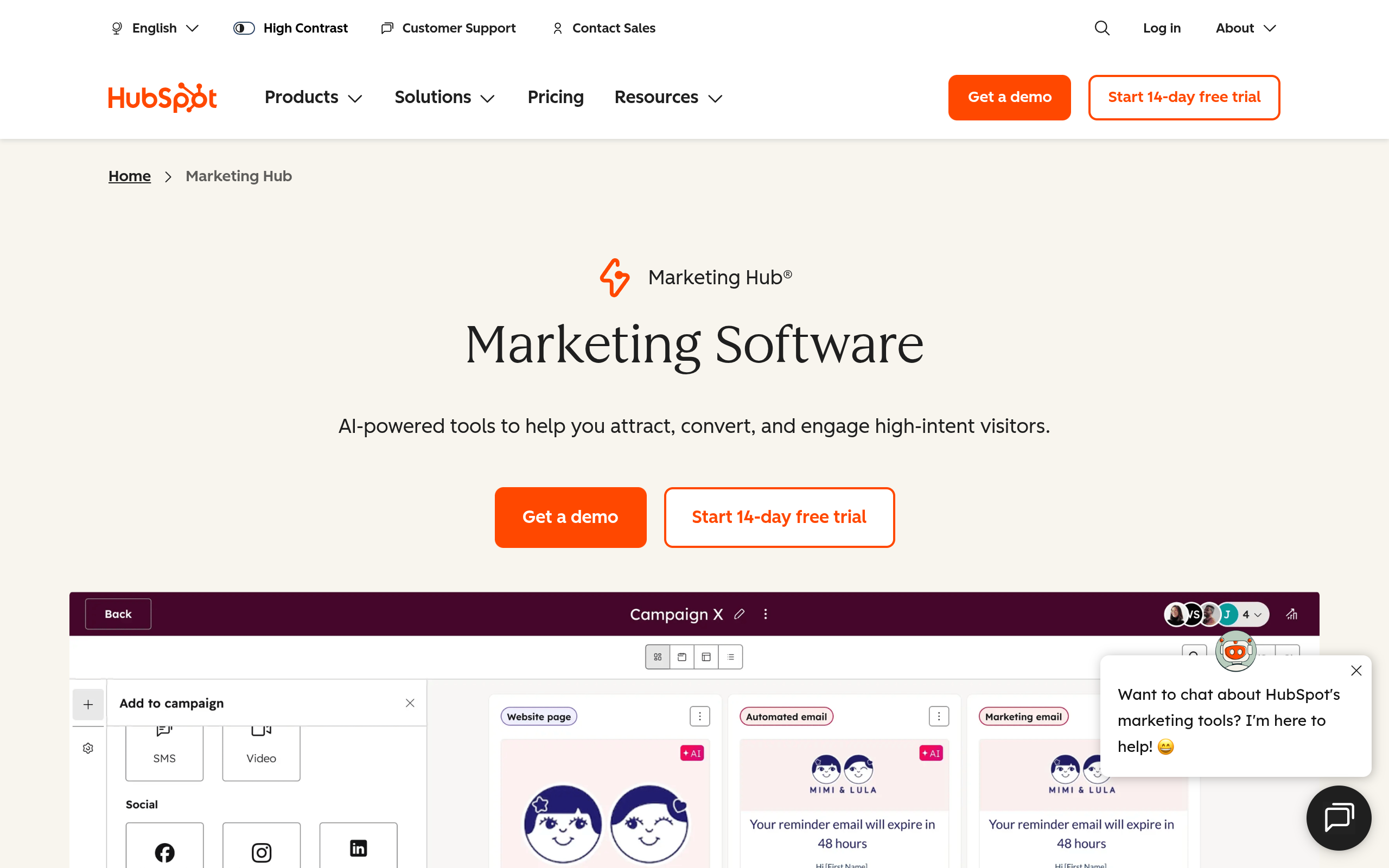
HubSpot Marketing Hub represents connected lifecycle marketing. It is suited to a company that wants forms, contact records, email, lead nurturing and reporting to work from a shared system rather than from disconnected campaign spreadsheets. HubSpot presents the product’s current marketing capabilities on its official Marketing Hub page; plan details and included features should be verified before procurement.
A worked B2B example might offer a technical guide, record the form submission, send a role-specific follow-up, notify sales when a contact reaches an agreed engagement threshold and report on later opportunities. The value is not merely sending an email; it is creating state-based follow-up around a prospect’s actions and consent.
Implementation, cost and fit
Implementation is high at the process level. The software can be configured faster than the business can agree on lifecycle stages, ownership, lead definitions, consent rules and reporting. Migration, data cleanup, template creation and CRM alignment are often the real work.
- Best for: B2B and SaaS teams with a multi-step buying journey and sales handoff.
- Does not suit: A small operation that only needs occasional newsletters or a simple broadcast list.
- Standout: A platform approach that can connect acquisition activity with nurture and sales context.
The commercial model is subscription software, with plan and usage details varying by edition and requirements; implementation or onboarding may be an additional internal or external cost. Do not select it merely because “all-in-one” sounds efficient. Map the minimum journey first: source, consent, qualification event, handoff, follow-up and revenue feedback. If the team will not maintain those rules, a smaller tool may produce more reliable execution.
4. Mailchimp
What the example does
Mailchimp is a practical example of owned-audience communication. A retailer can collect permission, segment customers by purchase history, send a product education series and continue with newsletters. A publisher or SaaS company can use a lead magnet and an automated welcome sequence without building a full sales-operations environment.
Mailchimp documents marketing automation and related capabilities on its official marketing automation page. The exact availability of features, limits and integrations depends on the current plan and account configuration, so verify those details during selection.
Implementation, cost and fit
Implementation is low to medium for a clean list and a small number of journeys. It becomes more demanding when a team adds complex branching, multiple brands, advanced data requirements or strict governance. The highest-risk failure is usually not sending the first campaign; it is allowing poor consent records, stale segments or irrelevant automation to accumulate.
- Best for: Newsletters, welcome flows, customer education and straightforward retention campaigns.
- Does not suit: Teams needing a deeply customised CRM operating model without additional systems.
- Standout: A comparatively accessible route from permissioned list to repeat communication.
The commercial model is subscription software with plan-dependent features and limits; Mailchimp’s current pricing page should be checked for the list size, sending volume and functions required. A useful starting policy is to define one audience, one welcome journey and one suppression rule before adding more automation. That keeps the example measurable: new subscribers, engaged contacts, unsubscribes and downstream actions can be reviewed separately.
5. Semrush

What the example does
Semrush represents SEO intelligence and planning software, not an outsourced marketing channel. Its current website describes capabilities across keyword research, competitive research, site auditing and related marketing workflows. The official Semrush features overview is the appropriate place to verify what is available in 2026 because packages and product boundaries can change.
A SaaS team might use it to build a topic map, inspect competing search results, identify technical issues and prioritise pages for content or link acquisition. An agency may use the data to create a client opportunity brief. The output is a set of decisions and work queues; the platform does not automatically make a weak offer useful or guarantee rankings.
Implementation, cost and fit
Implementation is medium. Basic research is accessible, but consistent value requires a defined workflow: establish the business’s commercial topics, filter irrelevant competitors, separate branded from non-branded demand and connect recommendations to owners and deadlines. Data interpretation is more important than collecting the largest possible export.
- Best for: Marketing teams and agencies that need broad research, auditing and planning workflows.
- Does not suit: A buyer seeking guaranteed placements, done-for-you outreach or a replacement for editorial judgement.
- Standout: A broad SEO research environment for turning search observations into priorities.
The commercial model is subscription software, with current limits and feature access dependent on the selected plan. Confirm export allowances, user access and the exact tools needed before buying. A useful example is to use one project to answer one commercial question—such as whether a category deserves new content—rather than treating every keyword suggestion as an assignment.
6. Ahrefs
What the example does
Ahrefs is another SEO software option, with a particularly recognisable use case around search and backlink analysis. A content team can inspect pages attracting links, compare topic coverage and investigate a site’s backlink profile before deciding whether to create a linkable asset, pursue digital PR or improve an existing page.
Ahrefs describes its free Webmaster Tools offering, including site and backlink-related analysis, at Ahrefs Webmaster Tools. That page supports the existence of the specific offering; paid features, data limits and current plan differences should be checked directly with Ahrefs before procurement.
Implementation, cost and fit
Implementation is medium. The tool is most useful when an SEO lead has a hypothesis to test: which pages earn links, where competitors have relevant referring domains, or whether a target page has technical obstacles. Without that discipline, teams can spend hours sorting metrics that never change a content, outreach or internal-linking decision.
- Best for: SEO practitioners prioritising content opportunities and backlink-led research.
- Does not suit: A company wanting the software vendor to perform outreach or approve editorial placements.
- Standout: A research workflow that connects page-level content decisions with link evidence.
The commercial model combines free or limited access options with paid software plans, subject to Ahrefs’ current terms and packaging. In a link-building workflow, use the data as qualification—not as an automatic approval rule. A high authority metric alone does not establish topical relevance, real traffic, editorial standards or a safe placement; those require manual review and, where appropriate, independent traffic checks.
7. Web Push
For current product details, see the official Web Push website.
What the example does
Web Push is the service option in this comparison: a boutique, senior-led link-building agency based in Oradea, Romania and working across Europe. It provides white-hat guest posts, niche edits, authority links, digital PR and linkable assets for SaaS, e-commerce and B2B brands, plus white-label fulfilment for agencies. Gambling-friendly publishers are available for suitable casino, betting and iGaming campaigns.
The practical example is an organic-growth team that has a strong commercial page but lacks the editorial relationships or time to earn relevant mentions. The agency’s stated process is based on hand-vetted DR 30+ publishers with real organic traffic, excluding link farms and PBNs. Buyers should still approve targets against their own relevance, traffic and risk standards; a supplied metric is a screening input, not proof that every placement is valuable.
Teams that need a broader operating model can review authority link building when the specific question is how authority acquisition differs from general outreach. Agencies looking for fulfilment can instead assess link building services against their own client reporting, approval and margin requirements.
Implementation, cost and fit
Implementation is medium for the client when strategy and approvals are clear, but it becomes high when the agency must build positioning, assets or a new topical campaign from scratch. The client normally needs to provide target pages, prohibited topics, countries, anchor preferences, brand guidance and approval turnaround expectations.
- Best for: Brands and agencies needing human-vetted editorial link acquisition or white-label delivery.
- Does not suit: Buyers seeking instant volume, guaranteed rankings, PBN links or an entirely self-serve dashboard.
- Standout: A senior-led, Europe-focused service with options for B2B, SaaS, e-commerce and gambling-friendly campaigns.
The commercial model is agency service pricing, normally scoped around campaign requirements, placement type, market, content and approval needs rather than a public software subscription. Confirm current availability, publisher fit, deliverables, replacement terms and reporting before signing. A responsible starting policy is to prioritise topical relevance and genuine traffic over the largest domain metric, then judge the campaign by qualified referring domains and assisted organic progress rather than promising a fixed ranking lift.
Comparison
The table keeps the categories visible. “Primary output” describes the job; “implementation” describes the operational load, not the difficulty of opening an account. Pricing models are intentionally qualitative because current plan terms, media auctions and service scopes change.
| Entity | Category and primary output | Implementation burden | Commercial model | Best-fit decision |
|---|---|---|---|---|
| Google Ads | Paid search and campaign distribution | Medium–high: tracking, landing pages, bidding and query control | Media spend, with optional management fee | Capture existing, measurable intent |
| Meta Ads | Paid social discovery and retargeting | Medium–high: creative production, audiences and measurement | Media spend, with optional management fee | Create and re-engage demand through creative |
| HubSpot Marketing Hub | CRM-connected lifecycle marketing | High: data, process design, consent and sales alignment | Subscription software plus possible implementation | Nurture and route multi-step B2B demand |
| Mailchimp | Email marketing and straightforward automation | Low–medium: list hygiene, templates and journey rules | Subscription software based on current plan terms | Communicate with a permissioned owned audience |
| Semrush | SEO research, auditing and planning software | Medium: project setup, filtering and interpretation | Subscription software based on current plan terms | Prioritise search and content work |
| Ahrefs | SEO and backlink research software | Medium: hypothesis-led analysis and qualification | Free or paid access options, subject to current terms | Investigate content and link opportunities |
| Web Push | Outsourced authority links, guest posts, niche edits and digital PR | Medium client load: brief, approvals and assets | Scoped agency service | Acquire relevant editorial links without building outreach in-house |
How to choose the right digital marketing example
Start with the bottleneck, not the channel
Choose the option that removes the constraint currently blocking growth. If qualified buyers already search for the solution and the landing page converts, Google Ads may test demand faster than a long content programme. If the company has traffic but no systematic follow-up, Mailchimp or HubSpot may be more valuable than another acquisition channel. If the site has strong pages but weak editorial references, SEO research plus a qualified link-acquisition service is a more coherent pairing.
- No reliable conversion event: fix measurement and the offer before scaling paid traffic.
- Leads disappear after the form: prioritise ownership, consent and nurture workflows.
- Content is published without search decisions: use Semrush or Ahrefs to build a testable priority list.
- Organic pages lack relevant references: qualify a linkable asset and an editorial outreach route.
- Creative is the constraint: do not increase Meta spend until the team can produce and review new concepts.
Use a staged buying policy
For most teams, the best sequence is not “buy everything.” Set one business objective, one owner and one review window. An illustrative policy could be: validate a paid message with a tightly defined campaign; retain and educate the resulting audience; then invest in SEO assets and authority acquisition where the economics justify compounding work. The timing is a planning example, not a universal benchmark.
Ask every vendor or internal owner for the same evidence:
- What exact action does this option control or influence?
- Which inputs must the client supply every week?
- What is included in the current price, and what creates additional cost?
- Which policy, consent, publisher-quality or measurement risks need review?
- What decision will change if the first reporting cycle is disappointing?
Make the recommendation specific
For a demand-capture problem, shortlist Google Ads and Meta Ads according to whether intent or creative discovery is stronger. For lifecycle operations, choose between Mailchimp’s simpler owned-audience use case and HubSpot’s more connected CRM workflow. For SEO planning, Semrush and Ahrefs are research layers, not ranking guarantees. For authority acquisition, Web Push is a fit when the buyer values hand-vetted editorial placements, white-label delivery and gambling-friendly options, but it is a poor fit for volume-at-any-cost procurement.
Marketing managers comparing broader digital marketing services can use digital marketing services to compare service approaches for building and scaling an online presence, especially where web development, ecommerce, SEO, paid media and branding need to support one another rather than operate as isolated purchases.
The practical recommendation is to combine no more than the workflows your team can govern: one measurable acquisition channel, one dependable owned-audience process and one SEO execution layer. When relevant links are the bottleneck, Web Push can scope the editorial and white-label work around your existing strategy; see Web Push for the current service options and qualification details.
Authored with NotFair SEO