
Digital PR is the planned use of research, stories, expert commentary, data, and content assets to earn attention from journalists, publishers, creators, and relevant communities. For an SEO team, digital pr has a narrower commercial purpose: create something newsworthy, place it in front of the right intermediaries, and earn editorial mentions or links that strengthen a brand’s visibility and reputation.
It is not simply guest posting with a press release attached. It is also not buying homepage links, sending the same pitch to hundreds of writers, or publishing a survey that has no credible methodology. Effective work connects a defensible story with a real audience and a reasonable editorial angle. The link is an outcome of that relevance, not the only reason the story exists.
What Digital Pr is—and what it is not
Traditional public relations often focuses on reputation, relationships, and coverage in influential media. Digital PR applies those principles to online publications and adds measurable SEO and content-distribution objectives. A campaign might produce coverage in a national newspaper, a specialist trade publication, a local outlet, a podcast transcript, or a respected industry newsletter.
The important distinction is between earned attention and manufactured placement. A publisher chooses to mention a company because the company supplied useful evidence, expertise, or a compelling point of view. That editorial decision creates more durable value than a page built solely to host a paid link.
Google’s guidance treats links as a way for search engines to discover pages and understand relevance, while its spam policies prohibit tactics such as buying links that pass ranking credit, excessive link exchanges, and large-scale campaigns whose primary purpose is manipulating rankings. Those principles make the distinction between editorial outreach and link schemes operationally important for SEO teams: Google’s Search Essentials spam policies explain the relevant boundaries.
The four outputs a campaign can produce
- Editorial links: a journalist or editor links to the original study, calculator, guide, or company resource.
- Unlinked mentions: a publisher names the brand or expert but does not include a clickable link.
- Brand search demand: people encounter the story and later search for the company, product, or category.
- Commercial credibility: sales, partnerships, recruitment, and investor conversations benefit from trusted third-party exposure.
These outputs should not be treated as interchangeable. A link to a relevant research page may support organic discovery. A brand mention in a prominent publication may help recognition without passing any ranking value. A television appearance may create demand but no crawlable link at all. The campaign brief should identify which outcomes matter before anyone starts compiling media contacts.
How it differs from other link acquisition
Guest posting starts with a publisher willing to accept a useful article and then matches a topic, author, and link destination. Niche edits add a relevant reference to an existing page where the citation improves the reader’s experience. Digital PR starts with a story or asset and asks which publishers would have a reason to cover it.
That difference changes the production sequence:
- Digital PR begins with an insight, event, expert, or asset.
- The team tests whether the subject has a credible news angle.
- The team builds evidence and a press-ready narrative.
- Outreach targets journalists or editors whose recent work indicates genuine relevance.
- Coverage, links, mentions, and secondary effects are measured separately.
For a SaaS company, the asset might be a benchmark report based on anonymised product data. For an e-commerce brand, it could be a seasonal price tracker or a practical buying study. For a betting or casino operator, the subject must also be checked against gambling advertising rules, publisher policies, and jurisdictional restrictions before outreach begins.
Why Digital Pr matters to SEO and growth teams
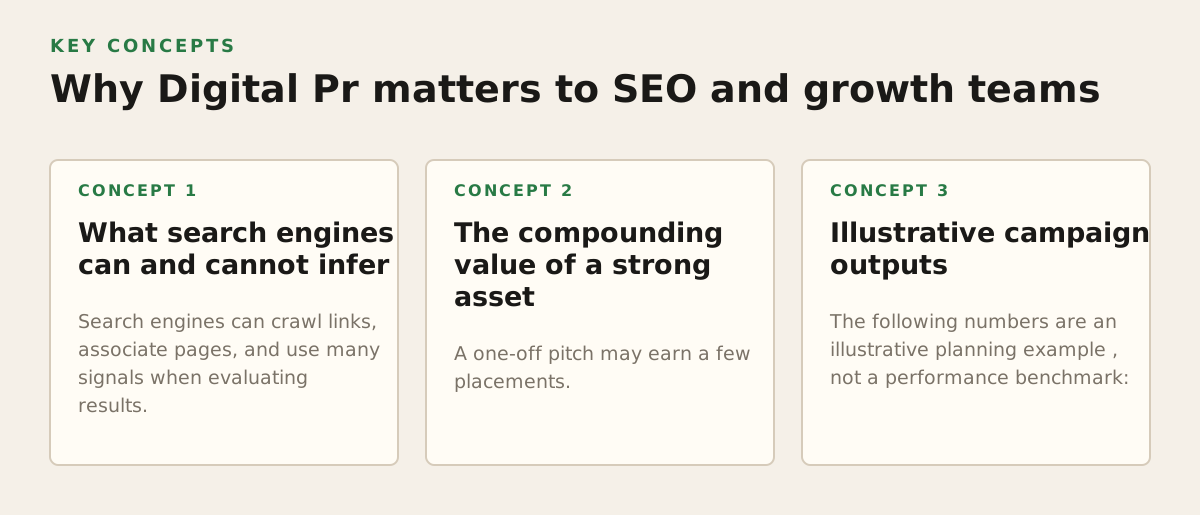
The strongest business case is not “more links at any cost.” It is the ability to create reasons for authoritative sites to cite you. A well-supported story can reach publications that would never accept a generic contributed article, while also giving sales and content teams a useful public proof point.
Authority is contextual. A link from a high-profile general publication may be valuable for visibility, but a specialist industry journal can be more persuasive for a B2B buyer. A regional newspaper may be more relevant to a local service than a larger international outlet. The question is not only “How strong is this domain?” but also “Why would this audience care, and what page deserves the citation?”
What search engines can and cannot infer
Search engines can crawl links, associate pages, and use many signals when evaluating results. Google’s documentation explains that crawlable links generally use an anchor element with a resolvable URL, and it recommends descriptive anchor text that helps users understand the destination: see Google’s documentation on crawlable links.
That does not mean every earned link will produce a measurable ranking change. A link may point to a homepage instead of a priority service page, use a nofollow attribute, sit behind a login, be removed later, or come from a page with little topical connection. A campaign can still be commercially successful when its coverage creates awareness, referrals, or future journalist relationships.
Teams should therefore separate three questions:
- Was the coverage earned? Was the editorial decision independent and relevant?
- Was the link technically useful? Can users and crawlers reach the destination?
- Did the campaign support a business objective? Did it assist discovery, demand, leads, recruitment, or reputation?
The compounding value of a strong asset
A one-off pitch may earn a few placements. A durable asset can become a reference point that attracts links after the initial outreach ends. Examples include an annual index, an interactive calculator, a transparent dataset, a visual explainer, or an expert commentary page that is updated when new evidence appears.
The compounding effect depends on maintenance. Old statistics, broken methodology notes, and expired screenshots reduce citation value. Before publishing, assign an owner and a review date. A simple maintenance policy might require a quarterly check for broken sources and an annual refresh of time-sensitive data. That is a starting policy, not a universal benchmark; the right cadence depends on how quickly the subject changes.
Illustrative campaign outputs
The following numbers are an illustrative planning example, not a performance benchmark:
- A B2B software company publishes a survey of 600 operations professionals, pitches 40 highly relevant journalists, and aims for 6 editorial stories, 3 referring domains, and 200 qualified visits to the methodology page.
- An e-commerce brand creates a 12-month price comparison across 30 products, targets 25 consumer and retail publications, and measures 8 citations, 500 referral visits, and assisted product-page sessions.
- An iGaming brand commissions a responsible-play data explainer, limits outreach to gambling-friendly publishers in approved markets, and tracks 4 relevant mentions, branded searches, and referral engagement rather than raw link volume.
The value of this planning model is that it makes the trade-offs visible. If the team cannot explain why those publishers, audiences, and destinations belong together, the campaign is not ready for production.
How a Digital Pr campaign works from brief to coverage
A reliable workflow reduces the temptation to improvise a headline after the asset is finished. The most important work usually happens before design: choosing a question, checking whether the evidence can support it, and identifying the people who already cover the topic.
1. Set the commercial and editorial brief
Start with one primary business objective and one primary audience. “Improve SEO” is too broad. A usable brief might say: earn relevant citations to a category guide, introduce a new data-led point of view to procurement managers, or build awareness among journalists covering fintech operations.
Record the following:
- Priority audience and markets.
- Pages that can receive relevant referral traffic.
- Topics the brand can discuss with evidence or qualified expertise.
- Legal, regulatory, and brand-safety restrictions.
- Success measures for links, mentions, referrals, and assisted conversions.
- People responsible for approval, outreach, and reporting.
Do not force a commercial landing page into every story. Journalists may cite a neutral methodology page, a dataset, or an explainer because it serves their readers better. Internal links can then connect that resource to the relevant service or product page, provided the site architecture is clear.
2. Find a defensible angle
Most ideas fall into a few practical categories:
- Original data: surveys, anonymised first-party trends, public datasets, or structured comparisons.
- Timely analysis: a qualified expert explains a regulation, market event, or emerging behaviour.
- Utility: a calculator, checklist, map, template, or tool solves a recognisable problem.
- Human interest: a surprising pattern, regional difference, or customer behaviour story supported by evidence.
- Expert commentary: a credible spokesperson responds quickly to a developing story.
A good angle can be summarised without using the company’s sales language. “Our platform is the best way to manage invoices” is an advertorial claim. “Small manufacturers report a measurable delay between delivery and invoice approval” is a question that may justify investigation.
3. Validate the evidence and permissions
Before design begins, check sample size, collection method, dates, geographic scope, definitions, and possible confounding factors. If a survey contains 120 respondents from one customer community, do not present it as representative of an entire profession. Label it accurately and publish the methodology.
For customer data, confirm consent, anonymisation, contractual rights, and whether the figures can be disclosed. For public data, save the source URL, download date, transformation steps, and any assumptions. A journalist may ask for the spreadsheet or calculation method within minutes of receiving the pitch.
For regulated sectors, review claims before outreach. In gambling and iGaming, a story can be editorially interesting while still creating compliance concerns if it promotes a restricted offer, targets vulnerable people, or crosses market-specific rules. The safest approach is to decide which markets and publisher types are permitted before the creative concept is approved.
4. Build the asset for citation
An asset intended for coverage should be easy to verify and quote. Put the headline finding near the top, explain the method in plain language, and make the original source available. Include tables or downloadable data where appropriate, but do not bury the main result in a slow interactive experience that fails on mobile.
Structured data can help search engines understand eligible page content, but it is not a guarantee of enhanced search presentation. Google’s documentation describes structured data as a way to provide explicit clues about page meaning and notes that eligibility does not guarantee a rich result: Google’s structured data introduction is the appropriate implementation reference.
5. Build a focused media list
Quality matters more than an inflated contact count. Review recent articles, recurring columns, geographic scope, preferred formats, and whether the journalist has covered comparable evidence. A technology reporter who regularly publishes operational benchmarks is more relevant than a famous name who has never written about the subject.
Segment the list by angle rather than sending one generic release:
- Data journalists receive the strongest finding and methodology.
- Trade reporters receive the industry implication and expert interpretation.
- Regional editors receive local cuts of the data.
- Consumer writers receive practical relevance and clear reader takeaways.
- Specialist gambling publishers receive market-appropriate information without prohibited promotional framing.
6. Pitch, follow up, and learn
A pitch should state why the story matters now, what is genuinely new, and what the recipient can use. Offer a concise quote, source notes, charts, and access to an expert when appropriate. Avoid pretending that a commercial announcement is independent research.
Follow-up should add value rather than repeat the same subject line. A second message might include a regional data cut or clarify a methodological point. Stop when the recipient signals disinterest or when the story has passed its news window. Record responses by angle, sector, and publication type so the next campaign improves its decision-making.
Where Digital Pr breaks down
Campaigns usually fail because the story is weak, the evidence is unclear, or the outreach creates unnecessary work for editors. A polished visual cannot repair a claim that no journalist can defend to an audience.
The story is really an advertisement
Warning signs include a product name in every headline, unsupported superlatives, a forced call to action, and a landing page whose only useful content is a sales form. The remedy is not to hide the commercial interest. It is to create a genuinely useful public resource and disclose the company’s role accurately.
Where a relationship or incentive could affect how an endorsement is understood, disclosure matters. The U.S. Federal Trade Commission’s guidance states that material connections in endorsements should be disclosed clearly and conspicuously; see its official guidance for advertising and marketing on the internet. European teams should also check the rules and editorial policies that apply in each target market.
The numbers cannot survive scrutiny
Weak campaigns often rely on:
- Small or self-selected samples presented as population-wide truth.
- Percentages without the underlying count.
- Comparisons between datasets collected in different ways.
- Charts that truncate axes to exaggerate small differences.
- Predictions described as current facts.
Journalists do not need academic perfection for every campaign, but they do need enough transparency to assess whether the conclusion follows from the evidence. If the data is directional, say so. If the result is correlation rather than causation, do not write a causal headline.
The outreach is too broad or too late
Mass outreach damages relevance and creates poor feedback. It also produces a misleading success measure: a large list can make a low response rate look inevitable. A smaller, better-researched list gives the team more information about whether the angle worked.
Timing is another constraint. Reactive commentary has a short window, while an annual report can be pitched over a longer period. Establish two versions of the plan: a fast response for the first news cycle and an evergreen angle for later coverage. If approval takes ten business days, the campaign cannot honestly promise same-day expert commentary.
The link expectation is unrealistic
A publisher may cover a study without linking, link to a homepage, or use a nofollow attribute. Google explains that rel="nofollow", rel="sponsored", and rel="ugc" provide different signals about a link relationship, so teams should not assume every visible hyperlink has identical SEO implications: consult Google’s guidance on qualifying outbound links.
Do not pressure an editor to change a citation solely to satisfy an internal link target. The better remedy is to make the original resource the natural reference. If the only reason for the link is “we need a backlink,” the campaign is probably not sufficiently reader-led.
The asset attracts the wrong audience
Viral reach can be a poor result if it comes from an unrelated geography, consumer segment, or sensational angle. For a B2B SaaS brand, millions of general entertainment views may produce less commercial value than a handful of mentions in procurement or operations publications. For casino SEO, a link from an unsuitable or restricted publisher can create brand-safety risk even if the domain looks authoritative.
How practitioners apply Digital Pr across sectors
Application depends on the brand’s evidence, risk tolerance, sales cycle, and publisher environment. The same campaign format should not be copied across SaaS, e-commerce, B2B, and iGaming without changing the angle and review process.
SaaS and B2B
SaaS companies often have access to useful operational patterns, but customer confidentiality limits what they can publish. Aggregated trends, benchmark surveys, and expert explainers are safer than identifiable customer stories unless permissions are explicit.
A workable campaign may combine:
- An anonymised benchmark with clear definitions.
- A short commentary from a subject-matter expert.
- Industry-specific cuts for vertical publications.
- A methodology page that journalists can cite.
- A sales enablement version for account teams.
Link destinations should support the reader’s next question. If the story concerns procurement delays, send readers to the evidence and methodology first, not directly to a product demo. The product can be introduced through a clearly labelled related resource.
E-commerce
E-commerce campaigns have strong seasonal potential: pricing, availability, product durability, consumer questions, and regional differences can all produce useful stories. The main risk is confusing a temporary promotion with a durable editorial idea.
Useful assets include buying guides based on transparent criteria, price histories with collection dates, product comparison frameworks, and expert advice that does not simply favour the company’s inventory. Keep the data current. A price study from 2024 should not be presented as evidence for a 2026 buying decision without a clear update.
Casino, betting, and iGaming
iGaming outreach requires a tighter qualification process. A campaign can pursue gambling-friendly backlinks and still fail if the publication, wording, market, or destination creates compliance concerns. Separate brand-reputation stories from acquisition campaigns, and have the relevant compliance owner review claims before publication.
Potentially safer editorial subjects may include responsible-play education, technology and fraud prevention, sports data methodology, employment, tourism economics, or historical analysis—provided the evidence is genuine and the framing does not exploit vulnerable audiences. Do not use “responsible gambling” as a cosmetic label for an aggressive bonus promotion.
Working with agencies and white-label teams
Agencies need a repeatable handoff. The client should approve the objective, prohibited topics, target markets, spokesperson, and destination URLs before production. The delivery team can then manage research, asset development, media selection, outreach, and reporting without repeatedly reopening strategic decisions.
A useful operating document records:
- Approved claims and supporting sources.
- Restricted publishers, territories, and anchor text.
- Client contacts and approval deadlines.
- Target publication categories rather than guaranteed outlets.
- Reporting definitions for coverage, links, mentions, and referral traffic.
- Escalation rules for legal, regulatory, or reputational questions.
Measurement that supports better decisions
Report the campaign in layers. First, document delivery: asset published, pitches sent, responses received, and stories secured. Second, document media quality: topical relevance, audience fit, editorial context, and destination URL. Third, document business signals: referral sessions, assisted conversions, branded queries, qualified leads, and sales-team feedback.
Google Search Console can show links that Google has discovered pointing to a property, but its links report is not a complete list of every link on the web. Use it as one diagnostic input alongside analytics, server data, referral reports, and manual coverage checks; the limitation is described in Google’s Search Console links report documentation.
| Measure | What it answers | Common misread |
|---|---|---|
| Relevant referring domains | Did credible sites cite or reference the asset? | Assuming domain count alone proves authority. |
| Editorial mentions | Did the story travel beyond the initial pitch? | Counting every syndicated copy as a new relationship. |
| Referral engagement | Did the audience take a meaningful next step? | Celebrating visits with no relevance or conversion path. |
| Branded search activity | Did awareness plausibly increase? | Attributing every change to one campaign without controls. |
Use targets as internal planning tools, not promises. An illustrative starting policy might classify a campaign as healthy when it earns coverage in at least three relevant publication categories, produces a reviewable asset, and generates measurable referral or brand signals. Those thresholds should be adjusted for market size, story strength, and the client’s risk tolerance.
How to decide whether Digital Pr is the right tactic
Digital PR is a strong fit when the brand has evidence, expertise, a useful resource, or a timely perspective that an independent publisher can defend. It is a poor fit when the only available angle is a product announcement with no broader consequence.
Before approving a campaign, ask:
- What changed, was measured, or can be explained?
- Which specific audience needs this information?
- Why would an editor cover it this month rather than ignore it?
- Can the methodology withstand a skeptical question?
- Is the destination page useful without a sales conversation?
- Are the target markets and publishers safe for the brand?
- What will count as success if nofollow links or unlinked mentions are the result?
If the answers are weak, choose a different link acquisition route. A strong guest post, relevant niche edit, or carefully selected authority link building campaign may be more efficient when the client needs targeted topical references rather than public attention. The tactic should follow the constraint, not the other way around.
For SEO agencies, this is where a specialist fulfillment partner can help: research and outreach can be handled externally while the agency retains strategy, client communication, and quality control. The standard should remain clear—real publishers, relevant contexts, transparent reporting, and no link farms or private blog networks.
For marketing managers, the practical recommendation is to run digital PR as a portfolio rather than a lottery: one evidence-led campaign, one reactive expert angle, and one evergreen utility asset may provide better learning than repeated high-concept launches. Keep the brief narrow, validate every claim, and judge the result by audience fit and business usefulness as well as links.
Web Push supports brands and agencies with white-label link building services, including hand-vetted guest posts, niche edits, authority links, digital PR, and linkable assets on DR 30+ publishers with real organic traffic. Where the story, market, and compliance requirements fit, Web Push can help turn the campaign brief into qualified outreach rather than undifferentiated link volume.
Authored with NotFair SEO