
A white label seo agency delivers search engine optimization work that another agency can present under its own brand. The arrangement is not simply “outsourcing SEO.” It is a fulfillment model with a division of responsibility: the supplier performs agreed tasks, while the client-facing agency usually owns strategy, communication, reporting, and the commercial relationship.
That distinction matters because white-label SEO can cover very different work. One provider may supply hand-vetted guest posts and niche edits. Another may execute technical audits, local SEO, content production, digital PR, or complete campaign management. The right choice depends on the agency’s delivery gap, the client’s risk tolerance, the level of internal expertise, and how much implementation the buyer can supervise.
What a White Label SEO Agency actually provides
At its narrowest, a white-label provider is a behind-the-scenes production partner. Your agency gives it a brief, target pages, markets, anchor-text preferences, and quality requirements. The provider sources or produces the deliverable, sends evidence and reporting, and allows your team to package the work as part of its own service.
At its broadest, a white-label SEO partner can operate as an external delivery department. It may help with research, content, outreach, link acquisition, digital PR campaigns, reporting, and client-ready documentation. “White label” describes the commercial presentation, not a guaranteed level of SEO quality.
The main service categories
- White-label link building: guest posts, niche edits, authority links, digital PR, and linkable assets acquired for your agency’s clients.
- White-label content: briefs, articles, landing-page copy, topical clusters, and content refreshes, sometimes with SEO recommendations.
- White-label technical SEO: crawls, indexation reviews, internal-linking recommendations, structured-data checks, and implementation guidance.
- White-label local SEO: listings, Google Business Profile work, local landing pages, review processes, and citation management.
- White-label full-service SEO: a combination of strategy, content, technical work, authority acquisition, and reporting.
These categories serve different buyer situations. An agency with strong strategists but no outreach team may need only link fulfillment. An agency that sells monthly SEO retainers but lacks technical specialists may need audits and implementation support. A small consultancy may require end-to-end production while keeping strategy and client calls in-house.
For a SaaS company, the practical requirement may be authoritative editorial links to product-led content. An e-commerce brand may need links to category pages, buying guides, or digital PR assets. A casino or betting operator needs a provider that understands gambling restrictions and can identify publishers willing to host relevant, compliant content. A B2B company may value industry publications and expert-led thought leadership more than a large volume of generic placements.
What the service is not
White-label fulfillment does not transfer accountability for the client’s organic growth. Search visibility depends on the site, competition, content quality, technical health, demand, brand strength, and many other variables. Google’s documentation says its systems prioritize helpful, reliable, people-first content rather than content created primarily to manipulate rankings; that principle should shape the campaign brief, not be treated as a slogan after links have been ordered. See Google’s people-first content guidance.
It also does not mean every supplier will remain invisible. Your contract should define whose name appears on reports, who handles publisher communication, whether the supplier may contact your client, and how confidential campaign information is treated. Brand separation must be specified operationally.
Why agencies and brands buy white-label SEO fulfillment
The central benefit is capacity. An agency can sell a service before it has built every production function internally. That can be sensible when demand is uneven, specialist skills are expensive to retain, or the agency wants senior staff focused on strategy and client relationships.
There is also a specialization benefit. Outreach, publisher qualification, content editing, digital PR, and link placement checks are separate disciplines. A focused supplier may have workflows that would take an in-house team months to build. This is particularly relevant when the buyer needs several markets or languages and wants consistent quality control across them.
When the model makes commercial sense
- Demand is variable: outsourcing prevents the agency from carrying a full-time team sized for its busiest month.
- The work is repeatable: defined deliverables such as outreach, guest-post production, and placement verification can be briefed and reviewed.
- The agency owns strategy: the buyer can determine which pages deserve authority and which topics support the client’s commercial goals.
- Quality can be inspected: every placement, content asset, or technical recommendation has clear acceptance criteria.
- Margins remain visible: the agency understands supplier costs, account-management time, revisions, and client-support obligations before setting its retail price.
The model becomes less attractive when the buyer cannot review work, cannot explain the strategy to clients, or is purchasing a vague “SEO package” with no inspectable outputs. Delegating production is different from delegating judgment.
How to define measurable success
For link acquisition, report outputs and leading indicators separately from rankings. Useful measures may include the number of accepted placements, referring domains, topical relevance, target-page distribution, link attributes, publisher traffic evidence, indexed status, and referral visits. Rankings and organic conversions should be tracked as business outcomes, but should not be promised as a mechanical consequence of a specified number of links.
For content, define acceptance around search intent, factual review, originality, internal links, subject-matter accuracy, and editorial usefulness. For technical SEO, measure completed recommendations, validated fixes, crawl findings resolved, and changes in indexation or performance where the site can attribute them credibly.
A useful success criterion is observable by both parties. “Improve authority” is not an acceptance test. “Deliver an editorial placement on a relevant publication, with the agreed target URL, live URL, surrounding context, and verification evidence” is much closer to one.
How white-label SEO delivery works in practice
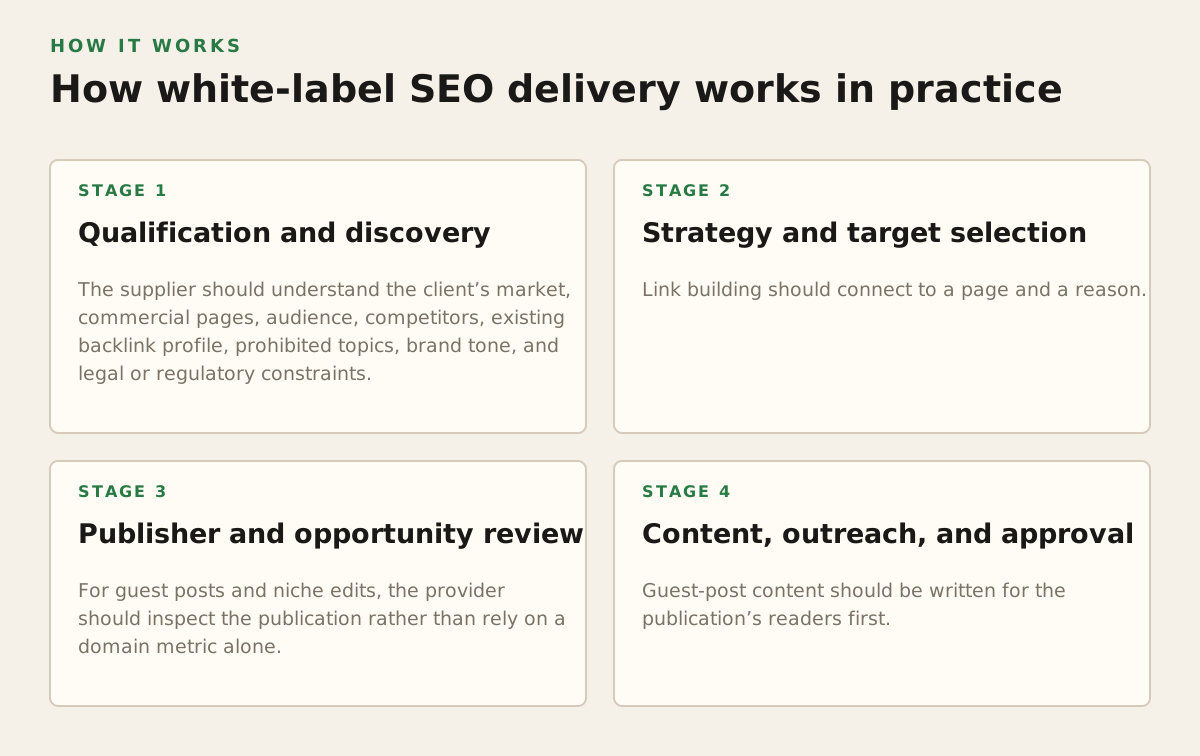
A reliable engagement starts with a service definition rather than a quantity. “Ten links per month” leaves unanswered questions about relevance, publisher standards, target pages, content ownership, replacement policies, and reporting. A proper workflow turns those variables into a brief and approval process.
1. Qualification and discovery
The supplier should understand the client’s market, commercial pages, audience, competitors, existing backlink profile, prohibited topics, brand tone, and legal or regulatory constraints. For a regulated or sensitive niche, disclose the category before the supplier proposes inventory. Gambling-friendly publishers, for example, are not interchangeable with general business publications.
The discovery stage should also identify who can approve targets and content. If the client requires legal review, translations, or subject-matter approval, those steps affect delivery time and revision responsibility.
2. Strategy and target selection
Link building should connect to a page and a reason. A useful target may be a research report, category guide, product comparison, data asset, or genuinely useful resource. Commercial pages can sometimes attract links, but forcing every placement toward a money page can create an unnatural campaign profile and weak editorial fit.
Google describes links as a way for users and search engines to discover related resources, and its crawlable-links guidance emphasizes standard, discoverable link structures. That does not make every link valuable, but it reinforces the need for contextual usefulness rather than isolated placement. The relevant technical guidance is available in Google’s documentation on crawlable links.
3. Publisher and opportunity review
For guest posts and niche edits, the provider should inspect the publication rather than rely on a domain metric alone. Review whether the site has real organic traffic, topical coherence, recent publishing activity, recognizable editorial standards, excessive sponsored content, suspicious outbound-link patterns, and pages that are actually indexed.
For digital PR, the process is different. The supplier may develop a data-led story, expert commentary, survey, or visual asset, then pitch journalists and relevant publications. Coverage is less controllable than a pre-agreed placement, so the contract should distinguish between a campaign effort, a media outcome, and a guaranteed deliverable.
Authority is multidimensional. Domain-rating-style scores can help sort prospects, but they do not prove editorial quality, relevance, organic visibility, or future stability. Ask for the evidence behind a prospect instead of accepting a single score as the product.
4. Content, outreach, and approval
Guest-post content should be written for the publication’s readers first. The brief should define the topic, intended audience, target URL, allowed anchor language, claims that require sources, and whether the client or agency has final editorial approval.
Niche edits require additional care because the link is inserted into an existing page. The surrounding paragraph must make sense before and after the edit, and the page should be relevant enough that a reader could reasonably follow the link. A provider that cannot show the proposed context is asking the buyer to approve an abstraction.
- An illustrative SaaS brief might request one editorial link to a technical integration guide from an operations publication, with no exact-match anchor requirement.
- An illustrative e-commerce brief might prioritize three category-supporting resources over links directly to every product page.
- An illustrative B2B brief might approve two expert articles and one research-led asset, each mapped to a different stage of the buying journey.
- An illustrative iGaming brief might require gambling-friendly publishers, reviewed terminology, permitted markets, and a documented replacement policy for removed placements.
These are planning examples, not universal quotas. The appropriate mix depends on the site’s existing profile and business objectives.
5. Verification and reporting
A delivery report should let the agency audit what it is reselling. At minimum, it should identify the live URL, target URL, anchor text, publication date, link attributes, content title, market or language, and any agreed quality evidence. If the link later disappears, the replacement terms should be clear.
Traffic estimates should be labeled as estimates and tied to a stated source and date. Do not present a third-party metric as verified visitor volume. Likewise, “indexed” should mean checked through a defined method and date, not assumed because the page is live.
UTM parameters can help measure referral traffic, but they are not a substitute for organic attribution. Google Analytics documentation explains how campaign parameters identify traffic sources and campaigns; use the official campaign-URL guidance when tracking referral activity.
Where white-label SEO arrangements break
Most failures are not caused by outsourcing itself. They come from ambiguous ownership, weak inspection, incentives based on volume, or a mismatch between what was sold and what can be delivered.
Quality collapses under volume pressure
A supplier paid to produce a fixed number of placements may prioritize easy inventory over useful inventory. The result can be a cluster of loosely related sites, recycled content, excessive commercial anchors, or publications with little evidence of real readership. Google’s spam policies specifically address manipulative practices, including link spam and scaled content abuse; review the official spam policies before approving a fulfillment model.
A safer policy is to allow a placement to be rejected without penalty when it fails the agreed relevance or quality criteria. That shifts the incentive from “fill the order” to “meet the acceptance standard.”
Metrics become a substitute for judgment
Domain authority metrics are convenient because they fit into a spreadsheet. They are dangerous when they replace inspection. A high-scoring site can have declining visibility, irrelevant audiences, unnatural outbound links, or a business model built around selling placements.
Use a qualification checklist that includes:
- relevance to the client’s industry, audience, or geography;
- evidence of organic visibility and recent editorial activity;
- reasonable outbound-link patterns and no obvious link-farm behavior;
- content quality that a client could defend publicly;
- clear labeling or disclosure expectations where applicable;
- placement stability and a defined removal or replacement process.
Client communication becomes opaque
White-label does not mean hiding material facts from the agency buying the service. If a client asks where links came from, your team needs an answer that is accurate and consistent with the contract. A supplier that refuses to disclose live URLs, uses unexplained network sites, or prohibits reasonable quality checks creates a reputational liability.
There is also a timing risk. Outreach results, editorial approvals, translations, and client revisions do not move at identical speeds. Selling a rigid monthly delivery promise when the supplier depends on independent publishers can create avoidable disputes. Separate controllable work from publisher-dependent outcomes.
Search risk is misunderstood
No ethical provider can guarantee rankings from link placements. Links can support discovery, authority, and referral traffic, but they do not repair poor information architecture, weak content, slow pages, or an unattractive offer. Google’s Search Essentials identify technical requirements, spam policies, and key best practices as separate parts of search performance; the Search Essentials documentation is a useful reference for keeping those responsibilities distinct.
For this reason, do not judge a link supplier only by ranking movement in a short reporting window. Compare performance against the agreed baseline, account for seasonality and algorithm changes, and inspect whether the acquired links are reaching pages that can convert or assist the buyer journey.
How to choose and manage the right provider
Start by deciding what you are actually buying. If the internal team can handle strategy, content review, and reporting, a specialized authority-link or guest-post partner may be enough. If those capabilities are missing, a broader white-label SEO provider may reduce coordination but increase dependency and review burden.
| Buyer need | Best-fit service type | Main trade-off |
|---|---|---|
| More relevant referring domains for existing content | Guest posts, niche edits, or authority link building | Requires careful publisher vetting and target-page strategy |
| Newsworthy campaign with potential editorial coverage | Digital PR and linkable assets | Creative and media outcomes are less predictable than a fixed placement |
| Large content backlog with consistent briefs | White-label content production | Internal subject-matter review remains necessary for accuracy |
| Unclear crawl, indexation, or site architecture problems | Technical SEO audit and implementation support | Recommendations have limited value if the site owner cannot implement them |
| Agency wants one external delivery department | White-label full-service SEO | Lower coordination overhead can mean greater strategic dependency |
| Casino, betting, or iGaming campaign | Gambling-friendly link building and digital PR | Publisher availability, market rules, and brand-safety checks narrow the inventory |
Questions to ask before signing
- Which parts of the work are performed internally, and which are subcontracted?
- How do you qualify publishers beyond a domain-rating metric?
- Can we review proposed sites, topics, anchors, and target URLs before publication?
- What evidence accompanies each completed placement or asset?
- How are removed, edited, deindexed, or materially changed placements handled?
- What are the revision limits and approval responsibilities?
- How do you handle regulated, gambling, medical, financial, or legally sensitive topics?
- What reports are delivered, in what format, and on what schedule?
- Which outcomes are guaranteed deliverables, and which depend on publishers or search engines?
- Can the engagement pause without forcing the agency to continue a poor-fit campaign?
The answers should be specific enough to turn into a statement of work. “We use high-quality sites” is not a process. “We review topical fit, organic visibility, publishing behavior, outbound links, and content standards, then provide the live URL and target mapping” is a process that can be audited.
Pricing and budget questions without false precision
White-label SEO is commonly packaged as a per-placement fee, monthly retainer, project fee, volume tier, or custom campaign budget. The model affects incentives. Per-placement pricing makes unit costs easy to compare but may encourage quantity. A retainer can support strategy and iteration but may be unclear if deliverables are not defined. A digital PR project may require creative work before any media result appears.
Do not compare offers until you know what is included. Ask whether the quoted scope covers research, writing, editing, outreach, publisher fees, translation, revisions, reporting, replacement work, and account management. Also calculate your internal burden: strategist time, client approvals, legal review, reporting, and handling rejected placements.
Use a starting policy, not a copied industry benchmark. For example, an agency might begin with a small pilot, approve every opportunity, and review quality and operational effort before committing to a recurring volume. The size and duration of that pilot are commercial decisions, not universal SEO standards.
How practitioners apply the model
An agency serving SaaS clients might sell an authority campaign around integration guides and original research. Its internal strategist maps target pages and approves angles; the fulfillment partner researches relevant publications, develops drafts, and supplies verified placements. Success is assessed through relevance, referring-domain quality, referral activity, and progress toward commercial content goals.
An e-commerce agency might combine digital PR with selective niche edits. Instead of pushing links to every product page, it could build authority to buying guides, comparison content, and category resources that support internal linking. The supplier’s job is to secure suitable editorial opportunities; the agency remains responsible for merchandising, technical implementation, and conversion analysis.
A casino or betting agency should establish publisher and market rules before outreach begins. The brief may restrict target countries, terminology, responsible-gambling language, commercial claims, and anchor patterns. A gambling-friendly provider can help identify suitable inventory, but the client still needs legal and compliance review for its own market.
A B2B agency may need fewer but more defensible placements. A subject-matter expert article in a relevant industry publication, supported by a useful research asset, may serve the buyer better than a large batch of generic guest posts. This is where authority link building should be understood as a strategic activity: the question is not merely whether a link exists, but whether it supports credibility, discovery, and a plausible reader journey.
When an agency is comparing broader link building services, it should document the difference between supplier production and agency oversight. That prevents a fulfillment partner from silently becoming the strategist while the agency still carries the client-facing obligation.
Make the purchase an auditable operating system
The best starting recommendation is to buy the smallest clearly defined service that solves the current delivery constraint. Specify the audience, target pages, publisher criteria, content standards, approval rights, evidence, replacement terms, reporting, and measurable review points before discussing scale.
Then run a controlled evaluation. Review a sample of opportunities, reject weak fits without pressure, compare the promised workflow with the delivered evidence, and calculate the real internal cost of managing the supplier. If the provider performs well, expand the scope gradually. If it relies on opaque inventory, guaranteed rankings, or unexplained metrics, stop before the arrangement becomes part of your client promise.
Web Push offers white-hat guest posts, niche edits, authority links, digital PR, linkable assets, and white-label fulfillment, with hand-vetted DR 30+ publishers, real organic-traffic checks, and gambling-friendly options for relevant campaigns. Web Push
Authored with NotFair SEO