
Digital pr services sit between public relations, content marketing and SEO. They turn a credible story, useful research, expert opinion or newsworthy asset into attention from journalists, publishers and relevant communities. The work may earn editorial coverage, referral traffic, branded searches, links, or several of those outcomes together.
That definition matters because “digital PR” is used for very different deliverables. A newsroom retainer, a data-led campaign, reactive journalist outreach and a link-building campaign can all be sold under the same label. For a SaaS company, the job may be to make a technical insight citeable. For an e-commerce brand, it may be to create a seasonal asset publishers can use. For a betting operator, the work may need gambling-friendly publications and careful review of jurisdiction, claims and responsible-marketing language.
The buyer should therefore evaluate the service as an operating system, not as a promise of “viral coverage”. The important questions are: what is being produced, who is being pitched, what editorial decision is expected, and how will success be measured?
What Digital Pr Services actually include
A useful digital PR engagement has four connected parts: a story or asset, an audience, a distribution process and a measurement plan. Remove any one of these and the work becomes less predictable. A polished report without a real audience is content production. A media list without a strong angle is outreach activity. Coverage with no business relevance may create visibility but not meaningful organic growth.
The core service categories
- Newsjacking and reactive PR: identifying a current story and supplying a qualified expert, comment, statistic or explanation while journalists are still working on it.
- Data-led campaigns: analysing first-party data, public datasets or commissioned research to produce an original finding, ranking, index or trend story.
- Creative digital campaigns: building an interactive, visual or editorial asset designed to make a topic easier to understand and more likely to be referenced.
- Expert-led thought leadership: packaging a founder, researcher or subject-matter expert’s experience into contributed commentary, interviews, podcasts or editorial pitches.
- Newsroom and online PR support: distributing announcements, product news, company viewpoints and media materials, usually with a stronger brand-communications emphasis than a campaign.
- Digital PR for link acquisition: creating or promoting a genuinely useful asset with the explicit objective of earning relevant editorial links, while accepting that publishers retain editorial control.
These categories overlap, but they create different burdens for the buyer. A reactive campaign may require a spokesperson who can approve a comment within hours. A data campaign may require legal review, methodology notes and permission to publish underlying data. A creative asset may need developers, designers and a landing page that can remain live after outreach ends.
The SEO connection should also be described accurately. Google says links can help it discover pages and understand relevance, while its guidance recommends making links crawlable and using descriptive anchor text; it does not say that every earned link will produce a ranking improvement. See the Google Search documentation on crawlable links. Digital PR can support authority and discovery, but it is not a substitute for useful pages, technical accessibility or search intent alignment.
What the buyer is really purchasing
In practice, the deliverable is not “a number of links”. It is a sequence of decisions:
- Choose a topic where the company has a defensible point of view or distinctive evidence.
- Define the reader and publisher who would care about that point.
- Build an asset that gives an editor something concrete to cite, explain or debate.
- Prepare a targeted pitch with a clear reason for contacting each publication.
- Handle responses, approvals, corrections, follow-ups and reporting.
That sequence helps separate a strategic service from a bulk placement package. If a provider cannot explain the story, target publication and editorial rationale before discussing volume, the engagement may be closer to link procurement than digital PR.
Why digital PR matters to SEO and organic growth
Digital PR earns attention outside the company’s own website. That can create branded demand, referral visits, expert recognition and editorial references. It can also give a useful page the initial exposure needed to attract further citations naturally. None of those effects should be treated as automatic, and a campaign should have a primary business objective before production begins.
Different objectives require different evidence
- Authority and trust: measure the quality and relevance of publications, the context of the mention and whether the cited page is genuinely useful.
- Organic search support: monitor referring domains, indexed links, impressions, non-brand clicks and the performance of the pages that received attention.
- Demand generation: use referral sessions, engaged sessions, assisted conversions and qualified enquiries rather than coverage volume alone.
- Brand visibility: track branded search demand, share of voice, expert mentions and the accuracy of the message being repeated.
- Sales enablement: give commercial teams coverage, research or expert commentary that helps prospects understand a problem and the company’s point of view.
Google Search Console can show queries, impressions, clicks and average position for a verified property. Its Performance report documentation explains those dimensions and their limitations. Use that data as one part of the evaluation, not as proof that a single campaign caused every subsequent ranking movement.
Attribution is especially difficult when several activities run at once. A new product page, technical fix, paid campaign and PR story may all influence the same period. A sensible measurement plan records the campaign’s publication dates, target URLs, referring domains, referral sessions and branded-query trend, then compares them with a defined baseline. It should also record negative outcomes: irrelevant coverage, unlinked mentions, corrections, or traffic that does not match the intended market.
Where links fit—and where they do not
A relevant editorial link can help a reader reach a source and can contribute to a site’s broader authority profile. But a campaign built around forcing exact-match anchors, buying undisclosed endorsements or placing links in irrelevant articles creates a quality and policy risk. Google’s spam policies specifically address link spam and manipulative practices, so the commercial objective should never override editorial integrity.
For teams comparing authority link building with digital PR, the distinction is practical. A link-building engagement may begin with a target page and a publisher qualification process. Digital PR begins with a story or asset and accepts that the final coverage, wording and link location are editorial decisions. Some campaigns combine both approaches, but the buyer should know which mechanism is carrying the work.
Choosing the right service type and trade-off
The best choice depends on the bottleneck. If the company has strong data but no internal production capacity, a campaign partner may be appropriate. If the company has an excellent spokesperson but no media process, reactive or expert-led PR may be more efficient. If the immediate objective is a controlled set of relevant editorial placements, a specialist link-building service may be more predictable than a large creative campaign.
| Buyer need | Best-fit service type | Main trade-off |
|---|---|---|
| Earn citations for a distinctive dataset or research finding | Data-led digital PR campaign | Higher research and approval burden; strong findings still need a timely angle |
| Provide expertise on breaking industry stories | Reactive PR or expert commentary | Requires rapid access to an approved spokesperson and limited control over publication |
| Build recognition for a founder or technical leader | Thought leadership and expert outreach | Reputation compounds slowly and depends on genuinely useful expertise |
| Support a product launch or corporate announcement | Newsroom and online PR | Clear brand control, but ordinary announcements may have limited editorial appeal |
| Promote a useful guide, tool or visual resource | Creative campaign plus targeted outreach | Production can involve design, development and revisions before pitching begins |
| Acquire relevant editorial links to existing commercial or informational pages | Targeted outreach, niche edits or authority link building | More controlled targeting, but less likely to create broad public conversation |
Evaluation criteria before signing
Ask for the operating details, not just a portfolio of impressive logos. A portfolio can show what happened, but not whether the same process suits your market, risk tolerance or internal resources.
- Story quality: Can the provider explain why the idea matters to a specific editor’s audience?
- Evidence standard: Are sources, sample sizes, methodology, permissions and limitations documented?
- Publisher relevance: Does the target list match the customer’s geography, industry and audience, rather than only carrying a high domain metric?
- Editorial practice: Are pitches transparent, personalised and free from undisclosed commercial arrangements?
- Production ownership: Who supplies data, copy, design, development, expert approvals and legal review?
- Reporting: Will the report show URLs, publication dates, link status, traffic signals and meaningful outcomes?
- Risk controls: How are regulated sectors, sensitive claims, gambling content, finance topics and personal data handled?
Pricing questions should focus on the cost model rather than an invented universal benchmark. Providers may charge by campaign, monthly retainer, project phase, placement, hour or a hybrid. Ask what is included in the quoted scope, what triggers additional work, whether research and development are separate line items, and whether follow-up continues when a campaign produces interest but no immediate coverage.
Set a budget as a starting policy based on available internal resources and the value of the target outcome, then revise it after a pilot. For example, an illustrative buyer policy could fund one campaign with a fixed research phase, a capped production phase and a defined outreach window. That is a planning example, not a market price or a guarantee of coverage.
How a digital PR campaign works in practice
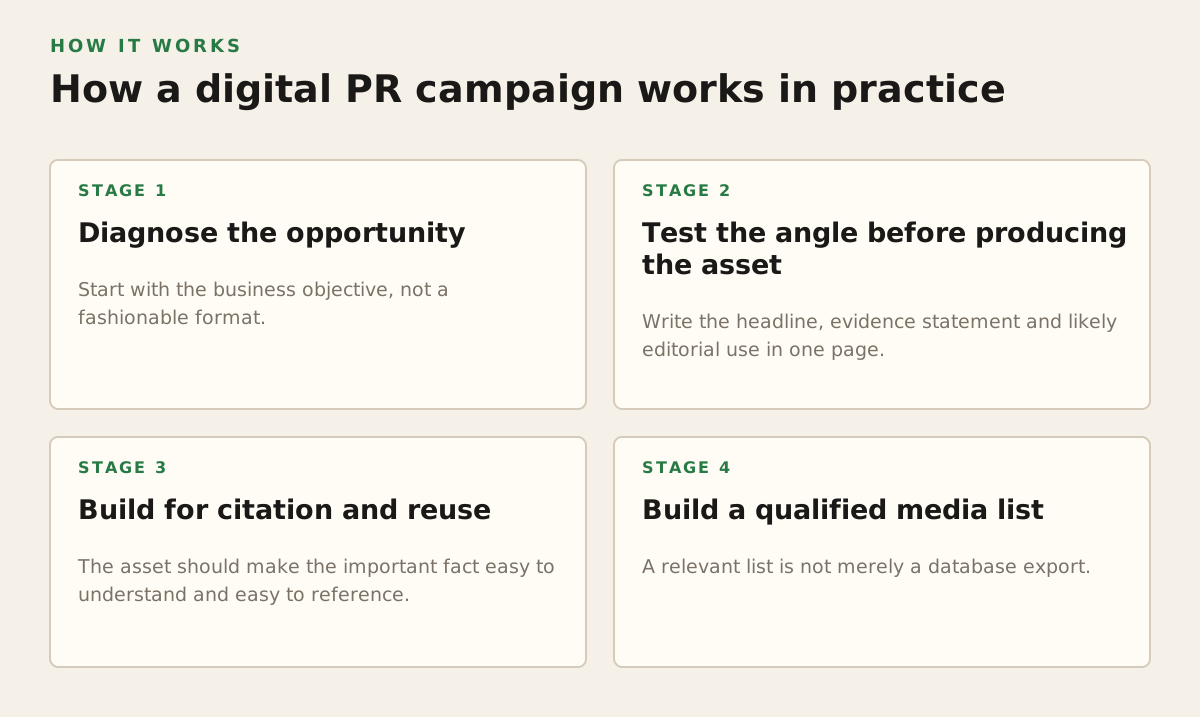
A credible campaign moves through gates. Each gate exists to prevent the next expensive step from being built on a weak assumption.
1. Diagnose the opportunity
Start with the business objective, not a fashionable format. Review the company’s existing content, customer questions, proprietary data, experts, seasonal moments and competitors’ media angles. Then define the audience in operational terms: journalists covering a beat, customers in a market, or publications read by a specific buyer group.
A SaaS company might have anonymised usage trends, a security specialist or a benchmark customers can act on. An e-commerce brand may have product demand data or a practical buying guide. A B2B firm may have a survey of procurement friction. A casino or betting brand needs an additional suitability screen: the publication, jurisdiction, claims, age-related language and responsible-gambling context all matter before outreach begins.
2. Test the angle before producing the asset
Write the headline, evidence statement and likely editorial use in one page. If the idea cannot be explained without adjectives such as “groundbreaking” or “shocking”, it probably needs more evidence. Speak to a small set of relevant journalists or editors where appropriate, without treating informal feedback as a promise of coverage.
Useful pre-production questions include:
- What new fact, comparison or explanation does the audience receive?
- Why is the information timely in 2026?
- Can an editor verify the claim quickly?
- Does the subject fit the company’s expertise and commercial reputation?
- What would make the story unsuitable for a mainstream or specialist publication?
3. Build for citation and reuse
The asset should make the important fact easy to understand and easy to reference. That may mean a concise methodology page, a downloadable chart, a quote from a named expert, a visible source list, a stable URL and an HTML version that works on mobile. Design for the reader who encounters the asset without the pitch.
Do not hide the evidence behind a form unless there is a clear reason. Do not publish a ranking with opaque scoring. Do not use a dramatic visual that says more than the underlying data supports. Google’s guidance on search essentials includes creating helpful, reliable content for people; the Search Essentials documentation is a useful baseline for keeping campaign assets accessible and policy-compliant.
4. Build a qualified media list
A relevant list is not merely a database export. It should include the publication, journalist or editor, beat, recent related coverage, geography, preferred format and a reason the story fits. For a multilingual campaign, the pitch and asset may need separate language versions rather than literal translation. For regulated or gambling-related campaigns, include an approval path before a pitch is sent.
5. Pitch, follow up and record decisions
The first pitch should make the editorial proposition clear within the opening lines. Follow-ups should add information or a useful angle, not simply repeat “checking in”. Maintain a record of responses, requests for clarification, publication status, link status and corrections. A no-response is not a failure of the journalist; it is a signal about timing, fit, angle or available attention.
Coverage can be linked, unlinked, syndicated, shortened, corrected or removed. Reporting must distinguish those states. A provider that counts every sent email as an outcome is measuring activity, not impact.
6. Measure the right time horizon
Record early indicators such as journalist replies, qualified opportunities and coverage. Then review later signals such as referring domains, referral engagement, branded search, target-page impressions and conversions. Keep the campaign URL and tracking conventions stable so the data remains interpretable.
As an illustrative measurement example, a team could classify 12 secured mentions into four groups: linked coverage, unlinked coverage, relevant referral traffic and coverage outside the target market. The exercise is valuable because it exposes quality differences that a single “placements” number hides. The quantities are an example of a reporting method, not a performance benchmark.
Where digital PR breaks down
Most disappointing campaigns do not fail because journalists are impossible to reach. They fail earlier, when the buyer accepts a weak premise, unclear ownership or an unsuitable success metric.
Weak or manufactured news
A survey with a leading question, a tiny unexplained sample or a ranking based on arbitrary scoring may generate a provocative headline but not durable trust. Editors and readers can inspect the methodology, and regulated sectors face additional reputational consequences. Publish limitations prominently and be prepared to withdraw or correct a claim.
Volume replacing relevance
A large list of low-fit domains may look efficient in a report while doing little for the intended audience. Domain authority metrics can be useful for sorting, but they do not prove readership, editorial quality or topical relevance. Inspect actual articles, traffic patterns where available, author quality and whether the publication accepts content that resembles a paid placement.
Confusing paid placement with earned coverage
Sponsored content, advertorials, contributed articles and editorial coverage have different disclosure and control characteristics. Do not present a paid placement as independent editorial endorsement. The U.S. Federal Trade Commission’s disclosure guidance explains why material connections should be made clear in relevant promotional communications; local law and platform rules may also apply outside the United States.
Overpromising links or rankings
No responsible provider can guarantee that an editor will link, that a publisher will keep a page live, or that rankings will rise by a particular amount. Google also warns against manipulative link practices, including schemes intended primarily to influence ranking. Review the official link-spam guidance before approving tactics that rely on paid, excessive or unnatural links.
Internal delays
Campaigns often lose their news window while legal, brand, product and executive stakeholders debate wording. Assign one decision-maker, define acceptable claims and prepare a response process before outreach. This is particularly important for financial, health, gambling, employment and security topics.
Common red flags include:
- Guaranteed rankings, guaranteed editorial links or guaranteed viral reach.
- Publisher lists supplied without URLs, topical context or recent examples.
- Reports that show placements but omit whether they are sponsored, indexed or relevant.
- Copied “unique research” appearing across several brands or campaigns.
- Requests to use exact-match commercial anchors in unrelated editorial copy.
- Unclear ownership of campaign assets, data, research files and published corrections.
- No process for handling sensitive claims, personal data or regulated industries.
How practitioners should brief and manage the service
A good brief makes the provider’s judgement visible. It should state the commercial context while leaving room for a better editorial idea. It should also make failure measurable: an unsuitable story rejected before production is preferable to an expensive asset nobody can responsibly pitch.
A practical brief structure
- Business objective: specify whether the priority is qualified referral traffic, relevant editorial links, brand recognition, expert positioning or sales support.
- Audience and geography: identify the buyer, language, market and publication types that matter.
- Available evidence: list proprietary data, experts, customer research, product information and approved third-party sources.
- Constraints: document legal, compliance, brand, privacy, gambling, licensing and timing requirements.
- Target pages: identify the pages that can receive attention and explain why they deserve it.
- Measurement: define baseline dates, reporting fields, attribution limits and review points.
- Responsibilities: assign owners for data, design, development, approvals, outreach and corrections.
For an agency buying white-label fulfilment, add the handoff requirements. Specify whether the end client sees the provider, which tools or templates are permitted, how publisher vetting is documented, and how the agency will explain uncertain outcomes. White-label does not remove the need for transparency; it makes process documentation more important because the intermediary carries the client relationship.
Questions to ask in the vendor interview
- What would make you reject our initial idea?
- Which parts of the work require our team’s time each week?
- How do you distinguish earned editorial coverage, sponsored content and a contributed placement?
- How do you qualify publications beyond domain-level metrics?
- What is your process when a publisher changes, removes or misrepresents the content?
- How are methodology, data permissions, privacy and factual corrections handled?
- What reporting fields will we receive, and which outcomes are outside your control?
- Can you show an anonymised example of a campaign that produced attention but fewer links than expected, and explain what changed?
- For gambling or other regulated verticals, which markets and publication types will you exclude?
- What is included in the scope, what is optional, and what event causes additional work?
Ask for a small, clearly bounded first engagement when uncertainty is high. A pilot should test the working relationship, editorial judgement, approval speed and reporting quality—not merely chase a predetermined number of links. Agree in advance how the pilot will be reviewed and what evidence would justify expanding, changing or stopping the programme.
Specific recommendation: choose digital PR when you have a credible story, evidence or expert perspective that deserves independent attention. Choose a more targeted link-acquisition service when the immediate need is relevant authority links to existing pages and there is no defensible campaign idea yet.
For teams that need both, Web Push provides senior-led link building services across guest posts, niche edits, authority links, digital PR and linkable assets, with hand-vetted DR 30+ publishers and gambling-friendly options described in its service materials. Use the service fit—not a promised placement count—as the basis for the conversation: Web Push
Authored with NotFair SEO