
White label seo services are SEO activities delivered by a specialist provider, then packaged so another agency can present the work under its own brand. The arrangement may cover strategy, technical implementation, content, link acquisition, reporting, or only a defined fulfillment layer. For an agency buyer, the important question is not whether outsourcing is available; it is which work should leave your team, under what controls, and with what evidence of quality.
This matters because “white label SEO” describes a commercial relationship, not one standardized service. A provider producing monthly blog drafts is solving a different problem from one securing editorial backlinks for a SaaS client. A casino brand may need gambling-friendly publishers and careful anchor-text controls, while a B2B company may need expert-led guest posts and digital PR. The right choice depends on the buyer’s sales promise, internal expertise, risk tolerance, and ability to review deliverables before they reach the end client.
What White Label SEO Services include
In practice, white-label fulfillment sits between your agency’s client relationship and a specialist’s production system. You own the commercial account, positioning, and often the final recommendation. The provider supplies some combination of research, outreach, production, placement, implementation, and reporting without presenting itself as the client-facing brand.
The scope should be written as a deliverable map rather than a vague promise to “improve rankings.” A useful statement might say: research relevant publishers, qualify them against agreed standards, secure editorial placements, provide live URLs and anchor details, and deliver a monthly report. That is much easier to inspect than an undefined package of “authority growth.”
The main service categories
- White-label link building: outreach and placement acquisition through guest posts, niche edits, digital PR, resource inclusion, or other editorial opportunities. This suits agencies that can manage strategy and client communication but lack a repeatable publisher network or outreach team.
- Content fulfillment: briefs, outlines, articles, landing-page copy, updates, and supporting assets delivered for agency review. It helps when production capacity is the bottleneck, but it does not automatically solve topical strategy, originality, or conversion quality.
- Technical SEO fulfillment: audits, issue prioritization, implementation guidance, or developer-ready tickets. This is useful when an agency can sell technical work but lacks specialists; responsibility for deployment must be explicit.
- Local and e-commerce SEO: listings, category-page recommendations, internal-link plans, product content, or digital PR tied to commercial pages. These projects require close access to the client’s inventory, geography, CMS, and brand constraints.
- Reporting and analytics support: dashboards, annotations, monthly narratives, and action plans. Reporting can reduce account-management burden, but it should not be treated as proof that every recommendation was implemented.
For link-focused agencies, the most important distinction is between asset production and placement acquisition. A provider may write an article but have no control over where it is published. Another may have publisher access but expect your team to supply the content. A third may sell a complete placement while outsourcing the writing. Those models have different review points and failure modes.
Who buys each type, and why
An agency with strong strategy and weak production capacity usually needs fulfillment, not a second strategist. An agency with junior account managers may need a structured reporting layer and escalation process. A specialist serving SaaS clients may seek expert editorial links, whereas an iGaming agency needs publishers that accept gambling-related topics and will not quietly remove or alter the link later.
The service should therefore be matched to a concrete job:
- A growing agency wants to sell link acquisition without hiring outreach staff.
- A content agency needs dependable production while its strategists retain editorial control.
- A white-label partner needs placements that can be shown to clients with publisher, URL, target page, anchor, and status data.
- A casino or betting agency needs a vetted route to relevant sites rather than generic lifestyle inventory.
- An e-commerce agency needs authority links and digital PR around products, categories, research, or seasonal campaigns.
Search engines do not treat a “white-label” relationship as a ranking signal. What matters is the quality, relevance, editorial context, and technical treatment of the published link and content. Google’s documentation describes links as crawlable when they use ordinary anchor elements with a destination, and it separately documents link-spam practices that violate its policies; see Google’s link-spam guidance. In other words, changing the logo on a report does not make weak acquisition safe.
Why the model matters to agencies and clients
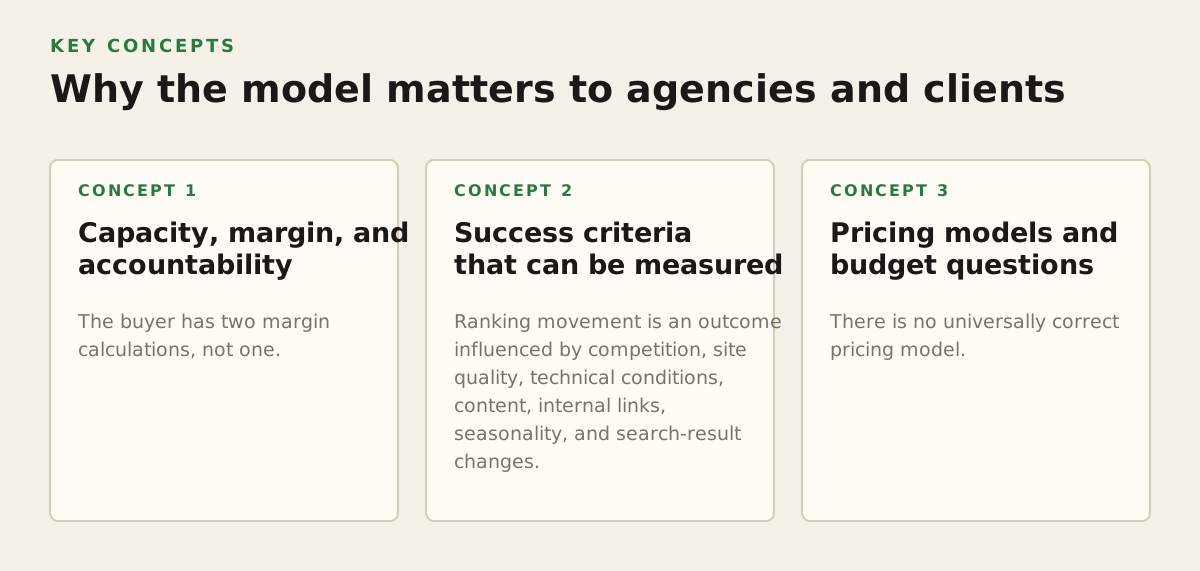
White-label fulfillment can improve capacity, but its commercial value comes from removing a specific constraint. If your agency cannot sell a service because delivery is too slow, specialist fulfillment may create room for growth. If the agency already has a capable strategist and outreach team, outsourcing the same work may add review overhead without improving the outcome.
Capacity, margin, and accountability
The buyer has two margin calculations, not one. First, compare the provider’s fee with the revenue attached to the service. Second, account for internal time: briefing, checking, revisions, client questions, replacement requests, and reporting. A low vendor fee can become expensive when every deliverable needs reconstruction.
Do not model the service only as a cost per link or article. Include:
- strategy and briefing time;
- approval and quality-control time;
- client-facing reporting;
- replacement or remediation work;
- sales effort needed to explain the service honestly;
- the opportunity cost of work your team cannot deliver while managing the vendor.
Capacity is not the same as quality. A provider may accept more orders than it can responsibly research, edit, and monitor. Ask what happens when a suitable placement is unavailable. A credible answer may involve a replacement, a revised target, a delayed delivery, or a partial refund according to written terms. “We always deliver exactly the requested metric” can be a warning sign if the metric encourages irrelevant inventory.
Success criteria that can be measured
Ranking movement is an outcome influenced by competition, site quality, technical conditions, content, internal links, seasonality, and search-result changes. It is a poor sole acceptance criterion for a monthly fulfillment contract. Define leading and operational measures as well:
- percentage of placements meeting the agreed relevance and publisher standards;
- number of live, indexable URLs and the date each was verified;
- target-page and anchor-text distribution;
- referring-domain quality and topical fit;
- content acceptance rate after internal review;
- replacement or removal rate;
- organic impressions, clicks, and target-query visibility over an agreed observation period;
- qualified referral traffic or assisted conversions where links are expected to send visitors.
Use these as a scorecard, not a promise of a fixed ranking gain. Google Search Console’s Links report can help a site owner inspect examples of linking pages and top linked pages, although its report is not a complete accounting of every backlink; the official explanation is available in Google Search Console’s Links report documentation. That limitation is important when a provider claims to have produced a complete link inventory.
Pricing models and budget questions
There is no universally correct pricing model. Common structures include a fixed monthly retainer, a defined number of deliverables, per-placement pricing, project pricing for digital PR, or a hybrid with strategy and fulfillment separated. Each shifts risk differently.
| Pricing approach | Useful when | Questions to ask | Main trade-off |
|---|---|---|---|
| Monthly retainer | You need continuous capacity and a recurring client service. | What work is included, and what happens to unused capacity? | Predictability, but scope can become vague. |
| Per deliverable or placement | Requirements are clear and approval is fast. | Is quality guaranteed, and are replacements included? | Easy to budget, but may reward volume. |
| Project fee | You are launching a digital PR campaign or linkable asset. | Which research, production, outreach, and follow-up stages are covered? | Good for campaigns, less flexible for ongoing needs. |
| Hybrid model | You need strategy, account support, and variable fulfillment. | Which components are fixed and which trigger additional fees? | More precise, but invoices require closer review. |
Ask for the commercial unit behind the quote. Is the buyer paying for outreach attempts, accepted placements, live links, content, or a combination? Are publisher fees, revisions, translations, rush work, link replacements, and reporting included? A provider that refuses to explain the unit economics makes it difficult to forecast margin or explain the offer to your client.
Any budget range you build should be an illustrative starting policy, not a universal market benchmark. For example, an agency might reserve a test budget for one campaign, define a review gate after the first approved deliverables, and expand only if quality, communication, and client relevance are acceptable. The amount depends on the niche, geography, content requirements, and commercial value of the client—not on a generic package label.
How a responsible white-label workflow works
A dependable workflow has gates. Each gate answers a different question: is the target strategically appropriate, is the publisher credible, is the content accurate, is the link technically acceptable, and did the final output remain live?
1. Translate the client brief into constraints
Start with the client’s pages, products, audience, countries, topics, prohibited claims, brand voice, and competitors. Separate pages that need authority from pages that need conversions. A homepage may be a natural brand destination, while a detailed guide, category page, or research asset may offer a more logical editorial reference.
Record anchor-text preferences as guardrails rather than a mechanical quota. Overly exact commercial anchors can look unnatural, especially when repeated across unrelated publishers. The brief should also state whether the campaign allows guest posts, niche edits, digital PR, unlinked brand mentions, or only editorial references.
2. Qualify publishers beyond a headline metric
Third-party authority metrics can help sort a prospect list, but they are not Google measurements and should not replace inspection. Check whether the site has genuine topical breadth, readable content, visible ownership or editorial standards, organic search activity, and a reasonable pattern of outbound links. Look for pages that exist mainly to sell links, sudden topic changes, copied articles, or dozens of unrelated commercial anchors.
A practical publisher review records:
- publisher URL and relevant section;
- topic and audience fit;
- estimated organic visibility from the chosen tool, labeled as an estimate;
- recent publishing pattern;
- outbound-link behavior and commercial density;
- country and language;
- link attributes and placement location;
- acceptance rules for regulated or sensitive industries.
For a gambling or betting campaign, qualification must happen before outreach. Confirm whether the publisher accepts the subject, whether the article can mention the operator or product accurately, and whether local advertising restrictions affect the content. Google’s advertising policy documentation distinguishes gambling-related requirements and restrictions by product and location; it is available in Google Ads’ gambling and games policy. Organic editorial outreach is not identical to paid advertising, but the policy is a useful reminder that jurisdiction and product type cannot be treated as afterthoughts.
3. Build and approve the asset
A guest post should earn its placement with useful information for the host publication’s audience. A niche edit should add a genuinely relevant reference to an existing page rather than force a link into a sentence that does not need it. A digital PR asset should give journalists a reason to cite, discuss, or share it: original data, a clear method, a strong visual explanation, or a timely expert perspective.
Use an approval stage before outreach where the topic, destination, and claim set are sensitive. This reduces the risk of a provider securing a technically valid link that the client cannot approve because of legal, medical, financial, or gambling language.
4. Outreach and placement controls
Outreach quality is not measured by the size of an email list. It depends on whether the pitch fits the publication, whether the proposed content is specific, and whether the provider can explain the editorial relationship. Request samples of anonymized outreach and ask how follow-ups stop when a publisher declines.
Links should be described accurately. Google documents rel="sponsored" for paid or sponsored links and rel="ugc" for user-generated content, while ordinary editorial links need not use those values; see Google’s guidance on qualifying outbound links. A provider should not promise that a particular attribute will guarantee rankings. The important issue is that the relationship and implementation are represented honestly.
5. Verify, report, and monitor
Before an item is accepted, verify the live URL, status code, indexability where relevant, destination, anchor, surrounding copy, publication date, and whether the page is accessible without an unexpected barrier. Record screenshots or page captures according to the agency’s retention policy. Recheck important placements later, because publishers can edit, remove, redirect, or change pages.
The client-facing report should be branded for the agency but traceable to source evidence. Include a concise narrative: what was delivered, why it supports the strategy, what remains pending, and what decision comes next. Avoid presenting a list of URLs as if it were a causal ranking report.
Where white-label SEO breaks down
The model usually fails at the boundaries: unclear ownership, incompatible incentives, insufficient review, or a provider that sells certainty where the work is inherently variable.
Volume replaces editorial judgment
A fixed placement target can encourage irrelevant sites, recycled content, or aggressive anchor patterns. This is especially dangerous when the client’s niche is narrow and the target number is more important than audience fit. A better contract defines minimum quality conditions and allows a suitable replacement or delayed delivery when inventory is poor.
Be cautious with networks that present many sites as independent publications but share templates, authors, contact details, or content patterns. Google’s spam policies identify manipulative link practices as a problem, so the agency should be able to explain why a placement is editorially plausible rather than merely point to a metric. The policy is available in Google Search Essentials’ spam policies.
Confidentiality and client ownership are vague
“White label” does not automatically answer who owns accounts, publisher relationships, drafts, data, or remedial obligations. Put the operational rules in writing:
- who may contact the client;
- which brand appears in emails and reports;
- who approves sensitive content;
- who owns the final copy and campaign data;
- how confidential client information is handled;
- what happens if a link disappears or a publisher changes the page;
- how either party handles termination and unfinished work.
Also distinguish confidentiality from disclosure. If a placement is sponsored, paid, or otherwise subject to disclosure requirements, the agency should not hide that obligation behind white-label presentation. The FTC’s official endorsement guidance discusses disclosure when a relationship could affect how an endorsement is understood; consult the FTC Endorsement Guides for the relevant U.S. context. Local rules may differ, so regulated campaigns need appropriate legal review.
Reporting creates false confidence
A polished dashboard can conceal missing implementation, weak traffic, or links that are not relevant to the client’s commercial pages. Require raw evidence and a clear distinction between delivered work, observed visibility, and business outcomes. Do not let a vendor attribute every ranking movement to a placement without considering content changes, technical releases, competitors, and seasonality.
The agency loses strategic capability
Outsourcing every research decision can leave account teams unable to explain why a link was pursued or whether a campaign should change direction. Keep strategy in-house where it affects positioning, target pages, customer insight, and risk. Outsource repeatable production only after the agency has defined what “good” means.
How practitioners should choose and manage a provider
Begin with a service decision, not a vendor shortlist. The following map is intentionally simple; most real campaigns combine more than one service, but the trade-offs should remain visible.
| Buyer need | Best-fit service type | Trade-offs |
|---|---|---|
| Repeatable editorial placements for client campaigns | White-label guest posts and niche edits | Efficient fulfillment, but publisher quality and relevance require active review. |
| Authority around a research report, tool, or study | Digital PR and linkable assets | Higher strategic and production burden, with less predictable pickup. |
| Specialist help for a narrow B2B or SaaS topic | Expert content plus targeted outreach | Stronger relevance potential, but subject-matter review may slow delivery. |
| Casino, betting, or iGaming link acquisition | Gambling-friendly editorial placements | Publisher inventory and compliance constraints narrow the eligible market. |
| Agency has strategy but lacks delivery staff | Fulfillment-only link building services | Clear division of labor, but briefs and approvals must be disciplined. |
| Agency needs broader authority strategy | authority link building with reporting support | More strategic value, but requires agreement on target pages and success measures. |
Vendor interview checklist
Use questions that expose the actual operating model. Ask for specific answers, not general assurances:
- Which parts of the work are performed internally, and which are subcontracted?
- How do you qualify a publisher beyond domain-level metrics?
- Can we approve topics, target URLs, anchors, and publishers before publication?
- How do you handle gambling, betting, financial, health, or other regulated topics?
- What evidence is included for each completed placement?
- What happens if a link is removed, redirected, nofollowed, or the article is materially edited?
- Which pricing unit appears on the proposal: hours, assets, outreach, placements, or live links?
- What is excluded from the quoted scope?
- How are revisions, rejected drafts, and delayed publishers handled?
- Can reports be delivered under our brand without hiding the underlying evidence?
- What information do you need from our strategist before starting?
- Which decisions remain ours, and when will an account manager escalate a problem?
Assess the answers against a short pilot or controlled first project. A pilot is not proof of long-term performance; it is a way to inspect communication, quality gates, evidence, and replacement behavior before committing more client work. Set acceptance criteria in advance, including what counts as a live deliverable and who has final approval.
Apply the model to real client situations
For a SaaS campaign, begin with pages that explain a meaningful problem, integration, benchmark, or workflow. Ask the provider to pursue publications whose readers could plausibly use the product, not merely sites with a high authority score. Measure qualified referral visits and visibility alongside the placement record.
For e-commerce, a product link alone may be a weak editorial proposition. A buying guide, original survey, category trend report, or expert commentary can create a more defensible reason for coverage. Coordinate link acquisition with internal linking and merchandising changes so the authority reaches pages that can convert.
For B2B, subject-matter accuracy often matters more than broad reach. Give the writer access to an expert, approved terminology, and customer objections. A technically correct but generic article can satisfy a publishing slot while doing little for brand credibility.
For casino, betting, and iGaming, define acceptable markets, terminology, responsible-gambling language, and publisher categories before outreach. Keep records of approvals and do not assume that a site accepting one gambling topic will accept every operator, product, or jurisdiction. The campaign needs both topical relevance and a clear risk review.
For an agency that wants a broader outsourced offer, separate strategic consulting from link building services fulfillment in the proposal. That makes the agency’s own value visible and prevents a provider’s production checklist from becoming the client’s entire SEO strategy.
Recommendation for 2026: choose white-label fulfillment when it removes a defined production constraint, preserves your strategic control, and can be checked against evidence-based quality gates. Start with a narrowly scoped service, document the acceptance and replacement rules, and expand only when the provider consistently protects relevance, editorial integrity, and client trust.
Web Push offers senior-led white-hat guest posts, niche edits, authority links, digital PR, linkable assets, and white-label fulfillment on hand-vetted publishers, including gambling-friendly opportunities where appropriate. Explore Web Push to assess whether its delivery model fits your agency’s client work.
Authored with NotFair SEO