
A white label marketing agency delivers marketing work that another agency can brand, package, and sell to its own clients. The arrangement can cover SEO, content, paid media, design, social media, or specialist link acquisition. For SEO agencies, the practical question is narrower: which work should be delegated, what quality controls are required, and how can the buyer protect client relationships while preserving margin?
That distinction matters because “white label” describes the commercial relationship, not the quality of the service. One provider may supply strategy and execution under your brand; another may only resell access to a freelancer network. A useful evaluation therefore starts with the actual deliverable, evidence behind it, implementation burden, and accountability when something goes wrong.
What a White Label Marketing Agency actually does
In a white-label arrangement, the client-facing agency owns the relationship while a specialist partner performs some or all of the work behind the scenes. The partner may use your templates, reporting format, project-management system, or email identity. The final client may never interact with the delivery team, although that is a commercial choice rather than a requirement.
The model is different from a referral. A referral partner introduces a prospect and receives compensation; a white-label provider performs contracted work for your agency. It is also different from simply hiring an employee, because the supplier remains an external business with its own processes, capacity, and risk profile.
The main service categories
- White-label SEO fulfillment: technical audits, keyword mapping, content briefs, on-page recommendations, reporting, and authority acquisition delivered under an agency’s brand.
- White-label link building: outreach, editorial placement, niche edits, digital PR, or linkable-asset promotion for clients that need authority signals without building an internal publisher network.
- White-label content production: articles, landing pages, product copy, briefs, editing, and content refreshes. The buyer must define subject-matter review and factual approval responsibilities.
- White-label paid media or social execution: campaign setup, creative production, optimization, and reporting. This usually requires clearer access controls and approval workflows than a one-off content order.
- White-label strategy or consulting: the partner supplies audits, roadmaps, or specialist advice while your account team remains responsible for prioritization and client communication.
For a SaaS company, the job may be earning relevant editorial links to comparison pages and research assets. For an e-commerce brand, it may be digital PR around original data or authority links to category pages. A casino or betting operator may need publishers that accept gambling-related content and use appropriate commercial and compliance review. A B2B company may value expert guest posts and niche edits in a narrow industry more than a large volume of general placements.
The buyer situation determines the useful service. An agency with strong strategy but limited outreach capacity needs execution. An agency with writers but no publisher relationships needs distribution. A marketing manager working directly for a brand may not need white-label delivery at all; a transparent specialist contract could be simpler unless an existing agency is coordinating the account.
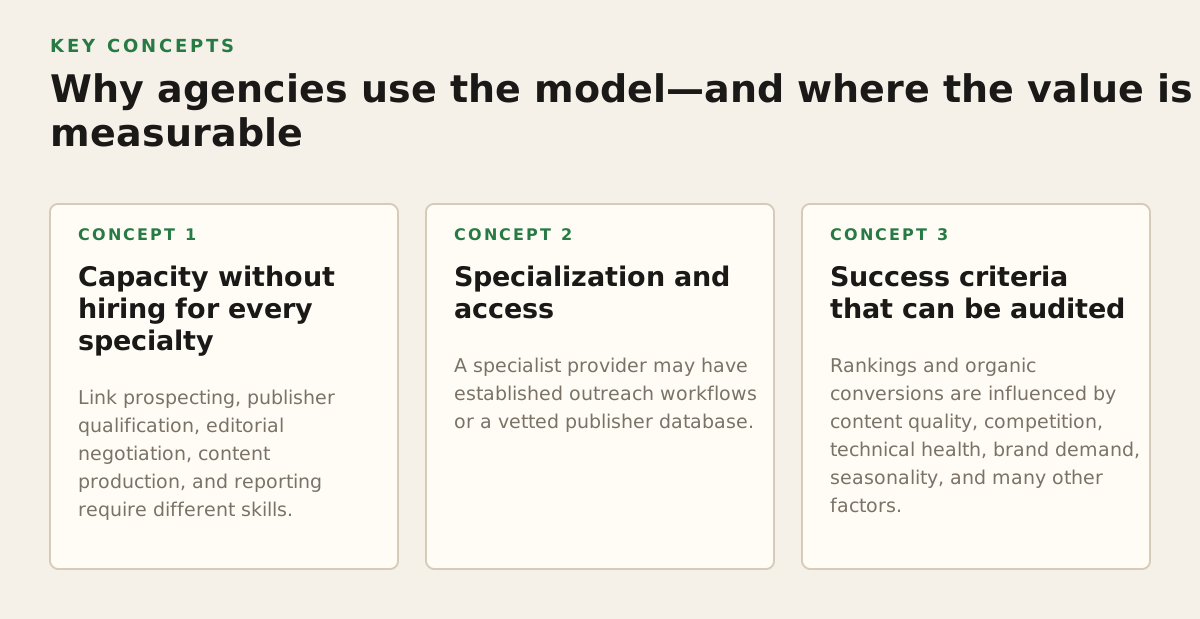
Why agencies use the model—and where the value is measurable
The strongest case for outsourcing is not that an external provider is automatically better. It is that a specialist can supply capacity, repeatable process, or access that would be slow or expensive to build internally. That benefit is only real if the work can be inspected and connected to a business objective.
Capacity without hiring for every specialty
Link prospecting, publisher qualification, editorial negotiation, content production, and reporting require different skills. An agency may have excellent strategists but no efficient way to maintain publisher relationships. A white-label partner can fill that operational gap while the agency retains positioning, account management, and commercial ownership.
This can be especially useful when demand is uneven. A sudden group of new clients may create a delivery backlog, while hiring a full-time team for a temporary surge creates a different financial risk. The contract should still specify capacity: accepted monthly order volume, lead times, revision handling, and what happens when the supplier reaches its limit.
Specialization and access
A specialist provider may have established outreach workflows or a vetted publisher database. That does not make every placement valuable. The relevant question is whether the inventory matches the client’s topic, geography, audience, and risk tolerance.
For authority acquisition, inspect the mechanism rather than accepting a domain metric as proof. Ask how the provider checks organic traffic, topical relevance, outbound-link patterns, indexing, editorial standards, and sponsorship disclosures. Google’s guidance describes links intended primarily to manipulate rankings as link spam and lists examples such as excessive link exchanges, automated links, and low-quality directory links; the official policy is available in its Search Essentials spam policies. The implication is practical: a high third-party score does not neutralize a manipulative placement pattern.
Success criteria that can be audited
Rankings and organic conversions are influenced by content quality, competition, technical health, brand demand, seasonality, and many other factors. A white-label provider should not be credited with every change in those metrics. Define a narrower delivery scorecard first, then track business outcomes separately.
- Placement quality: accepted domains meet agreed topical, geographic, traffic, and editorial criteria.
- Link integrity: target URL, anchor text, rel attributes, indexability, and placement context match the order.
- Delivery reliability: work arrives within the agreed window, with replacement rules for rejected or removed placements.
- Client usefulness: the referring page has a plausible audience and contributes to discovery, referral traffic, or credibility—not only a metric in a spreadsheet.
- Commercial outcome: qualified organic visits, assisted conversions, pipeline, or revenue are reviewed over an appropriate period without claiming causation that the data cannot establish.
Google’s documentation on crawlable links explains how links should be implemented so that search engines can discover and interpret them. It does not promise rankings from a particular placement. That separation is useful when writing client reports: confirm what was delivered, then present organic performance as a monitored outcome rather than a guaranteed consequence.
How the white-label delivery process works
A dependable process has more checkpoints than “send a URL and receive a link.” The exact workflow varies by service, but the commercial agency should be able to see where judgment is applied and where approval is required.
1. Scope and qualification
Start with the client’s pages, audience, markets, prohibited topics, competitor restrictions, brand voice, and risk tolerance. For link acquisition, record whether the objective is a product page, category page, research asset, homepage, or informational resource. A provider that accepts every target without questioning relevance may be optimizing order volume rather than outcome.
Use a written acceptance policy. It might specify minimum topical fit, traffic verification, language, country, editorial controls, link placement location, and whether sponsored or user-generated pages are excluded. Any numerical thresholds should be an internal starting policy, not presented as a universal SEO law.
2. Prospecting and publisher review
The partner identifies potential publishers through outreach, existing relationships, research, or a combination of methods. The agency should receive enough evidence to make a decision: site topic, audience, sample article, traffic source, recent publishing activity, outbound-link behavior, and the proposed editorial angle.
Domain Rating, Domain Authority, or similar scores can help sort a large list, but they are not proof of editorial quality or organic value. A useful review asks:
- Does the site publish substantial material for a defined audience?
- Are recent pages indexed and receiving plausible search visibility?
- Do articles contain excessive commercial links or obvious guest-post footprints?
- Is the proposed page relevant to the client rather than merely available?
- Does the publisher disclose paid relationships where applicable?
Where a placement is paid or otherwise involves a material relationship, disclosure and link attributes need attention. The Federal Trade Commission’s Endorsement Guides explain disclosure principles for endorsements in the United States. They are not a universal substitute for local legal advice, but they illustrate why editorial and commercial relationships should not be hidden from readers.
3. Briefing, production, and approval
A white-label article brief should include the reader’s problem, search intent, factual sources, internal-link targets, prohibited claims, preferred terminology, and the role of the target link. The link should support the page’s argument; forcing an exact-match anchor into an irrelevant paragraph creates editorial and risk problems.
Decide who approves facts, regulated claims, medical or financial statements, gambling references, and legal language. For casino and betting clients, publisher suitability is only one control. The brand also needs jurisdictional review, responsible-gambling language where relevant, and compliance with its own advertising and licensing obligations.
4. Placement, verification, and reporting
Verification should happen after publication, not only when a URL is first delivered. Check that the page is live, the link points to the agreed destination, the surrounding copy is accurate, and the page has not been materially altered. Establish a replacement or credit process for removals, redirects, accidental nofollow changes, or substantial edits.
Reports should separate completed work from inferred impact. A useful client-ready report can show the published URL, target URL, anchor, publication date, topical rationale, quality checks, and any caveat. It can then place Search Console, analytics, leads, and revenue in a separate performance section. Google’s Search Console Performance report documentation describes the available search metrics and their interpretation; those metrics are useful for monitoring, but they do not prove that one link caused a particular ranking change.
Decision table: match the buyer need to the service type
The cheapest-looking service is often the one that transfers the most review and remediation work to the buyer. Use the table as a starting point for deciding what to outsource and what to retain.
| Buyer need | Suitable service type | Main trade-off | Questions to settle before purchase |
|---|---|---|---|
| Too many outreach tasks for the existing SEO team | White-label link building | More capacity, but quality depends on publisher qualification and verification | Who approves domains, anchors, topics, and replacements? |
| Strong content team but weak distribution | Digital PR or outreach promotion | Potentially better editorial relevance, but campaigns require assets and newsworthy angles | What asset is being promoted, to which audience, and what counts as a qualified opportunity? |
| Need links within a live, relevant article | Niche edits or contextual link placements | Faster implementation can mean less control over the original page and its future edits | How is page relevance checked, and what happens if the page changes or disappears? |
| Need authority for a new B2B or SaaS category | Guest posts plus linkable assets | More control over the narrative, but requires credible expertise and useful content | Who supplies subject-matter review and validates claims? |
| Need gambling-friendly inventory | Specialist outreach for casino, betting, or iGaming publishers | Better category fit, but compliance and market restrictions narrow the pool | Which countries, licenses, topics, and responsible-gambling requirements apply? |
| Need a complete SEO function under another agency’s brand | White-label SEO fulfillment | Broader coverage, but greater dependency on the partner’s strategy and reporting discipline | Which decisions remain with the account agency, and who owns client communication? |
Where white-label marketing arrangements break
Most failures are not caused by the label itself. They come from unclear ownership, incentives that reward volume, or a reporting layer that hides weak work until a client notices.
Volume replaces relevance
A supplier paid per placement may have an incentive to accept marginal domains. A supplier paid for hours may have an incentive to expand process rather than output. Neither model is automatically wrong, but the contract should make quality visible and give the buyer authority to reject work that misses the brief.
Beware of guarantees that collapse a complex outcome into a simple promise: a fixed number-one ranking, permanent links, universal dofollow status, or a specified traffic lift. Search engines do not offer such guarantees, and no ethical provider can control every ranking variable. Google’s spam-policy documentation is a useful reference point when a proposed tactic sounds designed mainly to manipulate links rather than earn or support useful editorial content.
White-label anonymity weakens accountability
Client confidentiality can be legitimate, but “we cannot show any examples” should not mean “we cannot explain our process.” Ask for anonymized samples, redacted reports, sample acceptance criteria, and a description of escalation procedures. The agency buying the service still needs enough evidence to defend the work if a client or colleague asks how it was produced.
Margin disappears into hidden labor
Calculate the total delivery burden, not only the supplier’s invoice. Include briefing, domain review, revisions, client presentation, compliance checks, link monitoring, replacement requests, and payment administration. A service can appear inexpensive while consuming senior account time that was never included in the original resale price.
Pricing models should be discussed openly:
- Per placement or deliverable: easy to forecast, but may encourage quantity unless acceptance criteria are strong.
- Monthly retainer: supports continuity and planning, but unused capacity and scope boundaries must be clear.
- Project fee: suitable for a campaign or asset, with milestones tied to defined outputs.
- Tiered package: convenient for resale, but check whether the package hides unsuitable inventory or inflexible substitutions.
- Performance-linked fee: requires especially careful attribution rules and should not imply that the provider controls all organic outcomes.
Do not invent a universal budget. Instead, ask what is included, what triggers an extra charge, whether strategy is separate from execution, how rejected work is handled, and whether taxes, content, publisher fees, monitoring, and revisions are included. A sensible starting policy is to model three scenarios—expected demand, low demand, and surge demand—before committing to a minimum.
Risky practices become your client problem
Private blog networks, automated comment links, spun articles, hidden sponsorships, irrelevant exact-match anchors, and large-scale reciprocal arrangements can create reputational and search risk. The buyer should ask directly whether the provider uses them and require written exclusions. Do not rely on “white hat” as a label; inspect the operating rules.
For regulated or sensitive sectors, add a second review layer. Casino and iGaming campaigns may face market-specific restrictions, age-related concerns, licensing claims, and responsible-gambling requirements. B2B, finance, health, and cybersecurity campaigns may require subject-matter approval even when the placement itself is editorially sound.
How to evaluate and manage a provider
Evaluation should resemble supplier due diligence, not a quick comparison of domain scores. The agency needs evidence that the partner can deliver repeatedly, communicate exceptions, and protect the agency’s client relationship.
Use a staged buying process
- Write the acceptance policy: define acceptable sites, topics, countries, link types, anchor limits, content standards, and prohibited tactics.
- Request a process sample: ask for a redacted prospect review, brief, draft, verification record, and report—not only a list of logos.
- Run a limited pilot: use a real but contained project with agreed approval gates. Treat the pilot as an operational test, not proof of guaranteed ranking impact.
- Review the true workload: record internal hours spent on briefing, approvals, revisions, reporting, and remediation.
- Set renewal criteria: continue when delivery quality, communication, economics, and client usefulness meet the agreed standard.
Vendor interview checklist
- Which services are performed by your team, and which are subcontracted?
- How do you verify organic visibility, topical relevance, ownership, and publishing quality?
- Can the buyer reject a proposed publisher without losing the full order?
- What happens when a page is removed, redirected, deindexed, or materially edited?
- How do you handle regulated topics, gambling content, claims review, and market restrictions?
- What information appears in the white-label report, and can it be exported into our format?
- Who owns content, creative assets, publisher relationships, and account data if the contract ends?
- What are the minimum commitment, notice period, payment terms, and pause rules?
- Which outcomes do you report as delivery metrics, and which do you treat as influenced but not guaranteed?
- Can you explain a failed campaign or rejected placement without blaming the client?
For agencies comparing specialist options, review whether the provider’s service is narrow enough to be excellent and broad enough to fit the account. A link-only provider may be ideal when strategy stays in-house. A broader fulfillment partner may be more efficient when the agency needs content, reporting, and outreach coordinated. The right choice is the one that reduces a defined bottleneck without creating an invisible management job.
When the requirement is specifically high-quality editorial acquisition, investigate authority link building alongside broader link building services, but compare any provider against the same acceptance policy and reporting requirements. The decision should follow client fit, delivery evidence, and risk controls—not a generic promise attached to the phrase “white label.”
Apply the model without losing strategic control
Keep four decisions inside the client-facing agency unless there is a strong reason not to: the business objective, the audience and positioning, the acceptable risk level, and the interpretation of performance data. Outsource repeatable execution where the partner has a genuine process advantage, but do not outsource judgment by accident.
A practical operating rhythm is simple:
- At intake, map each target page to a business purpose and audience.
- Before production, approve the publisher category, angle, target URL, and compliance constraints.
- During delivery, review exceptions weekly rather than waiting for a monthly report.
- After publication, verify the URL and record removals, changes, and referral activity.
- Quarterly, remove weak publishers from the approved list and revise the acceptance policy based on evidence.
For a SaaS client, that may mean combining expert guest posts with a research asset that earns natural references. For e-commerce, it may mean separating category-page authority work from digital PR designed to attract attention and referral traffic. For an iGaming client, it may mean accepting fewer but more relevant gambling-friendly publishers after market and compliance checks. For a B2B client, it may mean prioritizing specialist publications over a larger volume of general domains.
The specific recommendation is to buy white-label marketing capacity only after defining what remains strategically yours, how delivery will be inspected, and what evidence justifies renewal. If you need a senior-led partner for hand-vetted guest posts, niche edits, authority links, digital PR, or white-label fulfillment—including gambling-friendly publisher options—Web Push can be assessed against that framework.
Authored with NotFair SEO