
A useful marketing campaign template turns a growth objective into a brief, asset, distribution plan, and measurement system your team can execute. Use the framework below to choose one commercial goal, define the audience and offer, assign channels such as guest posting or digital PR, and set evidence-based decision rules before work begins.
This is designed for marketing managers, SaaS and e-commerce teams, B2B companies, iGaming brands, and agencies that need a campaign another person can deliver without reconstructing the strategy from scattered messages. It also helps separate a campaign that can earn relevant authority links from one that merely produces content.
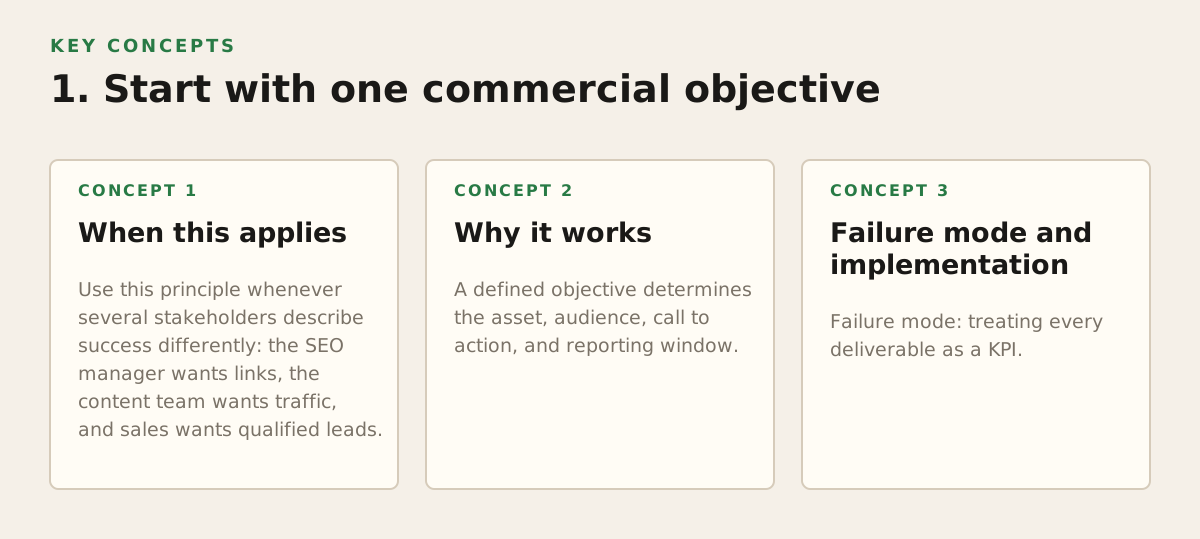
1. Start with one commercial objective
When this applies
Use this principle whenever several stakeholders describe success differently: the SEO manager wants links, the content team wants traffic, and sales wants qualified leads. A campaign can support all three, but it needs one primary objective and a short list of secondary indicators.
Why it works
A defined objective determines the asset, audience, call to action, and reporting window. “Improve visibility” is not an operating goal. “Earn relevant referring domains to the product comparison page while generating qualified demo visits” gives the team something to build and measure.
Keep the objective connected to a business outcome without promising a ranking position or traffic lift. Google describes helpful content in terms of creating content primarily for people rather than manipulating search results; that principle supports choosing a real audience problem before selecting keywords. See Google’s official guidance on creating helpful, reliable, people-first content.
Failure mode and implementation
Failure mode: treating every deliverable as a KPI. A campaign then rewards volume—more posts, more outreach, more links—instead of relevance or qualified action.
Implementation example: a B2B software company sets “earn editorial references to its procurement guide from relevant operations publications” as the primary objective. Secondary indicators are qualified guide visits, assisted demo sessions, and the number of genuinely relevant publishers that accept the story.
- Primary objective: the one result that determines whether the campaign continues.
- Secondary indicators: evidence that the campaign is moving toward that result.
- Guardrail: a quality condition, such as topical relevance or compliance with the brand’s claims policy.
2. Define a narrow audience and a useful message
When this applies
Use a narrow audience definition when the campaign must work across search, outreach, paid promotion, or sales enablement. “Businesses” is too broad for a campaign brief. Specify the person, situation, constraint, and decision they are facing.
Why it works
Specificity improves the message and the publisher list at the same time. A campaign for “European SaaS marketing managers preparing an international launch” will produce different evidence and outreach angles from one for “startups seeking more leads.” The audience also tells you which terminology, examples, and objections belong in the asset.
Write the message as a defensible promise: what will the audience understand, compare, calculate, or do after engaging with the campaign? Avoid unsupported superlatives. If the campaign includes testimonials, endorsements, or reviews, use clear disclosures where a material connection exists; the U.S. Federal Trade Commission’s endorsement guidance explains the general disclosure principle.
Failure mode and implementation
Failure mode: building a generic “ultimate guide” that gives outreach prospects no reason to cite it. Generic content creates a weak pitch because the publisher cannot see which readers benefit.
Implementation example: instead of “a guide to link building,” define the audience as “agency owners who need a white-label fulfillment partner for editorial placements and do not want their clients exposed to risky link networks.” The message becomes a practical vendor-evaluation framework rather than a broad SEO explainer.
3. Select an asset that can earn attention and authority
When this applies
Use this principle when organic growth, digital PR, or backlink acquisition is part of the campaign. Select the asset only after identifying the audience’s information gap. The asset might be a research summary, calculator, benchmark methodology, comparison page, original visual, expert-led guide, or a genuinely useful tool.
Why it works
Publishers link when a page gives their readers evidence, clarity, or a resource worth returning to. An asset should therefore have a clear citation reason, not just a keyword target. It also needs a logical destination: a product page may convert well but be difficult for journalists or bloggers to cite, while a well-built research or resource page can earn references and send qualified visitors onward.
For search visibility, make the page understandable to both users and search systems: state who it serves, explain how claims were produced, identify limitations, and keep the main answer easy to find. These are practical applications of Google Search Central’s people-first content guidance, not guarantees of rankings.
Failure mode and implementation
Failure mode: commissioning an asset because a keyword has search volume, then discovering that it contains no original utility. A long article does not automatically become linkable.
Implementation example: an e-commerce brand creates a seasonal shipping-cost calculator with assumptions, regional notes, and a downloadable methodology. Outreach focuses on logistics and retail publications that need a concrete reference, while the calculator links naturally to the brand’s relevant service pages.
- Choose a format that solves the information gap, not the format your team prefers.
- Document sources, assumptions, sample size, and update ownership.
- Place the commercial next step after the useful answer, not in place of it.
- Prepare a short citation sentence publishers can quote accurately.
4. Match channels to the audience’s decision stage
When this applies
Use a channel matrix when a campaign could involve organic search, guest posts, niche edits, email outreach, digital PR, social distribution, partnerships, or paid promotion. The question is not “Which channel is popular?” but “Where can this audience encounter credible evidence at this stage?”
Why it works
Different channels perform different jobs. Search captures existing intent, editorial placements borrow a publisher’s context, digital PR creates a news angle, and email outreach connects an asset to a specific publishing need. Combining channels is sensible only when each has a distinct role and a measurable handoff.
Use campaign parameters consistently for links you control. Google Analytics documents the use of UTM parameters for identifying campaign traffic in reports; its official campaign URL guidance covers the basic parameter structure. Keep naming conventions stable across agencies, regions, and languages.
Failure mode and implementation
Failure mode: distributing the same announcement everywhere. A sales email, a journalist pitch, and a guest-post brief have different purposes and should not use identical copy.
Implementation example: a casino software supplier publishes a responsible-operations briefing. Its digital PR angle targets business and gaming publications, its guest-post angle explains operational planning for operators, and its product-page link appears only where the editorial context supports it. The team records each channel separately rather than calling every visit “organic.”
| Channel | Best use | Required campaign input | Quality check |
|---|---|---|---|
| Organic search | Capture defined information or comparison intent | Search need and page purpose | Page answers the query directly |
| Digital PR | Earn coverage around evidence or a timely issue | News angle and quotable finding | Claim is sourced and defensible |
| Guest posting | Teach a relevant audience in a publisher’s context | Reader problem and proposed topic | Publisher has real topical fit |
| Niche edit | Improve an existing relevant resource where appropriate | Specific page and contextual reason | Placement is editorially justified |
| Email or partner distribution | Reach known audiences directly | Recipient segment and permission basis | Message is relevant and expected |
5. Build measurement before distribution
When this applies
Use this principle whenever several teams or suppliers will touch the campaign. Agree on what counts as a qualified visit, engaged publisher, earned link, assisted conversion, and completed deliverable before launch.
Why it works
Predefined measurement prevents post-launch storytelling. A campaign can earn links but attract the wrong audience, or generate visits without producing commercial intent. Track outcomes at three levels: delivery, audience response, and business relevance.
For SEO campaigns, treat link count as an incomplete measure. Review the linking page’s relevance, editorial context, indexability, destination, anchor language, and traffic potential. Google’s Search Essentials documentation explains broad technical and spam-policy expectations; see Google Search Essentials when setting quality guardrails.
Failure mode and implementation
Failure mode: reporting authority metrics as if they were business outcomes. Third-party metrics can help prioritize prospecting, but they do not prove that a publisher’s audience is relevant or that a link will improve revenue.
Implementation example: an agency reports placements in four columns: publisher relevance, live URL, contextual destination, and client-defined outcome. A campaign manager reviews qualified referral sessions and assisted conversions separately from placement volume.
- Delivery: published assets, accepted pitches, live placements, and tracked URLs.
- Response: engaged sessions, downloads, replies, citations, and returning visitors.
- Business relevance: qualified leads, demo assists, applications, or sales actions.
- Decision rule: the condition that triggers iteration, expansion, or stopping.
6. Protect quality, compliance, and brand fit
When this applies
Use a governance layer when campaigns involve regulated sectors, multiple countries, contractors, or third-party publishers. This is especially important for gambling, betting, financial, health, and claims-heavy campaigns, where the acceptable wording and publisher profile require closer review.
Why it works
Quality controls preserve the campaign’s usefulness when production pressure rises. Create a short approval checklist covering factual claims, disclosure requirements, link destination, brand terminology, target-country restrictions, and publisher suitability. For search-focused work, reject link farms, private blog networks, irrelevant placements, and pages created solely to pass signals.
Do not assume that a high third-party authority score makes a site suitable. Review topical alignment, visible editorial standards, organic audience evidence, outbound-link patterns, and whether the proposed article would be useful without the link. For a structured approach to evaluating relevant placements, see Web Push’s authority link building.
Failure mode and implementation
Failure mode: allowing a supplier to optimize for the cheapest or fastest placement while the campaign owner measures only quantity. This can create reputational risk and make later reporting impossible.
Implementation example: an iGaming campaign requires publisher approval before outreach. The reviewer checks audience geography, content category, responsible-gambling language, commercial claims, and whether the proposed link is natural in the article. Rejected sites are recorded so the same prospect is not reconsidered without new evidence.
7. Copyable marketing campaign worksheet
Copy this worksheet into a brief, project-management ticket, or agency intake form. Complete it before assigning content, outreach, or link-building work.
| Field | Prompt or question | Your answer |
|---|---|---|
| Campaign name | What short name will identify this campaign across teams and reports? | [Campaign name] |
| Primary objective | What single business result should this campaign support? | [One measurable objective] |
| Audience | Who is the buyer or reader, and what situation are they in? | [Describe the audience and problem] |
| Message | What useful, defensible idea should the audience remember? | [Core message] |
| Offer or asset | What will the audience receive, use, compare, or cite? | [Asset and destination URL] |
| Channels | Which channels will perform which job? | [Channel, role, owner] |
| Quality constraints | Which claims, markets, publishers, links, or disclosures need approval? | [Guardrails and approver] |
| Measurement | What will be tracked, and what decision will the data trigger? | [KPIs, tracking method, decision rule] |
Worked example
Campaign name: European SaaS procurement guide. Primary objective: earn relevant editorial references to a guide and support qualified product-page visits. Audience: operations and procurement managers comparing software vendors across multiple European markets. Message: a transparent evaluation model helps teams compare implementation risk, support requirements, and total cost assumptions.
Asset: a sourced comparison guide with an editable evaluation worksheet and a clear methodology page. Channels: organic search for the comparison need, guest posts for operations publications, and targeted outreach to authors maintaining procurement resources. Quality constraints: cite every external data point, label assumptions, exclude irrelevant general-business sites, and approve every product claim. Measurement: track asset engagement, qualified referral sessions, relevant live references, and assisted demo actions; expand outreach only if the responding publishers match the audience definition.
How to adapt the fields
For white-label agency work, add the client’s approval owner, reporting format, and prohibited publisher categories. For e-commerce, define the product margin or category priority before selecting the asset. For casino or betting campaigns, add market eligibility, responsible-marketing review, and publisher-category checks. For B2B, record the sales stage the asset supports so a high-volume awareness campaign is not judged by immediate conversions.
8. Execute in a controlled sequence
Use this order to keep strategy, production, and distribution connected:
- Brief the decision: complete the worksheet and confirm the primary objective, audience, guardrails, and owner.
- Validate the opportunity: review the audience problem, competing resources, publisher landscape, and evidence available for the proposed claim.
- Build the asset: produce the page, guide, research, calculator, or visual with sources, limitations, commercial next step, and update owner.
- Prepare distribution: create channel-specific pitches, guest-post concepts, partner messages, tracking links, and a vetted prospect list.
- Run quality review: approve claims, disclosures, destinations, publisher fit, anchor context, and market-specific requirements before publication.
- Launch and record: log every live URL, response, referral source, status, and owner in one campaign register.
- Review against the decision rule: retain the channels producing relevant responses, revise weak messaging, and stop activity that meets volume targets but fails quality or business criteria.
If your team needs an external fulfillment layer, Web Push provides link building services including hand-vetted authority placements, guest posts, niche edits, digital PR, and white-label support; use the worksheet to specify the audience, asset, publisher standard, and reporting requirement before requesting a plan via Web Push.
Authored with NotFair SEO