
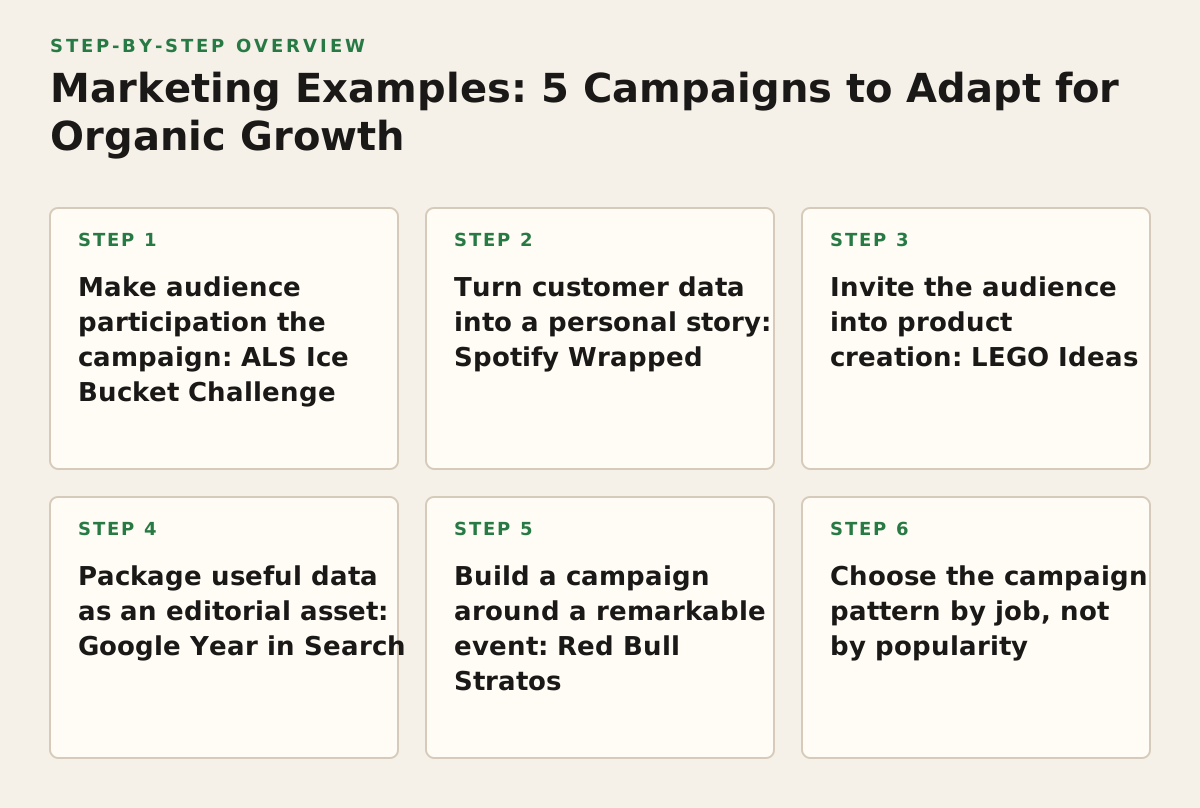
Marketing examples worth adapting give people a reason to participate, share, or cite something—not just notice an ad. Spotify Wrapped, the ALS Ice Bucket Challenge, LEGO Ideas, Google’s Year in Search, and Red Bull Stratos show five different ways to do that. For SaaS, e-commerce, B2B, and iGaming teams, the useful decision is which mechanism fits your audience and business goal, then how to turn it into a campaign that can earn attention and relevant links.
These are real campaigns, not templates guaranteed to perform. Their results depend on brand recognition, timing, audience access, and execution. The patterns below separate what happened from what a smaller team can reasonably adapt, including the failure mode to watch for.
1. Make audience participation the campaign: ALS Ice Bucket Challenge
What happened, and why it travelled
In 2014, the ALS Ice Bucket Challenge invited participants to film themselves pouring ice water over their heads, donate to ALS research, and nominate others to take part. The ALS Association reports that the challenge raised $115 million in the United States during that summer; its campaign account describes how participant videos and nominations helped spread it. The association’s campaign page documents the mechanism and result.
The mechanism was a repeatable public action. People did not need to explain a complex cause before joining in: the action was easy to recognize, record, and pass on. That made each participant a potential distributor, while the donation gave participation a purpose beyond visibility.
When to adapt it—and when not to
This pattern suits a launch, awareness drive, or community campaign when your audience can complete a simple action and invite others. A B2B team could ask customers to share one practical workflow improvement; an e-commerce brand could invite customers to show how they use a product. Keep the action relevant to the offer, and make it possible for people to participate without buying anything.
- Define one action: specify what someone does, records, and shares.
- Give participation a reason: connect the action to a useful cause, insight, or community outcome.
- Make sharing optional: avoid pressuring customers to publish personal or sensitive information.
Failure mode: copying the spectacle without its purpose. A forced challenge can feel like engagement bait, and a nomination mechanic can become irritating when people are expected to tag contacts. For an SEO campaign, do not assume that social sharing automatically earns relevant links. Build a useful landing page with clear facts and shareable assets, then measure referrals and earned coverage separately from social activity.
2. Turn customer data into a personal story: Spotify Wrapped
What the campaign demonstrates
Spotify Wrapped packages listening activity into personalized year-end summaries that users can share. Spotify reported that its 2023 Wrapped reached 574 million users, and its newsroom described the campaign’s personalized stories and shareable formats. Spotify’s 2023 announcement provides the campaign context and audience figure.
Personal data becomes marketing when it says something recognizable about the person. A generic usage dashboard is primarily for account management; a concise, well-designed recap can become a conversation starter. The distinction is interpretation: present a few meaningful observations, not a dump of metrics.
How to adapt the pattern
A SaaS company might offer an annual account recap showing a customer’s most-used workflows or milestones. An e-commerce brand could summarize a customer’s product category preferences, provided the data is collected and used appropriately. A marketing team could also create an aggregate recap—such as the most-read guides or most common customer questions—without exposing individual account data.
- Choose a small set of metrics that users can understand without explanation.
- Make the result easy to save or share, but let the user review it first.
- Link each insight to a useful next step, such as a guide or feature walkthrough.
Failure mode: treating personalization as a design task while overlooking consent, data quality, and privacy. A surprising number that is wrong or revealing can damage trust more quickly than a bland recap can build it. Do not imitate Spotify’s scale; adapt the principle of making relevant data legible, and keep the output proportionate to what users expect your product to know.
3. Invite the audience into product creation: LEGO Ideas
What the example shows
LEGO Ideas lets fans submit product concepts and gather support from other users. The platform explains its submission and review process, including a threshold of 10,000 supporters for a project to enter review. LEGO Ideas is a live example of turning audience participation into a structured product pipeline, rather than a one-off request for feedback.
Co-creation works when the audience can see what happens next. A prompt such as “tell us what you want” can produce unstructured suggestions that disappear into a form. A defined submission, visible support process, and stated review step give participants a reason to contribute and share a specific idea.
Use a bounded brief
A B2B software team could invite customers to propose a practical template, integration workflow, or reporting view, then publish which submissions it will evaluate. An e-commerce brand might invite product-use ideas within clear constraints. For an iGaming brand, any public participation mechanic should be reviewed against applicable advertising, age, and responsible-gambling requirements before launch; do not make regulated activity or claims part of a casual sharing prompt.
- Set the scope: state what can be submitted and what cannot.
- Explain selection: publish who reviews ideas and what happens to shortlisted entries.
- Close the loop: report back, even when an idea is not selected.
Failure mode: soliciting ideas without capacity or a credible decision process. That creates expectations the team may not meet and can invite disputes over ownership. Use clear terms, secure any needed permissions, and limit the pilot to a manageable theme. The marketing value comes from a genuine feedback loop—not from implying every popular idea will become a product.
4. Package useful data as an editorial asset: Google Year in Search
From information to a story people can cite
Google’s annual Year in Search projects turn search trends into a public recap of topics people searched for during the year. The 2023 edition presented search interests in an editorial format, rather than asking readers to interpret a raw dataset themselves. Google’s 2023 Year in Search post shows how the company framed that material for a broad audience.
A data asset earns attention when it answers a question in a usable form. A B2B team might publish a report on anonymized customer-support themes; an e-commerce retailer could analyze seasonal product questions; an SEO agency could turn a carefully defined industry dataset into a source journalists can quote. The asset needs methodology, context, and a clear audience—not merely charts.
Build the asset before pitching it
- Choose a question your audience or industry already asks.
- Document the data source, time period, exclusions, and limitations.
- Publish the findings with a concise summary, downloadable visuals, and a contact for follow-up.
- Pitch the most relevant finding to publications whose readers would care about it.
Failure mode: presenting correlation as causation, or making broad claims from a narrow sample. A journalist may cite the finding, but an inaccurate claim can undermine the brand and the outreach. Label estimates, disclose methodology, and make the underlying evidence accessible. For search visibility, a report should also be useful to people who never link to it; links are a possible outcome, not a substitute for substance.
5. Build a campaign around a remarkable event: Red Bull Stratos
Why an event can create an editorial moment
Red Bull Stratos centered on Felix Baumgartner’s 2012 high-altitude skydive and presented it as a live event supported by video and editorial coverage. Red Bull’s project page documents the campaign and its central event. Red Bull Stratos illustrates a useful distinction: the event was the story, while the surrounding content made that story accessible to different audiences.
A strong event gives publishers a timely reason to cover a subject. Most companies cannot stage a globally visible stunt—and do not need to. A specialist brand can create a smaller, relevant editorial moment: a public research briefing, a product demonstration that answers a real industry question, or a webinar where an expert presents original findings.
Scale the idea to your credibility
For SaaS or B2B, make the event proportionate to the evidence and expertise you can bring. For an e-commerce brand, a live demonstration may show a product in a real use case. For iGaming, keep campaign content within the brand’s legal and responsible-marketing review process; an attention-grabbing event is not a reason to overstate odds, outcomes, or user results.
Failure mode: investing in spectacle that has no useful afterlife. If the live moment is the only asset, its value can vanish when the event ends. Plan the recording, transcript, expert commentary, still images, and follow-up article before launch. Each asset should offer a distinct use, rather than repeating the same announcement across formats.
Choose the campaign pattern by job, not by popularity
The best-known campaign is not necessarily the right one for your team. Match the mechanism to the outcome you need, the evidence you can support, and the channels where your audience already pays attention. Use the table as a starting selection framework, then adjust it to your resources and risk tolerance.
| Business job | Pattern to consider | Useful first asset | Watch-out |
|---|---|---|---|
| Encourage sharing or community participation | ALS-style action prompt | A simple participation page with purpose and instructions | Do not rely on tagging or social reach as proof of business impact |
| Increase product engagement or retention | Spotify-style personal recap | A privacy-reviewed customer or aggregate summary | Check data accuracy, consent, and whether users expect this use |
| Collect structured product feedback | LEGO Ideas-style co-creation | A bounded brief with transparent review criteria | Set expectations about selection, ownership, and follow-up |
| Earn relevant editorial coverage | Google-style data story | A sourced report with methodology and reusable visuals | Avoid unsupported conclusions and thin, promotional research |
| Create a timely reason to publish | Red Bull Stratos-style event | An event plan with a recording and follow-up assets | Do not let spectacle outrun the brand’s credibility or capacity |
For organic search, the campaign’s link profile matters as much as its headline. Google’s spam policies identify practices such as buying links to manipulate rankings and excessive link exchanges as link spam. Google’s spam policies are a useful boundary when a campaign includes outreach: pitch assets because they are relevant to a publisher’s readers, not because a placement promises a ranking shortcut. A sustainable authority link building program starts with editorial fit and a destination worth citing.
Before launch, define one primary outcome and its evidence. A campaign can attract attention without producing qualified leads; it can earn links without improving conversions; and it can support sales without earning press. Google’s guidance on creating helpful, reliable, people-first content is a useful test for the landing page: does it satisfy the visitor’s need, or does it exist mainly to capture a ranking?
Implementation plan: move from example to campaign
- Choose the business job. Decide whether the campaign should generate qualified visits, product participation, press coverage, sales conversations, or another outcome. Select one primary measure and one supporting measure.
- Pick a pattern that fits your audience. Use a participation prompt when people can take a meaningful action; a recap when trustworthy user data adds personal value; co-creation when the team can review contributions; a data asset when the evidence is solid; or an event when there is a real moment worth covering.
- Write the constraints before the concept. Identify privacy, permission, regulatory, brand, and operational limits. For gambling and betting campaigns, include appropriate legal and responsible-marketing review before publishing or outreach.
- Build the destination and proof. Prepare a clear landing page, methodology or terms where relevant, shareable supporting material, and a direct next step. Ask someone outside the campaign team to test whether the offer and evidence are understandable.
- Plan distribution by audience. List the customer, community, partner, and editorial groups for whom the asset is genuinely relevant. Personalize outreach around the recipient’s subject area; do not send the same generic pitch to every publisher.
- Review outcomes and decide what to repeat. Compare the campaign with its stated goal, note what did not work, and reuse only the mechanism that the evidence supports. Treat earned links as editorial outcomes, not guaranteed deliverables.
For teams that need help turning a useful asset into relevant publisher coverage, Web Push offers link building services, including white-label fulfillment for agencies. See Web Push for a senior-led approach to editorial placements and digital PR across Europe.
Authored with NotFair SEO