
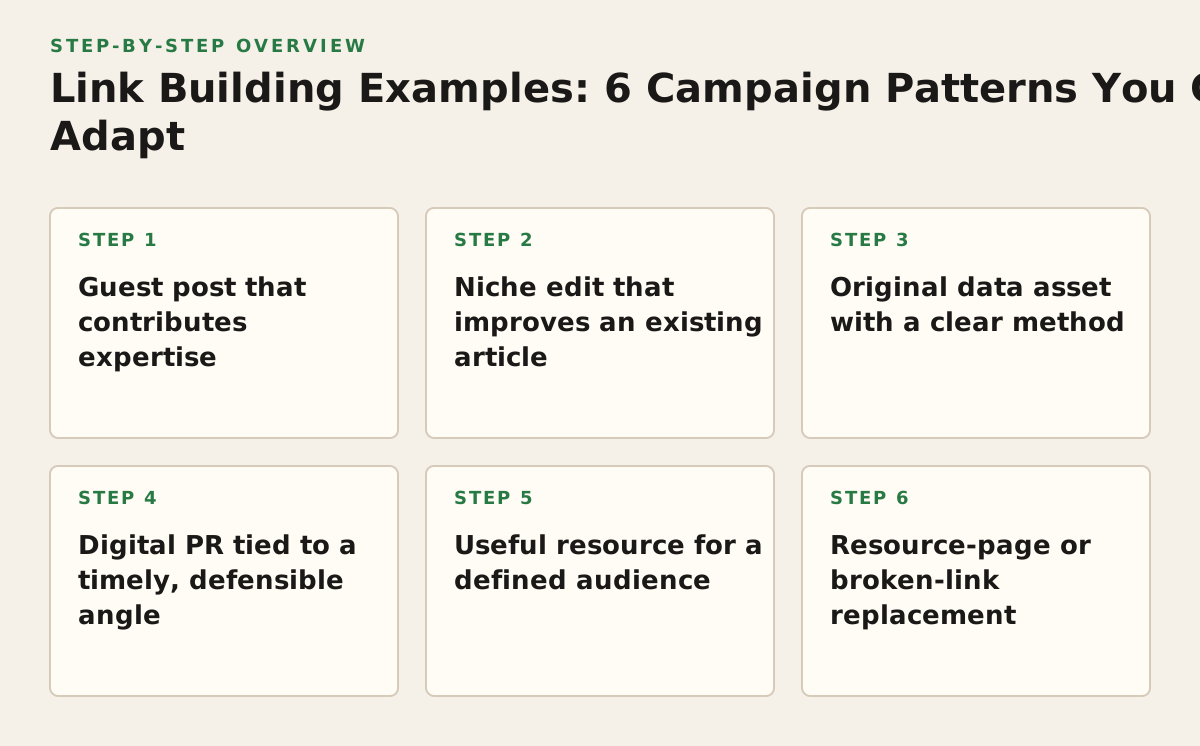
Useful link building examples include a guest post that solves a publisher’s audience problem, a niche edit that adds a genuinely useful citation, and digital PR built around original data. The right choice depends on the page you want to strengthen, the evidence or expertise you can contribute, and whether the linking page makes sense to its readers. Here are six patterns, with ways to adapt them and checks to avoid links that look good in a report but have little editorial value.
1. Guest post that contributes expertise
Use this pattern when your team can explain a subject from a distinctive, useful angle and a relevant publisher accepts outside contributors. It can work because the article gives the publication material its readers can use while linking naturally to a relevant resource on your site. It is not a reason to publish a thin article whose main purpose is to place an anchor.
Worked example: a SaaS workflow guide
Imagine a SaaS company that helps ecommerce teams manage product feeds. It proposes a publisher article on diagnosing feed errors before a catalog promotion, including a short troubleshooting sequence and examples of common failure points. A link to a deeper checklist is appropriate only if it adds steps the article cannot reasonably cover.
- Pitch the reader problem: explain the audience, the question the article answers, and why your contributor can answer it.
- Make the article independently useful: include the method, examples, and limitations in the guest article itself.
- Place the link where it helps: use descriptive anchor text that accurately names the linked resource, not a forced commercial phrase.
Failure mode: pitching a generic “ultimate guide” to every publisher, then inserting a link to a sales page regardless of context. Instead, tailor the topic to the publication and link to a supporting resource that genuinely advances the discussion. Google advises using descriptive, relevant anchor text for crawlable links; its guidance is a useful editorial check, not a formula for rankings (Google’s link best practices).
2. Niche edit that improves an existing article
Use this pattern when a published page already discusses the subject your resource supports, but omits a useful citation or next step. A well-matched contextual addition can serve readers without requiring a new article. It works only if the destination contributes something specific; topical similarity alone is not enough.
Worked example: adding a practical reference
Suppose an established article explains how B2B teams prepare a content brief but says little about checking whether a cited source is current. A company has a freely accessible checklist for evaluating source dates, methodology, and attribution. The proposed addition should make that section more actionable, and the publisher should decide whether the link belongs there.
- Read the whole target page and identify the exact paragraph the resource would improve.
- Check that the destination is accessible, relevant, and substantive—not a thin page created solely to receive links.
- Suggest a concise sentence that accurately describes the resource, while leaving the publisher free to edit or decline it.
Failure mode: treating any old page with a relevant keyword as a placement opportunity. A stale, unrelated, or poorly maintained article may offer little value even if its metrics look attractive. Review the page’s audience, outbound links, and current editorial context before proposing an addition. If the fit is sound, the work may belong within a broader authority link building plan rather than being judged by a placement count alone.
3. Original data asset with a clear method
Use this pattern when you can publish information that a journalist, analyst, or practitioner would reasonably cite. This might be an analysis of your own public dataset, a survey with a disclosed method, or a small benchmark drawn from a clearly defined sample. The mechanism is simple: a useful, checkable finding gives other writers a reason to cite the underlying work.
Worked example: a transparent category analysis
An ecommerce team could compare how product pages in a defined category present shipping and returns information. Its asset would state how the sample was selected, when pages were reviewed, what counted as a visible policy, and what the analysis cannot establish. A useful chart might show the categories of information observed; it should not imply that the sample represents every retailer.
- Define the question first: choose something a specific audience would want to cite or use.
- Document the method: explain the source, sample boundaries, collection date, and exclusions.
- Package the finding: provide a short summary, a chart or table, and a link to the full method and data where appropriate.
For survey-based assets, be explicit about the population and method rather than presenting responses as universal fact. Pew Research Center’s methods resources illustrate why survey design and methodology matter when readers interpret findings (Pew Research Center, methods). Failure mode: releasing a striking statistic without a traceable method. If readers cannot assess how it was produced, the asset is harder to trust and cite. Keep the claim no broader than the evidence.
4. Digital PR tied to a timely, defensible angle
Use this pattern when a timely event or industry question gives your research, data, or specialist explanation a reason to matter now. A pitch can earn editorial attention when it offers a specific, verifiable angle—not merely a company announcement. It works best when the underlying evidence is ready before outreach begins.
Worked example: explain a change, don’t just announce it
A B2B cybersecurity firm might publish an expert explanation of how a newly announced industry requirement could affect a defined type of business. The pitch should link to the original announcement, distinguish confirmed details from interpretation, and explain which organizations may need to investigate further. If the firm has no relevant expertise or supporting evidence, it should not manufacture a comment just to join the news cycle.
For a gambling or iGaming brand, the same discipline applies to market commentary: use a relevant, credible angle and verify that a publication is appropriate for the intended audience. A link from a loosely related site is not made valuable by a timely headline. Failure mode: pitching an unsupported claim as news or sending a mass release with no distinct editorial value. Prepare a short evidence pack and a tailored pitch, and let the publisher choose whether and how to cite it.
5. Useful resource for a defined audience
Use this pattern when you can build something that helps a particular group complete a task: a checklist, calculator, template, glossary, or carefully curated resource page. The format is not the link-building idea by itself. The value comes from solving a recurring problem better than a bare promotional page would.
Worked example: an agency handoff template
An SEO agency serving several clients could publish a link-placement review template for its internal workflow. It might prompt reviewers to record the linking page, topical fit, destination, anchor context, and any editorial or disclosure concerns. A separate explanatory page can show how to use it and where the template’s limits are. This is more reference-worthy than a download form that reveals nothing until a visitor submits personal details.
- Identify a recurring task the intended audience already performs.
- Make the resource usable without requiring a sales conversation.
- Explain who it is for, how to use it, and what it does not assess.
Failure mode: building a tool or template that repeats an existing resource without improving it. Before investing in production, inspect what the audience already uses and define the practical gap your asset fills. For white-label fulfillment, an agency can adapt the review fields into its own client approval process; the framework should make placements easier to evaluate, not disguise their origin or quality.
6. Resource-page or broken-link replacement
Use this pattern when a publisher maintains a curated page of references or has a relevant outbound link that no longer works. A replacement is useful only if your page serves the same reader need as the missing or outdated reference. This is a maintenance suggestion, not an entitlement to a link.
Worked example: a replacement reference
Suppose a trade association’s guide to onboarding suppliers links to a resource that has been removed. Your company has a current, freely accessible checklist covering the same onboarding task. A concise note can identify the broken reference, explain the overlap, and offer the checklist as one possible replacement. If the destination covers a different task, do not pitch it as an equivalent.
For resource pages, follow the same relevance test: a page about B2B procurement should not receive a general marketing asset simply because it lists external links. Failure mode: sending automated messages about broken links without checking whether the page is still maintained or whether your suggested resource is a fair substitute. Verify the issue manually, keep the suggestion specific, and accept that the editor may prefer another source or no replacement.
Choose the pattern with a repeatable screen
Before outreach, score the opportunity against the job it needs to do. This is a starting policy, not a universal benchmark: a high score does not guarantee a placement or a ranking effect. The purpose is to make the team’s reasoning consistent and expose weak fits before they consume outreach time.
| Check | Question to ask | Strong signal | Reason to pause |
|---|---|---|---|
| Audience fit | Would the linking page’s readers care about the destination? | The page serves a defined audience that overlaps with the resource’s users. | The only connection is a shared keyword or industry label. |
| Editorial fit | Does the proposed link improve the page? | It supports a claim, fills a gap, or gives readers a useful next step. | The sentence would read naturally without the link and gains nothing from it. |
| Destination quality | Does the target page deliver what the link implies? | It is accessible, focused, and useful without requiring a sales pitch. | It is thin, mismatched, or primarily designed to capture a link. |
| Method and disclosure | Is the placement earned editorially, or is it compensated? | The arrangement and any required disclosures are clear. | Payment or another material connection is hidden. |
| Strategic role | What page or audience need does this support? | The link fits a planned campaign and a relevant destination. | The sole success measure is a raw count of placements. |
Google classifies links intended primarily to manipulate rankings as link spam, and its policy discusses practices such as buying links for ranking credit and excessive exchanges (Google’s spam policies). For links involving payment or sponsorship, Google recommends qualifying the relationship with rel="sponsored" or, where appropriate, rel="nofollow" (Google’s guidance on qualifying outbound links). Separately, U.S. advertising guidance says material connections in endorsements should be disclosed clearly and conspicuously; disclosure needs depend on context (FTC disclosure guidance). Do not assume a paid placement is equivalent to an earned editorial citation. Record the arrangement and verify the applicable editorial and disclosure requirements.
Implement a small campaign in sequence
- Choose the destination: select a useful page that supports a business or audience need. Improve it before outreach if it does not answer the question a prospective reader would have.
- Pick one pattern: decide whether the strongest contribution is expertise, a contextual citation, original evidence, timely commentary, a practical resource, or a relevant replacement.
- Build a qualified prospect list: review each target page manually for audience, editorial fit, and current context. For gambling-related campaigns, check that the publication and topic are appropriate before approaching it.
- Prepare evidence and a tailored proposal: provide the editor with the claim, method, resource, or article outline needed to assess the idea. Do not promise rankings or imply an editor is obliged to link.
- Review placements and learn from them: record the live URL, destination, surrounding context, and any disclosure or link qualification. Track whether the placement serves its intended audience and referral purpose, not just whether it exists.
Teams that need external fulfillment can compare their requirements with Web Push’s link building services information. For hand-vetted publisher placements, guest posts, niche edits, and digital PR, Web Push can be a starting point for discussing fit; verify the scope and suitability of any campaign before proceeding.
Authored with NotFair SEO