
A niche edits publisher quality checklist should help you decide whether a publisher and a specific existing page deserve a place in your campaign—not just whether a domain has a strong-looking metric. Approve a placement only when the site is relevant and credible, the target page is useful and accessible, and the link fits its context; pause or reject it when any of those checks fail. The framework below gives agencies, in-house marketers, and iGaming teams a repeatable way to assess that decision before outreach or fulfillment.
Set pass-or-reject rules before reviewing publishers
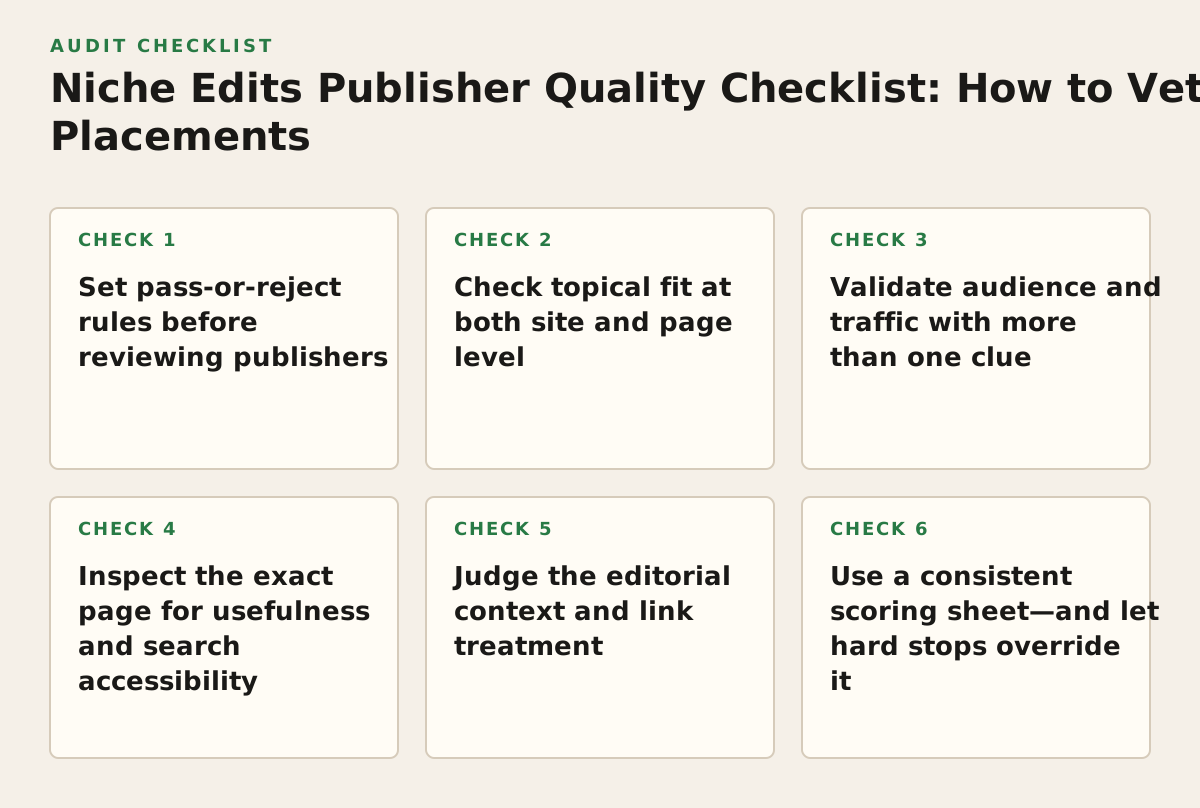
When several publishers are being compared, consistent rules prevent a persuasive domain score or a low quote from overriding basic quality concerns. Start with requirements that are non-negotiable, then score the remaining candidates against preferences. A placement should not pass simply because its score is high if the intended page is off-topic, inaccessible, or built mainly to sell links.
Google identifies links created primarily to manipulate search rankings—including certain paid links that pass ranking credit—as link spam. That makes the commercial arrangement and how the link is qualified relevant to review, not an administrative detail. See Google’s spam policies for Google web search before setting your campaign rules.
Separate hard stops from weighted signals
- Hard stops: the site is unrelated to the campaign, the page is not accessible to readers, or the publisher cannot explain how paid or sponsored links are handled.
- Weighted signals: topical fit, the page’s usefulness, evidence of real readership, editorial standards, and link placement.
- Review flags: a sudden change in site topic, repetitive commercial anchors, or many articles that appear to exist mainly to host third-party links.
For example, a B2B software campaign might reject a general lifestyle site whose only relevant content is a thin article about productivity, even if its domain metric looks attractive. Record the reason for rejection so a white-label team and its agency client can apply the same standard later.
Check topical fit at both site and page level
Use this check whenever a publisher covers several subjects or a page only loosely relates to the target URL. Site relevance is not page relevance: a publication may have a credible business section, while the proposed article is an unrelated entertainment list. Conversely, a broad publisher can sometimes offer a genuinely appropriate page if its audience, subject, and editorial context align with the campaign.
Map the reader, not just the category label
Ask whether the likely reader of the existing page has a sensible reason to follow the link. A link to a payment provider may fit an article comparing checkout options; the same link is harder to justify in a generic “best online shops” roundup with no discussion of payment systems. For casino or betting campaigns, check that the subject and audience are appropriate for the destination and that the publisher’s rules permit that category. Do not assume a site accepts gambling-related material because it publishes commercial content.
- Compare the publisher’s recurring coverage with the campaign’s subject.
- Read the full target page and identify the section where the destination would help.
- Check whether the anchor and destination match the promise made in that section.
Failure mode: choosing a site because its homepage category matches, then placing a commercial link on a page with no natural connection. Implementation example: for an ecommerce returns platform, shortlist pages about returns, fulfillment, or customer experience; reject a page that merely mentions online shopping in passing. Google recommends creating helpful, reliable, people-first content, so assess whether the surrounding page serves readers beyond carrying the link (Google’s guidance on helpful content).
Validate audience and traffic with more than one clue
This check matters when a publisher presents an impressive authority score but offers little evidence that its audience is active or relevant. A third-party metric is a screening signal, not proof of readership. Moz explains that Domain Authority is a comparative prediction metric, while Ahrefs describes Domain Rating as a measure based on the strength of a site’s backlink profile. Neither definition makes the metric a direct count of human visitors or a guarantee of search performance (Moz on Domain Authority; Ahrefs on Domain Rating).
Triangulate instead of chasing a threshold
Review available traffic estimates alongside the publisher’s recent content, visible audience signals, and the page’s own search presence. Estimates from third-party tools can differ, so look for a coherent pattern rather than treating one dashboard as ground truth. If a publisher supplies Search Console evidence, ask for a view scoped to the relevant property or page where appropriate; Google’s Links report describes links Google has found, but it is not a readership report or a certification of publisher quality (Search Console Links report).
- Check whether recent articles receive consistent, subject-relevant coverage rather than isolated bursts.
- Compare the claimed audience geography and language with the campaign’s intended market.
- Note whether visits appear concentrated on one unrelated topic or a few pages.
Failure mode: treating a high authority score or a traffic estimate as a pass despite mismatched audience and stale publishing. Implementation example: label each candidate “supported,” “unclear,” or “contradictory” for audience evidence. If the evidence is unclear, request a redacted, relevant report or downgrade the candidate rather than inventing certainty. A DR threshold may be part of a buyer’s initial filter, but it should never replace this review.
Inspect the exact page for usefulness and search accessibility
A niche edit lives on a particular URL, so review that page—not only the domain, media kit, or sample placements. This check is essential when the article is old, has changed topic, or has accumulated many edits. The page must make sense without the backlink. A useful page gives the reader a reason to stay, and the proposed addition should improve its explanation rather than interrupt it.
Run a page-level inspection
- Open the URL and confirm it loads without an access barrier that prevents the intended audience from reading it.
- Read the page from the introduction through the section where the link would appear; assess accuracy, clarity, and whether the section is still maintained.
- Check for obvious indexing or canonical concerns, including whether the page is redirected, blocked from crawling, or substantially different from the supplied preview.
- Look at the page’s existing links and edits for repeated exact-match anchors or unrelated commercial insertions.
Google explains that its systems use canonical signals to identify a preferred version among duplicate or similar pages; a link placed on a non-preferred duplicate may not serve the campaign as intended. Check the actual URL and its canonical context rather than assuming every live page is independently treated (Google’s guidance on consolidating duplicate URLs).
Failure mode: approving a placement based on a screenshot or an article title while the live page redirects, has been rewritten, or no longer supports the topic. Implementation example: save the URL, check it again before approval, and record the visible section and proposed sentence. If the page’s condition changes, require a fresh review rather than relying on an earlier screenshot.
Judge the editorial context and link treatment
Use this check to decide whether an insertion reads like a useful citation or an undisclosed commercial interruption. A good placement connects a specific statement to a destination that supports or expands it. Context carries more weight than anchor exactness: a natural, descriptive anchor in a relevant passage is easier to justify than a forced keyword inserted into unrelated copy.
Ask the publisher how the link is arranged when payment, sponsorship, or another commercial relationship is involved. Google recommends qualifying paid links with rel="sponsored"; nofollow is also acceptable for that purpose. Google’s documentation also explains how to qualify outbound links, so agree on the treatment before approval instead of assuming a paid placement will pass ranking credit (Google’s outbound-link qualification guidance).
- Prefer an anchor that accurately describes the destination or the resource being cited.
- Reject wording that makes an editorial claim the destination cannot support.
- Review whether the surrounding paragraph remains coherent if the link is removed.
- Clarify disclosure and link attributes for paid or sponsored placements.
Failure mode: approving an exact-match anchor because it mirrors a target keyword, even though it distorts the sentence or overstates what the linked page provides. Implementation example: if a passage explains how to compare ecommerce return policies, link to a relevant resource using descriptive language that fits that explanation—not a repeated commercial phrase chosen only for its keyword wording.
Use a consistent scoring sheet—and let hard stops override it
A shared scorecard makes placement decisions easier to explain across an agency, client, and fulfillment partner. Use the table as a starting policy, not a universal benchmark: adapt the weights to the campaign, but keep the evidence and rejection reasons visible. Score each category from 0 (fails or unsupported) to 2 (credible and well-supported), then review the notes before accepting a total.
| Check | What to record | Reject or pause when… |
|---|---|---|
| Topical fit | Site subject, page subject, audience connection | The page offers no defensible reason for the reader to use the destination. |
| Audience evidence | Traffic signals, geography, recent content pattern | Claims conflict with the observed site or cannot be substantiated. |
| Page condition | Live URL, accessibility, canonical or redirect concerns | The page is unavailable, materially changed, or not the intended URL. |
| Editorial quality | Clarity, usefulness, maintenance, link density | The page appears assembled mainly to sell placements. |
| Link fit and treatment | Context, anchor, disclosure, rel attribute | The link misleads readers or commercial treatment is unresolved. |
| Risk signals | Topic shifts, repeated anchors, unrelated outbound links | A serious concern remains unexplained after review. |
Do not average away a hard stop. A candidate with strong traffic evidence still fails if the proposed page is irrelevant or the publisher will not clarify paid-link treatment. Implementation example: record a score and a one-sentence rationale for every row; mark any unresolved hard stop as “hold,” regardless of the numerical total. That leaves a clear audit trail when a client asks why a publisher was excluded.
Watch for patterns that make a placement a poor bet
One questionable signal may deserve a follow-up; several reinforcing signals should change the decision. This is particularly useful when a site has a polished design but publishes a wide spread of unrelated commercial topics. Look for patterns across pages, not a single odd link in isolation.
- Recent topic changes without a clear editorial reason.
- Articles that repeat the same structure, anchor phrasing, and commercial calls to action.
- Large numbers of outbound links to unrelated businesses in a short or thin page.
- Publisher reluctance to identify the target URL, explain link attributes, or confirm what will be published.
Failure mode: treating each warning sign separately until none seems decisive, then approving a placement despite their combined pattern. Implementation example: if a publisher has a sudden topic shift, thin articles, and repeated commercial anchors, pause the order and request clarification on editorial policy and the specific page. If the answer does not resolve the concern, reject it and document why. The point is not to label a site from one signal; it is to avoid paying for a placement whose value and treatment cannot be responsibly assessed.
Implement the checklist in a fixed sequence
Run these steps in order so that expensive or detailed review is reserved for candidates that clear the basic checks. For an illustrative workflow, one person can screen sites while another reviews final pages; adapt ownership to your team and client approval process.
- Define the campaign fit. Write down the target audience, relevant subjects, destination pages, and any category restrictions before sourcing publishers.
- Apply hard stops. Remove clearly unrelated sites and candidates with unresolved policy or transparency concerns before comparing metrics.
- Triangulate evidence. Record what supports audience and traffic claims, what remains uncertain, and whether the publisher’s content pattern matches its stated audience.
- Review the exact live page. Check usefulness, accessibility, URL behavior, and the proposed place for the link.
- Agree on link context and treatment. Confirm the anchor, surrounding copy, disclosure, and appropriate link qualification before the placement is finalized.
- Recheck and log the outcome. Verify the final URL and record the approval, hold, or rejection reason so the decision can be reproduced.
Build the process around evidence that another reviewer can verify, not a promise of ranking gains. Web Push describes its placements as hand-vetted on DR 30+ publishers with real organic traffic, including gambling-friendly sites; teams assessing potential fulfillment can review its authority link building and broader link building services. For a practical next step, compare any proposed publisher against the same page-level checks before approving it, or learn more about Web Push.
Authored with NotFair SEO