
A saas link building agency plans and earns relevant backlinks to support a software company’s organic search work. The right partner matches tactics to your market, pages, content capacity and risk tolerance; it should explain how placements are sourced, what your team must provide, and how progress will be measured—not promise a specific ranking.
What a SaaS Link Building Agency does
Link building is the work of earning or placing links from other websites to pages on your site. A specialist agency handles some combination of prospecting, publisher outreach, content coordination, placement review and reporting. It is not the same as technical SEO, content strategy or a guarantee that a target page will rank. Links are one input among many, and outcomes depend on the wider search landscape.
The service can be useful when your team has worthwhile pages to promote but lacks the relationships, time or process to earn relevant coverage consistently. It is a poor substitute for a clear value proposition or pages that answer a real audience need. Before evaluating vendors, identify which product pages, integrations, comparisons, research or educational resources could reasonably earn a mention.
Know the service labels
- Guest posting means creating or contributing an article for another publisher, usually with a relevant link where it makes editorial sense. Your team may need to approve the topic, provide subject expertise and review drafts.
- Niche edits seek a relevant link added to an existing page. They may require less new content, but the page’s context, age, maintenance and reason for adding the link need careful review.
- Digital PR uses research, expert commentary, data or a newsworthy story to attract editorial attention. It can create broader visibility, but coverage and links are less controllable than a contracted placement.
- Authority link building is a broad service label, not a standard method or guarantee. Ask the provider to name the actual tactics, publisher criteria and editorial controls behind it.
- White-label fulfillment is delivery by an outside provider under an agency’s brand. It suits SEO agencies that need extra capacity, but the reseller remains accountable to its client for quality and communication.
Why the approach matters for SaaS growth
Software buyers search across problems, use cases, integrations and alternatives—not only product names. Links from relevant editorial pages can help prospective customers discover useful material and give search engines additional context about how pages are connected to the wider web. That does not mean every backlink will improve rankings, drive qualified visits or convert; measure those outcomes separately.
Start with the job each page should do. A comparison page may help a buyer assessing solutions, while an original research report may support PR outreach. A link to a generic homepage can be less useful than one pointing to a genuinely relevant resource, but forcing exact-match commercial anchors into placements creates risk. Google identifies links intended to manipulate rankings—including certain paid links and scaled guest-post links with optimized anchors—as link spam in its link spam policy.
Relevance is a better starting test than a headline metric. Check whether the publisher serves an audience that could plausibly care about your product category, whether the linking page is about a related subject, and whether the link helps a reader. Domain metrics can help screen a list, but they are third-party estimates, not proof of editorial quality or future search performance.
Set a baseline before work begins: record the target pages, their existing referring domains, relevant organic landing-page traffic and the queries or pipeline signals you already track. Google Search Console’s Links report can show links Google has found, but its documentation cautions that the report is not a complete list of all links; use it as one input rather than a definitive accounting system (Search Console Links report).
Match the service to the buyer’s situation
There is no single best tactic. The buyer’s internal capacity, need for control and willingness to accept uncertain editorial outcomes should shape the choice. The table compares typical trade-offs; vendors use these labels differently, so ask what is actually included.
| Buyer need | Service type to consider | Trade-offs and implementation burden |
|---|---|---|
| Reach a defined SaaS audience with a useful expert contribution | Guest posting | More control over topic and context, but requires subject-matter input, editorial review and a credible publisher fit. |
| Promote a strong resource that fits an existing article | Niche edits | Can avoid producing a new full article; confirm the page is maintained, relevant and not a collection of paid links. |
| Earn attention for original data, commentary or a timely story | Digital PR | Potentially broad editorial reach, with less certainty over timing, coverage and whether a link is included. |
| Increase delivery capacity without hiring in-house | White-label fulfillment | Reduces execution load for an agency, but adds a handoff layer and requires clear client-facing quality control. |
| Build links across several tactics or markets | Managed link building | Can consolidate planning and reporting; scope varies, so clarify which tactics, content and approvals are included. |
Choose by constraint, not label. If internal experts cannot review drafts, a content-heavy campaign may stall. If the asset needs news value to attract coverage, simply ordering placements is not a substitute for a story. For a broader view of the methods buyers may compare, see link building services.
How a credible campaign is planned and delivered
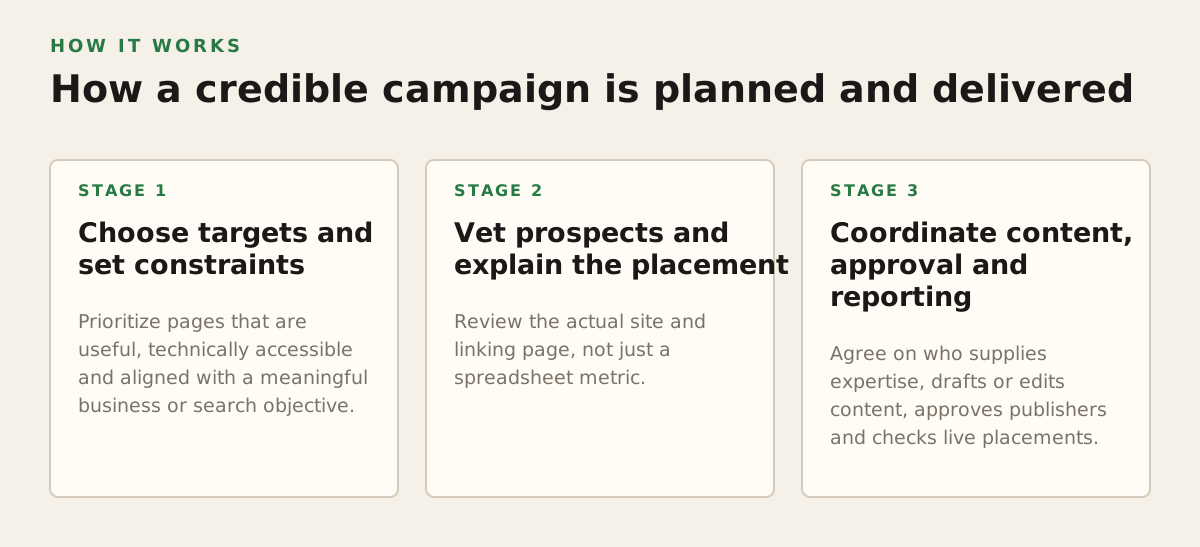
A sound process connects a business objective to a page, a publisher audience and a defensible reason for the link. Ask the agency to show how it handles each step—not just its list of domains.
1. Choose targets and set constraints
Prioritize pages that are useful, technically accessible and aligned with a meaningful business or search objective. Agree on prohibited publisher types, markets, topics, anchor-text rules and whether paid or sponsored placements are acceptable. If you need compliance or legal review, assign that owner before outreach begins.
2. Vet prospects and explain the placement
Review the actual site and linking page, not just a spreadsheet metric. Look for topical fit, real editorial purpose, readable content, a plausible audience and signs that the page is maintained. Ask whether the placement is earned, sponsored or otherwise compensated. Google advises qualifying paid links with rel="sponsored" or rel="nofollow"; its guidance on qualifying outbound links explains how these attributes communicate link relationships.
3. Coordinate content, approval and reporting
Agree on who supplies expertise, drafts or edits content, approves publishers and checks live placements. A report should make each placement auditable: live URL, target URL, link context, anchor text, date, publisher and any disclosure or qualification. A sample workflow for a small illustrative campaign might look like this:
- Week 1: select 2 target pages and record baseline traffic and referring domains.
- Week 2: review 10 proposed publisher opportunities against audience, page relevance and editorial standards.
- Weeks 3–6: produce and approve 3 content contributions, adjusting the count if editorial acceptance or internal review takes longer.
- After publication: verify each live URL, link attribute and destination, then review results on a recurring schedule.
Those numbers are an illustrative planning example, not a benchmark or a promise. Actual campaign pace depends on publisher decisions, content readiness and the scope agreed with the provider.
Where campaigns break: risk, workload and budget
Links can be delivered while the campaign still fails its business purpose. A publisher may be irrelevant, a page may disappear, content may lack useful expertise, or the link may point to a page that cannot convert or satisfy search intent. A vendor should explain what happens when a prospect is rejected, a placement is delayed or a link changes—not hide those cases inside a headline volume.
Price the full operating burden, not just the placement. Providers may charge per placement, by campaign or on a retainer; those are possible pricing structures, not evidence of what a particular vendor charges. Ask what is included: prospecting, writing, subject-matter interviews, revisions, publisher fees, approvals, replacements, reporting and account management. Compare proposals only after aligning scope and quality criteria. Do not infer that a higher fee guarantees better editorial value or that a lower quote is necessarily poor quality.
Build an internal budget around both agency fees and staff time. The SaaS team may need to brief the agency, check product claims, review drafts, provide data, approve targets and route legal questions. If those tasks have no owner, delivery can slow even when outreach is active. Agree on a realistic review window and a named approver before signing.
In the United States, where a placement functions as an endorsement, material connections may require clear disclosure under FTC guidance; the details depend on the relationship and context. Ask who is responsible for disclosure and obtain jurisdiction-specific advice where needed. The FTC’s Disclosures 101 guidance explains its expectations for disclosing material connections in social media endorsements; do not assume one document settles every publisher or market’s obligations.
Red flags worth pausing over
- Guaranteed rankings or traffic: a provider cannot control search engine decisions or editorial audience behavior.
- Opaque inventory: no sample live placements, no publisher-level review, or refusal to disclose where links will appear.
- Volume without context: a fixed link count is emphasized while relevance, target pages and editorial standards remain vague.
- Manipulative patterns: repeated exact-match anchors, irrelevant sites, spun articles or networks of pages built primarily to sell links.
- No correction path: the contract says nothing about broken, removed or materially changed placements.
Success criteria should be observable and falsifiable. Track delivery and quality first—approved opportunities, live links, relevance, target-page accuracy and link status. Then assess organic visibility, qualified referral visits or assisted conversions against a baseline, allowing for other marketing and product changes. No single report can prove that a link caused a ranking change; use trends and context rather than attributing every movement to the agency.
Interview the agency before you commit
Use a consistent checklist across proposals. The goal is to expose differences in method, accountability and workload before comparing cost.
- Which SaaS pages would you prioritize, and what makes each suitable for promotion?
- How do you vet a publisher and the specific page that will carry the link?
- Can we review proposed sites and approve them before content is commissioned?
- What proportion of the work is guest posting, niche edits, digital PR or another method?
- Who writes and edits content, and what expert input or review time do you need from us?
- How do you handle paid placements, link attributes, disclosure and our anchor-text preferences?
- What exactly is included in the fee, and which costs or tasks sit outside the scope?
- What happens if a placement is rejected, removed, redirected or no longer relevant?
- Which delivery, quality and business indicators will appear in the report, and how often?
- Can you describe a campaign that did not meet its intended goal and what changed afterward?
For a practical comparison, score each proposal on publisher relevance, transparency, content burden, approval control, reporting and fit with your risk policy. Treat a confident answer without examples or a written process as unverified. If you are comparing approaches to stronger, relevant placements, the authority link building page gives additional context; it does not replace checking a proposed campaign’s actual scope.
For a SaaS team, the sensible choice is the partner whose method fits the pages you can credibly promote and the review capacity you can sustain. Web Push describes its work as white-hat guest posts, niche edits, authority links, digital PR and linkable assets for SaaS and other brands; review the scope and publisher criteria against your own requirements. Explore Web Push if you want to understand those options.
Authored with NotFair SEO