
Website link building is the planned process of earning, placing, and maintaining hyperlinks from relevant external websites to pages on your own site. The objective is not to collect the largest possible backlink count. It is to make the right pages discoverable, credible, and useful to audiences and search engines while controlling editorial, commercial, and spam risk.
That distinction matters for a SaaS company promoting a comparison page, an e-commerce brand trying to strengthen a category, an agency fulfilling campaigns under its own name, or an iGaming operator that needs publishers willing to work with gambling topics. A sustainable campaign connects the right referring page to the right destination for a defensible reason.
What Website Link Building actually includes
A backlink is an external hyperlink pointing to your domain. Website link building covers the research, relationship development, content production, outreach, negotiation, placement review, and monitoring that make those links possible. It can include editorial mentions earned through digital PR, expert contributions, guest posts, niche edits, resource-page inclusion, partner references, and links attracted by genuinely useful assets.
It is not the same as submitting a URL to hundreds of directories, buying a fixed number of links without reviewing the sites, or publishing nearly identical articles across a network. Google describes links intended primarily to manipulate rankings as part of its link-spam policy, including buying or selling links that pass ranking credit and large-scale article campaigns where the main purpose is links. See the Google Search spam policies for the current guidance.
The four objects in a link campaign
Every placement has four separate objects. Treating them separately prevents a common mistake: approving a strong-looking domain while ignoring the weak page, unsuitable anchor, or commercially awkward context.
- Referring domain: the publisher, organization, or site that provides the link.
- Referring page: the exact article, category, interview, or resource page where the link appears.
- Destination URL: the page receiving the visitor and potential authority.
- Link context: the surrounding copy, anchor wording, placement, attributes, and editorial reason for inclusion.
A link from a relevant article on a real publication may be more useful than several links from unrelated sites, but “more useful” does not mean automatically powerful or guaranteed to improve rankings. Search engines evaluate many signals, and a link is only one part of a page’s ability to compete.
Common link types and their jobs
| Link type | Best use | Main decision |
|---|---|---|
| Guest post | Explain a problem to a relevant publication audience | Can the article stand on its own without the link? |
| Niche edit | Add a useful reference to an existing, indexed article | Does the surrounding paragraph genuinely need the source? |
| Digital PR | Turn research, data, or a strong point of view into coverage | Is the story interesting to journalists, not just to the brand? |
| Authority link | Support a strategic commercial or informational page | Does the publisher have topical and editorial credibility? |
| Linkable asset | Give other sites a reason to cite the brand | Will the asset save a writer time or add evidence? |
For agencies, the operational unit is usually not “one link.” It is a brief containing the target page, acceptable topics, prohibited claims, preferred markets, anchor guidance, publisher standards, and evidence required after publication. For brands, the equivalent is a campaign system that connects links to business priorities rather than handing an outreach provider a list of keywords.
Why links matter, and what they cannot do
Links perform two jobs that are easy to confuse. First, they can send qualified referral traffic. A mention in a specialist publication may put a product, study, or service in front of people who already have the relevant problem. Second, links help search engines discover relationships between pages and domains. Google’s documentation explains that crawlable links help Google find pages, while its Search Essentials also emphasizes creating helpful, reliable, people-first content rather than content made mainly to manipulate rankings. Those principles appear in Google’s crawlable links documentation and helpful content guidance.
A link therefore supports a broader SEO system. It does not replace a technically accessible site, a page that answers the query, or a clear internal linking structure. If the destination is slow, thin, confusing, blocked from crawling, or mismatched with the promise in the referring article, acquiring more links can simply send more attention to a weak asset.
The value equation
A practical way to assess a placement is to separate expected value from risk:
Expected value = relevance × editorial quality × audience fit × destination usefulness
That is not a search-engine formula. It is a decision model. If any factor is close to zero, the placement deserves scrutiny. A high-authority business publication with no connection to the subject may have less campaign value than a smaller specialist site whose readers need the product. Likewise, a relevant link to a homepage may be less useful than a relevant link to a well-built guide that answers the reader’s next question.
For a B2B software brand, the desired outcome may be qualified demo traffic and stronger support for a product-led guide. For an online retailer, it could be citations to original sizing data or a buying guide. For a betting brand, a link may need to come from a publisher whose audience, jurisdiction, and commercial policies make the relationship appropriate. Business relevance comes before domain metrics.
What to measure beyond link count
Monthly link totals are easy to report and easy to misuse. A useful report distinguishes activity from quality and business effect.
- Placement quality: referring domain, page topic, organic visibility, editorial standards, and whether the page is indexed.
- Link profile: destination mix, anchor-language mix, follow and nofollow or sponsored attributes, and concentration by domain.
- Visibility: impressions, clicks, average position, and query coverage for relevant pages in Search Console.
- Referral value: sessions, engaged visits, assisted conversions, lead quality, or revenue where analytics allows reliable attribution.
- Operational health: live status, correct destination, surrounding copy, publication date, and any later edits.
Google Search Console’s Links report can help site owners inspect top linking sites and pages, but it is not a complete commercial database of every backlink. Use it as one monitoring input rather than as the sole definition of campaign success; the official Search Console links report documentation explains what the report contains.
How a defensible campaign works
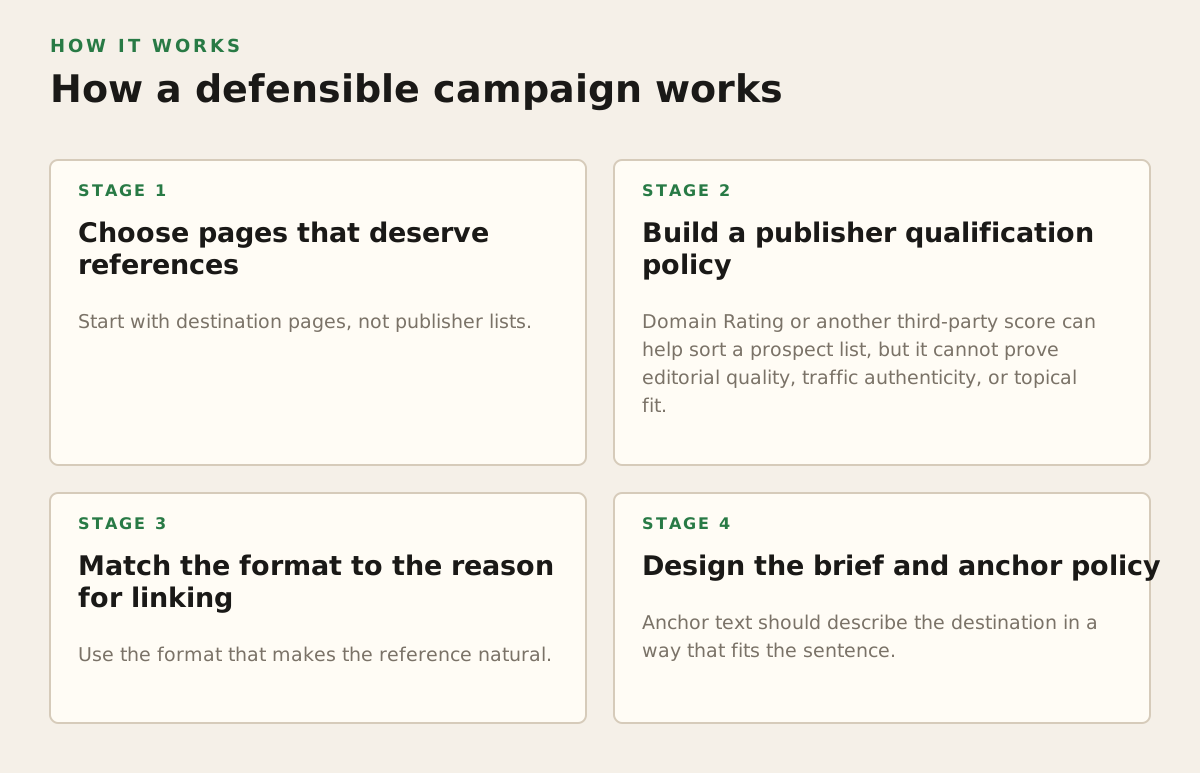
Good website link building is a sequence of decisions. Skipping the early decisions creates expensive cleanup later, especially when an agency has promised a volume target before confirming that suitable publishers exist.
1. Choose pages that deserve references
Start with destination pages, not publisher lists. A page is a strong candidate when it solves a specific problem, contains original evidence, clarifies a difficult process, or represents a commercially important category without being a bare sales pitch.
Examples include a SaaS migration checklist with implementation detail, an e-commerce material guide supported by testing, a B2B calculator with transparent assumptions, or an iGaming compliance explainer reviewed for the markets it discusses. A homepage can receive legitimate mentions, but it is often harder to pitch because it gives publishers less concrete material to cite.
- List the pages that matter to revenue, pipeline, or strategic visibility.
- Check whether each page answers a defined audience question better than existing results.
- Identify evidence, visuals, data, or expert commentary that another writer could cite.
- Improve the destination before outreach if it lacks substance, clarity, or a clear next step.
2. Build a publisher qualification policy
Domain Rating or another third-party score can help sort a prospect list, but it cannot prove editorial quality, traffic authenticity, or topical fit. A site may have a respectable metric and still show little current activity, excessive paid content, irrelevant outbound links, or a suspicious publishing pattern.
A practical qualification review should include:
- Recent publication activity and consistent authorship.
- Topic alignment with the destination and intended audience.
- Evidence of real organic visibility, not only a high historical metric.
- Visible editorial standards, contact information, and recognizable ownership.
- Reasonable outbound-link behavior without every article becoming a sales page.
- Country, language, and legal suitability for the campaign.
- No obvious PBN, link-farm, spun-content, or mass-syndication signals.
Web Push positions its placement work around hand-vetted DR 30+ publishers with real organic traffic and excludes link farms and PBNs. That is a starting filter, not a substitute for reviewing the exact page and campaign fit. For brands needing more context on the service category, its link building services page describes the available approach without turning a metric into a guarantee.
3. Match the format to the reason for linking
Use the format that makes the reference natural. A guest post is appropriate when the publisher needs a complete, useful article from an informed contributor. A niche edit works when an existing paragraph has a genuine information gap and the proposed resource resolves it. Digital PR is better when the campaign has a story, finding, expert opinion, or timely angle that publishers can independently interpret.
Do not force a guest post where the publication’s audience only wants news. Do not insert a commercial landing page into an old article simply because the URL has authority. Do not call a paid placement “earned media” if the commercial relationship would change how the publisher labels or discloses it.
4. Design the brief and anchor policy
Anchor text should describe the destination in a way that fits the sentence. Over-optimizing exact-match commercial phrases creates an unnatural pattern and may make the placement look manipulative. A better brief gives writers room to use brand names, plain URLs, descriptive phrases, and natural language while banning misleading anchors and claims.
For an illustrative campaign, a starting policy might be:
- Use the brand name or URL when the reference is primarily navigational.
- Use descriptive language when the reader needs to know what the destination contains.
- Reserve a commercial phrase for cases where it reads naturally and accurately.
- Allow the publisher’s editor to change the anchor if the sentence becomes awkward.
- Never promise a fixed anchor distribution as if it were a universal safety threshold.
The same discipline applies to link attributes. Google recommends qualifying links involving paid placements with rel="sponsored", and user-generated links with rel="ugc"; nofollow remains available when a site owner does not want to imply endorsement. The current recommendations are in Google’s guidance on qualifying outbound links.
5. Outreach, editorial review, and verification
Outreach should explain why the proposed subject or resource fits that specific publication. A credible pitch identifies the audience problem, the useful contribution, the proposed destination, and any commercial relationship that affects disclosure. Mass templates can support operations, but the research must remain publication-specific.
Before accepting a placement, verify:
- The article is original, readable, and aligned with the agreed brief.
- The link appears in a relevant passage rather than an author-box or footer.
- The destination resolves correctly and matches the surrounding promise.
- The publisher has used the agreed attribute and disclosure treatment.
- The page is publicly accessible and not blocked by a campaign-specific restriction.
- The article remains suitable after publication, including its neighboring links and edits.
Record the live URL, referring domain, destination, anchor, attribute, publication date, contact, cost or relationship type, and screenshots where appropriate. This record matters for agency handoff, client reporting, link audits, and later decisions about whether a publisher remains acceptable.
Where link campaigns break
Most failures are not caused by a single bad anchor. They come from incentives that reward volume, vague acceptance criteria, or a mismatch between the commercial objective and the editorial execution.
Metric shopping
A provider may present a list of sites with impressive authority scores while omitting traffic quality, topical fit, indexing, or outbound-link patterns. The remedy is to make the acceptance criteria observable. Ask for sample URLs, audience geography, publication frequency, estimated organic visibility, link location, attributes, and a process for rejecting unsuitable sites.
Metrics are also time-sensitive. A domain that looked healthy when shortlisted may later change ownership, lose visibility, or become dominated by paid articles. Publisher review is an ongoing control, not a one-time spreadsheet task.
Commercial content disguised as editorial content
Readers can usually tell when a supposed educational article exists only to place a link. The content has no independent argument, uses generic introductions, mentions the brand unnaturally, and links to a sales page without explaining why. That creates editorial risk and weakens referral value even if the URL is live.
When a relationship is paid or otherwise compensated, disclosure may be required by the relevant law, platform, or publisher policy. The United States Federal Trade Commission’s guidance on advertising and marketing on the internet explains that disclosures must be clear and conspicuous when they are needed to prevent an endorsement from misleading consumers. Requirements vary by market, so a multinational campaign should obtain appropriate legal review rather than applying one country’s rule everywhere.
Irrelevant or risky vertical adjacency
Relevance does not require every site to be narrowly identical to the brand. A cybersecurity company can contribute to a business publication, and a kitchen retailer can be cited in a home-improvement resource. The connection should be explainable to a reader.
The risk increases when the subject, audience, or jurisdiction is incompatible. Casino and betting campaigns need especially careful screening for gambling permissions, target market, responsible-gambling language, age restrictions, and publisher policy. “Gambling-friendly” should mean the publisher has been assessed for the actual campaign, not that any article can be placed there without review.
Scale without quality control
Large outreach operations can create repeated topics, similar phrasing, thin articles, and a visible concentration of links from the same type of site. Google’s spam guidance is particularly relevant where scaled content or article campaigns exist mainly to manipulate links. The safest response is not to stop using contributors or agencies; it is to add editorial gates and reject work that would be weak without the backlink.
Warning signs include:
- Guaranteed placements before the target page or market has been reviewed.
- Identical article titles offered to many unrelated publishers.
- Pressure to use exact-match commercial anchors in every placement.
- Publisher lists with no live examples or no explanation of traffic quality.
- Links hidden in templates, sidebars, footers, or author biographies.
- Inability to remove or correct a placement when the publisher changes it.
Confusing correlation with causation
Rankings can change after a link campaign because competitors publish new pages, search demand shifts, technical issues are fixed, or a search system update changes page interpretation. Do not attribute every movement to a backlink. Use a documented baseline, compare target pages with relevant non-target pages, and review impressions, queries, referral sessions, and conversions over a reasonable observation period.
Also remember that a placement can be valuable without producing an immediate ranking change. It may generate a qualified visit, lead to a partnership, expose a report to journalists, or become a reference that supports future outreach. That value should be reported separately from organic-position movement.
How practitioners apply it by business type
The campaign architecture should reflect the customer journey, sales cycle, regulatory environment, and available evidence. A single generic outreach package rarely serves all of these audiences well.
SaaS and B2B
SaaS and B2B brands often have useful expertise but package it in product language. Convert that expertise into material a publication can use: implementation lessons, benchmark data, integration explanations, process templates, or original research with transparent methodology.
A sensible sequence is:
- Choose one non-commercial asset that answers a recurring operational question.
- Interview subject-matter experts to add specific examples and limitations.
- Map publications by role and problem, such as finance operations, security, HR, or engineering.
- Pitch distinct angles rather than sending the same product summary everywhere.
- Use the resulting coverage to support sales enablement and further digital PR.
For B2B, a link to a rigorous guide may be more credible than a link straight to a pricing page. The commercial page can still benefit indirectly through internal links and brand demand, while the external article remains genuinely useful to its readers.
E-commerce
E-commerce link building works best when the brand supplies evidence or utility that product pages alone do not provide. Examples include material comparisons, care instructions, independent testing, seasonal data, original surveys, expert buying advice, or visual explainers.
Category pages can be destinations when they are genuinely useful and editorially appropriate, but outreach should not treat every category URL as an interchangeable target. Align the link with the article’s specific buying question. A guide about waterproof hiking footwear should not point to a general store homepage merely because the homepage is the preferred commercial URL.
Casino, betting, and iGaming
iGaming campaigns need a stricter qualification layer. Review the publisher’s geography, accepted gambling topics, responsible-gambling expectations, link policies, and audience legitimacy. Separate informational content from direct promotional claims, and ensure any statistics, odds, bonuses, or regulatory statements are current and jurisdictionally accurate.
Suitable assets might include a glossary, game-mathematics explainer, responsible-play resource, market analysis, or independently useful guide. The objective is to earn a defensible reference in a gambling-relevant environment, not to place the same money-related anchor across every available domain. A specialized authority link building process can be useful when the campaign requires publisher-level vetting and vertical-specific judgment.
Agencies and white-label fulfillment
Agencies need consistency more than promotional language. A white-label workflow should make quality decisions repeatable while leaving room for a senior reviewer to reject a questionable site or topic.
- Intake: collect client goals, markets, vertical restrictions, target pages, competitors, and prohibited claims.
- Planning: assign link formats, content angles, publisher standards, and review owners.
- Production: brief writers with audience, evidence, tone, internal-link, and disclosure requirements.
- Approval: check the exact URL, page context, anchor, attribute, and editorial quality before delivery.
- Reporting: provide live placements, qualification notes, referral data where available, and exceptions.
- Maintenance: monitor links, handle corrections, and remove publishers that fall below policy.
An illustrative starting policy for an agency might be to approve no placement until two reviewers have checked the publisher and the destination, then audit a sample of live links each month. That is an internal control example, not a universal benchmark. The right cadence depends on campaign volume, market risk, and how much work is delegated.
Choosing between in-house, specialist, and white-label work
Keep strategy in-house when the business has strong subject expertise, sensitive regulatory constraints, and enough time for publisher relationships. Use a specialist when publisher research, outreach, and editorial production would otherwise become a bottleneck. Use white-label fulfillment when an agency owns the client relationship but needs a discreet, senior-led delivery layer.
In each case, ask the provider to explain the mechanism rather than promise an outcome. A credible scope should specify how publishers are vetted, how unsuitable placements are rejected, how content is reviewed, how link attributes are handled, and what happens if a live page changes. Specific controls are more informative than ranking guarantees.
For a starting campaign in 2026, an illustrative plan could focus on two priority assets, three distinct audience segments, and a limited set of carefully qualified publishers over an initial quarter. That is a planning example, not a guaranteed timeline or performance benchmark. The campaign should expand only when the quality of the first placements, referral relevance, and operational reporting justify more volume.
The practical recommendation is to treat website link building as editorial distribution with an SEO consequence: build assets worth citing, qualify publishers at page level, keep anchors natural, disclose commercial relationships appropriately, and measure referral and visibility outcomes separately. Web Push supports this approach with white-hat guest posts, niche edits, digital PR, linkable assets, and white-label delivery across SaaS, e-commerce, B2B, and gambling-friendly campaigns; explore Web Push when you need senior-led publisher vetting rather than a bulk link list.
Authored with NotFair SEO