
Choosing white label link building services is not simply a matter of finding a supplier with a large publisher list. An SEO agency has to protect its client relationships while meeting delivery dates, a SaaS or e-commerce team needs links that support commercially important pages, and a casino or iGaming operator may need publishers that accept gambling-related content without creating compliance or reputation problems. This guide helps you decide which service category fits the job, what the delivery burden will be, how to evaluate pricing without relying on invented benchmarks, and which questions expose weak fulfillment before you commit.
The useful decision is rarely “links or no links.” It is usually which pages deserve authority, which acquisition method can earn a credible mention, and whether the provider can document the work at a standard your agency or brand is willing to defend. Treat link building as a managed acquisition process rather than a monthly order of URLs.
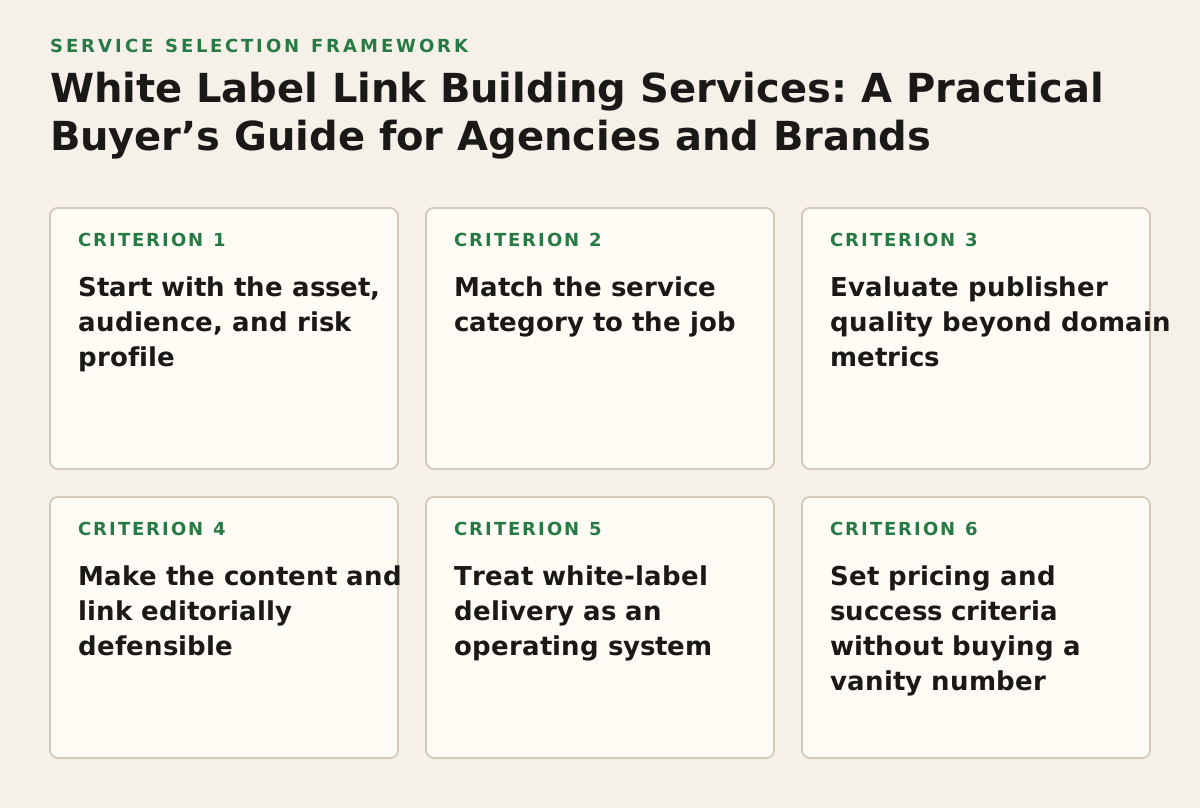
1. Start with the asset, audience, and risk profile
When it applies: Use this principle before requesting a proposal. A provider cannot sensibly recommend guest posts, niche edits, digital PR, or authority placements until it understands the page being promoted and the reason another publisher would link to it.
Why it works: A link is more useful when the destination satisfies the reader who encounters it. A detailed integration guide may attract SaaS links, while a category page may need supporting editorial content before it is suitable for outreach. Relevance also affects risk: a financial publisher linking to an unrelated casino offer, or a parenting site linking to a betting page, can look commercially forced even if the domain has strong metrics.
Build a brief that a supplier can execute
- Business objective: qualified referral traffic, stronger rankings for a topic cluster, support for a product launch, or improved discoverability of a resource.
- Priority URLs: include the page, its purpose, target country and language, and whether the page can accept editorial links.
- Audience fit: identify the people the referring publisher reaches, not just the industry label on its homepage.
- Anchor policy: specify preferred branded, descriptive, URL, or partial-match language and prohibit forced exact-match wording unless there is a defensible editorial reason.
- Constraints: disclose regulated verticals, gambling jurisdictions, legal review, brand-safety exclusions, and pages that must not be promoted.
Failure mode: A buyer gives a vendor only a domain, a keyword list, and a desired number of links. The vendor then chooses easy placements that satisfy the order but do not support the client’s commercial or editorial priorities.
Implementation example: A B2B analytics company wants links to an integration page and a research report. The brief assigns guest posts to the educational topic cluster, digital PR to the report, and niche edits only where an existing article genuinely needs the integration as a resource. That division creates a reason for each placement instead of treating every URL as interchangeable.
2. Match the service category to the job
Guest posts involve creating or placing a useful article on a relevant third-party publication. They suit agencies that need a repeatable editorial workflow, SaaS brands with educational topics, and B2B companies that can contribute informed commentary. The burden includes briefing, drafting, revisions, publisher approval, fact checking, and monitoring whether the article remains live.
Niche edits, also called link insertions, place a contextual link into an existing article. They can fit a resource that clearly improves an established page, especially when the surrounding topic and destination already align. The main constraint is control: the article’s original tone, outbound-link policy, and future editing history belong to the publisher.
Authority link building is a broader category for pursuing links from publications with meaningful editorial standards, topical credibility, or strong audience value. It is appropriate when the buyer values fewer, more defensible placements rather than a standardized volume. The work may require custom research, relationship development, expert input, or a stronger asset. See the separate authority link building resource when the buying question is specifically about authority rather than fulfillment volume.
Digital PR and linkable assets use original data, expert commentary, tools, explainers, surveys, or newsworthy research to give journalists and publishers a reason to cite a page. They suit brands with a story, proprietary insight, or subject-matter access. They have a higher creative and approval burden, and coverage is less predictable than a contracted editorial placement.
White-label fulfillment packages one or more of these methods behind an agency’s client relationship. It is most useful when an agency can sell strategy and account management but lacks the internal capacity for prospecting, outreach, writing, negotiation, and reporting.
| Buyer need | Best-fit service type | Trade-offs | Questions to resolve |
|---|---|---|---|
| Repeatable educational coverage for SaaS or B2B topics | Guest posts | Structured delivery, but requires quality control and editorial review | Who writes, who approves, and how are topics kept distinct? |
| A relevant existing article already discusses the subject | Niche edit | Faster contextual fit may be possible, but less control over surrounding copy | Can the provider show the exact article and explain why the edit is editorially justified? |
| One important page needs stronger topical authority | Authority link building | More research and negotiation; placement quantity may be less standardized | What makes the publisher authoritative beyond a domain metric? |
| A report, launch, dataset, or expert point deserves attention | Digital PR or linkable asset | Higher creative workload and uncertain pickup | What is the news angle, target journalist set, and fallback plan? |
| An agency needs delivery without exposing its subcontractor | White-label fulfillment | Scales execution, but creates dependency on process transparency | What can be branded, audited, revised, or escalated by the agency? |
| Casino, betting, or iGaming content needs suitable publishers | Vertical-specific outreach plus guest posts or niche edits | Smaller acceptable inventory and greater brand-safety scrutiny | Which countries, languages, page types, and gambling policies apply? |
Failure mode: Calling every placement “digital PR” or “authority” makes the proposal impossible to evaluate. Ask the vendor to label the actual mechanism: contributed article, editorial mention, existing-page insertion, journalist coverage, or asset-led outreach.
Implementation example: An agency serving online retailers selects guest posts for evergreen buying guides, niche edits for genuinely relevant product-comparison articles, and digital PR for seasonal consumer research. It does not promise the client that each method has the same cost, timing, or likelihood of referral traffic.
3. Evaluate publisher quality beyond domain metrics
When it applies: Use this checklist when a supplier presents a publisher inventory or sample placements. DR, DA, and similar metrics can help sort prospects, but they are not a substitute for examining the actual site.
Why it works: A publisher is valuable because of its audience, topical fit, editorial behavior, and ability to remain credible—not because one third-party score crosses a threshold. Google’s guidance says links intended to manipulate rankings can violate its spam policies, including buying links that pass PageRank and large-scale article campaigns where the primary intent is link building; the current guidance is available in Google’s Search Essentials spam policies. That makes the nature and editorial context of the placement central to due diligence.
Inspect each prospect for observable signals
- Does the site publish a coherent set of topics, or does it accept unrelated articles about every industry?
- Do recent pages have readable authorship, editing standards, citations, and consistent formatting?
- Is there evidence of real search or referral audience, rather than only a high metric?
- Are outbound links selective and contextually explained, or does every article contain several commercial anchors?
- Does the site have a clear country, language, and audience relationship with the client?
- Are gambling, financial, health, or other regulated topics handled transparently?
Failure mode: A vendor sends a spreadsheet of domains with metrics but refuses to show the target article, traffic evidence, recent examples, or outbound-link pattern until after payment. That is not proof of bad inventory, but it is a serious auditability problem.
Implementation example: For a German e-commerce client, the agency samples recent German-language pages, reviews commercial-link density, checks whether the articles attract the intended audience, and records why each publisher fits. A high-scoring English site with no German readership is rejected even if its metric looks attractive.
Google also distinguishes ordinary editorial links from links that should be qualified. Its documentation on qualifying outbound links explains the use of rel="sponsored" for paid or advertising links and rel="ugc" for user-generated content. Ask a provider how publishers handle these attributes and how that treatment affects the agreed objective; do not assume every paid placement should pass ranking signals.
4. Make the content and link editorially defensible
When it applies: This principle matters whenever the placement involves a contributed article, an existing-page edit, or a regulated topic. The content must make sense without the backlink being the only reason it exists.
Why it works: Editors approve useful material, not keyword containers. A credible article gives readers a complete answer, uses the client as a relevant source, and places the link where a reader could reasonably continue learning. For casino and iGaming work, the standard is stricter: the content must align with the permitted market, responsible-gambling expectations, operator identity, and publisher policy.
Set editorial rules before drafting
- Choose a topic that the publisher’s existing audience would recognize as useful.
- Use the client’s expertise, data, product documentation, or original examples rather than generic rewritten advice.
- Keep the destination page capable of answering the promise made by the anchor and surrounding sentence.
- Use branded or descriptive anchors by default; treat exact-match anchors as an exception requiring a documented rationale.
- Separate factual claims from promotional claims and send regulated copy through the client’s approval process.
Failure mode: The article reads naturally until the final paragraph, where a forced commercial sentence introduces an exact-match link unrelated to the argument. That pattern can reduce editorial credibility and create a poor experience even if the page is indexed.
Implementation example: A betting brand commissions an article about evaluating odds comparison tools for a publisher whose readers are in a permitted market. The link leads to an educational odds guide, not directly to an aggressive signup page. The brief includes jurisdiction, responsible-gambling language, prohibited claims, and an approval owner before outreach begins.
For sponsored or influencer-adjacent content, disclosure should be handled separately from SEO assumptions. The U.S. Federal Trade Commission’s Disclosures 101 guidance says material connections should be made clear to the audience. A provider should explain who controls disclosure wording and how paid relationships are represented on the publisher, especially when the campaign targets U.S. consumers.
5. Treat white-label delivery as an operating system
When it applies: This is the deciding principle for SEO agencies. The question is not merely whether a supplier can obtain placements, but whether its workflow can sit behind your strategy, account management, and client reporting without creating hidden work.
Why it works: White-label fulfillment succeeds when ownership is explicit. Prospecting, outreach, writing, revisions, publisher negotiation, link verification, invoicing, and escalation each need an owner. Without that map, the agency becomes the unpaid project manager and absorbs every delay or quality dispute.
Document the handoff points
- Intake: collect URLs, countries, languages, vertical restrictions, anchor guidance, excluded publishers, and approval contacts.
- Prospecting: require a reviewable shortlist or a defined acceptance policy before outreach.
- Production: specify who supplies briefs, drafts, expert input, images, citations, and revisions.
- Approval: set a response window and clarify what happens when a client rejects a topic or publisher.
- Placement: record the live URL, anchor, destination, date, publisher, and any rel attribute.
- Aftercare: define link checks, replacement policy, reporting, and escalation for removed or materially changed pages.
Failure mode: An agency sells a fixed monthly deliverable but learns that every rejected domain resets the schedule, every draft requires a rewrite, and the supplier reports only at the end of the month. Margin disappears through unpriced coordination.
Implementation example: The agency creates one client-facing status format and one internal fulfillment board. The supplier sees the internal requirements, but the client receives the agency’s approved terminology, quality rationale, and consolidated report. A rejected prospect is tagged with a reason so the same unsuitable site is not proposed again.
Google Search Console’s Links report documentation explains that the report shows examples of links Google has found, not a complete inventory of every link. Therefore, use live-URL verification and provider records for operational checks, while treating Search Console as one diagnostic input rather than a contractual real-time ledger.
6. Set pricing and success criteria without buying a vanity number
When it applies: Use this framework when comparing proposals with different scopes. A lower apparent unit cost may exclude writing, revisions, prospect approval, replacement coverage, reporting, or strategic research.
Why it works: Price should correspond to the work and risk being purchased. Ask whether the model is per placement, monthly retainer, campaign fee, asset-plus-outreach, or a hybrid. None is automatically superior. A per-placement model can be easy to reconcile but may encourage quantity; a retainer can support planning but needs clear deliverables; an asset-led campaign may have uncertain coverage and should not be evaluated like guaranteed placements.
Questions for the commercial proposal
- What exactly counts as delivered: a live URL, an approved opportunity, a published article, or a completed outreach cycle?
- Are research, copywriting, editing, translation, publisher fees, client revisions, and reporting included?
- What happens when a publisher rejects content, removes a link, changes ownership, or adds a qualifying attribute?
- Can unused capacity roll forward, and what is the cancellation or pause process?
- Is there a minimum commitment, and which parts are fixed versus dependent on client response time?
- For digital PR, is success measured by coverage attempts, earned mentions, live links, referral traffic, or a combination?
Failure mode: The buyer compares two proposals solely by cost per link. One supplier includes custom content and replacement support; the other charges separately for writing and treats any published URL as complete. The spreadsheet makes the second option look cheaper while hiding the delivery burden.
Implementation example: As an illustrative starting policy, an agency may score each proposal on total internal hours, approval cycles, usable live placements, publisher relevance, reporting effort, and replacement exposure. It then asks vendors to price the same written scope rather than negotiating against a headline quantity. This is a comparison method, not a universal budget benchmark.
Use measurable but realistic outcomes
Track placement quality, destination-page coverage, topical relevance, live-link retention, referral sessions where analytics permits, and movement in the target page’s organic visibility. Avoid promising a specific ranking lift from a fixed number of links: rankings depend on the query, competition, page quality, technical accessibility, internal linking, and many other variables. For an agency, operational metrics such as approval time and replacement rate are also meaningful because they determine whether the service can scale profitably.
7. Screen red flags and interview the provider
When it applies: Conduct this screening before sharing a client’s full strategy or signing a recurring agreement. A polished sales page cannot substitute for evidence of process.
Why it works: Most serious failures are visible in the answers: vague inventory, weak relevance, unclear ownership, or pressure to use risky anchors. A strong provider may not guarantee outcomes, but it should be able to explain its decisions, limitations, and remediation process in concrete terms.
Red flags that deserve a written explanation
- Guaranteed rankings, guaranteed traffic, or guaranteed indexing for every placement.
- Large numbers of sites described only by DR or DA, with no recent URLs or traffic context.
- One identical article angle offered to many unrelated publishers.
- Unrestricted exact-match anchor promises.
- Private-network or link-farm language disguised as “exclusive inventory.”
- Unclear disclosure, rel attributes, publisher ownership, or link-removal policy.
- Inability to accommodate language, country, gambling, financial, health, or brand-safety restrictions.
- Reports that omit the live URL, destination, anchor, publication date, and publisher name.
Vendor interview checklist
- How do you define a suitable publisher beyond a third-party domain metric?
- Can you show anonymized examples of the report and the approval workflow?
- Who writes and edits the content, and how is subject-matter accuracy checked?
- How do you handle a rejected topic, rejected publisher, delayed approval, or changed client URL?
- What proportion of the process is outreach versus access to pre-existing inventory?
- How do you handle paid, sponsored, user-generated, and editorial links?
- What are your policies for gambling and iGaming by jurisdiction, language, and page type?
- How do you verify a placement after publication, and for how long is replacement support available?
- Can the agency use its own client terminology, reporting template, and escalation path?
- Which outcomes do you measure, and which outcomes do you explicitly refuse to guarantee?
Failure mode: The buyer accepts a sample list as proof that all future placements will meet the same standard. Samples are evidence of possibility, not a service-level agreement. Put acceptance criteria, reporting fields, replacement terms, and exclusions in writing.
Implementation example: Before onboarding, an agency gives two shortlisted providers the same fictional brief for a French SaaS page and a gambling-sensitive English page. It compares the questions each provider asks, the publisher rationale, the content outline, the risk notes, and the proposed reporting—not just the number of domains returned.
8. Build a portfolio instead of forcing one tactic to do everything
When it applies: Use a mixed portfolio when a brand has several page types, markets, or business goals. It is particularly useful for agencies managing SaaS, e-commerce, B2B, and iGaming clients under one fulfillment relationship.
Why it works: Different assets create different legitimate reasons to link. A glossary may earn explanatory mentions, a study may support journalist outreach, and a product category may benefit from a relevant buying guide. Variety also prevents the campaign from appearing mechanically optimized around one anchor or one publisher type.
Assign tactics by page role
- Informational hub: guest posts, expert commentary, and resource mentions.
- Original research: digital PR, data-led outreach, and industry citations.
- Commercial category: contextual references from genuinely relevant guides, comparisons, and trade publications.
- Product or integration page: partner content, technical tutorials, and ecosystem publications.
- Regulated landing page: carefully screened vertical publishers, transparent copy, and jurisdiction review.
Failure mode: A campaign points every placement directly at the homepage because it is considered “safe.” The profile may look tidy, but important resources remain undiscovered and the acquisition story is weak.
Implementation example: An e-commerce brand promotes a sizing guide through editorial guest content, a seasonal data report through digital PR, and selected category pages through relevant niche edits. The agency records the purpose of each link and reviews whether the destination still serves the reader after publication.
For agencies that need a wider service mix, compare providers by the actual workflow they can support across content, outreach, authority placements, and reporting. The phrase link building services is useful as a starting point for defining that broader scope, but the evaluation should remain tied to the individual client brief.
Implementation plan: move from brief to controlled pilot
- Define the business case in week one of planning: choose the target market, priority URLs, audience, page role, acceptable publisher types, and the result that would justify continuing.
- Separate service categories: label the proposed work as guest posting, niche edits, authority outreach, digital PR, linkable-asset promotion, or white-label fulfillment. Do not accept an undefined “backlink package.”
- Write acceptance criteria: include topical fit, language, country, organic-audience evidence, editorial quality, anchor rules, link attributes, reporting fields, and replacement conditions.
- Run vendor interviews: give each provider the same brief, request a sample workflow, and ask how it handles regulated or gambling-related content where relevant.
- Compare total delivery burden: calculate the agency’s expected review time, client approvals, content revisions, reporting work, and escalation effort alongside the quoted fee. Label any budget model as an illustrative starting policy rather than a market guarantee.
- Begin with a controlled pilot: use a limited set of pages and publisher types, with no assumption that early placements predict ranking changes. Validate communication, editorial fit, documentation, and remediation.
- Review on agreed measures: examine live-link quality, destination coverage, referral behavior where measurable, organic visibility trends, client approval friction, and replacement handling. Do not judge the program by rankings alone.
- Scale selectively: expand the categories that meet the brief, pause those that create excessive review or brand risk, and refresh the publisher policy as markets, regulations, and client priorities change.
Web Push can support this process with hand-vetted guest posts, niche edits, authority placements, digital PR, linkable assets, and white-label fulfillment across European markets, including gambling-friendly publisher options for suitable casino and iGaming campaigns. Explore Web Push when you want to discuss a brief against publisher relevance, editorial standards, and operational fit rather than buy an undefined volume of links.
Authored with NotFair SEO