
Choosing among link building agencies is not a matter of buying the largest number of backlinks. SaaS and B2B teams need relevant editorial coverage, e-commerce brands need authority around commercial categories, and casino or iGaming operators need publishers that will actually accept gambling-related content. SEO agencies add another constraint: the provider must deliver reliably under your brand without exposing weak placements to your clients.
This comparison covers six agencies that sell link acquisition or closely related editorial outreach services. It is for marketing managers, SEO leads and agency owners who want a managed editorial link-building service, not a self-serve backlink index, native advertising platform or general content tool. The evaluation uses five practical criteria:
- Placement quality: Does the model emphasize relevant sites, editorial context and genuine organic visibility rather than raw domain metrics?
- Control and transparency: Can a buyer review targets, anchors, URLs, content and live placements?
- Implementation burden: How much briefing, approval, asset production and reporting work remains with the customer?
- Commercial fit: Is the model suitable for one campaign, recurring acquisition, white-label fulfillment or a specialist vertical?
- Risk management: Are sponsored attributes, gambling restrictions, link relevance and removal or replacement policies discussed clearly?
These are different service categories with different jobs. Digital PR uses research, data or newsworthy assets to earn coverage; it can produce powerful links but is campaign-dependent. Guest posting and niche edits are more repeatable managed services, although the buyer must scrutinize editorial quality and relevance. White-label fulfillment is built for agencies that need process and reporting behind their own client relationship. A specialist provider may be a better operational choice for gambling-friendly placements than a broad generalist.
Google’s current Search Essentials classify buying or selling links that pass ranking credit, excessive link exchanges and automated link creation as spam-related practices; the relevant guidance is available in the Google Search spam policies. That does not make every paid placement unusable, but it does make editorial justification, disclosure and link attributes important parts of vendor selection in 2026.
Before contacting a provider, define the job in measurable terms. For example, an illustrative six-month policy might target links to three priority product pages, growth in referring domains from relevant sites, improved impressions for a defined keyword set and qualified referral visits. Those are planning examples, not universal benchmarks. Do not accept “more authority” as the only success criterion.
1. Siege Media
Siege Media is a content-led SEO agency known for combining linkable assets, content production and outreach. It is most relevant when a SaaS, e-commerce or B2B company wants links earned through substantial resources rather than a catalogue of pre-selected guest-post placements. Its link-building service page explains the relationship between content and promotion more specifically than its homepage.
What the model is good at
The strategic advantage is asset-first link acquisition. A team may create a data study, calculator, visual guide or statistics resource, then identify publications and writers with a reason to reference it. This can give a campaign a stronger narrative than “please add our client’s URL.” It is also useful when the customer needs the asset itself for organic visibility, sales enablement or digital PR.
- Best for: SaaS and B2B brands with defensible data, research or educational angles.
- Standout: Content creation and promotion can be planned as one campaign rather than two disconnected suppliers.
- Does not suit: Buyers seeking a small, highly predictable monthly batch of niche edits or gambling-specific placements.
Burden, commercial model and limitations
Implementation is comparatively demanding. The client must provide subject-matter access, approve claims, supply brand or product information and often wait for research and creative development before outreach starts. The commercial model is generally custom-scoped agency work, so ask whether the proposal covers ideation, writing, design, promotion, revisions, reporting and any media relations separately. Do not infer a current price from old articles; request a 2026 proposal.
It is not a good fit for an agency that needs invisible, repeatable fulfillment at a fixed per-placement rate, nor for an iGaming brand whose primary need is a vetted list of gambling-friendly publishers. Ask for examples in your market, the approval gates before outreach and the definition of a qualified placement. A content asset can be excellent and still fail if there is no credible audience or publisher demand.
2. Editorial.Link
Editorial.Link focuses on editorial link placement and outreach. It suits teams that want links placed in existing or newly published content with attention to topical fit, rather than commissioning a large research asset for every campaign. The official site should be checked for its current inventory, process and qualification standards before purchase because publisher availability and service terms can change.
Placement logic and buyer fit
The key question is whether a proposed site has a plausible reason to mention the target page. A niche edit on a relevant article can be efficient when the article already receives search traffic and the link improves the reader’s next step. A new guest article may be better when the subject requires context or the target page needs a complete explanation. In either case, ask for traffic evidence and topical rationale, not only a DR or DA screenshot.
- Best for: SEO teams that want editorial placements without building every outreach workflow internally.
- Standout: The service is centered on the placement itself, making deliverables easier to compare than a broad content retainer.
- Does not suit: Brands that require guaranteed national media coverage, original research or a full digital PR campaign.
Burden, pricing model and risk questions
Implementation is moderate. The buyer normally supplies target URLs, preferred topics, exclusions and anchor guidance, then reviews proposed opportunities or completed placements. The pricing model should be confirmed directly; managed placement providers may scope by link, campaign or recurring package, but do not assume inventory equals guaranteed quality. Ask whether content writing, editing, replacement, link changes and removal requests are included.
This does not suit a regulated brand that cannot approve surrounding copy, or an agency whose clients demand complete publisher disclosure before authorization. Ask for a sample report, the process for rejecting an irrelevant site, how organic traffic is validated, and whether sponsored or commercial relationships are disclosed. For competitive sectors, insist that the provider explain why a placement is useful to readers rather than merely passing a metric threshold.
3. Loganix
Loganix provides several SEO services, including managed link building. Its link-building page is the appropriate starting point for confirming the current service scope. It can be considered by agencies and in-house teams that want a relatively packaged acquisition workflow rather than a bespoke PR-led engagement.
Where it can reduce operational work
A packaged service can simplify recurring ordering: the customer defines pages, topics, markets and quality constraints, while the provider handles prospecting, outreach and delivery. That is valuable when an SEO manager has a content calendar but not enough staff to conduct publisher research every week. The trade-off is that standardization can narrow customization; ask how much the campaign can adapt to an unusual vertical, brand voice or multilingual market.
- Best for: Teams looking for a managed, repeatable link-acquisition process across ordinary commercial niches.
- Standout: A broader SEO service context may make it convenient when link building is one workstream among several.
- Does not suit: Buyers who need a specialist digital PR newsroom or a tightly controlled gambling-publisher network.
Burden, pricing and limitations
Implementation is lower than a fully bespoke campaign, but it is not zero. Provide a clear URL map, anchor policy, topical exclusions, competitors and approval rules. Confirm whether the commercial model is per link, package, retainer or custom quote, and whether content and revisions are included. Never compare package prices without normalizing deliverables: one provider’s “link” may include writing and placement, while another charges those as separate line items.
Loganix may not suit a client that needs every publisher pre-approved, a highly technical B2B narrative or country-specific outreach in a language the team does not routinely support. Ask how sites are screened, whether links can be replaced if a page disappears, what reporting is supplied and how the provider handles a requested anchor that would look unnatural.
4. Page One Power
Page One Power is a link-building agency whose official service page describes a relationship- and content-based approach to earning links. It is a credible option for businesses that want outreach strategy and publisher relationships to sit alongside content planning, rather than buying anonymous inventory.
Strategic strengths
The approach is useful where relevance depends on a real editorial pitch: an expert contribution, a useful resource, a broken-link replacement or a topic that deserves a new explanation. It can be a sensible choice for B2B companies with knowledgeable subject experts who can review claims. The buyer should still separate outreach activity from earned outcomes; a large prospect list is not the same as a live, relevant link.
- Best for: B2B and SaaS brands prepared to support thoughtful content and expert review.
- Standout: A relationship-oriented process can be more defensible than purely metric-led placement buying.
- Does not suit: A buyer that needs immediate volume, fixed publisher menus or guaranteed links on named publications.
Implementation, commercial model and poor fits
Implementation burden is medium to high. Expect discovery, content or asset review, approvals and periodic strategic decisions. The pricing model should be requested directly and clarified by scope: strategy, prospecting, writing, outreach, reporting and account management may not be interchangeable. For a fair comparison, ask for the expected decision points and what happens if outreach produces interest but no placement.
It is not ideal for an agency that wants fully white-label, low-touch fulfillment unless the reporting and client-facing workflow meet that requirement. It may also be a poor fit for casino operators needing confirmed gambling-friendly publishers. Ask whether the provider will work in the target language, how it evaluates publisher relevance, what link attributes are used where appropriate, and whether the client approves an opportunity before publication.
5. Searchbloom
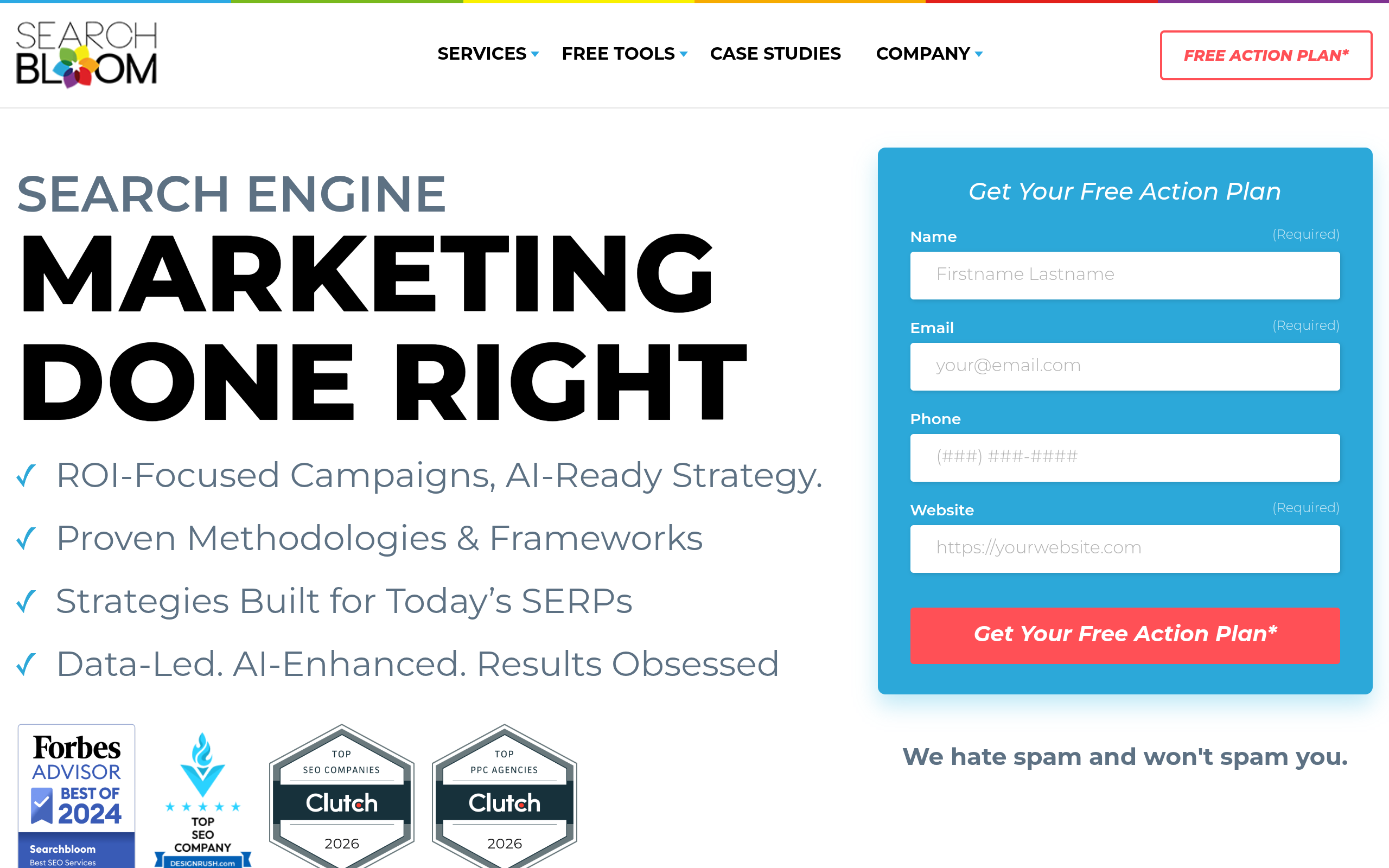
Searchbloom is a broader SEO agency that includes link-building work within a wider organic search offering. It belongs in this comparison for companies that want link acquisition connected to technical SEO, content and measurement. Its broader scope can be useful, but it also means a buyer must confirm how much of the engagement is dedicated to actual outreach and placements.
When an integrated engagement helps
Links are easier to evaluate when the target page is indexable, internally linked and aligned with search intent. An integrated provider can identify those constraints before requesting links. For example, acquiring references to an e-commerce category with thin copy may not produce a useful business result; improving the category and then earning relevant mentions may be the better sequence. Google’s SEO Starter Guide explains the broader role of crawlable, understandable content and site structure.
- Best for: Companies seeking one SEO partner for technical, content and authority work.
- Standout: Link decisions can be tied to a wider organic-growth plan rather than isolated metrics.
- Does not suit: An agency that already owns strategy and wants only discreet white-label fulfillment.
Burden, pricing and limitations
Implementation is potentially high because an integrated engagement involves access, analytics context, technical discovery and cross-channel prioritization. Confirm whether link building is a dedicated scope or one activity inside a general retainer. Pricing should be treated as custom SEO consultancy or retainer-based work unless the current proposal says otherwise; do not assume the existence of a service page confirms a standard package.
Searchbloom is a poor fit when the only acceptable output is a fixed number of publisher placements each month, or when the buyer needs specialists in iGaming outreach. Ask who performs publisher prospecting, how success is attributed, which pages receive links, and how the agency reports links separately from rankings and technical tasks. If your internal team cannot approve a broader SEO roadmap, a specialist placement provider may be operationally cleaner.
6. Web Push
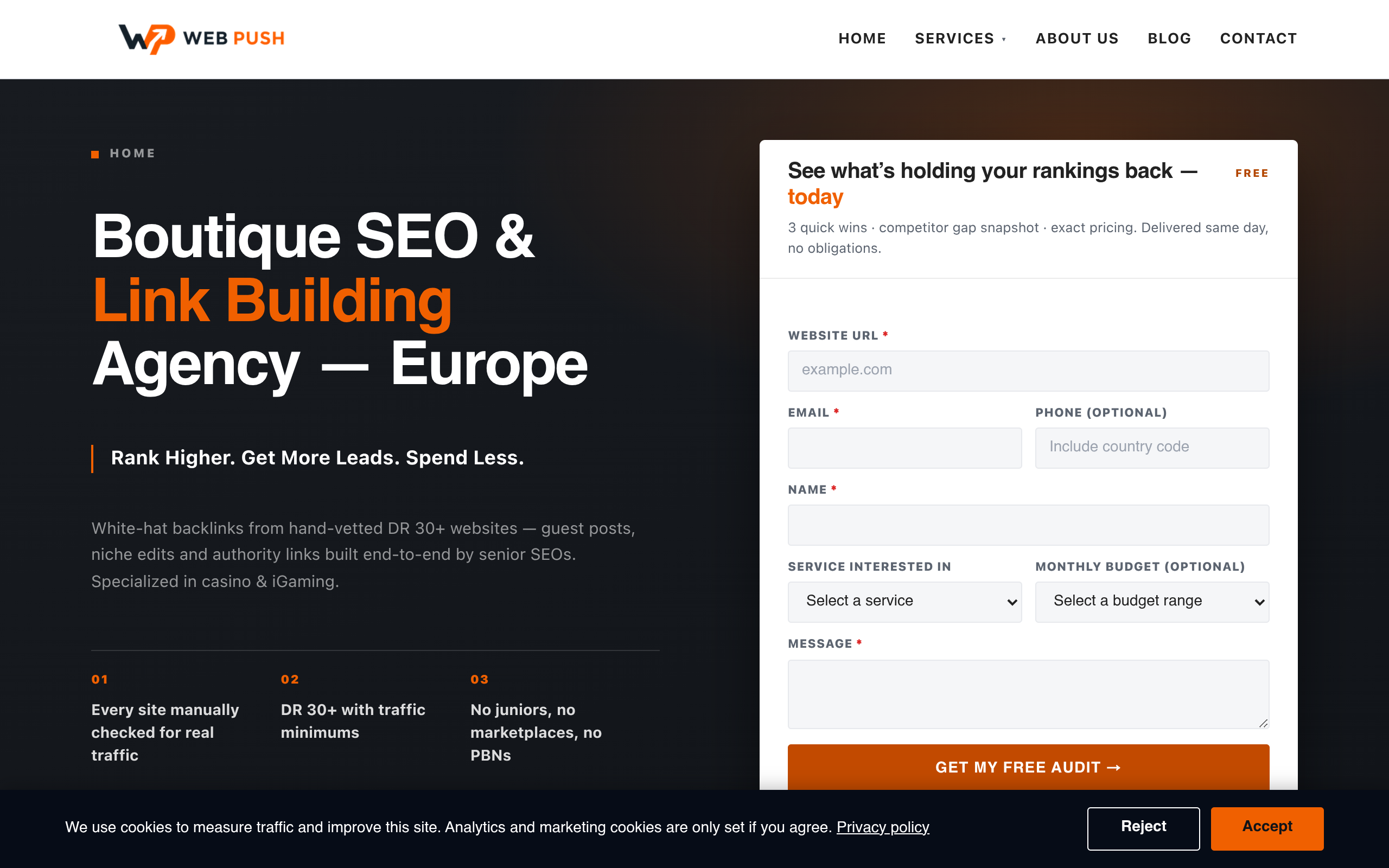
Web Push is a boutique, senior-led link-building agency. It offers white-hat guest posts, niche edits, authority links, digital PR and linkable assets, including white-label fulfillment for agencies. Its stated operating model emphasizes hand-vetted DR 30+ publishers with real organic traffic, no link farms or PBNs, and gambling-friendly opportunities for casino, betting and iGaming clients. Review the current link building services scope before treating any particular format as included.
Potential strengths for specialist buyers
The fit is strongest when the campaign needs European outreach, multilingual coordination or a publisher brief that accounts for gambling restrictions. A niche edit can support an established resource, while a guest post can provide the context needed for a new topic. For agency owners, the white-label model may reduce fulfillment pressure while preserving a client-facing relationship. A buyer considering authority link building should still ask for the exact qualification evidence behind each proposed site.
- Best for: European SaaS, B2B, e-commerce and iGaming campaigns needing hand-vetted editorial opportunities.
- Standout: The combination of white-label delivery and gambling-friendly publisher access is relevant to specialist agencies and operators.
- Does not suit: Buyers wanting guaranteed links on named top-tier news outlets or a large self-serve marketplace.
Implementation, pricing model and limitations
Implementation is moderate. Supply target pages, markets, topic boundaries, anchor preferences, prohibited sites and approval requirements; the team can then scope guest posts, niche edits, authority links, digital PR or linkable assets. The commercial model is quote-based and should be confirmed for each service, including content, outreach, revisions, reporting, replacement terms and white-label requirements. Senior-led does not mean hands-off: good results still require accurate product information and prompt approvals.
Web Push is not a fit for a client that wants volume without publisher review, links in every country regardless of relevance, or rankings guaranteed on a fixed date. Ask how organic traffic is checked, how gambling policies are confirmed, which link attributes are used, how a live link is monitored and what happens if a publisher later changes or removes it. Treat DR 30+ as a screening point, not as proof of audience quality or business value.
Comparison
The table uses the same buying criteria for every provider. “Implementation” describes the customer’s operational load, not a promise about a particular contract. Confirm current capabilities and pricing in a 2026 proposal, especially for publisher availability, languages, vertical restrictions and white-label reporting.
| Provider | Primary model | Best-fit buyer | Implementation burden | Pricing / commercial question |
|---|---|---|---|---|
| Siege Media | Content-led link acquisition and digital PR | SaaS, B2B and e-commerce brands with linkable ideas | High: research, assets and approvals | Custom scope; confirm asset, promotion and reporting inclusions |
| Editorial.Link | Managed editorial placements and outreach | SEO teams wanting repeatable placements | Medium: briefs, reviews and approvals | Confirm per-placement or package terms and replacement policy |
| Loganix | Packaged managed link building within broader SEO services | Teams seeking a standardized recurring workflow | Low to medium: provide targeting and constraints | Normalize package deliverables before comparing quotes |
| Page One Power | Relationship-led content promotion and link building | B2B and SaaS brands supporting expert content | Medium to high: discovery and content collaboration | Request scope for strategy, outreach, content and no-placement outcomes |
| Searchbloom | Integrated SEO with link-building work | Companies wanting technical, content and authority support together | High when the wider SEO scope is included | Separate link activity from retainer and consultancy fees |
| Web Push | Guest posts, niche edits, authority links, digital PR and white-label fulfillment | European, multilingual and iGaming campaigns; SEO agencies | Medium: targeting, approvals and brand input | Quote-based; confirm publisher, language, reporting and white-label terms |
How to choose among Link Building Agencies
Start with the buyer job, not the agency’s strongest marketing phrase. A campaign that needs ten relevant editorial references to product-led pages is not the same as a campaign that needs one research asset to attract journalists. Use the following decision map before requesting proposals:
| Buyer need | Most suitable service type | Main trade-off |
|---|---|---|
| Repeatable links to defined commercial pages | Managed guest posts or niche edits | More predictable workflow, but greater need to audit relevance and editorial quality |
| Coverage around original data or a useful tool | Digital PR and linkable assets | Higher creative burden and less predictable placement volume |
| Fulfillment under an SEO agency’s brand | White-label link building | Lower internal workload, but client risk depends on reporting and quality controls |
| Casino, betting or iGaming links | Vertical-aware outreach with gambling-friendly publishers | Smaller eligible inventory and stricter relevance or policy checks |
| Technical problems plus authority growth | Integrated SEO agency | Broader strategic coverage, but link spend and outputs may be less separable |
Ask for evidence, not promises
Request a sample anonymized report and ask the provider to walk through one placement from prospecting to publication. The explanation should cover the site’s topical relationship, estimated organic visibility, audience location, page context, target URL, anchor rationale and whether the link is editorially appropriate. Google Search Console’s links report documentation explains what site owners can inspect in Search Console, but it should not be treated as a complete third-party link audit.
- Publisher screening: How are traffic, indexing, topical relevance and suspicious outbound-link patterns checked?
- Editorial control: Can you reject a site or surrounding article before publication?
- Anchor policy: How do they avoid forcing exact-match commercial anchors into unsuitable copy?
- Attribution: Will reporting separate delivered links, referral visits, impressions, rankings and revenue?
- Maintenance: What happens if the article is deleted, the link changes, or the publisher’s quality declines?
- Disclosure: How are sponsored relationships and appropriate link attributes handled?
For paid or incentivized content, ask specifically how disclosures and link attributes are handled. The U.S. Federal Trade Commission’s disclosure guidance is written for endorsements and influencer relationships, but it illustrates the broader principle that commercial relationships should not be hidden from audiences. Local law and publisher policy may differ, so a vendor should explain its process rather than offer legal certainty.
Set success criteria that survive scrutiny
Use a baseline taken before the campaign: referring domains to the target section, ranking impressions, non-brand clicks, qualified referral sessions and conversions where tracking is available. A link may be valuable even when a keyword does not move immediately, but the agency should state what it can and cannot influence. Rankings are affected by competition, content, internal linking, technical health and algorithm changes; therefore no responsible provider can guarantee a specific ranking date.
For an illustrative B2B campaign, a sensible review might ask after each quarter whether the delivered pages remain live, whether referring sites are relevant to the buying audience, whether target pages gained impressions, and whether referral traffic shows engagement. For an agency client, add fulfillment metrics: approval turnaround, on-time delivery, report accuracy and replacement handling. For iGaming, add publisher eligibility, jurisdiction, language and brand-safety checks.
Recognize red flags early
- Guaranteed rankings or a guaranteed algorithmic “authority” lift.
- Large link counts with no sample URLs, topical explanation or approval process.
- Only DR, DA or another third-party metric, with no traffic or audience evidence.
- Requests for unrestricted exact-match anchors across every placement.
- Opaque “private network” language, obvious link farms or networks of near-identical sites.
- No answer about deleted links, changed URLs, sponsored attributes or unsuitable publishers.
- Pricing that hides writing, editing, outreach, reporting or replacement costs.
Agencies comparing outsourced search optimization work can use Nepal SEO agency to compare SEO agencies that handle outsourced search optimization work, rather than treating a backlink supplier and a full SEO partner as interchangeable.
Questions to put in the vendor interview
- Which service category are you proposing: guest posts, niche edits, digital PR, linkable assets or a combination?
- What information do you need from our subject experts, developers, writers and legal or compliance reviewers?
- What is your definition of a qualified publisher, and can you show an anonymized example of the evidence?
- How do you handle target pages that are commercial, regulated, multilingual or related to gambling?
- What is included in the commercial scope, and which activities trigger additional fees?
- Who owns the content and publisher relationships, and can the customer approve or reject opportunities?
- How will you report live status, target URL, anchor, publisher context, traffic evidence and changes over time?
- What is the remedy for a removed, redirected, deindexed or materially altered placement?
A practical selection process is to brief three providers with the same target pages and exclusions, then compare their proposed mechanisms rather than their promised totals. Give extra weight to a vendor that explains why a link belongs in a reader journey. Give less weight to a low quote that depends on unverified sites or hides production work. If you are a marketing manager, include the cost of internal approvals in the business case; if you are an agency owner, include the cost of QA, client communication and reputational risk.
There is no universal winner in this category. Choose a content-led PR agency when the campaign has a genuinely newsworthy asset, a managed placement provider when repeatability matters, an integrated SEO agency when technical and content constraints are unresolved, and a specialist or white-label partner when vertical and fulfillment requirements dominate. For European, multilingual or gambling-friendly campaigns, Web Push can be evaluated alongside the same evidence and commercial questions as every other option; see Web Push for its current scope.
Authored with NotFair SEO