
SEO content marketing is the coordinated practice of creating, optimising, distributing, and improving content so that it attracts qualified search demand and supports commercial growth. It is not simply “writing blogs for SEO.” The work connects a business objective, a clearly defined audience problem, a search opportunity, a useful page, and a method for earning visibility and links.
For a SaaS company, that may mean building a comparison page that helps a buyer choose between workflow tools. For an e-commerce brand, it may mean producing an expert buying guide that supports category pages. For a casino or betting operator, it may involve responsible, jurisdiction-aware content that earns relevant coverage without relying on risky anchor text. For an SEO agency, the challenge is often operational: turning a client’s expertise into publishable assets and securing credible placements at a repeatable standard.
What SEO Content Marketing actually includes
The phrase describes a system rather than a content format. A page can be optimised for search and still fail as marketing if it attracts people who cannot become customers. Conversely, a persuasive article can support a sales process but remain difficult to discover because its topic, structure, and internal links do not reflect how people search.
A useful definition has four connected parts:
- Search demand: the language, questions, comparisons, and problems used by a defined audience.
- Content usefulness: the evidence, explanation, tools, or decisions the page provides.
- Commercial relevance: the path from the content to a product, service, lead, subscription, or other business outcome.
- Distribution and authority: internal links, external references, digital PR, guest posts, niche edits, and other legitimate ways the content becomes discoverable and trusted.
That makes content marketing broader than on-page optimisation. A content brief should not stop at a primary keyword. It should explain who needs the page, what decision they are trying to make, what competing pages omit, which proof is required, and what the reader should do next.
Content types serve different jobs
Informational content answers a problem or teaches a process. It is useful for early-stage discovery, but it should still point toward a relevant next step. A B2B article about reducing invoice-processing errors might link to a workflow template, product page, or implementation guide.
Commercial investigation content helps someone compare options. Examples include “software A vs software B,” alternative pages, use-case pages, and buying guides. These pages need balanced criteria, limitations, and decision support rather than exaggerated claims.
Transactional content is designed to help a visitor act: a service page, category page, product page, demo page, or landing page. Supporting articles should pass relevance to these pages through meaningful internal links, not through repetitive calls to action.
Authority assets are created partly because other publishers may want to reference them. Original research, a benchmark, a calculator, a map, a glossary with proprietary examples, or a well-documented industry analysis can support digital PR and link acquisition. The asset must be genuinely useful before outreach begins; outreach does not repair a weak reason to link.
Google’s SEO Starter Guide describes search optimisation as helping search engines understand content and helping users decide whether to visit a result; it also stresses that there are no secrets that automatically rank a site first. That distinction matters because SEO supports discoverability, while the content’s usefulness and credibility determine whether the visit has value. Google’s official SEO Starter Guide is a useful baseline for separating technical clarity from ranking promises.
Why the system matters for organic growth
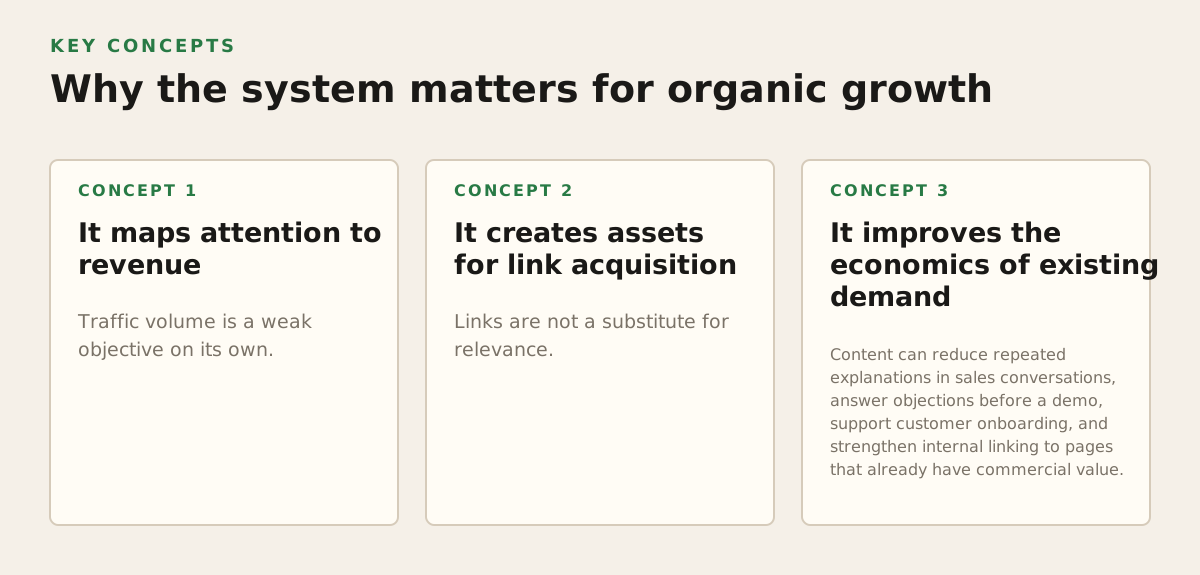
Content is most valuable when it compounds across the site. A well-planned article can attract search traffic, answer a sales objection, provide a target for internal links, give a PR team something to pitch, and create a credible reason for another publisher to cite the brand. Those effects are connected, but they are not automatic.
It maps attention to revenue
Traffic volume is a weak objective on its own. A page attracting thousands of visitors with no relationship to the buyer, geography, or product may consume editorial resources without helping the business. A smaller page that reaches procurement managers, technical evaluators, or high-intent shoppers can be strategically stronger.
Use a simple chain when setting objectives:
- Identify the business offer or commercial page that needs support.
- Define the audience problem that exists before the purchase.
- Choose the content format that resolves that problem best.
- Specify the action that indicates progress, such as a qualified enquiry, assisted conversion, tool use, or movement to a product page.
- Choose the authority or distribution work needed to make the page discoverable.
For example, an illustrative SaaS plan might target operations managers searching for ways to standardise approval workflows. The content could explain process design, include a downloadable checklist, link to the software’s workflow feature, and be supported by relevant guest posts on operations publications. The objective is not merely to rank for “approval workflow”; it is to create a useful entry point for a defined buying problem.
It creates assets for link acquisition
Links are not a substitute for relevance. They are one way a page can gain discovery, referral traffic, and editorial credibility. The strongest link prospects have a reason to cite the destination: a source, definition, data point, methodology, tool, or expert explanation that improves their own page.
For brands investing in authority link building, the content decision comes before the placement decision. A link to a generic article with no distinctive value is difficult to justify to an editor and may send little qualified traffic. A link to a practical research asset, detailed guide, or genuinely useful resource has a clearer editorial role.
White-label agencies face an additional constraint. Their fulfillment partner must preserve the client’s topical relevance, language, editorial quality, and risk tolerance while delivering at scale. A placement that satisfies a domain metric but appears beside unrelated or low-quality material can weaken the campaign’s credibility.
It improves the economics of existing demand
Content can reduce repeated explanations in sales conversations, answer objections before a demo, support customer onboarding, and strengthen internal linking to pages that already have commercial value. It can also expose gaps in the product or service proposition: if a company cannot explain a process clearly, the content brief may reveal an unclear offer or weak proof.
However, content is not a guaranteed traffic asset. Search demand can change, competitors can publish stronger material, a query can become answered directly in search results, or the business may lack enough authority to compete. A responsible plan therefore includes a review point and a decision about whether to improve, consolidate, redirect, or retire a page.
How an SEO Content Marketing system works
A practical workflow moves from business context to search evidence, then from publication to measurement and promotion. Skipping the early decisions usually creates a large catalogue of plausible topics that do not form a useful site structure.
1. Start with audience and offer constraints
Document the market before collecting keywords. Record the target roles, industries, countries, languages, buying stage, product limitations, compliance concerns, and claims that require evidence. A casino SEO brief, for example, should distinguish between an informational gambling guide, a brand page, an affiliate comparison, and a jurisdiction-specific responsible-gambling resource.
Ask:
- Who would use this information at work or during a purchase?
- What do they already understand, and where are they likely to be sceptical?
- Which products, services, or categories can legitimately solve the problem?
- Which claims are factual, time-sensitive, regulated, or impossible to substantiate?
- What would make an independent publisher cite this page?
2. Build a topic and intent model
Keyword research is more useful when grouped into problems and decisions rather than treated as a list of isolated phrases. Cluster terms by the page that should satisfy them and by the user’s expected next step.
| Search situation | Likely content role | Useful evidence | Next step |
|---|---|---|---|
| “How to audit SaaS backlinks” | Process guide | Checklist, examples, decision rules | Audit service or template |
| “Best accounting software for agencies” | Commercial comparison | Evaluation criteria, limitations, use cases | Product comparison or demo |
| “Women’s waterproof hiking jacket” | Category or buying guide | Fit, materials, conditions, sizing | Relevant category page |
| “Online casino payment methods” | Jurisdiction-aware information page | Current availability, restrictions, responsible-use guidance | Compliant operator or help page |
Search results are evidence, not instructions to copy. Inspect the recurring format, unanswered questions, freshness requirements, first-hand expertise, and commercial intent. If every strong result is a product comparison, a generic 2,000-word definition is unlikely to satisfy the same need.
3. Design the brief around a differentiated answer
A good brief gives a writer room to think while protecting the strategic objective. It should include the primary topic, related questions, intended reader, page type, internal-link targets, evidence requirements, proposed title, and a measurable conversion or engagement action.
More importantly, state the page’s information gain: what will the reader learn here that is not already obvious from ten competing pages? It might be a worked calculation, a decision tree, original interviews, a transparent methodology, a set of screenshots, or a specific implementation sequence.
Google’s documentation on creating helpful content advises publishers to prioritise people-first content, demonstrate appropriate expertise, and avoid producing material primarily to manipulate search rankings. The guidance is not a formula for a guaranteed position; it is a useful quality filter for briefs that would otherwise be assembled from keywords alone. Google’s people-first content guidance supports this emphasis on a satisfying, trustworthy answer.
4. Produce, edit, and optimise the page
Production needs distinct roles even when one person performs them all. The subject matter expert validates accuracy. The writer creates a clear argument. The editor removes repetition and unsupported claims. The SEO reviewer checks discoverability, structure, internal links, and search intent. The final approver checks brand, legal, and commercial accuracy.
On-page optimisation should clarify the page rather than distort it. Check:
- A descriptive title and introduction that match the actual promise.
- Logical headings that help a reader scan the argument.
- Specific examples, definitions, caveats, and evidence.
- Useful internal links with descriptive surrounding context.
- Images, tables, or tools where they improve understanding, not merely to decorate the page.
- Metadata that accurately represents the content rather than promising an unsupported result.
Structured data can help search engines understand supported content types, but it does not make inaccurate or low-quality content trustworthy. Google’s introduction to structured data explains that markup provides explicit clues about a page’s meaning and also links to the relevant feature guidelines. The official structured-data documentation is the right reference for implementation decisions.
5. Publish, distribute, and earn relevant references
Publication is the start of distribution. Share a genuinely useful asset with audiences that already care about the subject: industry editors, analysts, partners, communities, journalists, customers, and specialist publications. The pitch should identify the editorial reason for inclusion, not merely ask for a backlink.
Possible methods include:
- Digital PR based on original data, expert commentary, or a timely industry finding.
- Guest posts that contribute a complete, relevant explanation to a publication’s audience.
- Niche edits where an existing article has a genuine contextual gap and the destination improves it.
- Partner and supplier pages where the relationship is real and the mention is editorially appropriate.
- Internal promotion through newsletters, sales enablement, communities, and relevant social channels.
Bing’s Webmaster Guidelines also emphasise quality content, clear site structure, and avoiding manipulative link schemes. Its guidance is useful as a second search-engine perspective on the principle that relevance beats artificial volume. Bing’s official Webmaster Guidelines provide the relevant baseline for content and linking practices.
6. Measure outcomes and make a decision
Measurement should connect page-level performance with business outcomes. Track impressions and clicks for visibility, but also monitor engagement quality, assisted conversions, enquiries, qualified leads, revenue where available, and referral traffic from earned placements.
Search Console’s Performance report includes metrics such as clicks, impressions, click-through rate, and average position, with dimensions that help separate queries, pages, countries, and devices. Google’s Search Console documentation explains the report and its available views.
Use a review table rather than a vague “wait and see” rule:
| Observation | Likely diagnosis | Action to consider |
|---|---|---|
| Impressions rise, clicks remain weak | Promise, title, or intent alignment may be poor | Review the result framing and first-screen answer |
| Clicks arrive, engagement is weak | The page may attract the wrong audience or bury the answer | Refine targeting, opening sections, and internal paths |
| Engagement is strong, qualified leads are absent | The topic may be too far from the offer | Add a relevant next step or change the content’s commercial role |
| Good content is not discovered | Insufficient internal prominence or external authority | Improve linking, distribution, and editorial outreach |
The thresholds in any reporting dashboard should be treated as decision aids, not universal benchmarks. An illustrative starting policy could review a new page after 90 days, compare it with pages serving similar intent, and require one specific action: improve, promote, consolidate, redirect, or retain. The period and thresholds must reflect the site’s authority, market, seasonality, and publishing history.
Where content-led SEO breaks down
Most failures are not caused by a missing keyword. They come from a broken connection between the page, the audience, the site, and the distribution plan.
Publishing volume replaces usefulness
High-frequency production can create overlapping pages, thin variations, and editorial fatigue. If several articles answer the same question, they may compete for internal links and make the site harder to understand. Consolidation is often better than adding another near-duplicate.
Google’s spam policies identify scaled content abuse as a problem when many pages are generated primarily to manipulate rankings rather than help users. The policy applies regardless of whether the content is produced by automation, people, or a combination of methods. Google’s official spam policies make the underlying risk clear: production method does not excuse low-value intent.
Keyword targeting ignores the buyer
A keyword with substantial apparent demand may be too broad, too competitive, geographically wrong, or unrelated to the product. A marketing manager should be able to explain why the query matters to the business before approving the brief.
Warning signs include:
- The proposed reader cannot buy, influence, use, or recommend the offer.
- The content requires claims the company cannot prove.
- The page has no sensible internal destination or next action.
- The topic was selected because a tool displayed a number, with no business rationale.
- The article would be equally relevant to every competitor.
Links are treated as a separate commodity
Content and link building should have separate quality checks but a shared strategy. A placement on a relevant, real-traffic publisher may help discovery and credibility; a random placement chosen only for a domain metric may not. Metrics are useful for screening, but they do not replace topical fit, editorial standards, traffic quality, or the context around the link.
Risk increases when a campaign uses unnatural anchor text, repeated exact-match phrases, unrelated websites, or pages created solely to host links. For agencies outsourcing fulfillment, a documented publisher-vetting process matters: check topical relevance, visible editorial quality, organic traffic patterns, outbound-link behaviour, language, and whether the site serves a real audience.
Regulated and sensitive sectors receive generic treatment
Casino, betting, iGaming, finance, health, and legal content require more than keyword matching. Country-specific rules, age restrictions, responsible-use language, product availability, and claims review can change the brief. A gambling-friendly publication is not automatically suitable for every operator or market.
For iGaming campaigns, separate:
- Educational content from operator promotion.
- Brand-safe informational anchors from aggressive commercial anchors.
- Permitted markets from markets where the offer is unavailable.
- Current payment, bonus, or regulatory information from evergreen explanations.
- Editorial relevance from placements that merely accept gambling topics.
The consequence is practical: compliance and editorial review must happen before outreach, not after a placement is live. If a claim cannot be verified or a destination cannot be promoted in a market, the campaign should change direction.
How practitioners apply the framework
The framework becomes operational when every proposed page has a role in a larger system. The following examples use illustrative numbers to show planning logic, not performance predictions or universal targets.
Illustrative example: a B2B link-building agency
Suppose an agency wants to attract SaaS and B2B clients rather than broad “marketing” traffic. Its content system could contain:
- 3 commercial pages for guest posts, niche edits, and digital PR.
- 6 supporting guides covering publisher vetting, anchor-text risk, linkable assets, outreach briefs, reporting, and white-label workflows.
- 2 authority assets, such as a link-quality checklist and a campaign planning template.
- 12 outreach angles built from the assets, each matched to a different editorial audience.
The point is not the number 3, 6, 2, or 12. It is the relationship between the assets. A guide about evaluating publishers should internally support the service page, while the checklist can earn references from agency and marketing publications. Outreach should lead with the checklist’s usefulness or methodology, not with a request to insert a commercial link.
A white-label partner would also need a handoff document covering brand voice, prohibited claims, target markets, preferred topics, acceptable publisher types, and reporting fields. That reduces the risk that a campaign looks efficient in a spreadsheet but inconsistent to the client.
Illustrative example: a SaaS company
A project-management SaaS brand may have a product page for approval workflows but little non-branded visibility. Its content map could connect:
- A problem guide explaining how approval bottlenecks form.
- A template showing a simple approval matrix for a five-person marketing team.
- A comparison page covering spreadsheets, email approvals, and workflow software.
- A case-led implementation guide with measurable process inputs, not invented customer outcomes.
- A product page explaining how the software handles the relevant workflow.
Each page has a different intent. The guide earns discovery, the template earns use and possible references, the comparison helps evaluation, the implementation page addresses adoption, and the product page handles conversion. Internal links should follow those relationships naturally. External outreach is most credible for the template or evidence-led guide, while the commercial page may receive authority through internal links and relevant editorial mentions.
Illustrative example: an e-commerce brand
An e-commerce company selling technical outdoor clothing should not force every article toward a product keyword. A useful structure might include a category page, a materials explainer, a weather-condition guide, a sizing resource, and a comparison between insulation types.
The editorial decisions are specific:
- Explain which material suits which conditions instead of repeating “high quality.”
- Link the guide to the relevant category and product filters.
- Include care instructions that reduce purchase uncertainty and returns.
- Use first-hand product information where it is available and label general advice accurately.
- Pitch the materials guide to outdoor publications only when it adds technical clarity or a useful reference.
Authority links can support the category or guide, but the campaign should avoid forcing exact commercial anchors into every placement. Natural references usually make more editorial sense when the linked page is a resource rather than a sales slogan.
Illustrative example: a casino or betting brand
A regulated gambling brand might divide its content by market and user need. One page could explain payment methods available in a specific jurisdiction; another could describe account-safety practices; a third could provide a neutral guide to odds and variance. Each needs a review date, market scope, responsible-gambling information where appropriate, and a clear distinction between education and promotion.
For link acquisition, suitable publishers should be reviewed for audience, geography, editorial standards, and whether gambling content fits their existing coverage. Gambling-friendly backlinks still require relevance. A general entertainment site with no meaningful connection to betting may be a weaker choice than a specialist publication with a smaller but clearly relevant audience.
Use conservative campaign rules for sensitive verticals:
- Approve destination pages before outreach begins.
- Keep claims and offers current and market-specific.
- Record the publisher, URL, topic, anchor, market, and review status.
- Prefer varied, descriptive anchors over a repeated exact-match pattern.
- Reject sites with obvious link-farm signals, unrelated outbound links, or weak editorial context.
Choosing an execution model
Some teams can manage research, writing, editing, and outreach internally. Others need specialist support for one stage. The right decision depends on subject expertise, editorial capacity, market coverage, and the cost of quality control.
Internal production offers close product access but can stall when experts lack writing time. A generalist content supplier may produce quickly but require substantial subject-matter editing. A specialist agency can provide workflow and publisher access, but the buyer should still demand transparent briefs, placement criteria, live URLs, and clear rejection rules.
For teams comparing link building services, assess the whole chain rather than a promised number of links. Ask how topics are selected, how publishers are vetted, how sensitive industries are handled, what happens when a placement fails review, and whether reporting explains relevance and context. A credible process should make it possible to reject a placement that technically meets a metric but does not meet the campaign’s editorial standard.
A practical operating scorecard
Review each campaign monthly or at another explicitly chosen interval using five categories:
- Relevance: Does the content reach the intended role, industry, country, and buying stage?
- Quality: Does it provide evidence, examples, expertise, and a clear answer?
- Architecture: Does it support important pages through sensible internal links?
- Authority: Are external references contextually relevant and editorially defensible?
- Outcome: Is there evidence of qualified visibility, engagement, assisted conversion, or useful referral traffic?
Mark each category as strong, uncertain, or needing action. This prevents a campaign from being declared successful because it published frequently or acquired links while the underlying audience and commercial outcomes remain unclear.
The specific recommendation for 2026 is to build fewer, more accountable content assets: each should have a defined audience problem, a differentiated answer, an internal destination, a distribution route, and a review decision. When the plan also requires relevant, hand-vetted placements, Web Push can support the execution with white-hat guest posts, niche edits, authority links, digital PR, linkable assets, and white-label fulfillment through Web Push.
Authored with NotFair SEO